
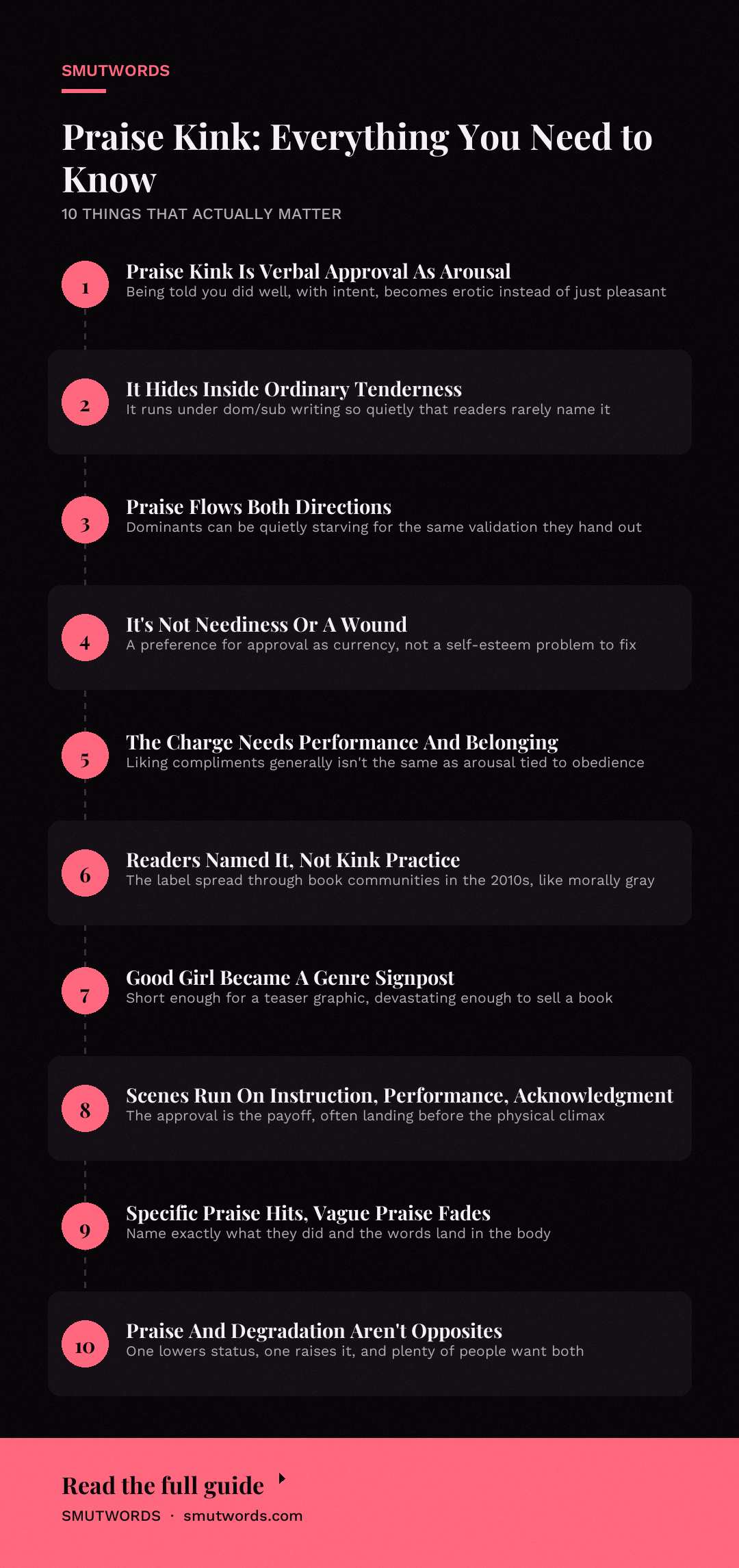
Praise kink is the erotic charge a person gets from being told they did well. Not flattery, not a compliment tossed off in passing, but direct verbal approval delivered with intent: good girl. That's it, just like that. You're being so good for me.
The praise lands somewhere deeper than the ears, and the body answers. It's one of the most common kinks in contemporary romance and erotica, and one of the least talked about as a kink at all, because it hides inside scenes that look, on the surface, like ordinary tenderness.
That hiding is part of the appeal. Praise kink is the engine running underneath a huge amount of dominant/submissive writing, and once you can name it, you start seeing it everywhere: in every "good girl" that makes a heroine's thighs clench, in every well done whispered after an orgasm, in every dominant who says I'm proud of you and means it as a command.
What Praise Kink Actually Means
The term describes a dynamic where verbal approval produces genuine arousal or deep emotional fulfillment, usually inside a power-exchange context. The praise can be sexual ("you take me so well"), behavioral ("you asked so nicely"), or broader ("you're mine, and you're perfect"). What matters is that the receiver experiences the words as reward, and the reward becomes erotic.
Praise kink overlaps with submission but isn't identical to it. Plenty of dominants have a praise kink pointed the other way: they get off on being told they're good at what they do, that they're wanted, that their partner is proud to belong to them. Praise flows in both directions in well-written scenes, and some of the hottest versions of this trope are the ones where a dominant is quietly starving for the same validation they're doling out.
It also isn't the same thing as having a healthy relationship. Praise kink is a specific erotic mechanism, not a personality trait and not a diagnosis. Wanting to hear good girl during sex tells you almost nothing about how someone handles a mortgage or a disagreement.
What does and doesn't count is mostly about where the charge comes from. Someone who enjoys compliments generally does not automatically have a praise kink. Someone whose arousal spikes specifically when approval is tied to performance, obedience, or belonging, especially inside a scene with a power differential, is describing something much narrower and much more specific.
Common misconceptions worth clearing up:
- It's not neediness. Praise kink is a preference, not a wound. Readers who love it aren't looking for a partner to fix their self-esteem, they're looking for a scene where approval is the currency.
- It's not always soft. Praise can be delivered in a hard register: you did that exactly like I told you to, didn't you. Say it. The words are warm, the tone can be anything.
- It's not automatically submissive. Service tops, bratty dominants, and switches all have versions of this. The kink lives in the approval, not in who's kneeling.
- It's not gender-specific. "Good girl" gets the most airtime in marketing copy, but good boy, good pet, good slut, and good boy/girl as a gender-neutral phrase all show up, and so do entirely original pet names invented for one character.
One more thing worth saying plainly: getting praised during sex can be intense in a way people don't anticipate. More than one reader has reported that the first time a partner said good girl with real weight behind it, the response was closer to tears than to anything else. That reaction is normal, and it's often exactly the reaction the writer is chasing.
Where Praise Kink Comes From
Verbal approval as an erotic reward has a long history in actual kink practice, where praise is a standard tool for reinforcing obedience alongside, or instead of, degradation kink. Trainers and dominants have used praise as a reward marker for as long as dominance and submission have been written about systematically, and the pairing of praise with punishment is one of the oldest structures in the literature.
But the term "praise kink" as a label is recent, and it's mostly a reader-driven phenomenon. It spread through online fandom and book communities in the 2010s, the same way terms like "touch her and die" and "morally gray" did: readers noticed they kept having the same reaction to the same line, gave it a name, and the name stuck.
Publishing history matters here more than kink history does. The "good girl" line became a recognizable marker in indie romance and dark romance in that same decade, partially because it's short enough to fit in a teaser graphic and devastating enough to sell a book.
By the early 2020s it had become a genre signpost. Readers searched for it directly. Authors put it in the first three pages on purpose.
What's shifted since is the range. Early praise-kink content leaned almost entirely on a dominant man telling a submissive woman she was good. Current versions include praise between two submissives, praise from a brat who's topping from below, praise in throuples and group dynamics, and praise in monster romance where the approval comes from something that has never heard of human social norms and is simply, honestly delighted.
The structure survived the expansion because the underlying mechanic, approval as arousal, travels well across subgenres. There's also been a shift in how the praise is framed emotionally. Older versions sometimes treated the submissive character's need for approval as something to be overcome. Newer writing treats it as something to be met, deliberately and generously, by a partner who understands exactly what they're doing.
How It Shows Up in Erotica
On the page, praise kink is a dialogue craft problem more than a plot problem. The scene has to earn the line. A good girl dropped into a scene with no buildup reads as filler. The same line after three pages of careful tension, delivered at the exact moment the character has done the thing they were most afraid of doing, lands like a physical blow.
Strong praise scenes usually run on a specific architecture: instruction, performance, acknowledgment. The dominant gives a directive. The submissive carries it out, often with visible effort. Then the approval arrives, and the approval is the payoff, at least as much as any orgasm.
Writers who understand this will often delay the physical climax to let the verbal one hit first.
Common variations that show up across the subgenre:
Enjoyed this? Get a free book.
Join the list and we will send a complete free story straight to your inbox, plus new releases every week after that. No credit card, no catch.
- The first-time "good girl." The heroine has never been talked to like this before. The line cracks something open. Often the emotional center of the whole book.
- Praise as reward inside a punishment structure. The character is being pushed, held back, or denied, and the praise is what she's working toward. This is the version that overlaps most heavily with use kink, since being told she's a good tool for someone's pleasure hits differently than being told she's pretty.
- Praise with a possessive frame. Good girl. That's mine. You did that for me. Belonging language layered over approval, common in mafia romance and other high-stakes settings.
- The quiet inversion. The dominant, mid-scene, needs to hear they're good too, and the submissive figures it out. This is a harder version to write, and it tends to produce the most memorable scenes in the category.
- Praise after roughness. A scene built on rough sex or primal play ends with deliberate, tender approval. The contrast does the work.
- Praise as the whole dynamic. Entire relationships written around one partner's need to be told they're doing well, and the other partner's willingness, and often eagerness, to keep saying it.
What separates a strong version from a flat one comes down to specificity and timing. Vague praise ("you're amazing") is pleasant and forgettable. Specific praise ("you held still exactly like I asked, even when it was hard, and that's why you get to come") creates a scene the reader can feel in their body. The more precisely the words describe what the character actually did, the harder they hit.
Timing matters just as much. Praise delivered too early kills tension. Praise delivered at the exact moment of surrender, or just after, is when it does the most damage. Editors who work on this subgenre will tell you the same thing: if a reader has to scroll back to find the praise line, it wasn't placed well.
There's also a version problem worth flagging. "Good girl" is the most common phrase in the category, and it has been used so heavily that it now reads as generic in a lot of books.
Writers who want the line to land will often either build a unique phrase for their characters (a nickname, an in-joke, a term borrowed from the setting) or use the standard phrasing but make the delivery so specific to the moment that it feels earned. Both approaches work. What doesn't work is a stock phrase dropped into a stock scene.
Praise kink also shows up non-sexually in romance plotting, especially in books where one character is starved for approval in a broader sense and the love interest is the first person to give it. That's often the emotional spine of the book, and it's doing praise-kink work even in chapters with no sex in them at all.
Praise Kink vs Degradation Kink
These two get confused constantly, and the confusion is worth clearing up because they aren't opposites and they aren't mutually exclusive. Degradation kink means getting off on being verbally diminished: called worthless, used, dirty, lesser. Praise kink means getting off on being verbally exalted. Both are verbal, both are about the power differential, and both are often used as rewards or punishments inside the same scene structure.
Plenty of people have both, sometimes in the same session. The dominant calls the submissive a filthy thing and then, at the end, tells her she was perfect. The whiplash is the point. The line between them can be thinner than people expect, and writers working with either one benefit from understanding how the other works, since the two are frequently paired.
Where they genuinely differ is the direction of the charge. Degradation works by lowering the receiver's status. Praise works by raising it. If a scene is confusing to a reader, it's usually because the writer reached for one and delivered the other by accident, or because they tried to do both without building the transitions.
Frequently Asked Questions
Is praise kink a real kink or just something readers made up?
It's a real kink that's been practiced in dominance and submission dynamics for a long time; the phrase itself is newer and mostly came out of reader communities naming a pattern they kept responding to. Both things are true. The label is recent, the phenomenon isn't.
What are common signs someone has a praise kink?
Getting noticeably more aroused or emotional when told they're doing well, especially during sex or submission. A strong reaction to "good girl," "good boy," or similar phrasing. Wanting to hear explicit approval after finishing a task, sexual or otherwise. Frequently asking how they did, in bed or out of it, and caring about the answer more than the situation warrants.
How do you bring up a praise kink with a partner?
The same way you'd bring up any other preference: outside the bedroom, before it matters, with concrete language. "I like being told I'm doing well" is a complete sentence and it doesn't require a speech. If you're both the type to plan things, a yes/no/maybe list is one of the cleanest tools for covering this alongside everything else.
Can praise kink go wrong?
Yes, in two main ways. One, praise can land as pressure or as a performance scorecard if the receiver is being graded on things they don't actually want to be graded on. Two, if approval is the only thing that makes a scene feel safe, the dynamic can drift toward the receiver doing things they don't want in order to keep hearing it. Clear agreements about what's being praised, and check-ins during and after, prevent both.
Does praise kink always involve power exchange?
No, though it often does. Praise can be erotic between equals, especially in scenes built around tenderness or long-term intimacy. The power-exchange frame is extremely common in fiction because it makes the praise loaded, but it isn't required.
What's the difference between praise kink and just liking compliments?
The intensity and the context. Most people enjoy being told they're good at something. Praise kink means the approval carries an erotic or deeply emotional charge, usually tied to performance, obedience, or belonging, and usually delivered inside a specific dynamic. The difference is whether the words are pleasant or whether they do something to the body.
How do you write a praise kink scene that actually works?
Earn the line, make the praise specific, and time it precisely. Build tension around what the character is being asked to do, describe the effort, then deliver the approval at the moment the effort pays off. Vague praise reads as filler. Specific praise reads as reward.
Final Thoughts
Praise kink sits at the intersection of two things readers chase constantly: vulnerability and being seen. It's why the "good girl" line has outrun every attempt to declare it overused, and why the strongest versions of it still stop people mid-paragraph.
If you want a book that handles it with unusual care, one that treats approval as a real emotional negotiation and not just a scene-tag, start with The Complete Guide to Face Slapping Kink first for the consent-and-intensity framework, then read the praise-kink titles further down this page. The best of them understand something the weaker ones don't: being told you're good lands hardest when the person saying it has clearly been paying attention.







Loading comments…