Revenge sex and breakup sex get filed under the same messy drawer in most readers' heads, usually right next to "makeup sex" and "hate sex," as if they're all just variations on fucking while upset.
They're not. The revenge sex vs breakup sex distinction matters, because the two fantasies run on completely different fuel and deliver completely different payoffs. A writer who blurs them ends up with a scene that doesn't satisfy either itch.
One is anger looking for a target. The other is grief looking for a witness. Get those confused and you get a third thing entirely, which is just sad sex with extra steps.
Here's the version readers actually search for, and why the search terms split the way they do.
What Revenge Sex Actually Is
Revenge sex starts with a scoreboard.
Somebody wronged the protagonist, and the sex is the receipt. Not closure. Not catharsis in the therapeutic sense. Retaliation, staged for an audience, usually the ex.
The classic setup: the heroine gets cheated on, or dumped for someone younger, or humiliated at a party.
Within twenty pages she's in a hotel room with a man who is deliberately, almost comically, more impressive than the one who left. Taller. Richer. Better hands.
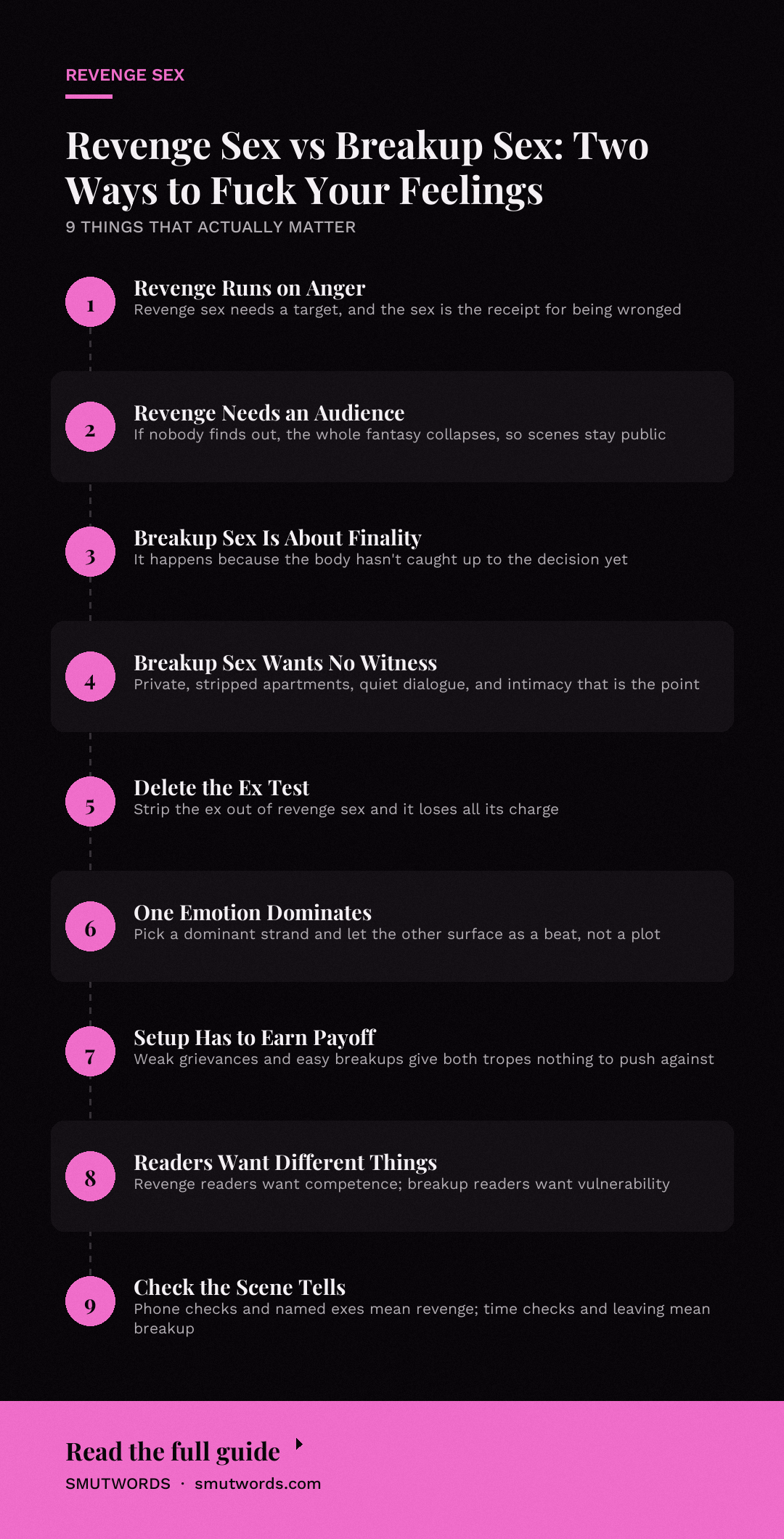
The scene isn't about her pleasure in isolation; it's about the imagined reaction of the person who'll hear about it. That's the engine. If nobody finds out, the fantasy collapses.
This is why so much revenge sex fiction leans on public settings or near-discovery. A wedding. A reunion. The parking lot outside the bar where the ex is still sitting with his friends.
The scene needs a potential spectator the way a magic trick needs an audience.
Why It Runs on Anger, Not Grief
Anger wants a witness. Grief wants a blanket fort. That's the cleanest way to hold the difference in your head while you're reading.
A revenge sex scene that's working will have a mean streak running under the heat. The dialogue is sharp in a way that's meant to cut. Somebody says the ex's name mid-scene, on purpose, as a weapon.
The protagonist watches her own reflection and likes what she sees for the first time in months. There's a cold satisfaction in it that has almost nothing to do with tenderness.
If you stripped the ex out of the equation entirely, the scene would lose its charge. That's the test. Revenge sex can't survive the removal of the person it's aimed at.
What Breakup Sex Actually Means
Breakup sex is the other animal. Same bed, sometimes the same person, completely different emotional architecture.
The trigger isn't humiliation, it's finality. The relationship is already over. The boxes are packed, or the lease is up, or one of them is moving cities on Sunday.
The sex happens because the body hasn't caught up to the decision, and both people know it, and they do it anyway. Not to win anything. To say goodbye with their hands because words already failed.
Readers looking up the breakup sex meaning usually aren't hunting for a power fantasy. They want the specific ache of a last time. The one where you already know every inch of each other, so there's no discovery, just familiarity being taken away in real time.
That's the whole point. It's a scene about subtraction.
Grief-Driven Closure, Not Payback
Nobody's watching. That's the structural difference. Breakup sex happens in private, often in a half-empty apartment with the furniture already gone, and the intimacy is the point rather than the byproduct.
The dialogue in a good breakup sex scene is quiet and a little wrecked. Someone cries and it isn't framed as embarrassing. There's a line, usually near the end, that lands like a door closing: this is the last time, said out loud, which turns the whole scene into a countdown.
You could delete every other character from a breakup sex scene and it would still work. In fact, that's usually how it's written.
Revenge Sex vs Breakup Sex: Side by Side
Here's where the two fantasies diverge in the details that actually show up on the page:
Enjoyed this? Get a free book.
Join the list and we will send a complete free story straight to your inbox, plus new releases every week after that. No credit card, no catch.
- Emotional driver: Revenge runs on humiliation and anger; breakup runs on grief and anticipatory loss.
- Who's watching: Revenge needs a potential audience (the ex, the friend group, the group chat); breakup needs nobody at all.
- Setting: Revenge favors public or semi-public spaces; breakup favors empty apartments, stripped bedrooms, hotel rooms near the airport.
- The partner: Revenge usually pairs the protagonist with someone new and pointedly better; breakup usually pairs them with the person they're losing.
- Dialogue tone: Revenge dialogue cuts; breakup dialogue confesses.
- How the scene ends: Revenge ends with a win, however petty; breakup ends with someone leaving, or watching someone leave.
- What happens the next morning: Revenge has a smug morning after, sometimes a second, more tender scene once the anger burns off; breakup has an empty side of the bed and a text that goes unanswered.
Same amount of clothing on the floor. Entirely different weather in the room.
Where the Two Overlap (and Where Writers Fumble It)
The genres blur in one specific scenario: sex with the ex right after the breakup, when the protagonist is still angry about how it ended. That's the hybrid, and it's where a lot of otherwise solid books lose the thread, because the writer can't decide which fantasy they're servicing and the scene reads like neither.
The fix is usually to pick a dominant strand and let the other one surface as a beat, not a competing plot. A revenge scene can include a moment of genuine grief, one sentence where the protagonist's face does something complicated in the mirror.
A breakup scene can include a flash of anger, one line that lands harder than intended before someone apologizes. That's texture. But if both emotions are fighting for equal page time, the reader can't tell what they're supposed to be feeling, and the scene goes limp.
There's a similar failure mode in the way these tropes run alongside redemption arc romance structures. If the revenge sex is supposed to lead somewhere, the payoff has to be earned across the rest of the book, not just declared in the aftermath. The ex doesn't stop existing because the heroine had one great night. Readers notice when the scoreboard gets abandoned halfway through.
Why These Two Tropes Hit Different Readers
The split isn't arbitrary. It maps onto two different things readers want from erotic fiction at different times.
Revenge sex readers want competence. They want a protagonist who was underestimated, humiliated, dismissed, and who takes her power back by enjoying something the person who hurt her can't touch. It's a competence kink dressed up as a grudge.
The best versions of this trope lean into the protagonist's agency, her choices, the specific way she decides to stop apologizing for wanting things. There's a reason it pairs so comfortably with edging and other slow-burn dynamics, where the delay itself is the power play. The same logic drives stalker romance, where pursuit becomes the whole game.
Breakup sex readers want vulnerability. They want the ache, the honesty, the sense that two people are being completely unguarded with each other for the last time. It's closer to a mourning scene than a triumph scene, and for a certain kind of reader that's more satisfying than any revenge plot, because the emotional stakes feel real instead of performative.
Neither is more sophisticated than the other. Revenge sex can be written badly, with a cartoon ex and a partner who reads like a catalog description. Breakup sex can be written badly too, usually by making the grief so vague it stops meaning anything. The quality of either comes down to how specific the scene gets about what the protagonist actually feels in the middle of it.
How to Tell Which One You're Reading
If you're a few chapters in and can't tell what you've picked up, look for these tells:
- The protagonist checks her phone to see if the ex has responded: revenge sex.
- The protagonist checks the time because they're leaving soon: breakup sex.
- Someone says the ex's name out loud in bed: revenge sex.
- Someone says the partner's name out loud, slowly, like they're memorizing it: breakup sex.
- The scene has a musical moment that feels like a victory lap: revenge sex.
- The scene has a musical moment that feels like a eulogy: breakup sex.
- A third party hears gossip about the night within the next chapter: revenge sex.
- Nobody hears anything, ever, and that's the tragedy: breakup sex.
A lot of writers working with these tropes eventually try to combine them, and the successful combinations usually appear in books that are already doing something more complicated with the relationship arc. If you've read much in that lane, you've probably seen the rockstar romance version of revenge sex, where the public humiliation is baked into the fame structure and the ex is always watching whether she wants him to or not.
Common Mistakes Writers Make With Both
Revenge sex fails when the protagonist has no real grievance. If the ex was just a guy who wasn't that into her, the revenge scene has nothing to push against and the anger reads as overreaction. The setup has to earn the payoff.
Breakup sex fails when the breakup was mutual and easy. No real grief means no real scene. The whole fantasy depends on the audience believing these two people actually lost something.
Both tropes fail when the sex is written as a generic heat scene with the emotions bolted on afterward. The sex in a revenge scene should feel like a performance, structured, a little strategic, watching itself. The sex in a breakup scene should feel unplanned, tender in a way that's slightly painful, the way it goes when two people already know each other's rhythm and are using it one last time.
There's also a plumbing question writers skip: what happens after.
Revenge sex that ends with the protagonist walking out into the morning feeling great is a satisfying vignette. Revenge sex that's supposed to be the first act of a full novel needs somewhere for the anger to go once it's spent, and "she fell in love with the revenge guy" only works if the writer does the work to make that turn believable.
Breakup sex doesn't need a sequel, but a lot of writers force one anyway, and the result reads like a second book stapled onto a one-scene premise.
Which One to Read Tonight
If you're in the mood for a win, a scoreboard, someone being exactly as petty and gorgeous as she's earned the right to be, pick revenge. If you're in the mood to cry a little and feel seen in a way that's more tender than triumphant, pick breakup. Both fantasies do something the other can't, and the best versions of each know exactly what they're doing and don't try to do the other one's job.
The quickest way to find out which one you're actually a reader of: think about the last time you were devastated. Did you want to be held, or did you want to be seen winning? Your answer is your genre.
Final Thoughts
Start with a book that does the revenge side cleanly, because it's the harder one to get right, and it'll show you how much setup actually matters. Reach for Office Sex vs Workplace Free Use if you want the formula applied to a trope you already know, since it's a clean case study in how the power dynamic has to be built before the payoff scene can land.
Then come back to the breakup side when you want something slower, and pay attention to how little happens in the best breakup scenes. That restraint is the whole craft.







Loading comments…