Edging is the practice of bringing someone to the very brink of orgasm, then stopping, backing off, or slowing down before they tip over the edge. Over and over, until the eventual release hits harder than it would have otherwise. In erotica, that's more than a sex act. It's a power structure, a pacing device, and one of the most reliable tension engines the genre has ever produced.
The person holding back the orgasm holds everything: the pace, the permission, the promise. The person being edged holds nothing except the next wave of almost. That imbalance is the point.
Readers don't come to edging scenes for a clinical description of the start-stop technique. They come because edging turns a single orgasm into an entire narrative arc. And because a partner who can read a body well enough to stop at the exact right second has clearly been paying very close attention.
What Edging Actually Means
The word comes from "the edge," used literally: the edge of orgasm, the boundary where control starts to dissolve. Push past it and the orgasm happens. Stop just before it and the arousal stays elevated, sometimes for hours. The whole practice lives in that narrow band between "almost" and "now."
Edging doesn't require penetration, toys, or even a second person. It can be done solo, with a hand and a decision. What makes it recognizable as edging rather than just slow sex is the deliberate interruption. The orgasm is actively withheld, not delayed by accident.
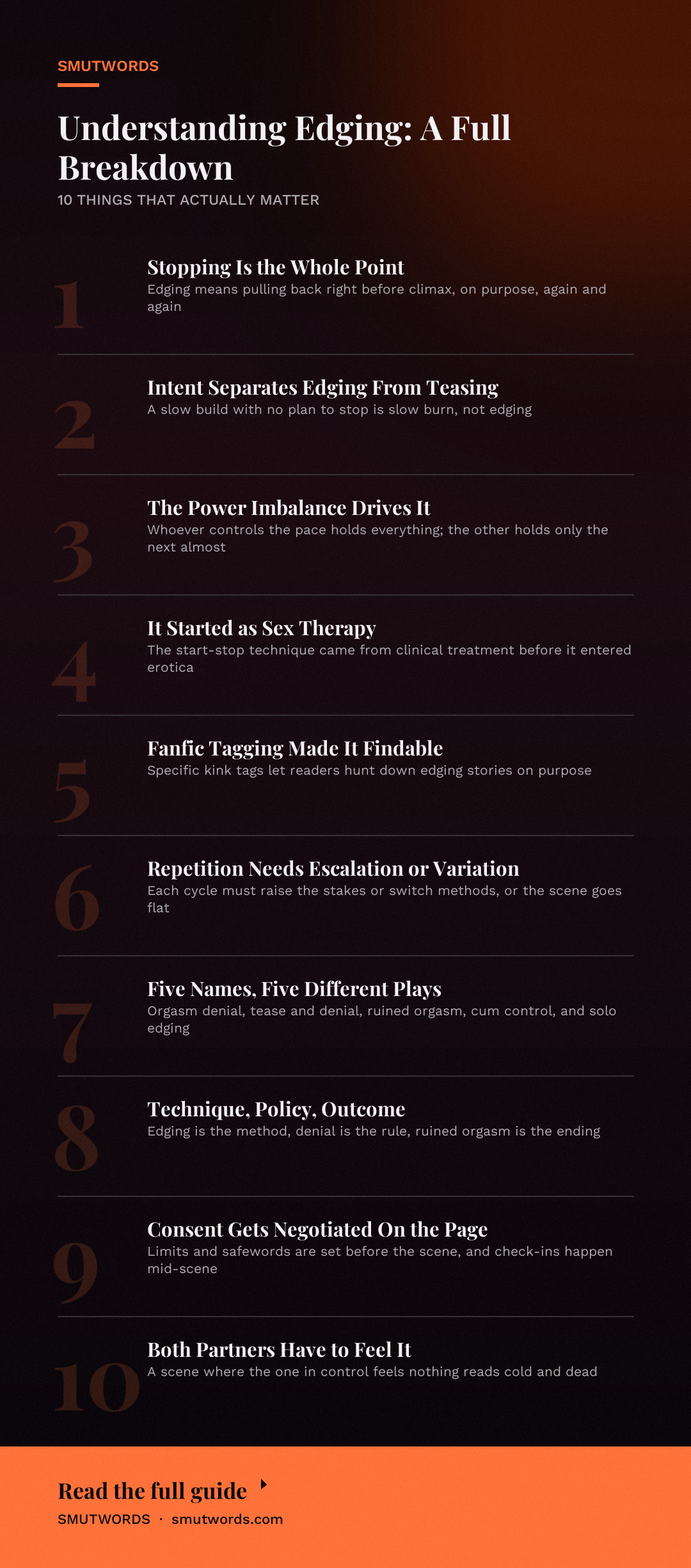
Worth being precise about what counts. A long, teasing build with no intention of stopping early is slow burn, not edging. A scene where someone loses control and comes too soon is premature, not edged. The defining element is intent: somebody, at some point, chooses to pull back right when pulling back is the hardest thing to do.
Common misconceptions pile up fast. Edging isn't the same as denial, though the two live in the same neighborhood.
It also isn't inherently dominant or submissive. The person being edged can be the one in charge, instructing their partner exactly when to stop. And edging isn't cruelty, even when a scene frames it that way. In a well-written version, the withholding is a form of attention, not neglect.
There's also a misconception that edging is purely a physical technique. On the page, it's closer to psychology with a hand attached. The mechanics are simple. The reason the scene works is that the person being edged cannot stop thinking about the person controlling the pace.
Where Edging Comes From
Edging has been part of real sexual practice for a long time under clinical names like the start-stop technique, a method originally discussed in sex therapy contexts as a way to manage premature ejaculation. That clinical origin is real, but it isn't where the erotica version came from, and it isn't what readers are looking for when they search for it.
The genre history matters more. Edging entered erotic writing as a supporting act, a detail inside longer BDSM and power-exchange scenes where a dominant character controlled a submissive partner's pleasure. In the 1990s and 2000s, that control often appeared in published erotica anthologies and early internet fiction as one element among many, rarely the headline.
Two shifts pushed edging into the spotlight. First, the rise of female-authored and female-read romance and erotic romance through the 2010s made extended foreplay and detailed pleasure-focused scenes more central to the plot, not just the payoff. Second, fanfiction culture normalized tagging extremely specific kinks, which meant readers could find edging stories on purpose rather than stumbling into them.
The result is that edging graduated from a technique mentioned in passing to a trope that carries entire books. Contemporary authors write it as a standalone dynamic, complete with negotiating rules, safewords, and the question of who actually controls the orgasm. The kink didn't change much. The publishing world finally gave it room to breathe.
There's also a quiet influence from keyholding culture, where one partner literally holds the means of another's release. Edging scenes and keyholding scenes share the same emotional engine: the transfer of permission from one person to another, made explicit and ritualized. Forbidden erotica runs on a similar transfer of permission, which is part of why the genre's handling of forbidden erotica keeps circling back to the same power questions.
How It Shows Up in Erotica
An edging scene on the page has a very specific shape. Arousal climbs. The reader feels it climbing. Then a hand stops, a mouth pulls away, a command lands, and the climb resets at a higher floor than before.
Repeat. The craft problem is that repetition can get boring fast, and a flat edging scene reads like a list of identical near-misses.
Strong versions solve that problem in a few reliable ways. The most common is escalation: each cycle raises something besides physical arousal, whether that's the intensity of the dirty talk, the amount of restraint involved, or the emotional stakes between the characters. By the fifth edge, the scene shouldn't feel like the first edge with more sweat. It should feel like something has been raised that neither character can lower.
Variation is the other tool. Authors rotate between oral, hands, toys, penetration pulled back at the last second, and the especially cruel trick of letting a partner get close through their own movement and then pinning them still. Switching the method keeps the reader from predicting the next stop, which is the entire source of tension.
Common Edging Variations in Erotic Fiction
Edging shows up under several names in the genre, and each one plays slightly differently on the page.
- Orgasm denial — the broadest umbrella. The orgasm is withheld for a set period, sometimes ending in a ruined climax and sometimes ending in nothing at all. Edging is often the technique used to enforce the denial.
- Tease and denial — emphasizes the verbal and psychological side. Lots of dirty talk, lots of "not yet," lots of watching a partner squirm. The teasing is as important as the stopping.
- Ruined orgasm — stimulation ends at the exact moment of release, producing a climax that arrives without satisfaction. Frequently paired with edging, and almost always used to underline who's in charge.
- Cum control — the kink framed as a long-term rule rather than a single scene. A character might be required to ask permission every time, indefinitely, which turns edging into a relationship dynamic instead of an isolated event.
- Solo edging — one character edges themselves on instruction, either in person or over text, which lets the author show obedience and desperation without a second body in the room.
The permission-asking beat deserves its own note. When a character has to request release and is told no, the scene borrows heavily from the same register as praise kink, where approval itself is the reward. A "good girl" or "good boy" delivered after a successful hold does more work than any physical description, because it confirms the submissive character did the impossible thing and waited.
Which brings up what separates a strong edging scene from a flat one. Flat edging scenes describe the body and nothing else. Strong ones describe the negotiation happening in real time: the submissive character's internal calculation about whether they can take one more round, the dominant character's quiet enjoyment of the answer, and the slow accumulation of trust that makes the whole thing possible.
Enjoyed this? Get a free book.
Join the list and we will send a complete free story straight to your inbox, plus new releases every week after that. No credit card, no catch.
The other failure mode is forgetting that edging is a two-person psychological event even when only one person is physically active. A scene where the character doing the edging feels nothing but clinical focus reads dead on the page. The best versions show the person in control getting something out of it: satisfaction, arousal, the specific pleasure of watching someone fall apart on command.
Edging also works well as a bridge into rougher territory. A prolonged edge can justify a sudden shift into rough sex, because the character being edged is already desperate and already past the point of wanting gentleness. The withheld orgasm becomes permission for everything that follows.
Where edging fits inside a larger dynamic is worth tracking too. In a harem romance, one character might be edged while the others watch, which turns the practice into a group dynamic and adds a layer of audience. Put the same scene in primal play and it reads differently again, because the chase itself becomes part of the withholding and the eventual release lands more like a hunt ending than a scene finishing.
If the dynamic tips into something more instinctual and less negotiated, it starts brushing against feral play, where the stopping and starting is driven by appetite rather than instruction. The line between the two is consent and framing. Feral play reads as unrestrained, edging reads as deliberate, and readers respond to the difference.
Edging vs Orgasm Denial and Ruined Orgasm
These three terms get used interchangeably online, and they shouldn't be. The confusion is real and worth clearing up, because it changes what a reader should expect from a book tagged with each one.
Edging is a technique. It's the act of stopping near the peak and restarting. The word describes what's being done to the body, not how long it lasts or what happens at the end.
Orgasm denial is a policy. It's the decision that an orgasm will not be permitted, for a scene, a night, or a much longer stretch. Edging is one of the ways denial gets enforced, but you can deny an orgasm without ever edging and you can edge someone without ever denying them the finish.
Ruined orgasm is an outcome. Stimulation is withdrawn right as the climax begins, so the release happens without the pleasure that should accompany it. It's often the ending of an edging or denial scene, and it's the moment where the power imbalance gets underlined hardest.
In practice, a single scene often contains all three: an edging cycle repeated several times, an explicit denial when the character asks to finish, and a ruined orgasm when the dominant character finally decides the answer is yes but on their own terms. If you're reading a blurb that promises edging, expect the cycle.
If it promises denial, expect the wait. If it promises a ruined finish, expect the release to land wrong on purpose. For a related look at how the genre frames extended tension without release, the breakdown of interactive JOI games covers a lot of the same permission mechanics from the instruction side.
One more comparison worth making is between edging and the setup in a one night stand story. Both can be built entirely around a single night, but a one night stand plot runs on novelty while an edging plot runs on repetition and escalation. Same timeframe, completely different engine.
Frequently Asked Questions
Is edging the same as orgasm denial?
No. Edging is the technique of stopping near climax and starting again. Orgasm denial is the broader rule that an orgasm won't be allowed at all. Edging is often one tool used to carry out denial, but the two terms describe different things and appear in different kinds of scenes.
What is a ruined orgasm, and how does it relate to edging?
A ruined orgasm happens when stimulation stops right as the climax begins, so the physical release occurs without the accompanying pleasure. It's frequently the final beat of an edging scene, functioning as the moment the character in control makes their point.
Can edging be done solo?
Yes, and it's extremely common in erotic fiction. Solo edging usually involves a character following instructions from someone else, either in the room or over text, which lets the author maintain the power dynamic without a second body present.
Why is edging so popular in erotica if it doesn't end in an orgasm?
Edging usually does end in an orgasm, just a delayed and intensified one. The appeal isn't the absence of release. It's the tension created in the waiting, the visible attentiveness of the partner controlling the pace, and the sense that the eventual payoff was earned by both characters.
Does edging require a dominant and submissive dynamic?
Not necessarily. One partner usually controls the pace, but that role doesn't have to map to a formal dom/sub relationship. A character can be edged by a partner who's equally wrecked by the process, and the scene still reads as edging as long as the stopping is deliberate.
What's the difference between edging and slow burn?
Slow burn is a pacing structure that stretches across a story, delaying the characters' first real encounter. Edging is a specific act that happens inside a scene. Slow burn controls when the sex happens. Edging controls when the orgasm happens.
How do authors handle consent in edging scenes?
Well-written edging scenes establish limits and a safeword before anything starts, and often show a check-in partway through. Because the line between pleasure and genuine frustration can blur, the negotiation isn't just a formality in the genre. It's frequently one of the most charged moments in the scene.
Final Thoughts
Edging earns its place as one of the genre's most reliable tension engines because it turns a single moment into a structure. The stopping is the story. The almost is the plot. If you want a book that builds an entire relationship around the question of who gets to decide when it ends, start in the glossary before you pick your next read.







Loading comments…