Office Sex vs Workplace Free Use: Two Fantasies That Look Identical on the Cover
Both fantasies start with the same furniture. A desk, a chair with someone else's jacket on it, a door that locks from the inside.
Then they split hard. One version is about getting away with it: the stolen twenty minutes, the meeting that runs long, the coworker who knows exactly what the closed door means. The other version removes the sneaking entirely and asks what happens when nobody has to hide anything because the arrangement is already agreed on.
That gap between office sex and workplace free use is the whole thing. Readers who grab the wrong one off the shelf end up disappointed for reasons they usually can't name.
What Readers Mean When They Search "Sex in Office"
The version with a locked door and a deadline
The classic sex in office story runs on risk. Two people who shouldn't be doing this, a building full of people who would notice, and a window of maybe fifteen minutes before someone knocks. The heat comes from the countdown, not the act itself.
Her skirt is still on the floor when the elevator dings down the hall. His tie is somewhere under the desk. That's the genre in one image.
What makes it work is that both people chose it in the moment. Nothing was pre-negotiated in a document. The boss and the assistant didn't sign anything at the start of the fiscal year. They looked at each other across a conference table during a budget review and decided, badly, to see what happened next.
Why the "we could get caught" element does the heavy lifting
Strip the risk out and the scene collapses. A couple having sex in an empty office on a Sunday with the alarm disabled is just a couple having sex in a weird room. The entire charge is the possibility that the door opens.
Every good version of this trope puts an obstacle between the characters and the door: a client call on speaker, a coworker who always forgets her keys, a glass-walled conference room and a blind spot that only covers half the table.
If you like your risk dialed to the ceiling, the same mechanism shows up in forbidden erotica, where the obstruction is social rather than structural. Same engine, different cage.
The beats you'll recognize immediately
- The late night with one car left in the lot
- The business trip with a single king room and a front desk that "can't" fix it
- The after-hours "can you stay back for a minute" that means something else
- The coworker who figures it out and says nothing, or says everything
- The performance review where the power imbalance gets named out loud and neither of them stops
Note what's absent from that list: consent negotiated as a system. In office sex, consent happens per encounter, in the moment, often messily. That's part of the appeal.
What Workplace Free Use Actually Is
The structured version, and why the structure is the point
Workplace free use takes the same office and rewrites the rules before page one. Everyone in the scenario has agreed, in advance, that certain people are available at certain times, and the plot is not whether it happens. The plot is what it does to the people living inside the arrangement.
Sometimes that's a company-wide policy in a near-future setting. Sometimes it's a smaller contract between a boss and a new hire, spelled out on the first day along with the dental plan.
Either way, the tension moves. It's no longer "will they get caught" because there's nothing to get caught at. It becomes "how does she feel the fourth time he walks past her desk and crooks a finger without looking up from his email."
The psychological load replaces the thriller load
This is where the two fantasies genuinely separate. Secret office sex is a thriller with clothes on. Workplace free use is a character study where the sex is constant and the interesting part is the slow reorganization of everyone's internal life around it.
A good free use story spends real page time on the moment the new employee reads the clause and has to decide how she feels about it. It spends time on the coworker who opted out and what that does to the office dynamic. It spends time on the Wednesday afternoon when the whole thing stops being novel and starts being Tuesday. That's a different pleasure than the locked-door sprint, and readers who want the sprint often bounce off it.
Enjoyed this? Get a free book.
Join the list and we will send a complete free story straight to your inbox, plus new releases every week after that. No credit card, no catch.
Side by Side: The Differences That Actually Matter
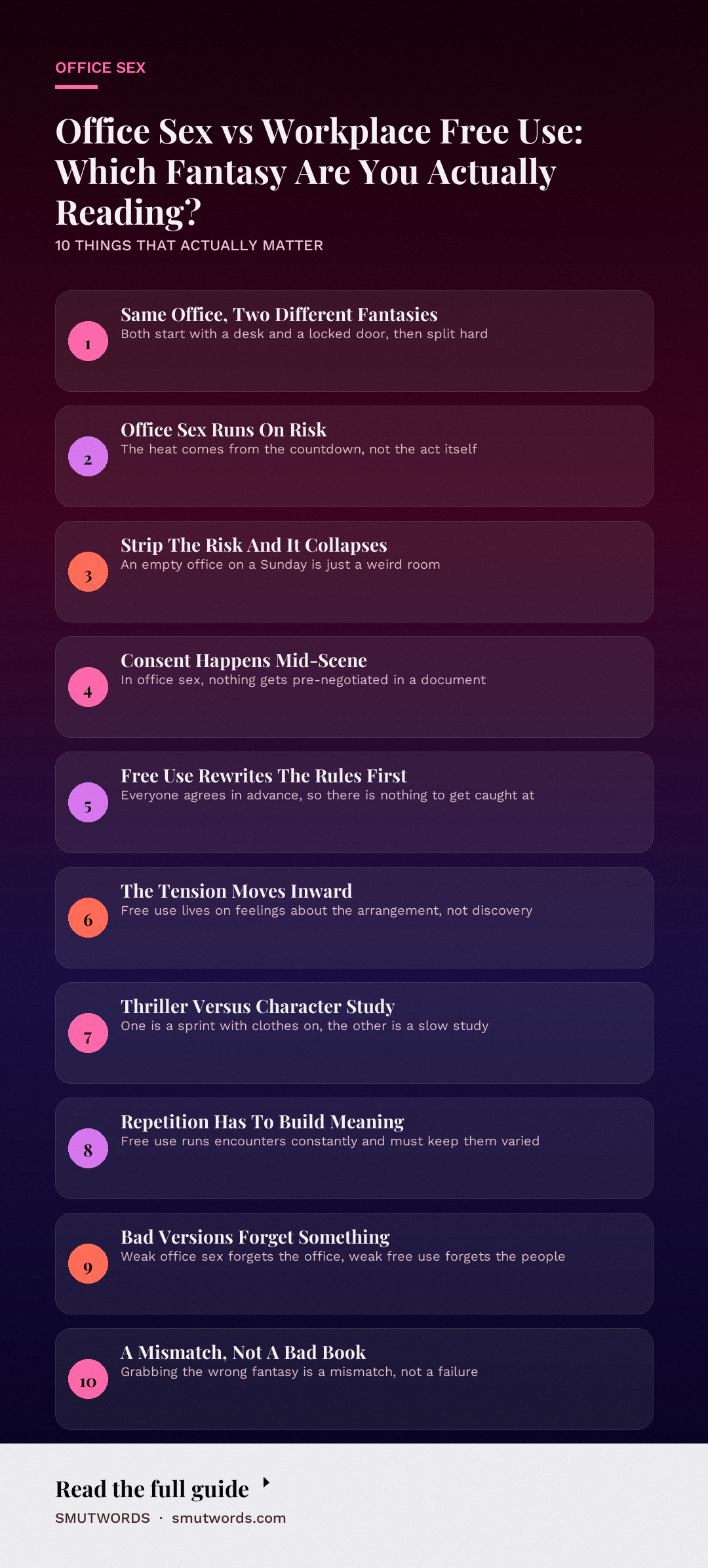
- Consent timing. Office sex: negotiated each time, often wordlessly, mid-scene. Free use: settled up front, sometimes in writing, sometimes with HR involved.
- Where the tension lives. Office sex lives on the possibility of discovery. Free use lives on the characters' feelings about the arrangement itself.
- Scene count. Office sex usually has one or two big scenes per book. Free use runs the encounters constantly and has to keep them varied or the book dies.
- Who holds power. Office sex lets the power imbalance sit unexamined and let it fuel the scene. Free use usually has to examine it, because the whole premise is that the imbalance got formalized.
- The climax. Office sex tends to end on either exposure or escape. Free use tends to end on a person deciding they want to stay.
You can also layer either one with other dynamics. A workplace free use book where the two leads started out at each other's throats borrows the charge of enemies to lovers and stacks it on top of the standing arrangement, which is a combination that either sings or turns into mush depending on the writer.
Which One Are You Actually in the Mood For?
Pick office sex if...
You want the stolen hour. You want the two of them straightening their clothes in a stairwell while a meeting lets out two floors up. You want the coworker who clocks it from the break room and smirks. You want the specific pleasure of characters who know they're being stupid and do it anyway.
Pick workplace free use if...
You want the logistics. You want the handbook page, the first awkward morning, the moment it stops being awkward, the moment it becomes something else entirely. You want the repetition to build meaning instead of dulling it. You want a book that treats "she's available at 2pm on Thursdays" as a premise and then asks what happens to a person who lives inside that sentence for six months.
If the answer is "both, but I want the second one to have real teeth," stalker romance and free use share some DNA in the way they handle surveillance and access. The difference is who's doing the watching and whether the watched person signed anything.
How Bad Versions of Each Trope Fall Apart
The worst office sex books forget the office. The sex could happen in a hotel room or a parked car and nothing changes. Good ones keep the office present in the scene itself: the sound of a printer through the wall, a Slack notification on a silenced phone, someone's forgotten coffee going cold on the corner of the desk.
The worst workplace free use books forget the people. The arrangement exists, the encounters happen, and nobody has a single complicated feeling about any of it. That's not a story, it's a checklist. The good ones put a scene in between two encounters where someone sits in their car in the parking garage and thinks about whether they actually like this or just agreed to it three months ago.
Related failure mode, same family: books that copy the office setting but ignore the emotional logistics of an actual workplace. If the author has never had a job where a coworker's chair creaks a specific way, the details go generic fast.
Where These Overlap With Other Workplace-Adjacent Tropes
Neither fantasy exists in isolation. The editor/author romance setup runs on the same power-imbalance engine, just in publishing instead of accounting. Same for tutor/student romance, which swaps the org chart for a one-on-one schedule and keeps the "we shouldn't" charge intact.
If you're drawn to the free use side because of the long-term exposure and the domestic intimacy it forces, lactation kink reads share a similar "we built a system around this and now we live in it" structure.
And if you want the surveillance-and-access angle pushed further than any office setting will allow, ghostwriter romance and celebrity romance both put the "who has access to whom, and who agreed to what" question at the center of the plot, just with cameras instead of conference rooms.
Some readers come to office sex looking for free use, and vice versa, because the covers and blurbs rarely distinguish. If you grab a book expecting the secret stairwell encounter and get forty pages of a signed arrangement instead, that's a mismatch in the fantasy, not a failure of the book. Worth knowing before you buy.
Honest Signs You Picked the Wrong One
- You keep waiting for someone to walk in and nobody ever does
- You keep waiting for the two leads to have a single unguarded moment and the arrangement keeps getting in the way
- You're skimming the encounters hoping for plot
- You're skimming the plot hoping for another encounter
- The book keeps telling you the arrangement is hot instead of showing you two people who are actually into each other
None of those mean the book is bad. They mean the book is the other fantasy, and you showed up for a different one.
Final Thoughts
If you want the locked-door version where the risk does the work, start with something that keeps the office loud in the background of every scene.
If you want the structured version, pick a book willing to spend real pages on the second week, not just the first. For the free use side specifically, look for the ones that treat the contract as the beginning of the story rather than the end of the setup, because that's where the fantasy actually lives.







Loading comments…