
Double penetration is a sex act and a fiction staple in which one character is penetrated in two places at once. Most often the vagina and the anus, sometimes two openings below the waist, sometimes one opening filled by two people or a person and a toy. It is one of the most searched-for scenarios in erotic writing for a reason.
The appeal sits in total physical overwhelm, the surrender of a body to more sensation than it was built to process alone, and the specific charge of two partners coordinating around one person's pleasure. On the page, a well-written double penetration scene is less about logistics than about trust, stamina, and the moment a character stops being able to think in full sentences.
What Double Penetration Actually Means
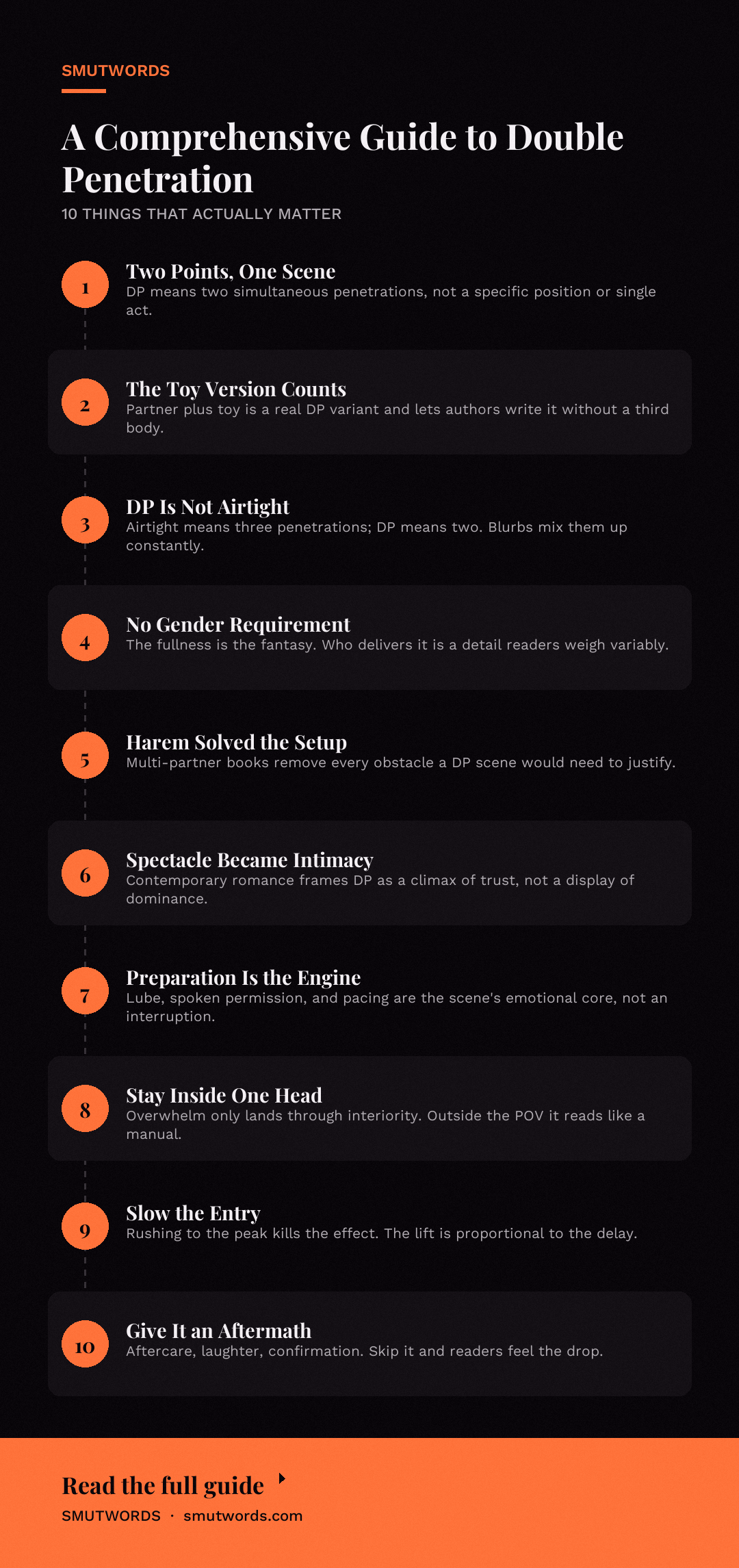
The term has a clinical-sounding name and a very un-clinical reality. "Double penetration" entered porn and kink vocabulary as a literal description: two points of penetration, simultaneously, in one scene. It is not a specific position or a single act. It is a category, and the category contains several distinct configurations that writers and readers use the same label for.
What counts as double penetration depends on where the two penetrations happen. The most common version in erotica is vaginal plus anal penetration, usually by two different partners. A close second is the same opening filled twice, which gets its own abbreviation in some communities: DVP for double vaginal penetration.
Double anal exists and is rarer in mainstream romance because of the physical demands it implies, though it shows up in darker kink writing.
The "partner with toy" version is where double penetration gets accessible for a wider range of scenes. One real partner plus one dildo, one hand plus one cock, a strap-on plus a person. This variant is the workhorse of solo or paired scenes and lets an author write DP without assembling a full cast of three.
Double penetration is not the same as airtight, though readers and even some authors use them interchangeably. Airtight conventionally means three simultaneous penetrations (mouth, vagina, anal) and belongs to a different scene architecture. It is also not the same as double riding, group sex with sequential partners, or a threesome where one person watches. The defining feature is simultaneity inside the body, not the number of people in the room.
One common misconception: DP is often described as something that "has" to involve two men. That is the dominant configuration in cis-het romance, but the act itself does not require specific genders.
Two women with toys, a woman and a trans partner, two men with a third person, any combination that puts two points of penetration on one body counts. The fantasy is the fullness. The anatomy of who is delivering it is a detail readers care about variably.
Another misconception is that DP is inherently degrading or violent. It can be written that way, and in some corners of why choose romance it often is, but plenty of DP scenes are tender, giggly, careful, or openly romantic. The tone depends entirely on how the author handles the negotiation, the pacing, and the aftermath.
Where Double Penetration Comes From
Double penetration has been a recognizable fixture of erotic media since at least the 1970s porn boom, where it circulated as a visual spectacle in the same category as other "extreme" acts. Its history as a written trope runs somewhat parallel and somewhat separate. In print erotica and, later, online fiction, DP appeared most reliably in three contexts: group-sex scenes, harem and reverse-harem setups, and the darker end of BDSM writing.
The genre shift worth paying attention to is the move from spectacle to intimacy. Early porn-coded writing treated DP as a display of one person's capacity or a partner's dominance. Contemporary romance writing treats it much more often as a climax of trust, the moment three people have to coordinate flawlessly for one person's sake. That reframing is recent, maybe the last fifteen years, and it tracks the broader shift in romance toward consent-forward, character-interior writing.
Fanfiction accelerated the trope's spread. The 2000s and 2010s fanfic boom made DP a familiar reader-side fantasy, and the writers who came out of that ecosystem brought its pacing and its emotional architecture into original romance. That is a large part of why contemporary DP scenes often read less like porn and more like emotional payoff with a very physical conclusion.
The rise of harem romance and reverse-harem publishing has been the single biggest driver of DP's current popularity. A harem structure solves the biggest structural problem DP poses for a writer: getting two (or more) plausible partners into one character's bed without the author having to justify it from scratch. When the whole book has been building a multi-partner dynamic, the DP scene arrives as the obvious, earned destination.
The group marriage subgenre, and the broader why choose category, made this even easier. In a why-choose book, the protagonist has already chosen all of them. The DP scene is where the choice gets physical, and readers who arrive for the emotional logic of a multi-partner romance get the payoff they were promised.
How It Shows Up in Erotica
A double penetration scene in a well-edited book tends to follow a recognizable shape. Preparation, positioning, the moment of entry, the adjustment, the build, the peak, and the aftermath. Cut any of the first three steps and the scene reads like a checklist. Cut the aftermath and it reads like a porn script with a romance wrapper on it.
The preparation is the part inexperienced writers skip and experienced writers mine hardest. Lubrication, spoken permission, positioning that actually works for the bodies described, careful pacing on entry. That material is not foreplay interruptus. It is the scene's emotional engine.
A reader who is here for DP is also here for the specific intimacy of two partners negotiating how to hold one person safely, and the negotiation is where the trust gets demonstrated.
Enjoyed this? Get a free book.
Join the list and we will send a complete free story straight to your inbox, plus new releases every week after that. No credit card, no catch.
Multiple variations recur across the genre, and it helps to know them by name:
- Two partners, vaginal and anal. The classic. Usually the emotional centerpiece of a harem or triad book.
- Partner plus toy. One live partner, one dildo or vibrator. Common in solo scenes or paired scenes where the author wants DP without assembling a third body.
- Double vaginal (DVP). Two penetrations in the same opening, usually written with the most explicit pacing work.
- Double anal. Rarer in romance, more common in dedicated kink writing, needs the steadiest hand on the physical logistics.
- Watched DP. A third character on the periphery, sometimes styled through the voyeur husband trope or a related frame where one partner watches another receive.
- Dark or degradation-coded DP. Overlaps with degradation kink, where the act carries a verbal charge as well as a physical one.
What separates a strong version from a flat one is almost always interiority. Weak DP scenes describe body parts and friction. Strong ones stay anchored in one point of view and let the reader feel the character's overwhelm, the way thought starts fracturing, the specific way they lose track of who is where.
Overwhelm is the whole pitch. Writers who stay outside the character's head write a scene that reads like a manual.
The second separator is pacing. DP has a natural architecture, and the writers who rush to the peak lose the effect. A good scene slows on the way in, lets the reader feel the body adjust, and only accelerates once the character has settled. The lift is proportional to the delay.
The third is aftermath. Contemporary romance readers, especially the ones who came up through fanfic, expect the scene to land somewhere emotionally. Aftercare, laughter, confirmation, a conversation. Skip it and the scene reads as a set piece rather than a relationship moment, and the reader feels the drop.
A note on safeword presence. The best DP scenes reference negotiation, positions, and verbal check-ins naturally, woven into dialogue. That reference is one of the genre's quiet teaching tools. Readers who are curious can see how clear agreements look, how lubrication and pacing are handled, and how a scene gets paused if something is off.
If you want to see how SmutWords handles the practical side of a physical kink, the spanking kink guide is a good reference for the same trust-and-negotiation framework. The DP version is similar, with extra care for lubrication, position holding, and comfort throughout.
Voyeur and watching dynamics often braid with DP in why choose books, and to a lesser extent in dark romance, where the scene sometimes carries a feral or primal charge. Writers leaning into that register should know it exists but should not feel obligated to hit it. The DP itself does the work. The flavor is optional.
Frequently Asked Questions
Is double penetration safe in real life?
Yes, with care. The main considerations are generous lubrication, clear verbal agreements on positioning and pace before the scene starts, a safeword everyone has agreed to, and a slow entry with frequent check-ins. Communication and comfort are the entire foundation, and any partner who skips those steps is a partner to skip.
What is the difference between DP and airtight?
Airtight means three simultaneous penetrations (mouth plus two lower openings). Double penetration specifically means two. The terms get used interchangeably in casual conversation and occasionally in book blurbs, though they describe different scene sizes and different physical logistics for the characters involved.
Does the term "double penetration" apply when one of the penetrations is a toy?
Yes. Partner-plus-toy configurations are some of the most common DP variants in erotic writing. The definition turns on simultaneity inside the body, not on the number of people present or the specific anatomy of what is doing the penetrating.
Why is double penetration so popular in harem and why choose romance?
Because the harem structure solves the setup problem. A book that has already established three or more partners has already removed every obstacle a DP scene would need to overcome. What is left is the scene itself, which lands as a natural climax of the relationship rather than an awkward addition.
Is double penetration always written as degrading?
No. It has a strong following in dark romance and in degradation kink circles, where the verbal charge is part of the appeal. In a lot of contemporary harem and reverse-harem writing, the same scene reads as tender, careful, and openly romantic. The tone depends on the words around the act, not the act itself.
What should a writer get right in a DP scene?
Interiority, pacing, and aftermath. Stay in one character's head, slow down on the entry, and give the scene an emotional landing. Reference lubrication, positioning, and check-ins through dialogue rather than skipping them. If those three elements are solid, the scene will read as a relationship moment rather than a checklist.
Final Thoughts
Double penetration earns its place because it can plausibly carry every emotional register at once: overwhelm, trust, coordination, surrender, and, in the right book, love. Writers who treat the setup with as much care as the peak are the ones readers return to.
For a next read that handles the multi-partner dynamic with the pacing this scene deserves, look for a why choose romance with a well-built triad at its center, one where the negotiation is on the page and the payoff is earned. If you want a sense of how this genre earns its emotional beats elsewhere, why readers can't stop reading insta-love is a useful companion read on why payoff matters more than setup.






Loading comments…