
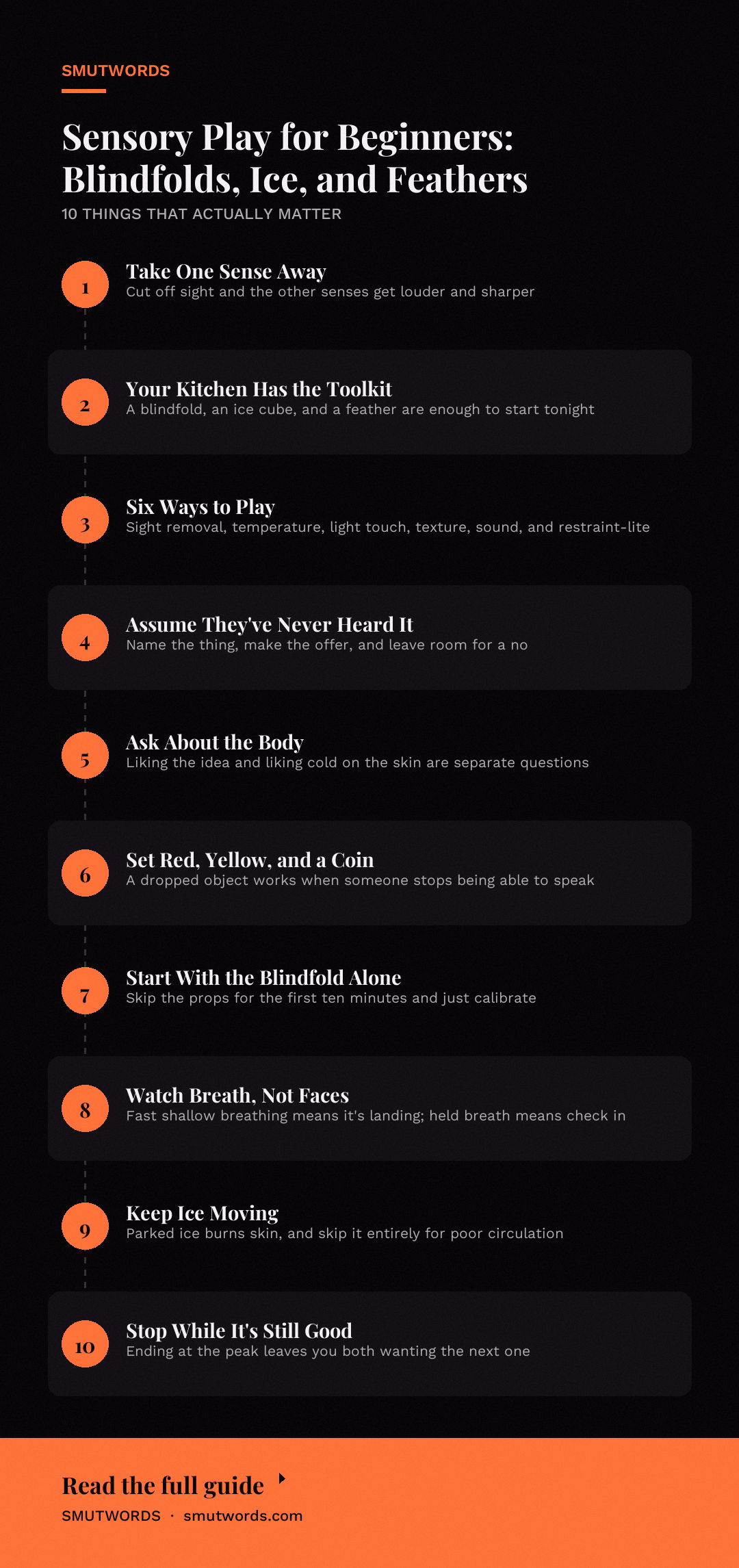
Sensory play has a reputation problem. Half the internet makes it look like a prop closet exploded onto a hotel bed, and the other half makes it sound like a clinical intake form. Both versions miss the point, which is simpler than either one: you take one sense away, and everything else gets louder.
If you're new to it, that's the whole premise. Sensory play for beginners is less about gear and more about paying attention to what happens when sight, sound, temperature, or texture gets deliberately dialed up or down.
A blindfold, a cube of ice, a feather dragged along the ribs. That's it. That's the entire toolkit you need, and you can run your first session tonight with things already in your kitchen.
What Counts as Sensory Play
The term covers anything that works on the senses on purpose. Some people use it as foreplay, some as a full scene, some as a way to practice being present with a partner without the pressure of anything else happening. All three are valid.
In practice it usually means one of these:
- Sight removal — a blindfold, a sleep mask, a scarf. The classic entry point because it's cheap, low-risk, and instantly effective.
- Temperature — ice cubes, warm oil, a cold metal spoon, a hot towel. The body reads temperature changes fast and reacts to them before the brain catches up.
- Light touch — feathers, fingertips, a silk scarf, a makeup brush, the tassels of something soft.
- Texture contrast — rough against smooth, cold against warm, wet against dry. Running a leather glove down one arm and a wet cloth down the other reads as two completely different events.
- Sound — a partner's voice close to your ear, music, white noise, or earplugs that mute the room down to your own breathing.
- Restraint-lite — a hand held down, a wrist looped in a soft tie. Not full bondage, just enough that the body understands it isn't the one steering.
Notice that nothing on that list requires a shopping trip. The gear people spend money on later is mostly a refinement of these basics, not a replacement for them.
Why It Works
When you cut off a major sense, the brain doesn't just sit there with less information. It reallocates. Touch gets more bandwidth. You feel the direction a fingertip is traveling, you notice the temperature of the air, you clock a breath near your ear as a distinct event instead of background noise.
That's the mechanical explanation, and it's true, but the felt experience is usually described as something closer to being handled. A partner who can't be seen has to be tracked entirely through contact. For a lot of people that's the actual draw: not sensation for its own sake, but the shift in attention. You stop performing and start receiving.
It also doesn't require you to already know what you like. Sensory play is a good first kink for exactly that reason. You try ice on the inner wrist, you find out whether you hate it or can't get enough, and you've learned something concrete in four seconds. Compare that to guessing at a whole scene you've never done.
How to Bring It Up With a Partner
You don't need a formal sit-down. The worst version of this conversation is the one that sounds rehearsed and ominous, because it makes the other person brace for something heavy.
Try the direct version instead. "I read something about blindfolds and it sounded like fun. Would you be into trying it sometime?" That's the whole script. It names the thing, it makes an offer, and it leaves room for a no.
A few things that help:
- Be specific about the first step. "I want to tie you to the bed and use a flogger" is a big ask from a standing start. "I want to put a blindfold on you and touch you for ten minutes" is not.
- Ask about the body, not just the idea. Someone might be thrilled by the concept and still not want anything cold on their skin, or anything near their neck, or anything that leaves a mark. Those are separate questions.
- Make it mutual. Offer to go first. Being blindfolded by your partner teaches you more about their nerves than watching them do it ever will.
- Treat a maybe as a maybe. "Not tonight" and "not ever" are different answers. Don't collapse them.
If you're both new and neither of you wants to be the one to raise it, that's extremely common. If you want a sense of how these dynamics shake out in fiction before you try them for real, the site has a useful primer in Dominant vs Submissive: What Each Role Actually Does. It's a decent way to figure out which side of the blindfold you're curious about.
Your First Session: A Real Walkthrough
Pick a night when neither of you has to be anywhere. Not a rushed one. The best first session runs twenty minutes and ends while you both still want more.
Before you start
Have everything within arm's reach before anyone gets blindfolded. Water, a towel, whatever props you picked, and a way to stop. Fumbling for a dropped ice cube in the dark is not the mood, and a person who can't see can't help you look.
Agree on a stop word and a slow-down word. "Red" and "yellow" are the standard pair and they're standard for a reason: short, clear, and you don't have to think about them.
A physical signal works as a backup for anything where speech is hard. The easiest version is holding a small object and dropping it. Keys, a coin, a hair tie. If it hits the floor, everything stops immediately.
The first ten minutes
Start with the blindfold alone. No ice, no feathers, just the mask and your hands. This is the calibration phase and it's the part most people rush past.
Talk to them while you do it. Where you're touching, what's coming next, whether they're warm or cold. A blindfolded person loses track of the room, and your voice becomes the thing that keeps them oriented.
Watch their breathing, not their face. You can't read a face under a mask anyway, and breath is a better signal. Fast and shallow means something is landing. Held breath usually means something needs checking on.
Adding the props
Introduce one thing at a time and give it a minute. Ice first is the conventional choice because the sensation is unmistakable. Drag it slowly along the inside of a forearm, then stop and let the water sit there. That trailing cold-after is often better than the cube itself.
Enjoyed this? Get a free book.
Join the list and we will send a complete free story straight to your inbox, plus new releases every week after that. No credit card, no catch.
Feathers work better slow than fast. The temptation is to do a lot of quick strokes, which mostly reads as a tickle and gets a laugh, not a reaction. One long, unhurried pass down the sternum does more. If you want the contrast to really register, follow a feather with something blunt and warm, like the pad of your thumb.
Then get a little creative with sequence. Cold, then warm. Soft, then scratchy. The order matters more than the individual objects.
Payload areas and caution zones
Inner wrists, inner forearms, the backs of the knees, the collarbone, the small of the back, the sides of the neck, and the thighs all read sensation strongly. Those are your reliable targets.
The neck is where people get cavalier, and it's the one to slow down on. Ice on the front of the throat near the windpipe can trigger a genuine gasp-and-panic reflex in some people, which is not the fun kind of gasp.
The sides and the back of the neck are safer and usually more sensitive anyway. Nothing goes over the mouth or nose, ever, for any reason. Nothing goes around the throat.
Risks and How to Lower Them
Sensory play is one of the lower-risk things you can do, which is why it makes a good starting point. Lower-risk is not the same as no risk, and the failure modes are boring and predictable.
- Falling. A blindfolded person standing up and taking a step is a blindfolded person who can trip over a shoe. Keep them seated or lying down, and clear the floor first.
- Frostbite and cold burns. Ice held in one spot for too long damages skin. Keep it moving, don't leave it parked on the same patch, and skip it entirely on anyone with poor circulation.
- Allergic reaction. Oil on skin is a real risk if you haven't used that oil together before. Patch-test anything new, and never use food oils on or near genitals without checking first, because some of them cause irritation or break down barriers.
- Drop. The flat, shaky, vaguely sad feeling that can show up after an intense scene. It's common, it's not a sign anything went wrong, and the fix is simple: water, food, a blanket, and company. Don't skip the ten minutes of aftercare because the scene was short.
- Going nonverbal. Some people stop being able to talk partway through, which means a spoken safeword won't reach you. This is exactly why the dropped-object signal exists. Set it up before you need it, every time.
If you graduate from a scarf to actual rope, the rules change and get stricter. Nerves don't forgive sloppy knots the way skin forgives a feather, and there's a full breakdown of what to watch for in the site's A Comprehensive Guide to Rope Safety. Read it before you buy anything.
When to Stop
Stop on the safeword, immediately, without negotiating about it in the moment. Debrief later. This is non-negotiable and it's the single habit that separates people who play for years from people who blow it up in one bad night.
Stop early if any of these show up: numbness or tingling in a limb, skin that's gone white or waxy from cold, real panic rather than a startled reaction, or a partner who's gone quiet and unresponsive in a way that doesn't feel like enjoyment. You can always start again. You can't un-do a cold burn.
And stop while it's good. Ending at the peak rather than grinding it out past the interesting part is what leaves both of you wanting the next one.
Building It Out Over Time
Once the blindfold and the ice cube feel routine, the natural next steps are combining senses and adding a dynamic on top. Blindfold plus a held-down wrist. Earplugs plus a single feather. A rule the blindfolded person has to follow.
That last one is where sensory play starts overlapping with power exchange, and it's a common on-ramp for people who later get into the broader dominant/submissive thing.
Plenty of readers use fiction to figure out what they want to try before they try it, which is a legitimate use of it. If you want to see how a blindfolded, restrained dynamic plays out at novel length, Bound to the Galactic Alpha: Dark Alien Captive Romance with Rite of Binding, Forced Obedience, and Explicit Sci-Fi Erotica runs a captivity-and-binding plot at full intensity.
The Queen's Slutmate handles the service-and-command side of it. Both are useful for working out which half of the power exchange is doing it for you.
If your taste runs more toward open relationships than props, The Complete Guide to Polyamory and A Comprehensive Guide to Stag and Vixen cover the arrangements where this kind of play often gets shared between more than two people. Different structure, same requirement for clear communication beforehand, and the sensory stuff slots into it exactly the same way.
There's also the group-scene version, which raises the stakes because now you're managing multiple people's attention and nobody can read the blindfolded person's face.
Free Use Cruise Ship is fiction, but it's good at showing why the person in the mask needs one trusted person whose only job is watching them. That's a real practice, not a plot device. If you ever play with more than one partner, designate someone as the watcher and give them authority to call the whole thing off.
Final Thoughts
You don't need much to start. A sleep mask from a drawer and a glass of ice water will tell you more about what you like in fifteen minutes than a month of reading about it. Set your words, put a coin in the hand you can't see, keep the room warm, and stop while it's still good.
When you're ready for the version where someone else is doing the binding, The Queen's Slutmate is the one to pull up next. It takes the blindfold-and-order dynamic seriously enough to be a decent map for how the real thing is supposed to feel, and the safety habits in this guide will serve you in every scene after it.






Loading comments…