
Hair pulling kink is the erotic charge that comes from a hand closing in someone's hair and taking control of their head. It shows up in a bedroom and on a page as one of the oldest gestures in the language of sex: a grip that says stay, bend, or come here.
The pull can be a light, teasing tug at the nape or a full-fist yank that tilts a partner's throat back. What makes it a kink and not just a rough move is the intent behind it, the reaction it draws, and the fact that both people want it there.
Writers come to this glossary entry for the same reason readers search it: hair is a handle, and handles mean power. A hand in the hair is shorthand for urgency, ownership, and heat, and it's one of the most reliably effective beats in all of erotica. This guide covers what the term means, where it came from in the genre, how skilled authors actually write it, and the real-world details that keep it safe and hot at once.
What Hair Pulling Kink Actually Means
The plain definition is a sexual or erotic charge derived from gripping, tugging, or yanking a partner's hair. That charge can land on either side of the exchange. The person whose hair is pulled feels claimed, steered, or put in their place. The person doing the pulling feels a jolt of authority and access, a hand wrapped around something the other person keeps close and groomed and personal.
The term describes a sensation kink, a dominance move, and a physical tell all at once, which is part of why it's so versatile in fiction. A hair pull needs no equipment. One hand, and a body close enough to reach. That low barrier is exactly why it appears in almost every flavor of erotic writing, from a tender first-time scene to the dirtiest thing in a dark romance.
What counts and what doesn't
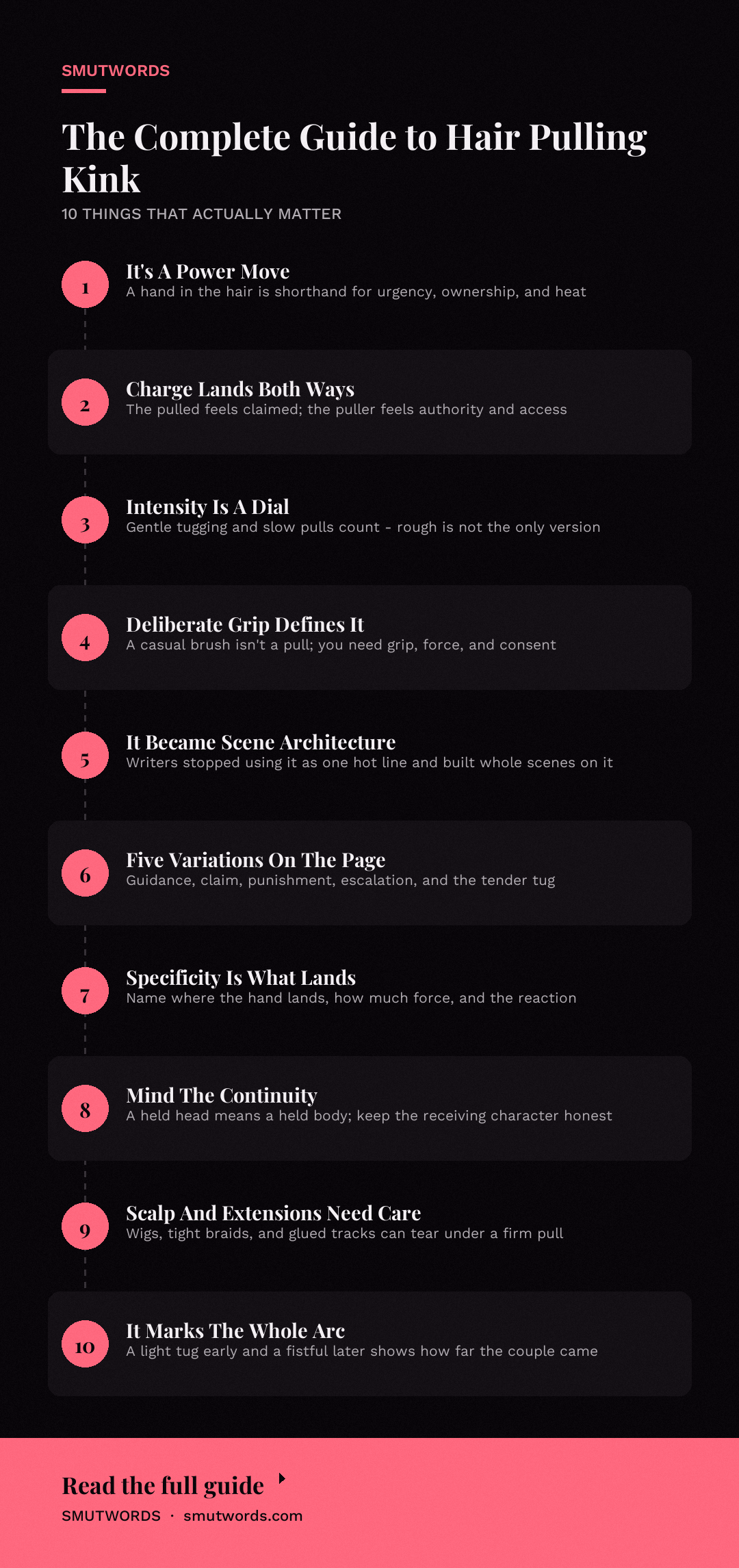
A casual brush of fingers through hair is not a pull. A stylist tugging at a tangle is not a pull either. The qualifying ingredients are deliberate grip, deliberate force, and erotic context or consent.
There's also a difference between a pull used as a one-off accent and a pull that anchors an entire dynamic. Both live under the hair pulling kink umbrella, but they do different narrative work.
Another distinction worth making: the kink can be about pain, about control, or about neither. Some people feel almost no pain from a scalp grab and simply love the loss of mobility. Some feel every strand and want the sharpness.
Others care only about the symbolism, the claim in the gesture. A good writer figures out which version their character is experiencing and writes that specific thing.
Common misconceptions
- It's only rough. Gentle tugging, scalp scratching, and slow pulls count. Intensity is a dial, not a switch.
- It's always the man pulling. Anyone with a hand can pull. The dynamic follows the characters, not their gender.
- It's easy because it's just hair. Scalp sensitivity, extensions, and existing tension make this one of the most injury-prone moves people get casual about.
- It's the same as pain play. Hair pulling can be about control with zero pain tolerance required, and plenty of people who hate pain love a firm grip.
Where Hair Pulling Comes From
The gesture is ancient because it's biological. Grabbing hair is one of the fastest ways to control a head, and heads control bodies. Animals do it: cats bite the scruff, primates grip and hold.
Humans discovered early that a fistful of hair decides where someone is looking and whether they can move, and that discovery turned up in art, myth, and the oldest written smut we have. You don't need a secret lineage to explain it. The body came with the hardware.
As a genre phenomenon, though, hair pulling earned its own reputation in romance and erotica during the modern rise of the alpha hero. In the vintage paperback era, covers sold a fantasy of the commanding man and the yielding woman, and the hair pull was already there in the prose: the hand fisted at the back of the neck, the forced eye contact. It was never the headline act. It was the seasoning.
The shift from accent to architecture
Something changed in the last two decades of erotic fiction. Writers stopped treating the hair pull as a single hot sentence and started building scenes around it. That's when the kink got its own gravity. The internet made hair pulling a searchable fantasy in its own right, and fan fiction pushed the move into sharper, more explicit territory, first in slash and dark fic, then in the booming indie romance market.
The bigger publishing shift came with dark romance and the dominance-forward contemporary. Authors began naming the kink out loud, having characters negotiate it, and letting it carry a whole relationship dynamic rather than a single beat. You can trace the same arc in other niches, from how the brat play 101 guide explains a whole power game instead of one spicy moment. Hair pulling went from garnish to structure in much the same way.
Today the trope is a staple of the enemies-to-lovers playbook, the reverse harem, and the dark mafia romance, and it overlaps heavily with the general appetite for rough sex that drives a huge share of the erotica market. It's also one of the easiest kinks to slot into a scene that doesn't otherwise advertise itself as kinky, which keeps it permanent.
How It Shows Up in Erotica
The craft question is what a hair pull is doing in a scene, and the answer changes everything about how to write it. An editor who has read hundreds of these books can spot a lazy pull instantly: a character grabs a ponytail, pulls, and the page moves on with no consequence. A strong version uses the grip to change the power, the pacing, or the truth of the moment. Here's how the best authors deploy it.
The main variations on the page
- The guidance pull. A hand in the hair steers a partner's mouth, tilts a face up for a kiss, or brings someone closer. The charge is control plus access, and it's the safest and most common version in the genre.
- The claim pull. A firm grip that says mine, often at a moment of jealousy or possessiveness. This is a favorite in dark romance and mafia books because it signals ownership without dialogue.
- The punishment pull. Force used as discipline inside a power-exchange dynamic, often paired with spanking or a verbal scolding. It's where the pain component gets loudest.
- The escalation pull. A yank that tips a scene from warm to urgent, often right as the clothes come off. It's the gear shift from foreplay to the main event.
- The tender tug. Gentle, steady pulling or scalp massage during aftercare or slow lovemaking. It reads as devotion rather than domination and works beautifully in softer books.
The variants read differently depending on whose head the reader is inside. A pull written from the receiving character's point of view highlights the tilt of the throat, the sting, the loss of control, the sudden vulnerability. Written from the giver's point of view, it becomes about grip, the leverage of the body, and the heady feeling of being allowed to do it.
What makes it land versus fall flat
The strong version is specific. It names where the hand lands (roots, nape, ponytail base), how much force there is, and what the receiver does in response. It tracks the small physical consequences: a bared neck, a gasp, a stumble, a scalp that aches afterward. It also gives the pull a reason inside the emotional story, whether that's frustration, possession, or the first crack in a character's restraint.
The flat version is generic. "He pulled her hair" tells the reader nothing beyond the fact of it.
Enjoyed this? Get a free book.
Join the list and we will send a complete free story straight to your inbox, plus new releases every week after that. No credit card, no catch.
The strong version reads more like: his hand closes at the base of her ponytail and he draws it back until her chin lifts and her breath catches in her throat, and neither of them pretends this is still an argument. That's the level of specificity to aim for, and it's the same advice the shibari vs rope bondage piece gives about writing restraint: the detail is the heat.
Strong pulls also respect continuity. A grip on the hair means the head is being held, which means the body is held, which means the writer has just constrained their own scene. Authors who ignore that leave a character with a free hand doing something impossible for someone being steered by the scalp. The best writers use the constraint on purpose, keeping the receiving character's body honest.
Where it fits best in a book
Hair pulling thrives wherever a story already runs hot on power. It's a natural fit in dark romance, mafia, and captor-captive plots, where a possessive grip needs no explanation. It also works beautifully in enemies-to-lovers, where the first hard pull is often the moment the fight turns into something else.
It's an easy addition to a group scene too, though the logistics multiply fast once more hands appear. If you're writing one, the guide to the adult foursome and the complete guide to the orgy are both worth reading for how to keep multiple people's hands accounted for. A stray yank in a crowded scene lands very differently than a deliberate one between two.
It also pairs well with other kinks that share the same power logic. A scene built on primal play might use the hair as the first grab in a chase. A scene with a keyholding dynamic might use a sharp tug as the reminder of who decides. The gesture is a universal accent, which is exactly why it appears in so many books across subgenres.
One more craft note: the hair pull is a fantastic way to show a relationship changing without a word of dialogue. A light tug in chapter three and a fist full of hair in chapter twenty tell the reader the whole arc of trust and heat in one comparison. Authors who understand this stop writing the pull as a random flourish and start using it as a marker of how far the couple has come.
Hair Pulling Kink vs Related Kinks
Readers often lump hair pulling in with other grabs without thinking about the differences. The closest neighbor in the genre is rough sex, the broader category for all forceful, urgent, messy physical heat.
Hair pulling can be a feature of rough sex, but it can also show up in the most tender scene in a book, which is why it deserves its own term. The pull is about the grip and the head. Rough sex is about the overall intensity of the encounter.
Shibari is a different comparison entirely. A shibari scene and a hair-pulling scene both use restraint and control as the charge, but shibari involves rope, technique, and a full head-to-toe setup where hair pulling is a single hand and a single move. If a story wants an elaborate scene of a bound body, shibari is the tool. If it wants one sharp, intimate moment of control, the hair grab does the job faster than anything else.
Frequently Asked Questions
Does hair pulling hurt?
It can, and for many people the sting is part of the appeal. Force ranges from a light tug to a hard yank, so the sensation depends entirely on how the pull is done and how much scalp sensitivity the person has. In real life the rule is simple: start gentle, check in, and stop if it crosses from hot to painful. A safeword or a tap-out signal keeps it from going bad.
Is hair pulling kink only for dominant and submissive couples?
No. The gesture carries an easy power charge, so it shows up most in D/s writing, but plenty of couples without any formal dynamic enjoy it. A playful tug mid-kiss works just as well as a full grip in a power-exchange scene. The kink belongs to whoever enjoys the sensation and the intent, not to one specific relationship style.
What about hair extensions and hair loss?
Real hair extensions and wigs can tear away from the scalp under a firm pull, and tight braids or glued tracks are especially prone to damage. Before any real-world play, the person being pulled should mention anything anchoring their hair that isn't their own. A pull at the roots is riskier than a pull at the gathered bulk of the hair, which is why experienced play partners grip wide and near the base when they want force.
Why is hair pulling so common in erotica?
Because it's a single gesture that does an enormous amount of narrative work. It can establish dominance, signal jealousy, escalate a scene, force eye contact, and show how a relationship has changed, all in one hand movement. It also requires no equipment and no explanation, so writers reach for it constantly. It's one of the most economical moves in the genre's toolkit.
Can hair pulling be too rough in a book?
Any force can be written badly, and the worst versions yank without any reaction, consequence, or consent. A strong scene shows the physical result (a tilted head, a gasp, a marked scalp) and gives the receiver some agency or a way to tap out. Rough is fine. Careless is what flattens the scene.
What should I do if I want to try hair pulling for the first time?
Talk about it first, find out what your partner likes and whether their scalp or hair is fragile, and agree on a signal that means stop. Start with a light grip at the base of the hair and build up. Check in with words the first several times. The best version of this kink is built on trust and feedback, the same as any other.
Final Thoughts
Hair pulling earns its place in erotica for the same reason it earns a place in a bedroom: it's a single hand doing a whole conversation. Written with specificity and a little care for the scalp at the other end, it stays one of the most reliable moves in the genre.
If you want a book that uses it with real intent, start with Captive Prince by C.S. Pacat, where a possessive grip and a tilt of the throat carry more tension than half a chapter of dialogue. Read it for the way the pull changes who holds the leash in the scene, and keep that lesson for your own page.







Loading comments…