
The first time someone calls their partner "brat" mid-scene, there's usually a half-second where everyone in the room has to decide what they mean by it. Brat play gets talked about like it's obvious, and it isn't. It's a specific dynamic with its own logic, its own risks, and a failure mode that has nothing to do with how hard anyone gets spanked.
Get the framework right and it's one of the most fun things two (or more) people can do to each other. Get it wrong and you're just having a fight with extra steps and a safeword nobody remembers.
This is a practical guide to brat play: what the dynamic actually is, why it appeals to the people who love it, how to negotiate it before you're naked and improvising, and how to tell the difference between a playful no and a real one in the moment. It's written for adults who already know they're curious and want to do it without wrecking anything. If that's you, keep reading.
What Is Brat Play, Exactly?
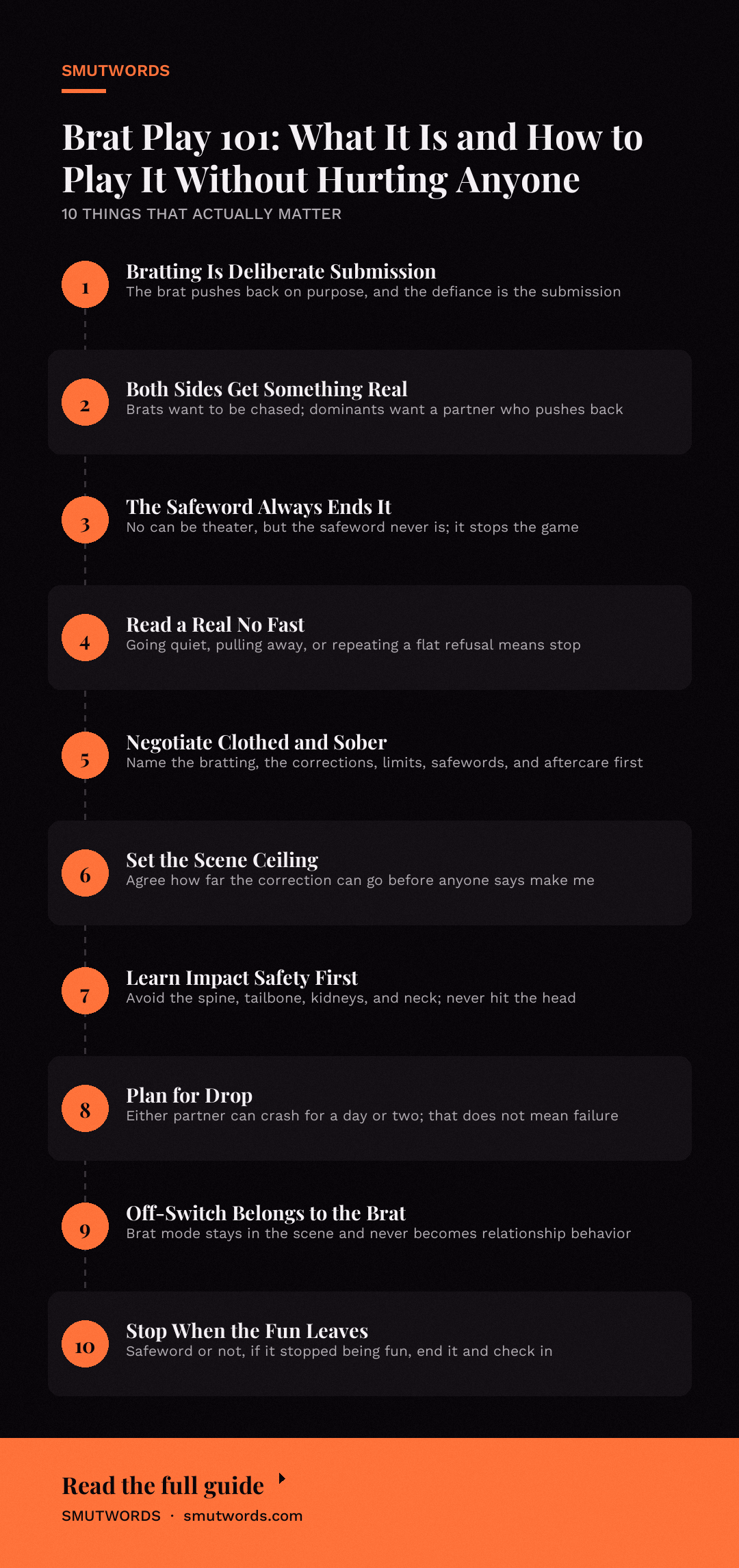
Brat play is a power-exchange dynamic where the submissive partner (the brat) deliberately pushes back, talks back, disobeys small instructions, and generally makes the dominant partner work for their compliance. The defiance is the point. The brat isn't failing to submit; they're submitting by way of a fight, and the dominant's job is to win it in a way everyone enjoys.
That word "deliberately" is doing a lot of work in the sentence above. A brat who genuinely doesn't want to do the thing isn't being a brat; they're just saying no. The whole dynamic runs on the submissive wanting to be caught, corrected, and outmatched. The sass is a gift they're handing over, wrapped in a smirk.
It's a subtype of dominance and submission, and it lives close to a few other things that get confused with it. Age play sometimes borrows the bratty register. Primal play sometimes uses the same chase energy.
Some switches land in brat mode depending on who they're with on a given night, which is worth knowing if you're figuring out what a switch is and how dominance and submission actually move around. Brat play is its own thing, though, and the dynamic has a particular flavor: playful, teasing, and built on a shared joke that everyone is in on.
Why People Are Drawn to Brat Dynamics
The appeal splits pretty cleanly down the middle of the slash.
For the brat: getting a reaction is the whole game. There's a specific charge in saying "make me" to someone who can and will. A lot of brats describe it as feeling wanted in a very direct, physical way. Noticed. Chased.
The brat gets to be the center of the dominant's attention, and the correction that follows is proof they earned it.
For the dominant: brats are active partners. You're not performing dominance into a void; you're responding to a live provocateur who wants to see what you'll do. Some dominants find pure obedience sweet but a little sleepy. A brat keeps the scene awake.
The satisfaction is in reading the pushback, deciding which corners to press, and landing the correction at the moment it'll hit hardest.
The dynamic also does something useful for people who struggle with submission in their day-to-day life. A brat can hand over control while keeping their dignity intact, because they made you take it. That framing matters for a lot of people who'd find naked, immediate compliance uncomfortable or even a little humiliating in the wrong way.
If you like the fantasy of a partner who resists and gets claimed anyway, that's the engine behind a lot of the fiction on this site, from The Crimson Reclamation: Captive to the Alien Breeding Commander, where the captured party spends a good chunk of the book refusing to go quietly, to Zorgon's Pet. Fictional versions crank the drama up. Real life runs on negotiation.
Playful Defiance vs. a Real No: How to Tell the Difference
This is the section that matters most, so read it twice.
A playful no sounds like "make me," "you'll have to catch me first," an eye roll, a theatrical sigh, or a direct "no" delivered with a grin while the person leans in instead of pulling away. The body is open. The tone is teasing. The brat is watching to see whether you'll take the bait, and there's a little forward lean in the whole performance.
A real no looks different, and it can arrive in the middle of play from someone who was thoroughly enjoying themselves ten seconds earlier. That's normal. People change their minds. The signs to watch for:
- They go quiet and flat. No teasing, no eye contact, no lean.
- They pull away instead of toward. Physically, they're creating distance.
- Their voice drops into something serious, and the playfulness evaporates.
- They repeat the same refusal without any of the theater around it.
- They name a safeword, or they say "stop" without the smirk that usually goes with it.
The single most important rule of brat play is this: a safeword always ends the game, even if the brat is mid-bit. If you've negotiated a safeword, the word "no" can be part of the performance. The safeword cannot.
Use a system that's clear. The traffic-light system works well for brats, because "yellow" lets the brat say "you're close to the edge, push a little harder but watch it" without breaking the scene. "Red" means everything stops.
If a brat yells "yellow" you slow down. If they yell "red" you're done, and you're checking in immediately.
The pushback you're allowed to enjoy is the pushback they've agreed you can enjoy. If you're not sure in the moment, pause and ask. A dominant who stops to check in looks confident, not weak.
A dominant who keeps going past a real no has just done something that isn't brat play at all. If you're new to the D/s side of this, read up on orgasm denial as a way of understanding how giving and withholding control actually feels from the bottom; the consent framework is the same and the "is this still fun" checkpoints translate directly.
How to Negotiate Brat Play Before You Start
Brat play fails hardest when people skip the conversation because they think the conversation is unsexy. It isn't. Negotiation can be its own kind of foreplay, and it means the actual scene can go further because you already know where the walls are.
Have this conversation clothed, sober, and not five minutes before you plan to start. Somewhere private and unhurried. Here's what you need to settle:
- What counts as bratting. Backtalk? Refusing small instructions? Playful physical evasion? Specific phrases or gestures? Name them. A brat who knows exactly which behaviors land gets to be more creative, not less.
- What the dominant is allowed to do about it. This is the other half. "I'll brat, you'll spank me" is a start, but be concrete. Corner time? Verbal correction? Being pinned? A funishment (a punishment that's really a reward)? Write down what's on the table and what isn't.
- Hard limits both directions. What the dominant will never do, what the brat will never accept, even as a joke. These are off the table permanently, no matter what the scene is doing.
- Safewords. Pick them. Make sure both of you can say them under pressure. Agree on what happens when one gets used: stop, check in, water, decide whether to continue or end.
- The pause signal. If a brat needs to step out of character to ask a real question, they need a way to do it that doesn't collapse the scene. Some couples use a phrase like "out of character" or a quick hand squeeze. Use whatever works.
- Aftercare. Who needs what when it ends. Cuddling, water, a snack, decompression time, talking through what happened. Plan it before you need it, because brat scenes can leave both people a little raw, and that's part of the fun.
If you've never done any power-exchange before and you're coming from vanilla relationships, don't skip straight to brat play. The bratting is the advanced-level portion of a dynamic that runs on clear communication and trust. Learn the basics first. Know how to top and how to bottom with someone who won't push back.
Bringing It Up With a Partner
You don't need a formal proposal. You need a low-stakes conversation.
The easiest opener is curiosity, not confession. "Have you ever heard of brat play? I read something about it and it made me think of us." Then watch the reaction.
If they look baffled, you can explain it in one sentence: a dynamic where one person deliberately pushes back and the other responds, and everyone's in on it. If they look interested, you've got a conversation to have.
If your partner is the one who wants to be bratted and you're the one who has to respond, it helps to know you don't have to be a natural sadist to do this well. You need to be present, attentive, and willing to play. The reaction you're offering is the reward, not the punishment itself.
Some of the best brat-taming dominants are people who genuinely enjoy the banter and get a kick out of watching the brat's face when they realize they've been outmaneuvered.
Enjoyed this? Get a free book.
Join the list and we will send a complete free story straight to your inbox, plus new releases every week after that. No credit card, no catch.
If the conversation ends in a no, that's a no. Brat play is a kink you can revisit later, not a personality trait someone has to unlock. Pressuring a reluctant partner into it is the fastest way to make sure they never want to try it.
The Real Risks and How to Lower Them
Brat play carries a specific set of risks that aren't obvious from the outside. None of them are dealbreakers. All of them are manageable, if you go in knowing what they are.
1. The misunderstanding problem
The biggest risk is misreading a real no as a bratty one. The fix is the safeword system above, plus check-ins during the scene.
Ask questions. Watch body language. The brat's job is to make you work for it; your job is to know when the work is done.
2. The escalation problem
Bratting can push a dominant into intensity they didn't plan for. "Make me" is a challenge, and challenges escalate. Agree in advance on what the ceiling is for any given scene. If neither of you has decided how far the correction can go, you don't know what you're saying yes to.
3. The physical safety problem
If your correction involves impact (spanking, flogging, anything with force), there are real risks. Avoid the spine, the tailbone, the kidneys, and the neck. Never hit the head. Learn proper technique from a real source before you wing it.
Unsupervised heavy restraint (full-body ties, suspension, anything that could restrict breathing or cut circulation) is not a beginner activity, full stop. Breath restriction of any kind carries genuine injury risk and shouldn't be treated as a funishment.
4. The emotional problem
Brats and dominants can both get their feelings hurt in ways that surprise them. A brat who pushed too hard and got a real rebuke instead of a playful one. A dominant who discovered that correcting someone made them feel bad. Build in a check-in after the scene, and give each other room to say "that landed wrong" without it being a crisis.
5. The drop problem
Sub drop and dominant drop are both real. After an intense scene, either partner can crash for a day or two. Plan for it. You don't have to plan for it well, but know that it's coming and that it doesn't mean something went wrong.
Common Mix-Ups: What Brat Play Isn't
A few things get confused with brat play, and the confusion costs people.
Brat play isn't disrespect. The brat is playing a character who is disrespectful. The person is not.
Outside the scene, they don't get to carry that behavior into the rest of the relationship. A good rule: brat mode has an on-switch and an off-switch, and the person flipping it decides which one.
Brat play isn't a way to address a real grievance. If you're annoyed at your partner about something, bratting is not the vehicle for that conversation. Handle it directly. Bratting is for the fun resistance, not the real one.
Brat play isn't the same as primal play. The energy is similar (there's chasing, there's a hunt, there's the pleasure of being caught), but the driver is different. Bratting is verbal and psychological; primal play is more physical and instinctive.
A lot of brats are also prissier than they want to admit. Know which one you're actually doing.
Brat play isn't a free-use scene. In free-use dynamics, the submissive is available at any time, and the rules are set by that arrangement. In brat play, the submissive is actively resisting, and the whole point is the resistance.
A reader who picks up Free Use Nurse: A Hospital Free-Use Fantasy expecting brat energy will find a different kink entirely. Both are valid. They're just not the same shape.
The same goes for brat-flavored fiction versus actual brat play. A book like The Work Party Dare might have a disobedient energy to it, and Rent Paid in Cum belongs to the power-exchange neighborhood, but the agreements those characters have aren't the ones you're going to make with your partner. Read them for the fantasy. Negotiate for the practice.
When to Stop
You stop when the safeword comes out, and you stop when the fun leaves, even if nobody's called it yet. Both. Not one or the other.
A scene that started as a game and turned into a real confrontation is done. A scene where one person is tired and pushing through it out of a sense of obligation is done. A scene where the correction has escalated past what was planned is done, and you can restart fresh another night. There's no prize for finishing a scene that stopped being fun twenty minutes ago.
End it cleanly. Check in. Ask what landed and what didn't. Thank each other, even if the scene was rough and playful.
That's not a formality; it's how you build the trust the next scene runs on.
If the check-in reveals that a limit got crossed, that's not the end of the relationship. It's a conversation. Don't get defensive, don't dismiss what the other person is telling you, and don't agree to a "we'll be more careful next time" without actually changing the plan.
Most of the people who get good at this dynamic are the ones who had a few clumsy scenes early on and debriefed them honestly afterward.
For the fiction side, the dynamic shows up in all kinds of places, and a good story can be a genuinely useful way to figure out what you're curious about, whether it's the power-exchange framework in Ridden by the Herd or something stranger. Use it to find your language and then use the language with a real person before you try the practice.
Final Thoughts
The best place to start is with a scene that's smaller than you think it should be. Pick one move: a single rule, a single bratty behavior, a single correction, a single check-in afterward.
Talk about it first. Try it for fifteen minutes. Debrief.
The dynamic gets richer as you build it, and the first version doesn't have to be the finished version. If you want a book to read after this, and one whose brat runs hot from the first chapter, start with Zorgon's Pet. Then have the conversation.






Loading comments…