
Semi-public sex means sexual activity that happens somewhere other than a closed bedroom door, in a place where other people could plausibly walk in, hear you, or catch a glimpse. The parked car, the office after hours, the stairwell, the bar bathroom, the dressing room, the back row of a theater. Any space that belongs to the world at large but has a lock, a shadow, or a few seconds of privacy to exploit.
The thrill comes from the risk of discovery. It also comes from what that risk does to the body and the voice: the held breath, the whisper, the hand clamped over a mouth. When readers search for the semi-public sex meaning, they usually want three things: the trope explained, the appeal articulated, and the difference between a hot scene on a page and a genuinely terrible idea in real life. This guide covers all three.
What Semi-Public Sex Actually Means
The name is doing something specific. "Public" gets softened by "semi" because the defining feature of this kink is the near miss, not exposure to a crowd.
The empty parking garage. The hotel balcony at dusk. The supply closet. A locked room with the wrong door, or the right door with no lock at all.
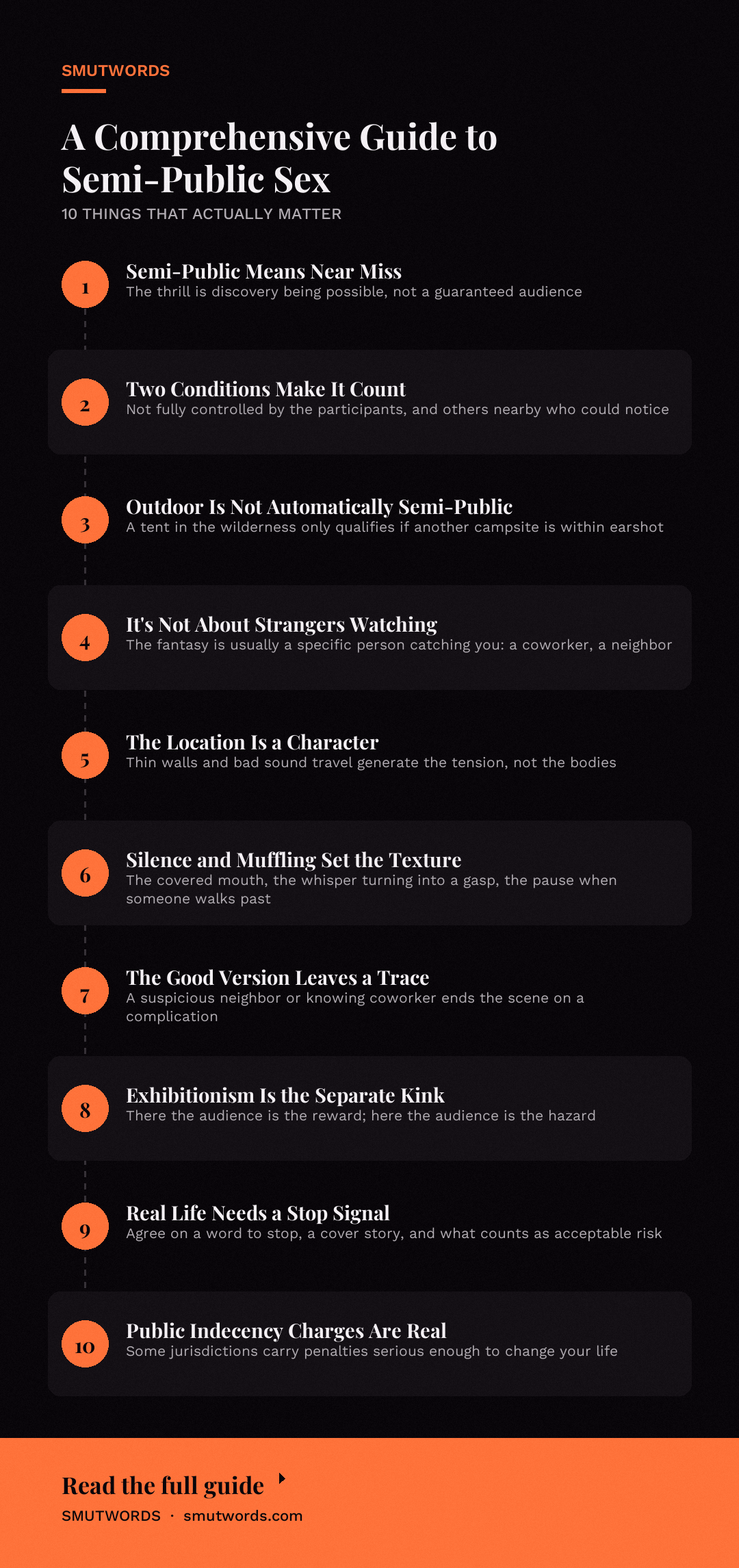
For a scene to count as semi-public, two conditions usually need to be true. First, the location is not private property controlled entirely by the participants. Second, other people exist nearby and could become aware of what's happening. If nobody could possibly overhear or walk in, you're just having sex in a slightly unusual room.
What counts and what doesn't
A few distinctions worth making, because readers get fuzzy on them:
- Counts as semi-public: a parked car on a quiet street, a hotel balcony above a busy pool, an office after the staff have left, a bar bathroom stall, an apartment stairwell, a tent at a crowded campground, a library study carrel, a changing room at the gym.
- Doesn't count: a fully private home with the curtains drawn, a hotel room with a deadbolt and thick walls, a sex club or play party where everyone present has consented to be there and to see what happens.
- Adjacent but separate: exhibitionism, which is about being seen and getting off on the audience itself, and voyeurism, which is about watching. Semi-public sex sits between them: the appeal is the possibility of discovery, not a guaranteed show.
Common misconceptions
The biggest one is that this kink is about wanting strangers to watch. It usually isn't. In most erotica, the thrill is that a specific person might catch you: a coworker, a neighbor, the friend who lives upstairs. The abstract stranger is a second-tier fantasy.
The second misconception is that "semi-public" is just a spicier word for "outdoor." Lots of outdoor sex is entirely private. A tent in the wilderness qualifies as semi-public only if there's another campsite within earshot.
The third is that it's inherently risky in a real-world legal sense. Some of it is. But the fantasy operates on a sliding scale from "the back seat of a car in a quiet parking lot" to "the supply closet during the Tuesday staff meeting," and the version readers return to most is closer to the car than the meeting.
Where Semi-Public Sex Comes From
Erotic writing has been using locations as a pressure valve for a very long time. Classic erotica from the eighteenth and nineteenth centuries was often dressed up as confession or complaint, and the sneaking around was half the plot.
The pool of public spaces to get caught in was smaller when so much writing was meant to be instructive or ironic, but the pattern holds: the illicit thrill of a place where someone could walk in shows up across a range of century-old erotica.
The modern trope in romance and smut fiction is easier to trace. The office hookup became a staple once office romance itself became a staple, somewhere in the mid-to-late twentieth century, and it grew into the corporate settings and power dynamics that are so common now.
The parked car and the outdoor hookup became especially popular alongside the rise of contemporary romance, where characters live in spaces that have sightlines and shared utilities. Stairwells and service corridors became common once fiction started caring about workplaces in specific, granular detail.
The interesting evolution is in how the trope has shifted from a way of conveying danger to a way of conveying sensitivity. In older erotica, the risk of getting caught was mostly about reputation or legal consequences. In contemporary smut, the risk is usually about being overheard by someone specific, and what that would mean between the characters. The trope has shifted from a plot complication to a form of intimacy testing.
Categorically, "semi-public sex" as a search term and as a tag on fiction sites is relatively recent. The phrase spread through fanfiction and independent erotica communities first, where tags have to be specific enough for readers to know what they're clicking on. It's grown into a standard tag with subvariants (office after hours, car, balcony, stairwell) because the setting provides the whole fantasy.
How It Shows Up in Erotica
The best semi-public scenes share one thing: a lot of the drama has nothing to do with bodies and everything to do with logistics. A scene that's purely about hooking up in a risky location is often less compelling than a scene where the location is a character.
A stairwell with terrible sound travel. An office that shares a wall with the boss's office. A balcony that faces a neighbor's window.
When the location is well-developed, the tension is real. When it's painted with a broad brush, the scene reads like it comes off a checklist.
The most common variants in popular fiction
- Office or workplace hookup. The version everyone knows. Often begins after hours or in a supply room. The risk is being overheard by a specific colleague or boss, and it's frequently combined with power dynamics and the "we can't do this here" tension. This variant pairs well with the multi-partner setups explored in the foursome guide when the office is hosting an event.
- Car or parked vehicle. Usually intimate rather than raunchy. Steam, fogged windows, the line between the driver's seat and the passenger's seat becoming suddenly awkward. A central example is a car at a rest stop or a roadside pull-off, where another car could pull in at any moment.
- Outdoor spaces. A quiet hiking trail, a rooftop, a beach after dark. Often leans into the natural world, sometimes overlapping with sensory themes like those in feral play.
- Small spaces with thin walls. The bathroom of a party, the stairwell of a building with an open stair, a shared hotel room wall. The risk is acoustic, and the scene hinges on what the players do to stay quiet.
- The near-caught. Doesn't begin in a risky location but reaches one. A hookup on a friend's couch, with the host walking back in. This variant works well in stories built around a group of friends, like those using friends with benefits dynamics, where the possibility of discovery is baked into the social circle.
What makes the trope work on the page
A strong semi-public scene uses the setting to create specific constraints, then follows the consequences. If the walls are thin, the characters have to negotiate how loud they can be. If there's a window, someone has to notice.
If it's cold, the characters are aware of their nudity in a way that amplifies tension. The constraints generate the scene.
The weakest versions treat the location as set dressing. You get a paragraph of description, then a standard bedroom scene in a different room. Fine for some readers. It's still missing what makes this trope distinct.
Emotional stakes matter as much as physical ones. A lot of the best semi-public scenes are about characters choosing each other despite the fear of being discovered. The risk shows what's at stake. If a character is willing to have sex with someone in an alley behind a wedding, the relationship is already serious in a way a private bedroom scene wouldn't communicate.
Enjoyed this? Get a free book.
Join the list and we will send a complete free story straight to your inbox, plus new releases every week after that. No credit card, no catch.
Another craft element is noise. Silence and muffling are the texture of this trope. The moment the heroine has to cover her own mouth, the whisper that turns into a gasp, the pause when someone walks past. There's a natural pairing here with games built on restraint and control; the brat play primer covers some of the same ground around negotiation, consequence, and reading signals.
The final craft note: the good version leaves a trace. Being caught is one thing, but the most memorable semi-public scenes usually have an audience that's suspicious. The coworker who gives a knowing look. The neighbor who seems to be watering plants more than necessary.
The scene ends on a complication instead of a clean break, and the complication is what flips the page.
What about the kink of getting caught in action itself?
There's a subvariant where the scene is built around discovery. The couple wants to be caught, or has planned a location where they will almost certainly be seen. This overlaps with exhibitionism, but the emotional register is different. The risk is about being perceived and the social consequences that follow.
In romance, this version often pairs with stories of young or inexperienced characters, and it carries a lot of shame-and-thrill tension. Stories in this register can also engage themes around power and vulnerability that echo contexts found in harem romance structures or why choose romance premises, where the number of people who know about the relationship compounds the exposure risk.
The real-world layer
Most readers of semi-public sex fiction are reading for a fantasy, and the fantasy is doing its job. Real-world practice, if someone is considering it, comes with a short list of considerations.
The first is consent. The fantasy is about the risk that someone might notice. In practice, that means keeping the chance of encounter low enough that you don't involve people who haven't signed up for it. Public sex in the middle of a crowd isn't a fantasy; it's what gets people prosecuted.
Second: legal and safety issues. Depending on where you are, public indecency laws carry serious penalties and can mean sex offender registration in some jurisdictions, which is a genuinely life-altering consequence. Nobody's personal growth is served by a night in a police station.
Third: escape plans and signals. If someone is practicing, negotiate ahead of time: a word or signal to stop, a plan for what to do if someone walks by, an agreed cover story, and a clear agreement about what counts as an acceptable risk. This isn't a mood-killer. It's the same logic behind any other form of play where one partner is managing risk for another.
Semi-public sex vs exhibitionism
These two terms get used as if they're the same thing, and they're close enough that readers often confuse them, but the distinction is real and useful. Exhibitionism is the specific kink of being seen by others. The point is the audience, and the satisfaction comes from the exposure.
Semi-public sex is more about the tension of the possibility. In most semi-public erotica, the characters don't actually want to be caught, and the scene works because they're trying not to be. The audience is the threat, not the reward.
Related: scenes that combine the two often work by having one partner who's more exhibitionist and one who's more risk-averse, creating internal tension. If a reader wants the pure exposure version, the way it's handled in Swinging circles makes a good real-world contrast, since swinging scenes involve audiences who have actually consented to be there.
Frequently Asked Questions
Is semi-public sex just public sex?
Not quite. Public sex usually implies a public place where being seen is likely, if not the point. Semi-public sex implies a place with some private cover, where discovery is possible but not guaranteed. The parked car with fogged windows is the classic difference: it's in a public space, but the point is the few seconds of cover.
Is semi-public sex the same thing as voyeurism?
No. Voyeurism is about someone getting off on watching. Semi-public sex is about the people having sex, and the watcher is usually incidental, unless the scene includes an element of getting caught on purpose. In most romance novels, the "watcher" is the person who accidentally stumbled onto the scene, not someone directing it.
What's the difference between semi-public sex and being an exhibitionist?
The delivery. Exhibitionism is about being seen and getting off on the audience's attention. Semi-public sex is about proximity and the tension of possible discovery. There's a lot of overlap, and lots of characters have both qualities, but the trope has different emotional stakes when the audience is desired versus when the audience is a hazard.
What's a common setting in semi-public sex erotica?
The car and the after-hours office dominate the category. The car offers locked doors and a specific physical space that heightens intimacy. The office offers architecture: thin walls, glass doors, and the social structure of colleagues and bosses. Both are common enough now that readers have expectations for how each scene should be paced, and a strong author delivers a variation on the expected beats.
Is semi-public sex a good idea in real life?
When it's carefully scoped and doesn't involve anyone who hasn't agreed to be part of it, some people find it thrilling. The practical constraints are significant, though: legal risk, the need for a clear stop signal, and a plan for what to do if someone happens by. Any version where the potential discovery is a stranger who hasn't consented falls firmly into not worth it.
Why is the kink so popular in contemporary romance?
Because it solves a structural problem. Romance needs external obstacles to generate tension, and the semi-public setting provides one automatically: a staircase, a coworker, a locked door. The scene also gives the writer a test of the characters' relationship. If they're willing to risk sneaking around, they're serious about each other. Readers respond to that snapshot of commitment as much as the sex itself.
Final Thoughts
The semi-public sex meaning is straightforward on its face, but the trope's real value in fiction is the pressure it puts on a relationship. It shows two people who can't wait, can't be reasonable, and are willing to get caught being reckless about each other.
If that's the version of the trope you want to read, start with a contemporary romance built around makeup sex after a near-miss in a shared space: two characters who've been avoiding an argument, one office after hours, and all the risk that comes with having it out loudly when the rest of the building might still be there.








Loading comments…