
Public sex in romance and erotica is any sexual scene where the characters could plausibly be seen: a parked car on a dead-end road, a stairwell, a fitting room, a trailhead after dark.
The semi-public sex meaning readers usually go looking for is narrower and more useful than the bare phrase suggests. Semi-public sex is sex in a space that belongs to the world but is temporarily private, where discovery is possible, not guaranteed. That gap between possible and certain is where the whole kink lives. It is also why the best scenes in this territory are engineered like small suspense plots with orgasms at the end.
The thrill is exposure, the risk of being caught, the decision to do it anyway. Readers come for the adrenaline and stay for what the risk reveals about the couple. A character who will pull their partner into a supply closet is telling you something about how badly they want them, and the book gets to show that instead of stating it.
What Public Sex Actually Means
The term covers a wide band of exposure, and the band matters. At the mild end you have semi-public spaces: parking garages, empty offices after hours, hotel balconies, the back row of a movie theater. At the hard end you have genuinely public acts witnessed by strangers, which is exhibitionism in the clinical sense and a much rarer beast in mainstream romance.
Most books that get filed under public sex are actually writing semi-public sex. The location is shared, but the moment is protected by timing: late hours, bad weather, a locked door inside a building that is not locked. The characters are one bad decision from an audience. Usually they do not get one, or they get a near miss that spikes the tension higher than a full reveal would.
What does not count, at least not cleanly, is the private-but-thrilling scene. A couple going at it on a kitchen counter in an empty house is hot, but there is no public in it, and the specific charge of this kink is absent. The space has to belong to someone else, or to everyone, for the risk to register.
A few common misconceptions are worth clearing up, because they show up in reader reviews and forum threads constantly:
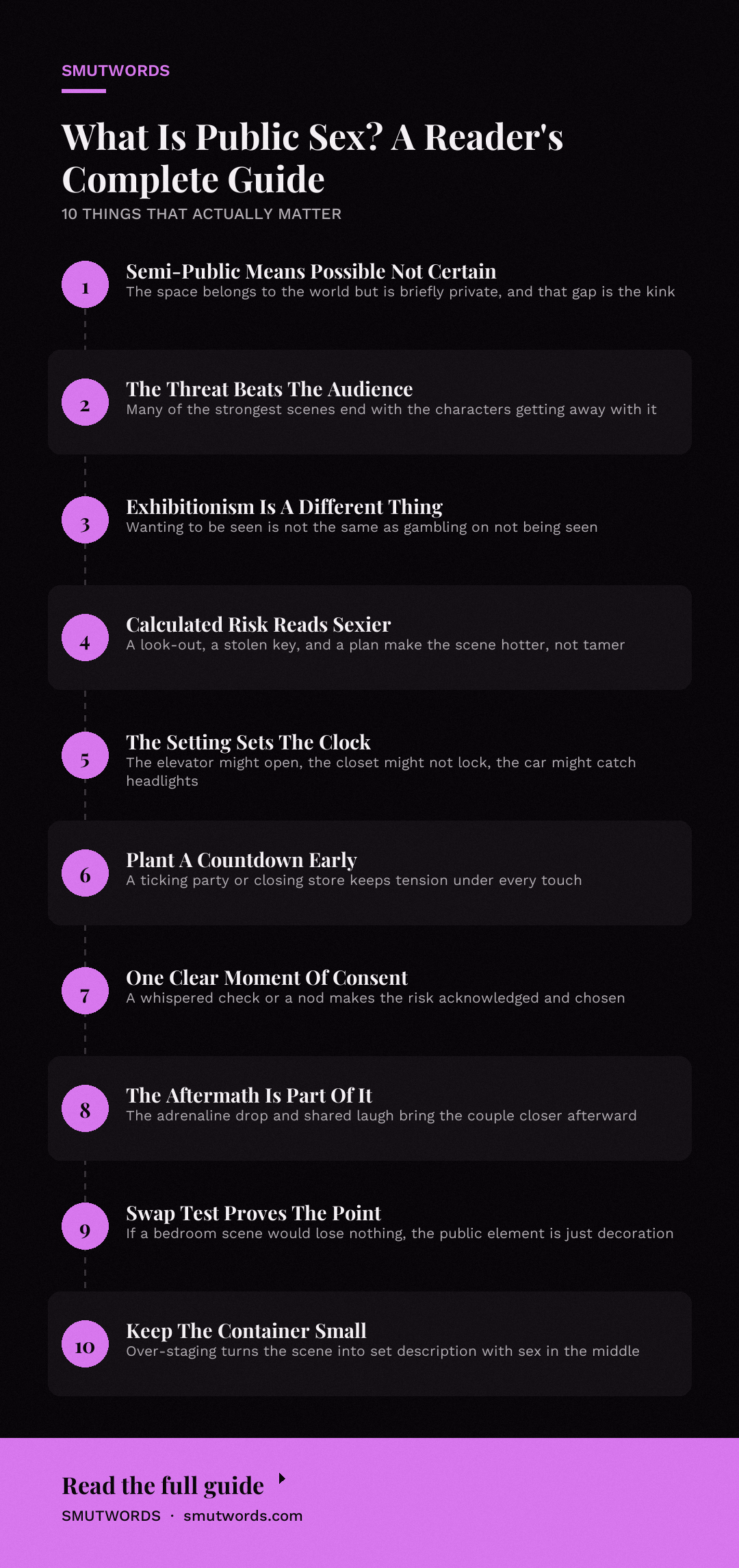
- That it requires an actual audience. The threat of one does the work. Many of the strongest scenes end with the characters getting away with it.
- That it is the same as exhibitionism. Exhibitionism is the desire to be seen. Public sex is often about the gamble, and plenty of characters in these scenes would be mortified if anyone actually looked.
- That it is always reckless. The genre's better writers give their characters a plan, a look-out, a stolen key, a reason the risk is calculated. Calculation makes it sexier, not tamer.
- That it is a genre of its own. It is a scene type, a technique. It can appear in a small-town romance, a workplace thriller, a why choose story, or a monster romance with equal ease.
The term sits alongside rough sex in the way readers search for it, but the two are doing different jobs. Roughness lives in the bodies. Public sex lives in the setting and the clock.
Where Public Sex Comes From
Public sex is old. It is in Chaucer, it is in Boccaccio, it is in every dirty joke that predates the printing press. The version readers find in modern erotica and romance has a shorter, more traceable history, and that history is mostly a publishing story about what could be printed and sold.
Through the twentieth century, explicit sex in mass-market fiction was constrained by obscenity law and distributor squeamishness. The places where sex could be printed anyway, the pulp paperbacks, the underground slicks, the imported European editions, leaned hard on transgression as a selling point. A book that promised a scene in a public place was promising something the reader could not easily get in respectable fiction: the frisson of indecency without the reader having to admit to wanting it.
When mainstream romance opened up in the 1980s and 1990s, the public scene came with it, often softened into a near-miss. The heroine gets pulled into an alcove at a ball. The hero takes her against the wall of a garden maze while the party continues inside.
By the 2000s and 2010s, contemporary romance had made the office and the workplace stairwell into reliable staples, and the car scene had graduated into something close to a required move in new adult fiction.
Indie publishing changed the supply side. Once authors could publish without a gatekeeper, they could write whatever degree of exposure their readers wanted, and a healthy wing of the market went in for fully witnessed public acts, voyeurism, and club settings.
The genre now runs both tracks comfortably: the tense near-miss for readers who want the rush without the crowd, and the party scene, the club, the balcony with an audience, for readers who want the crowd too. If the latter is your speed, the dynamics overlap heavily with what you will find in a good orgy guide, where the choreography of being watched and watching is the whole point.
How It Shows Up in Erotica
The working mechanics of a public sex scene are surprisingly technical. The best ones are built on a handful of reusable parts, and once you can see them you can tell within a page whether the author knows what they are doing.
The Container
A scene needs walls, and here the walls are architectural and social at once. A supply closet, an elevator, a bathroom stall, a car with fogged windows: each one sets a different clock and a different failure mode.
The elevator might open. The closet door might not lock. The car might get a headlight in the rearview.
What kind of building it is tells the reader how loud the scene can get and how badly it would go if someone walked in. That is why the setting has to be specific. Generic "outside" is boring.
The Timetable
Public sex scenes run on interruption logic. Someone is coming down the hall, the party is about to end, the store closes in ten minutes. Good writers put a countdown in early and let the reader feel it ticking under every touch. When the countdown is missing, the scene can feel like it could happen anywhere, which drains the charge.
The Consent Scaffolding
A strong scene establishes, before anything happens, that both people are in it, that they have agreed to the risk, and that there is a shared understanding of what happens if they get caught. Consent reads as hot when it is embodied in a look, a whispered check, a pair of eyebrows going up and a nod coming back. It reads as flat when it is dropped entirely and the reader is left to assume everyone is fine.
You do not need a contract. You need one clear moment where the risk is acknowledged and chosen.
The Aftermath
What happens after the door clicks shut is where most scenes either land or fizzle. The best versions treat the aftermath as part of the kink: the adrenaline drop, the shared laugh, the humiliation one character feels and the other finds adorable, the way the couple is closer afterward because they got away with something together.
That afterglow is the same territory a good makeup sex scene is working in, where the intensity comes from what just happened rather than the sex act alone.
The Main Variants You Will See
Readers who like this kink tend to have a favorite niche within it. Here are the versions that show up most often across the market:
Enjoyed this? Get a free book.
Join the list and we will send a complete free story straight to your inbox, plus new releases every week after that. No credit card, no catch.
- Semi-public near-miss. A shared space with a real chance of discovery. The staple of contemporary romance. Often set in offices, hotels, and cars.
- Full public with an audience. Strangers or a party watch. Common in erotica and in erotic romance with a club setting. Overlaps with exhibitionism and voyeurism as character traits.
- Outdoor sex. Trails, fields, beaches at night. Often leans on nature as a co-conspirator, but the real threat is hikers, rangers, or a distant light.
- Car sex. Its own subgenre. Tight space, fogged glass, dead-end road, someone's headlights sweeping the rearview. Almost always semi-public rather than fully public.
- Workplace and academic settings. Stairwells, supply closets, empty classrooms. The social risk is as hot as the physical one because discovery means a career problem.
- Risk-adjacent variation. Scenes where the "public" is not a physical space but a social one, like doing something with a partner under a blanket at a party. Public in effect even when technically covered.
Underneath all of these runs the same engine: exposure, risk, and intimacy built out of both. The public setting does a job no bedroom can do, because it forces the characters to choose each other in front of the world, briefly and privately, and the reader gets to watch them decide.
What Makes a Strong Version Work
Strong scenes share a few habits. They keep the setting concrete. They give the reader a specific sensory detail that signals the place: the smell of ozone in the stairwell, the hum of a refrigerator in the break room, the cold edge of a tailgate. They plant one secondary character who could plausibly walk in, and then let that person get close enough to be a threat.
They also tend to put the risk in dialogue before the clothes come off. The characters discuss it, however briefly. A whispered "you're sure?" or a rival's footsteps one floor below does more work than three paragraphs of internal anxiety, because it makes both the choice and the danger visible to the reader in real time.
The strongest versions finish with a change. The couple is different after. One of them trusts the other more. A fear has been faced. A lie has been dropped.
If the scene could be swapped for a bedroom scene without anything being lost, the public element is decoration. If swapping it out would break the emotional arc, the author got it right.
What Makes a Flat Version Fail
Flat versions are easy to spot. The location is vague, the risk is mentioned once and then ignored, and the secondary character who was supposed to threaten an interruption gets forgotten until the last page. The consent is missing or so perfunctory it comes across as a content warning rather than a choice.
Another common failure is over-staging. The setting gets so elaborate, with so many exotic details of the club or the greenhouse or the private balcony above a theater, that the scene reads as set description with sex in the middle. Public sex is a pressure cooker, and pressure cookers work because they are small.
The last failure mode is tonal. A scene that plays the risk for laughs throughout, or that alternates wildly between tense and jokey, tends to leave readers unsure what to feel. Pick a register, usually suspense, and stay there until the relief at the end.
Where It Pairs Well With Other Kinks
Public sex plays nicely with a lot of other interests because it is a frame more than an act. Pair it with shibari and you get the tension of rope work under a coat, invisible to everyone else in the room. Pair it with rough sex and you get something both physically and socially dangerous.
Pair it with group dynamics and the stakes change again. A couple escalating into a broader arrangement often starts with a scene someone else can see, so the club and party settings of a why choose romance are natural territory. If the couple is drifting toward a larger arrangement that eventually becomes something like a group marriage, the public-ness of early scenes can work as a rehearsal for being seen together by everyone.
Playful power exchange is another good fit. If you like scenes where one character is being coaxed into the risk, the dynamic is close to the one covered in brat play, where the push and pull over what someone will agree to is the source of tension. The public setting just adds an audience-shaped threat.
Public Sex vs Rough Sex
These two get confused because they often appear in the same book and because both are filed under the vague banner of "riskier." They are doing separate jobs. Rough sex describes how bodies meet: intensity, force, grip, restraint. Public sex describes where and when bodies meet, and who else might be in the room.
A public sex scene can be tender. A rough sex scene can be in a private bedroom. Most erotica combines the two because both signals push the same button, the one marked "this is dangerous and the characters are choosing it anyway." But if you are looking for one, searching for the other will leave you disappointed.
If your actual interest is where a couple does it and who might see, you want public. If your interest is the physical intensity, you want rough.
Frequently Asked Questions
What does semi-public sex mean in romance?
It means sex in a space that belongs to the world but is temporarily private: a parked car, an unlocked office, a stairwell, a balcony after dark. Discovery is possible but not certain, and that gap is the point. Most books tagged "public sex" are actually writing this version.
Is public sex the same as exhibitionism?
No. Exhibitionism is the desire to be seen, and it drives scenes with a real audience. Public sex is often about the gamble, and plenty of characters in these scenes would be horrified if anyone actually looked. The two overlap when the characters want a witness, but they are not synonyms.
Why do readers like public sex scenes so much?
The forbidden exposure spikes adrenaline, and the risk makes the intimacy feel enormous because the characters are choosing each other at cost. It also shows rather than tells: a character who will pull their partner into a supply closet has demonstrated how badly they want them. The reader gets the rush and the proof in the same scene.
Are public sex scenes always in contemporary romance?
No, they show up across every subgenre. Historical romance has garden mazes and carriage rides, fantasy romance has forests and castle corridors, and science fiction romance has ships. The mechanics carry over because the effect depends on the space and the threat, not on the era.
How much realism should I expect?
Fiction is not a how-to. The risk of getting caught is the fantasy, and the version on the page is engineered for tension, not for replicating safely. In real life, the equivalent requires an actual conversation about who might see and a location that avoids legal or physical harm to everyone involved. The genre is not obliged to show that conversation, but the good books will show the choice.
What is the difference between car sex and public sex?
Car sex is a subset. The car is one of the most reliable semi-public settings because the space is intimate and the windows are the audience, but a car parked in a private garage with a locked door is not public. What makes it public is the possibility that someone outside the car could see in.
Final Thoughts
The best way to understand public sex in erotica is to read a scene that does all of its work with one secondary character and a bad lock. A couple who has to be quiet, quick, and certain is more exposed than any scene with a crowd of strangers, because the book has made the risk specific and the choice visible.
Pick up a good workplace or new adult romance on the SmutWords shelves and pay attention to the room the characters walk into before the scene: the ceiling, the light, the soundproofing, the footsteps on the stairs. If you liked the foursome and group dynamics angle here, the foursome breakdown covers the same choreography-with-witnesses problem in a different key. The space is the plot. Everything else is choreography.







Loading comments…