Teratophilia is the fetish or romantic fixation on monsters, mutants, aliens, and any other lover whose body is visibly, unapologetically nonhuman. The creature's difference is the entire point. In teratophilia erotica and romance, a partner is wanted because of the fangs, the claws, the too-many-eyes, the wings, the size, the wrongness, rather than in spite of them.
It is the one corner of the genre where nobody has to pretend the love interest is secretly a normal guy underneath. He is not. That is the appeal, and it runs from minotaur ranch smut to eldritch cosmic horror with a wedding ring at the end.
What Teratophilia Actually Means
The word breaks down cleanly: terato from the Greek for monster or marvel, philia for love or attraction. Attraction to monsters. The clinical-sounding construction is a little misleading, because teratophilia is not a diagnosis. It is a reader taste, a kink, and a large, thriving subgenre of romance publishing all at once.
The short definition above is accurate but thin. The fuller version has a few moving parts, and each one matters for understanding what does and does not count.
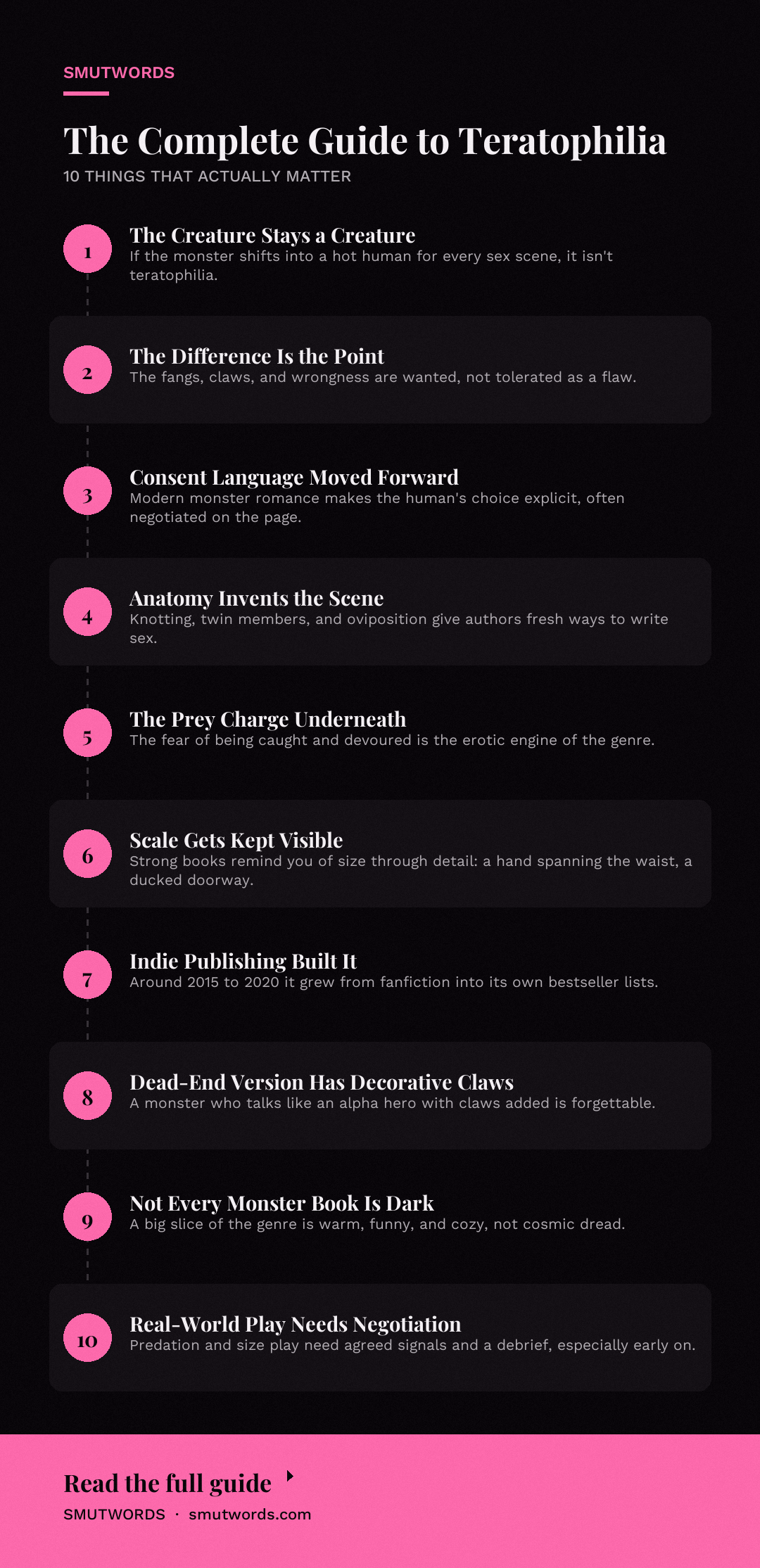
The creature must stay a creature
This is the load-bearing rule. Teratophilia requires that the monstrous form remain monstrous. A werewolf who shifts back to a handsome human for every sex scene is a shifter romance, not teratophilia. A demon who is described as a tall hot guy with slightly pointy ears is, functionally, a hot guy.
The kink lives in the nonhuman body being present and desired during the intimacy. Some books bend this rule on purpose. A beast-shifter who keeps his true form for the bedroom and his human face for the grocery store is doing a specific dance with the trope, and readers notice which half of the character the author actually finds sexy.
The difference is erotic, not tolerated
Plenty of fantasy romance features a nonhuman love interest whose nonhumanity is treated as an obstacle to overcome or a quirk to smooth over by the epilogue. Teratophilia inverts that. The horns are a feature. The tail has a job.
The fact that he could crush her is the thing making the reader's pulse jump.
When the prose keeps apologizing for the monster, or keeps reminding us he's really gentle inside, the book drifts away from teratophilia and toward a beast-fable with a beauty-and-the-beast ending. Both can be good. Only one of them is this.
What gets confused with it
- Shifter romance. Overlaps heavily, but only counts as teratophilia when the animal or monstrous form stays present and central. Wolf-man in a suit by chapter three: not it. Wolf-man in the bed and staying that way: it.
- Alien romance. A major vein of teratophilia, especially when the alien body is genuinely strange (extra limbs, non-mammalian anatomy, bioluminescence, hive features) rather than a human with purple skin.
- Beauty and the Beast retellings. The ancestor of the whole genre, but most retellings resolve the beast into a prince. Teratophilia refuses the resolution.
- Furry and anthro content. Adjacent and often overlapping, but furry is its own fandom with its own conventions and a stronger emphasis on anthropomorphic character design. Teratophilia is broader and more horror-inflected.
None of these are strict borders. The genre is a swamp and everything overlaps in the middle. The distinction is mostly useful for readers searching for a specific flavor and authors figuring out which shelf their book belongs on.
Where Teratophilia Comes From
The honest history here is a publishing history, not a clinical one. Attraction to monsters is as old as storytelling, and the Greeks had their satyrs and minotaurs doing exactly what you'd expect. But teratophilia as a named, recognizable category of erotic fiction is a recent phenomenon, and it grew out of specific market forces.
The older roots
Beauty and the Beast is the obvious ancestor. So is Dracula, which has been read as erotic since the day it was published, and the entire Gothic tradition that followed. H.P. Lovecraft gave the 20th century its tentacled cosmic horror, though he would have been appalled at what the internet did with it.
The phrase "monster fucker" and the affectionate internet term "monsterfucker" appeared in fandom spaces long before publishing caught up. Fanfiction archives spent the 2000s and early 2010s quietly building an enormous library of monster-human pairings across every fandom that had a monster in it. If that kind of internet-native kink history interests you, it's the same fandom soil that grew things like rope bondage into a recognizable category.
The publishing shift
The real turning point was around 2015 to 2020, when indie romance publishing noticed what the fanfiction numbers already showed. Monster romance went from a niche curiosity to a category with its own bestseller lists, its own subreddits, and its own conventions.
Two things drove it. First, ebooks and self-publishing let authors write exactly the book they wanted without a marketing department insisting the monster turn into a handsome duke in the last act. Second, and more interestingly, the audience expanded far beyond the kink community into mainstream romance readers who wanted a love interest whose entire appeal was that he wasn't a man with a mortgage and a complicated ex.
The genre's most important evolution is in the consent language. Early monster erotica often leaned on dubiously consensual or outright non-consensual capture dynamics, because the fear of being claimed was the engine.
Contemporary monster romance has largely moved toward a model where the monster is wildly powerful and visibly dangerous and the human partner is enthusiastically choosing it, sometimes with explicit negotiation on the page. Both versions sell. The second one sells more, and it's better written.
The alt names and where they live
Readers searching for this will type a lot of different things. Monster romance is the widest publishing label. Monsterfucking is the fandom-friendly, self-aware, slightly mocking version. Xenophilia is the term for attraction to aliens specifically.
Cryptid romance covers Bigfoot, Mothman, and the Loch Ness Monster. Eldritch romance is the cosmic-horror-tentacles-and-sanity-loss corner. Creature feature is the affectionate B-movie term. Beast romance and monster lover are the older, softer labels.
How It Shows Up in Erotica
This is where the genre gets interesting to read as craft, because monster romance has to solve problems that human romance never does. A monster's body is different. His instincts are different. His anatomy, if the author is doing the job, is different.
Every good monster book is a series of elegant workarounds, and the workarounds are the fun part.
The anatomy problem and why authors love it
Human erotica has a limited number of moving parts. Monster erotica has infinite ones. Authors invent knotting, twin members, hemipenes, oviposition, bioluminescent fluid, barbed tongues, tentacle-based restraint, and a hundred other variations, and each invention is a fresh way to write a sex scene that hasn't been written before.
Enjoyed this? Get a free book.
Join the list and we will send a complete free story straight to your inbox, plus new releases every week after that. No credit card, no catch.
The best authors use anatomy to express character. A kraken who can hold his partner with six arms and choose not to is a monster making a choice about restraint. A dragon whose scales heat up when he's aroused is a monster with no ability to hide what he's feeling. Anatomy becomes characterization.
The prey dynamic and the fear charge
The engine underneath most teratophilia is predation. The monster could hunt, catch, and consume the human partner. He does not, or he does in ways carefully bounded by the fiction. The fear of being devoured is the erotic tension, and it's the same charge readers chase in brat play, where the pleasure comes from the dominant's response to the challenge rather than from the challenge itself.
A strong monster book keeps the threat flavor present even in the soft moments. The claws rest against her throat, retracted. The monster breathes on her neck and she feels the heat of the furnace inside him. The danger stays on the page as flavor, and the reader gets to enjoy it from a safe distance.
Size and the visual imagination
A huge number of teratophilia books feature a love interest substantially larger than the human partner, and that overlap with macrophilia is real and worth naming. Minotaurs, giants, ogres, and aliens the size of small buildings all push the same buttons: the comprehension that the human body is small, soft, and completely outmatched, and the decision to want this anyway.
The best size play in monster romance is crafted, not just stated. The author keeps reminding the reader of scale through physical detail: a hand that spans the whole waist, a body that doesn't fit on a normal bed, a doorway that has to be ducked through. This is the same craft move good muscle worship writing does, keeping the body's reality vivid at all times rather than saving it for the climax.
The visual fetishes that ride the creature
A lot of monster erotica inserts a secondary fetish into the creature's design. Clawed hands in long gloves show up constantly, and the glove fetish readers will recognize the appeal: the hand as a beautiful, dangerous instrument. Wet scales, dripping slime, and slick alien fluids can slide into wet and messy fetish territory. Tentacles and slime trails often read as the erotic-maximalist version of the same pleasure.
Lingerie and armor become fun in monster books because the creature has nothing human to wear. A minotaur in a ceremonial harness makes a different sort of image than a billionaire in a silk robe, and authors lean into it as character design. The lingerie fetish crowd may not find what they're looking for, but they'll find something adjacent and strange.
What makes a strong version versus a flat one
The flat version of monster romance has a monster-shaped love interest who behaves exactly like a human alpha hero with claws added as an accessory. He talks in possessive one-liners, he has a fated-mate revelation in chapter two, and the monstrous elements are decorative. The reader finishes it and can't remember what the monster looked like.
The strong version does four things:
- Commits to the body. Specific, physical, repeatable detail about the nonhuman form. What does his skin feel like? How does he move? What does he sound like when he breathes?
- Makes the difference matter to the human. The human partner has to interact with the monster's body as a body, not as a symbol. She has to climb it, touch it, and learn what to do with it.
- Keeps the threat present even when the sex is tender. The danger flavor is the point. The book loses its charge when the monster becomes perfectly safe.
- Resolves the consent question explicitly. Readers want to know the human wanted it. Show the wanting.
There is also a craft issue at the sentence level: the best monster authors have a large vocabulary for nonhuman bodies and use it precisely. Bad monster romance describes a "large pectoral" on a creature with no pectorals. Good monster romance describes the hot stone of him, or the soft between his scale ridges. Precision is where the eroticism is.
Frequently Asked Questions
Is teratophilia the same as monster romance?
Mostly, with a difference in register. Monster romance is the publishing category and the wider label. Teratophilia is the term for the specific kink on the monstrous body itself, which not every monster romance foregrounds. A monster romance can exist without teratophilia; teratophilia in fiction almost always lives inside one.
Is teratophilia a real fetish or just a reading taste?
Both, and the categories bleed together. Some people experience genuine arousal to monstrous imagery or body horror, and some people enjoy monster scenarios in fiction without ever wanting anything like it in reality. Most of the human race's erotic life is a mix of the two. There's no pathology in either direction.
Where should someone start with monster romance?
Start with an author whose anatomy-commitment matches your taste. If tentacles and cosmic dread appeal, go eldritch. If minotaurs and size differentials appeal, go beast romance.
If aliens with truly nonhuman anatomy are the goal, go xenophilia. Sample the subgenre rather than starting with whatever is on the bestseller list. The overlap with amnesia romance is real too, so read a few blurbs before you commit.
Is monster romance always dark?
No. A substantial slice of the genre is warm, funny, and deeply cozy, with a monster who badly wants to make his partner dinner and also eat her out. There is a whole subgenre of monster books that read like small-town romance with a hairy hero. The darkness varies wildly by author and subgenre.
What is the appeal of teratophilia for readers who are not into heavy kink?
It removes an enormous amount of social baggage. The monster partner has no opinions about the human's career, no ex on the friend group, no complicated family. He wants what he wants.
Readers who are tired of contemporary romance's low-level social anxiety find that simplicity genuinely relaxing. The genre also leans hard into a wish for being chosen, so outright, by something powerful.
How do real-world monster "play" scenarios stay safe?
Fantasy often leans on size, strength, and predation themes, and this is exactly what makes negotiation essential in real-world partner play. Size and strength dynamics need agreed language for "slow down" and "stop," not just a safeword but a plan for how a partner signals when speech isn't possible. Predation and chase play need pre-scene discussion of hard limits and a clear exit. Debrief afterward, especially the first few times.
Final Thoughts
The genre's biggest strength is that it lets a reader enjoy a love story where the partner is dangerous, present, and unmistakably other, and where the human on the receiving end chose to want that. If you're coming to this for the first time, the best entry point is a book whose author is clearly in love with the monster's body.
Open it to any sex scene and check one thing: does the creature still have its creature features on the page? Start with an author who spends a paragraph describing the creature's scales. That's the signal.




Loading comments…