
Second marriage romance is a love story built around protagonists who have already been married once, and usually divorced or widowed, before the book begins. The tension does not come from a first blush of discovery. It comes from two adults who know exactly how badly a marriage can go wrong, and who have to decide whether they are willing to sign up for that risk again anyway.
The shelf label covers a wide range: widower romance, divorced heroine stories, single parent romance, and the broader category publishers sometimes call second chance at love or late-in-life romance. What unites all of it is that the characters arrive at the new relationship already carrying receipts.
This is not a niche curiosity. It is one of the fastest-growing subcategories in contemporary romance, partly because the reading audience for romance skews older than the cover art suggests, and partly because a marriage that already failed once makes for better drama than a marriage that has never been tested.
What Second Marriage Romance Actually Means
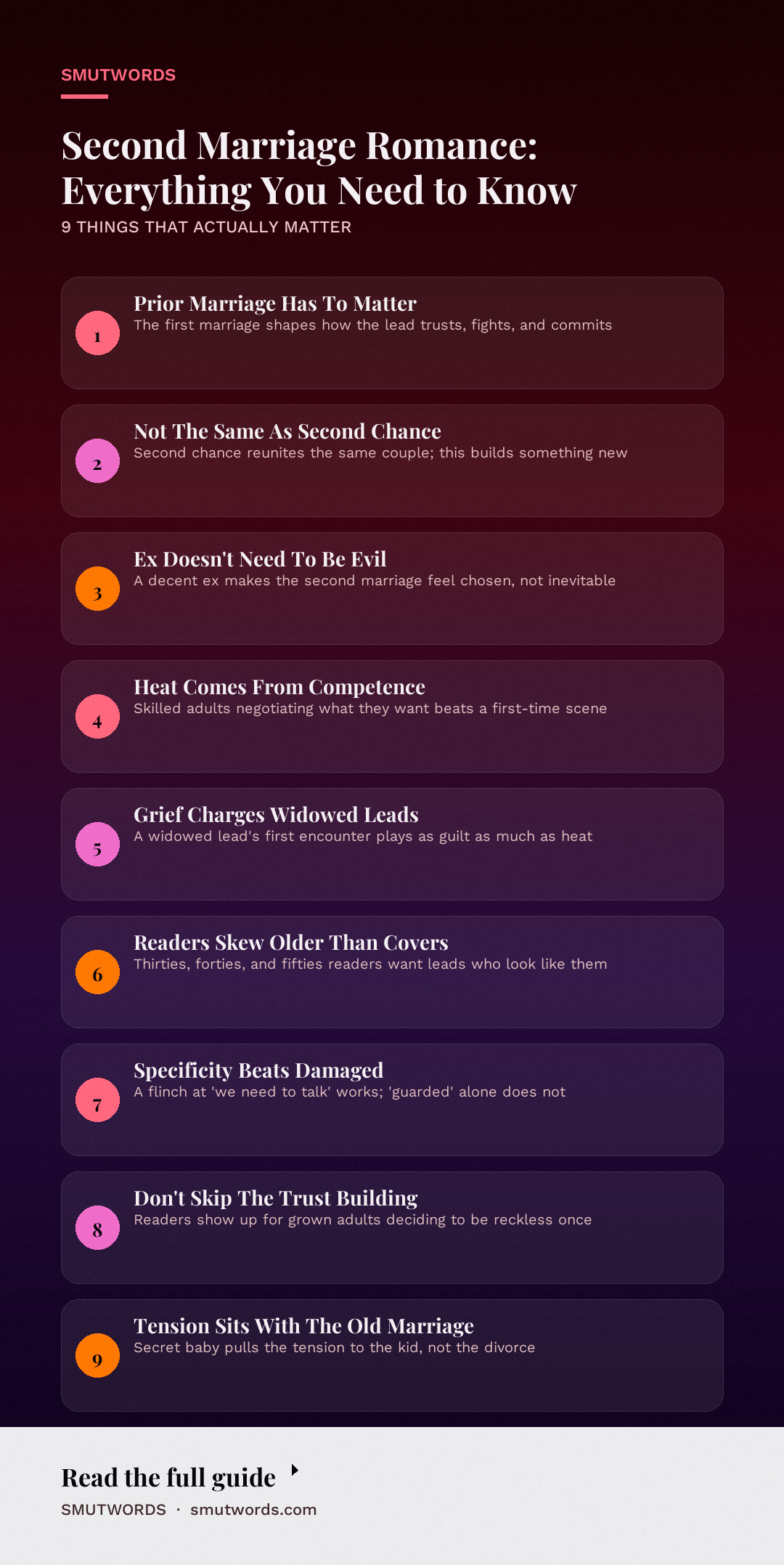
The term describes a romance where at least one lead has a prior marriage in their past. The prior marriage is not background wallpaper. It shapes how the character trusts, how they fight, how they handle money, how they parent, and how they think about commitment itself. A divorced hero might flinch at the phrase "I do." A widowed heroine might feel guilty for laughing in bed with someone new.
What counts as second marriage romance is broader than the name suggests. It includes:
- Divorced leads who ended a marriage on their own terms, or had it end for them.
- Widowed leads whose spouse died, which brings grief into the bedroom in ways a divorce does not.
- Single parents whose children are a permanent feature of every date, every fight, and every decision about the future.
- Never-married leads paired with a divorced or widowed partner, which produces a different tension entirely.
- Leads reconnecting with a first love after decades apart, a cousin of the trope that borrows heavily from it.
What does not count: a character who was briefly married in a green-card arrangement nobody remembers, or a lead whose ex exists only to be killed off in chapter two so the hero can be "free." The prior marriage has to matter. It has to have left marks.
The most common misconception is that this is the same as a second chance romance. It is not. Second chance romance usually means the same two people reuniting after a breakup. Second marriage romance means the leads are building something new, often with entirely different partners, and the story is about whether they can do marriage better the second time.
Another misconception: that the trope requires the previous spouse to be dead or evil. Plenty of strong second marriage romances feature an ex who is simply a decent person the protagonist no longer loves, which is a harder and more honest setup than a cartoon villain ex.
Where Second Marriage Romance Comes From
Romance publishing spent most of the twentieth century treating divorce as a problem to solve rather than a starting condition. Mid-century category romance and the gothic paperbacks that dominated drugstore racks almost never featured a divorced heroine as a sympathetic lead. If a character was divorced, it was usually because she had been wronged, and the marriage plot existed to prove she was still worthy of a respectable man's attention.
The shift happened in stages. The 1970s and 1980s brought a wave of longer historical and contemporary romances with widowed heroines, since death carried less stigma than divorce. A widow could be sexually experienced and still "respectable," which let authors write more explicit scenes without the moral asterisk a divorced heroine still carried at the time.
By the 1990s, category lines like Harlequin's more mature imprints were regularly publishing divorced heroines, often paired with a single father, and the child from a prior marriage moved from complication to central plot device. Those books are the direct ancestors of the single parent romance shelf today.
The real expansion came after 2010. Self-publishing and indie digital-first imprints collapsed the gatekeeping that had kept "older" heroines off covers, and authors discovered that readers in their thirties, forties, and fifties wanted protagonists who looked like them. The rise of the small-town contemporary, the blue-collar hero, and the emotional slow burn all fed directly into second marriage romance.
What has changed most in the last decade is how the previous marriage gets framed. Earlier versions often punished the ex, or revealed the ex was secretly terrible all along, so the reader could feel clean about the new pairing. Newer books are more likely to let the first marriage have been a real relationship with real love in it, which failed for understandable reasons. That change makes the second marriage feel earned instead of inevitable.
There is also a distinct publishing phenomenon at work: second marriage romance has become a reliable tag for readers filtering by "mature" or "seasoned" leads, and the books that carry it sometimes outsell younger-lead contemporaries in the same imprint. The audience is real and it is loyal, and it is not looking for a first-time experience.
How It Shows Up in Erotica
On the page, second marriage romance changes the mechanics of a sex scene in ways authors either lean into or waste. When two characters have been married before, they typically know their own bodies and their own preferences well enough to say what they want, which is a completely different erotic register than a first-time scene. The heat often comes from competence and negotiation rather than discovery.
A strong version of this trope uses that. The heroine knows she needs a specific rhythm to finish. The hero knows he gets in his own head if the room is too quiet. They bring that knowledge into the scene, and the scene becomes about two skilled adults choosing to be vulnerable with someone new after years of being sexually known by someone else.
That last point is where the eroticism actually lives. There is a specific charge to being touched by a new person after a marriage ends. The heroine might notice how different a hand feels. The hero might realize he has not been kissed like this in a decade.
Writers who understand the trope build scenes around those small disorienting comparisons.
Enjoyed this? Get a free book.
Join the list and we will send a complete free story straight to your inbox, plus new releases every week after that. No credit card, no catch.
Common variations authors use:
- The widowed lead who has not been touched since the death, which makes the first sexual encounter a grief scene as much as a heat scene.
- The divorced lead coming off a dead bedroom, where the new partner's appetite becomes the shock.
- The single parent sneaking around their own house, which folds in a domestic-discretion tension similar to what you get in secret baby plots, minus the paternity reveal.
- The ex who reappears mid-book, which can turn the whole thing into a marriage in trouble story with a new partner in the mix.
- The revenge-flavored version, where the heroine's second marriage is partly aimed at the first husband's ego, borrowing machinery from revenge romance.
Where second marriage romance goes flat is when the prior marriage is used only to make the character "damaged" without any specificity. A heroine who is "guarded because of her divorce" is not a character. A heroine who still flinches when someone says "we need to talk" because her ex used that phrase to start every fight is a character.
The other failure mode is a rushed second act. Because these protagonists are adults, some authors assume they can skip the trust-building and get straight to the wedding. Readers of this trope are here precisely for the trust-building. The whole appeal is watching grown people who have every reason to be careful decide to be reckless about one specific person.
Tone varies widely and it is worth knowing which lane you are in before you buy. Some second marriage romance is warm and domestic, closer to women's fiction with an explicit second act. Some is hard-edged and filthy, especially in the indie contemporary space where authors push the sex scenes longer and kinkier than traditional publishers would.
If you want a sense of how other tropes handle the same emotional territory of adult decision-making under pressure, the SmutWords breakdown of power exchange is useful reading, because negotiation scenes in kink and negotiation scenes in a second marriage have a lot in common. Both are about two people who have been burned before, agreeing on terms out loud.
Second marriage romance also overlaps heavily with blue-collar and small-town settings, where divorced heroes are common and the heroine is often a returning local rebuilding after a city marriage collapsed. That setup lets the book keep the ex in town, which keeps the tension alive without turning the ex into a villain.
Second Marriage Romance vs Secret Baby
These two tropes get shelved near each other and readers confuse them constantly, so it is worth separating them. A second marriage romance is about the lead's previous marriage and how it shapes the new one. A secret baby plot is about a hidden pregnancy and the reveal that a child exists, and the child usually belongs to the current love interest, not the ex.
They can combine. A divorced heroine who had a one-night stand before her marriage ended, and who never told the man she slept with that his child exists, is both a second marriage romance and a secret baby book. That combination is common enough that readers should expect it.
The tell is where the tension sits. If the book's central question is "will she trust a man with her heart again after her divorce," you are reading second marriage romance. If the central question is "what happens when he finds out about the kid," you are reading secret baby, and the previous marriage is background.
One more related lane worth mentioning: the fictional worlds where a prior marriage is complicated by a supernatural element, like a mating bond that does not follow human legal rules. If you like the emotional maturity of second marriage romance and want it with fangs, the SmutWords guide to big cat shifter romance covers how those stories handle previously bonded leads finding a new mate.
Frequently Asked Questions
Is second marriage romance the same as second chance romance?
No. Second chance romance usually means the same two people get back together after a breakup or years apart. Second marriage romance means the lead is entering a new marriage, often with a brand-new partner, after a previous one ended. The overlap is real but the emotional premise is different: one is about rekindling, the other is about starting over.
Do second marriage romances always involve kids?
Not always, but frequently. Single parent romance is the most common variant, and children from a prior marriage often drive the plot's timeline and stakes. Some second marriage romances feature divorced or widowed leads with no children at all, especially in late-in-life romance, where the conflict is usually about adult children, exes, or geographic distance rather than custody.
Can a widowed lead count as a second marriage romance?
Yes. Widower romance and widow romance sit squarely in this category. The emotional mechanics differ from divorce, though. Grief introduces guilt into new sexual encounters that a divorced lead usually does not feel, and many widower romances spend real page time on whether the lead is betraying their dead spouse by moving on.
How explicit are second marriage romance books?
It depends entirely on the imprint or the indie author. Traditional publishers in this lane often write closed-door or low-heat. Indie contemporary and erotic romance authors writing second marriage leads frequently go fully explicit, sometimes with kink. If heat level matters to you, check the book's tags before buying, because the trope itself does not determine the spice.
Why do readers like second marriage romance so much?
Because it is honest about how love actually works for adults. Most readers of this trope are not looking for a fantasy of being someone's first. They want a story where two people who have already been hurt, and who know exactly how bad it can get, decide the risk is worth it anyway. That is a more convincing version of romance than a first kiss for a lot of people.
Does the ex have to be a villain?
No, and the best versions usually avoid that. An ex who is decent, or complicated, or simply wrong for the protagonist rather than evil, makes the second marriage feel chosen instead of inevitable. Villain exes are still common, especially in shorter category books, but they tend to flatten the emotional stakes.
Final Thoughts
Second marriage romance works because it treats love as a decision made by people who have already learned how much it can cost. If you want a book that handles the trope with real care, the one to pick up next is the widower-lead story on our ranked list below, which gets the grief-and-desire balance exactly right. Read it with the lights low and your phone on silent.





Loading comments…