
Power exchange explained for someone who's never read it before sounds clinical, like a consent seminar with handouts. Then you read your first scene where a character kneels on a kitchen floor because someone told them to, and the seminar evaporates. The heat isn't in the rope or the collar. It's in the negotiation underneath it: both people chose this, and one of them is choosing to give something up on purpose.
If you've been circling kinky romance and wondering what you're actually signing up for, here's the version I'd want handed to me.
What Power Exchange Actually Means
Power exchange is the umbrella term for any dynamic where one person consents to hand over some measure of control to another. It covers a wide range: a single scene, a weekend, a full-time relationship where one partner makes the rules and the other follows them.
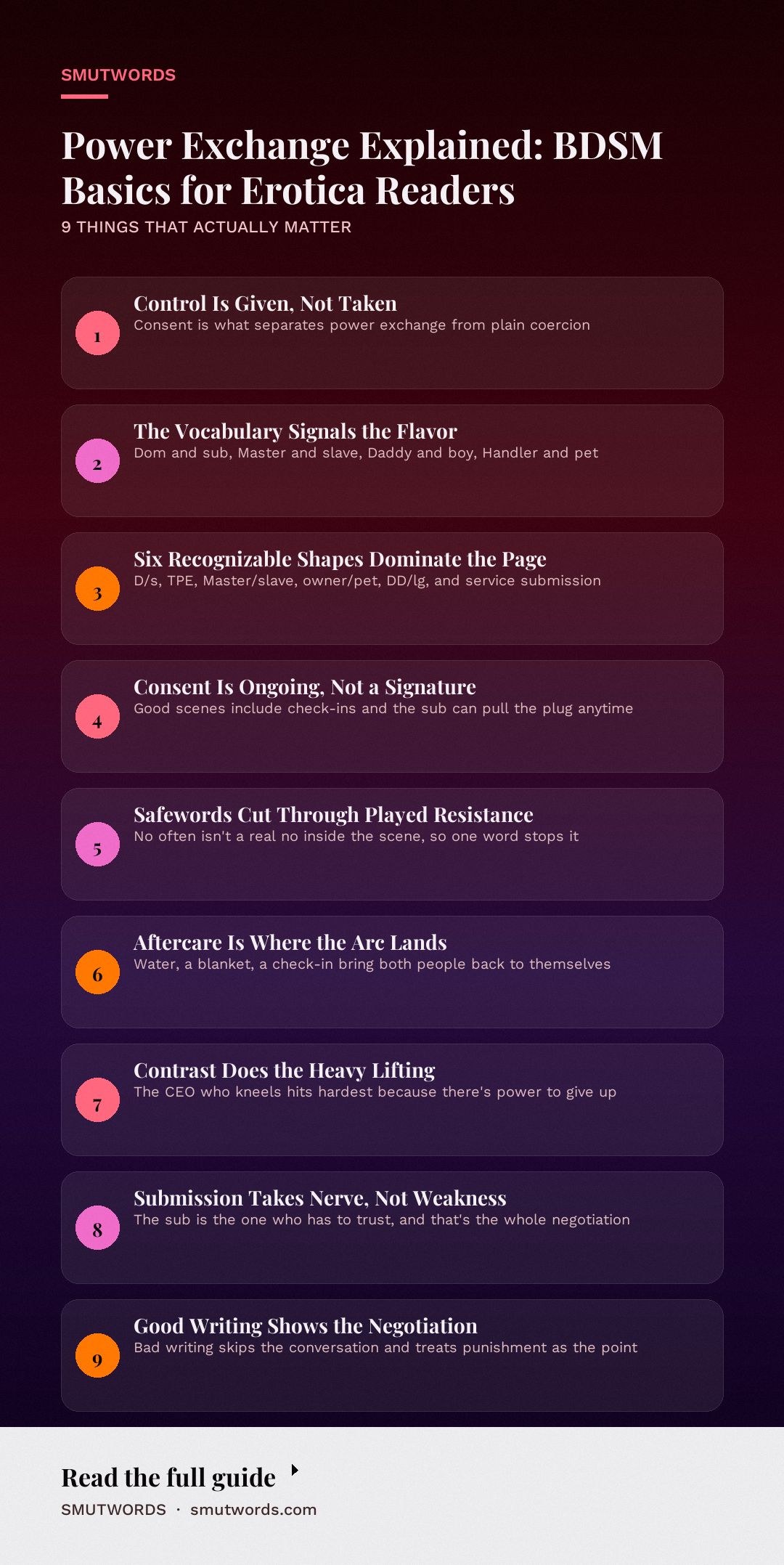
The important part is that the control is given, not taken. That's what separates power exchange from plain coercion in fiction, and honestly from a lot of the lazy writing that gets the label slapped on it. Two people agree on what's happening, agree on how far it goes, and know how to stop it.
Every dynamic has a top who takes charge and a bottom who surrenders, though the words change depending on who you ask. Dom and sub. Master and slave. Daddy and boy. Handler and pet.
The vocabulary is a tell for the flavor of the story more than anything else.
The Main Types of Power Exchange You'll See in Erotica
Most of what's on the page falls into a handful of recognizable shapes. Knowing which one you're reading helps you figure out fast whether it's your thing.
- D/s (Dominance and submission): the catch-all. One partner leads, the other follows, the degree of control varies from scene to scene.
- Total power exchange (TPE): the dynamic runs the whole relationship, not just the bedroom. Rules cover money, schedule, clothing, everything.
- Master/slave: the most extreme version of TPE, usually with formal collars, contracts, and titles that stick outside of sex.
- Owner/pet: the sub takes on animal-coded behavior. Collars, leashes, pet names that aren't romantic so much as possessive.
- DD/lg: a daddy or caregiver dynamic with age play elements, where the sub is cared for rather than commanded.
- Service submission: the sub's role is to be useful, not degraded. Think a houseboy who takes pride in doing the job well.
None of these are locked categories. Most books borrow from two or three, and the hybrid is usually where the interesting tension lives.
The Non-Negotiables: Consent, Safewords, and Aftercare
The part beginner readers skim past is the part that actually makes the fantasy work.
Consent in power exchange is ongoing, not a one-time form you sign at the start. A good scene includes check-ins. The dom asks if the sub is still with them. The sub can pull the plug at any point without it being a betrayal of the dynamic.
Bad writing skips all of that. It tries to pass off a character's inability to say no as proof of how surrendered they are, which is the opposite of the thing.
The safeword matters because "no" often isn't a real no inside the scene. A sub might be playing at resistance, begging to stop, saying they can't take more.
A safeword slices through that in one word. Red. Pineapple. Whatever the pair agreed on before anything started.
Aftercare closes the loop. Water, a blanket, a check-in, some version of physical or verbal grounding that brings both people back to themselves. In good erotica, aftercare is where the emotional arc lands, and skipping it is how you can tell a writer doesn't actually know the world they're writing about.
Why It Works as Fantasy
The pitch of power exchange is about giving up the exhausting business of deciding. Someone else picks. Someone else is responsible. All you have to do is obey, and in the right hands that's a relief rather than a punishment.
That's why the trope hits hardest when the sub character is powerful in their regular life. The CEO who kneels. The detective who calls someone Sir behind a locked door. The contrast does the work.
If the character is already small and powerless, the dynamic has nowhere to push against. You need something to give up before the surrender costs anything.
If you want to see the ceiling of that contrast, the free use dynamic in Free Use Casino turns the concept into a whole world with rules and rituals. Read The Complete Guide to Free Use Kink alongside it if you want the theory before the scene.
Power Exchange Across Different Genres
Contemporary and Motorcycle Club Romance
Contemporary settings tend to keep the power exchange close to real life. Same city, same jobs, same apartment, but with a secret contract that runs underneath it. Motorcycle club books lean into the ownership flavor, because the whole genre already runs on brothers, patches, and a rules-based hierarchy that makes the D/s layer feel native.
The MC world has built-in chain-of-command pressure, which is why the kink never feels bolted on. If that's a lane you like, the glossary entry on motorcycle club romance is a decent starting map.
Paranormal and Monster Romance
Shifters, aliens, and monsters can push the dynamic much further, because the nonhuman partner doesn't have to obey human social rules. You get claiming, marking, mate bonds, and a dominance hierarchy that spans a whole species.
Mate Bond and Marking Explained walks through how that overlap works mechanically, and Lured by the Lizard Beast runs the dynamic through an actual nonhuman partner instead of a metaphor for one.
Science Fiction and Space Opera
Space opera gives you power exchange with literal empires attached. A captain, a commander, a warlord with a ship and a crew and a sub who signed onto the arrangement for their own reasons. The politics of the setting do a lot of the dominance work for free.
Enjoyed this? Get a free book.
Join the list and we will send a complete free story straight to your inbox, plus new releases every week after that. No credit card, no catch.
That's the whole engine of Zorgon's Pet. The title alone tells you the flavor.
Historical and Fantasy
Historical settings can get complicated, because the power dynamics are often already baked into the world through marriage contracts and class hierarchies, which leaves less room for the consensual part to feel like a choice. The best ones make the kink an escape from the era's rules rather than a mirror of them.
Fantasy settings have more freedom, since you can invent an order, a court, or a species whose norms justify the dynamic without leaning on real-world inequality.
Common Beginner Confusions
Three things trip people up on their first kink read.
Confusing D/s with abuse. They can look similar on the page if the writing is weak. The difference is consent and reversibility.
In a real dynamic, the sub can end it at any time and the dom respects that. If the "dom" in the book punishes their sub for trying to leave, you're reading abuse, not power exchange.
Assuming submission means weakness. Giving up control on purpose takes nerve. The sub is the one who has to trust, and trust is the whole negotiation. A well-written sub is more confident than the dom in a lot of scenes, because they know exactly what they're handing over.
Thinking it's always sexual. Some dynamics are devoted to service, ritual, or discipline without any erotic charge attached. That said, the version in erotica usually has both wheels turning.
Where Power Exchange Crosses Into Other Kinks
Power exchange almost never travels alone. It stacks.
Humiliation and degradation are the most common neighbors. So is impact play (spanking, caning, whipping). Bondage and restraint. Chastity, orgasm control, and denial, where the dom decides when the sub is allowed to come.
You'll also see it fold into exhibitionism, cuckolding, and hotwife arrangements, where the dynamic includes deciding who else gets access to the sub. If that overlap is what you're after, Permission Slip: A Cuckold Erotic Short Story and Shared Without Shame: A Hotwife Exhibition & Sharing Fantasy both run the humiliation-and-permission angle hard. Pair either with Partner Swapping: Everything You Need to Know if the shared-access part is what you're actually curious about.
And it stacks with revenge plots, too. The dom who has a score to settle with their sub, and the sub who signed up anyway. That's the engine behind redemption arc romance and its darker cousin, the revenge romance, where the power dynamic carries the same weight as the plot. If you want the full version, Revenge Romance 101: What It Is and Why Readers Love It breaks down why the trope gets readers every time.
How to Tell Good Power Exchange Writing From Bad
The tell is almost always in the negotiation, and in what the writer bothers to show.
Good power exchange shows the conversation before the scene. The dom asks what the sub wants out of this, and the sub has to say it out loud, which is often hotter than the sex because it's the moment the two characters actually admit something to each other.
Bad power exchange skips the conversation, treats the sub's surrender as a foregone conclusion, and treats punishment as the whole point. You can usually tell within a few pages.
If the sub's only characterization is "they're a submissive," that's a problem. If the dom's only feeling about the arrangement is "they enjoy being in charge," same problem. The dynamic is a relationship, and relationships need two people with interior lives in them.
The Vocabulary You'll Keep Running Into
A quick translator for the words that show up across the genre:
- Scene: a single planned encounter. Has a beginning, a middle, and an end.
- Contract: the written-out terms of the dynamic, sometimes used for drama more than realism.
- Collar: the physical object that marks the relationship. Often symbolic, sometimes actual jewelry.
- Safeword: the one word that stops everything without debate.
- Aftercare: the post-scene wind-down. Water, blankets, affection, conversation.
- Drop: the emotional crash that can hit a sub after a scene, which aftercare is specifically designed to catch.
- Switch: someone who can top or bottom depending on the pairing.
Learn these and you can read a BDSM-tagged book without feeling like you missed a memo.
What to Read First
If you've never read a full-length power exchange story and want a soft entry, start with a short that runs the dynamic in one contained arc before you commit to anything longer. The He Paid Him to Fuck Me setup keeps the humiliation and permission stuff front and center without burying it under a hundred pages of worldbuilding.
If you already know you like the darker end, jump straight into the sci-fi versions where the dynamic has an empire behind it. Genre doesn't change the consent math, but it changes how much the world can justify what the two characters are doing to each other.
And if you find yourself drawn to one specific flavor more than the rest, the glossary is the fastest way to find more of it. Rockstar romance and tutor/student romance both bend the dynamic through character roles that already have power baked in, and the guide to open relationships is worth a read once you notice that a lot of kinky books are quietly drawing on those relationship norms too.
Final Thoughts
The dynamic you start with doesn't have to be the one you stay with, and the fastest way to find your lane is to read short and read wide. Permission Slip: A Cuckold Erotic Short Story is a good next read if the humiliation-and-control flavor of power exchange is what pulled you in, because it keeps the negotiation on the page instead of in the subtext. That's the version worth reading twice.






Loading comments…