
Sexual tension vs slow burn gets argued about in author spaces like they're the same tool used two ways. They aren't. One is a scene-level instrument you tune line by line. The other is a whole-book commitment to withholding, and it can run for three hundred pages or collapse by chapter four.
Confuse them and you get a manuscript where two people glare at each other for nine chapters and nobody can say why they keep reading.
Readers feel the difference even when they can't name it. A book with strong tension and a broken slow burn feels like it's stalling. A book with a tight slow burn and flat tension feels like waiting in a nice room. The best ones know exactly which lever they're pulling and when.
What Sexual Tension Actually Is
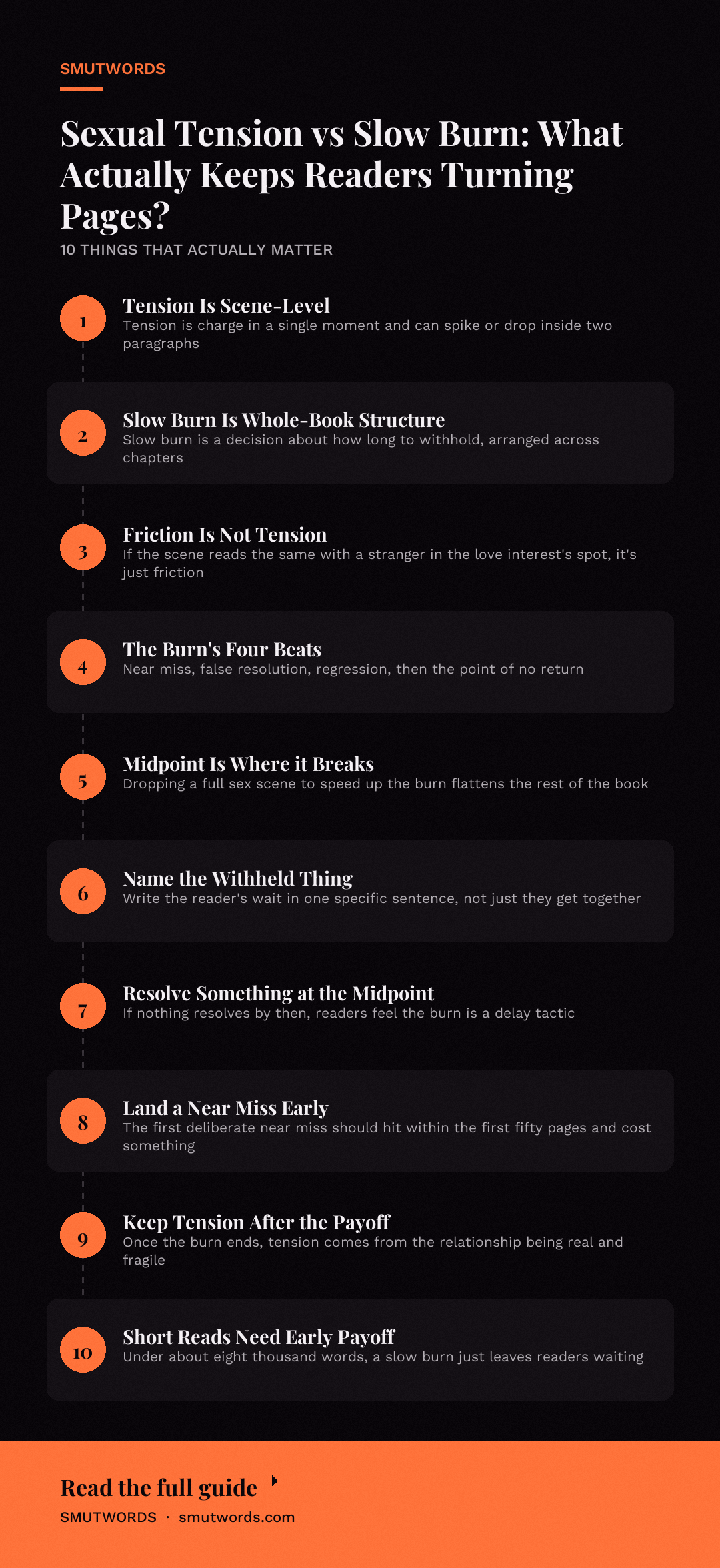
Tension is charge in a specific moment. It lives in a single scene and it can spike or drop inside two paragraphs. When she reaches past him for the door handle and he doesn't move, that's tension.
It doesn't require plot. It requires proximity, a reason to stay, and a reason it can't go further yet.
The unit of tension is the beat, not the chapter. You can have six tension spikes in one scene at a bar and none of them advance the romance at all. That's fine. Tension is a texture you lay over whatever the plot is doing.
Authors who understand it well build tension out of small denials. A hand that almost lands. A sentence that starts honest and gets cut off. The clothed sex scene is a masterclass here, because everything is still on and the tension does the work the nudity usually does.
Signs tension is working
- A reader can point to the exact line where they had to put the book down and breathe.
- The characters have a stated reason not to cross the line, and it survives being said out loud.
- Physical detail carries the charge: a thumb on a wrist, a knee that doesn't move, the pause before an answer.
- Dialogue has subtext a reader can decode. They're talking about dinner. You know it's not about dinner.
Signs it's just friction
Friction is conflict. Two people arguing about whose turn it is to pay for parking is friction, and it can fill pages without generating a single degree of heat. If the scene would read identically with a stranger in place of the love interest, the tension isn't there. Tension requires that the other person be the only one who could cause it.
One reliable test: delete the physical proximity from the scene in your head. If nothing changes, the charge was never coming from the body language.
What Slow Burn Actually Is
Slow burn is a structural decision about pacing across the whole book. You're deciding how long to withhold the consummation, the confession, the first kiss, the first honest sentence. That's an arrangement of chapters, not a vibe.
A real slow burn makes a promise in chapter one and pays it off in chapter twenty-two. The reader knows what's coming and has agreed to wait. Your job is to make the waiting worth more than the arrival would have been at chapter eight.
It works best when the thing being withheld is genuinely the thing the characters can't have yet, for reasons the plot keeps reinforcing. A marriage in trouble setup gives you that for free: they're already married, so the burn has to be emotional, and every withheld conversation costs something.
The structural beats of a slow burn that lands
- The near miss in the first third. Something almost happens and gets interrupted by a real consequence, not a phone call.
- The false resolution at the midpoint. A kiss, a confession, a night that feels like the payoff. It resolves one question and opens a worse one.
- The regression. The characters pull back for a stated reason that the reader believes.
- The point of no return. The burn ends because the characters can no longer afford to keep it going.
Notice that none of those steps are about tension. They're about the shape of the book. You can hit all four with barely any heat on the page, and you can hit none of them while every scene sizzles. That's the whole comparison in miniature.
Where the Two Get Confused
Authors mix them up most often at the midpoint. Someone decides the burn is going too slow and drops a full sex scene in to satisfy readers, which pops the tension in that scene and then flattens the rest of the book because the withholding wasn't replaced with anything.
The fix is rarely a scene. It's usually a smaller thing: a conversation that goes a half-step further than it should. The kind of arrangement where someone else is in the room, literally or not, is a good example of a move that keeps the burn going while raising tension, because the tension now has three people in it and none of them can say what they want.
The other confusion runs the opposite way. Writers assume a slow burn needs quiet, restrained scenes. It doesn't. A slow burn can have public sharing and exhibition all the way through and still burn slowly, as long as the thing the reader is waiting for stays out of reach.
Heat on the page and heat withheld from the characters are separate variables.
How to Balance Both in One Manuscript
You need tension in every chapter and patience across all of them. That's a scheduling problem, and it's easier than it sounds once you're tracking the two on separate axes.
Start with the slow burn. Write down, in one sentence, what the reader is waiting for. If it's "they get together," that's too vague. Be specific: the first time she says out loud that she wants him and means it.
Enjoyed this? Get a free book.
Join the list and we will send a complete free story straight to your inbox, plus new releases every week after that. No credit card, no catch.
Now every scene either serves that wait or delays it on purpose.
Tension checklist for individual scenes
- Is there a physical reason the characters have to be near each other right now?
- Does each of them want something they can't say in this scene?
- Is there a concrete thing that could be lost if one of them crosses the line?
- Does the scene end on a shift, even a small one?
If a scene fails all four, it's probably a plot scene wearing a romance hat. That's fine. Plot scenes can carry tension too, if you let the stakes run through the relationship rather than around it. A motorcycle club romance handles this by making the club the thing that keeps pulling them apart and pushing them back together at the same time.
Slow burn checklist for the full book
- Can you name the withheld thing in one sentence?
- Does the reader learn something new about why it's withheld every three or four chapters?
- Does the midway point resolve at least one question?
- Does the ending pay off the specific thing you withheld, not just a generic committed-together ending?
That third point trips up more drafts than anything else. If you haven't resolved anything by the midpoint, readers start to feel like the burn is a delay tactic. Readers who like stalker romance tolerate a lot of withholding, but they still expect the tension to be doing something in each scene while the plot waits.
Pacing the Withholding
Here's the practical part authors ask about most. How much do you let happen before the payoff, and where?
My rule of thumb: the first deliberate near miss should land within the first fifty pages, and it should cost the characters something. Not a thwarted kiss for its own sake. A moment where one of them steps back and can't explain why, and it changes how the other behaves in the next scene.
After that, escalate what's allowed. A touch permitted where it wasn't before. A sentence said out loud that was only thought in chapter two. Draw it out until the point of no return, then let the tension have somewhere to go.
Once the burn ends, the writer's job shifts: the tension in every following scene now comes from the relationship being real and fragile, not from whether it'll happen.
Plenty of drafts collapse after the payoff because the author stopped writing tension once the withholding stopped. If your heat scenes feel flatter than your build-up, that's the culprit. Tension can be a hundred percent post-consummation, as long as the characters have something left to lose.
When the Burn Shouldn't Be Slow
Plenty of short-form erotica shouldn't burn slowly at all. If the format is a single scene or a quick read, the tension goes in the first paragraph and the payoff is the rest of the page. A deliberate slow-burn structure in a nine-thousand-word piece just leaves readers waiting for something that never arrives.
Slow burn works best in books long enough to earn the wait. A novella can usually hold one withheld thing for a handful of chapters. A full novel can hold two or three, layered. Anything under about eight thousand words is better served by a tight tension arc and an early payoff.
Different subgenres also come with different reader expectations baked in. Someone reading a monster breeding romance is often fine with the burn being shorter because the payoff is the whole point. Readers picking up a celebrity romance might expect a longer build because the public-private split gives you easy reasons to withhold.
That's not a rule, and plenty of books break it well. It's just useful to notice what readers arrive expecting, so any deviation feels deliberate rather than accidental. Lured by the Lizard Beast is a good example of a book that delivers on both fronts by making the reader's wait the story rather than an interruption to it.
Common Mistakes
The frequent failure is a slow burn with no tension inside it. The author is so committed to withholding the kiss that they forget the characters have to be feeling something in every scene. You get a book where nothing happens for six chapters and everyone is polite.
The opposite mistake is a tension-heavy book with no structural patience. Every chapter sizzles and the payoff lands in chapter five because the author ran out of reasons to wait. Readers finish it and feel like they missed something, because they did: the slow burn part.
You can usually tell which mistake a draft made in the first three chapters. If every scene is a near miss and nobody has an internal reason to keep withholding, the burn is out of control.
If every scene is plot and nobody has looked twice at each other, the tension is missing.
Final Thoughts
If you want a single book to read next that gets both the tension and the slow burn right at the same time, start with Free Use Casino. It's a good study in how a scene can be red hot and still leave the characters waiting for something bigger, which is the whole comparison in one place.
Write your tension scene by scene and your slow burn chapter by chapter. Track them separately on your outline. If you can point to the beat in chapter three that made a reader lightheaded and to the line in chapter nineteen where they finally get what they were promised, you've done the job.






Loading comments…