
Why Sex After a Long Dry Spell Feels So Awkward
Three years. That's how long one reader told us it had been since she'd had sex with her husband, and the reason wasn't dramatic. A baby, a grueling job, a stretch of insomnia, and then a habit of not touching that got so comfortable neither of them knew how to break it.
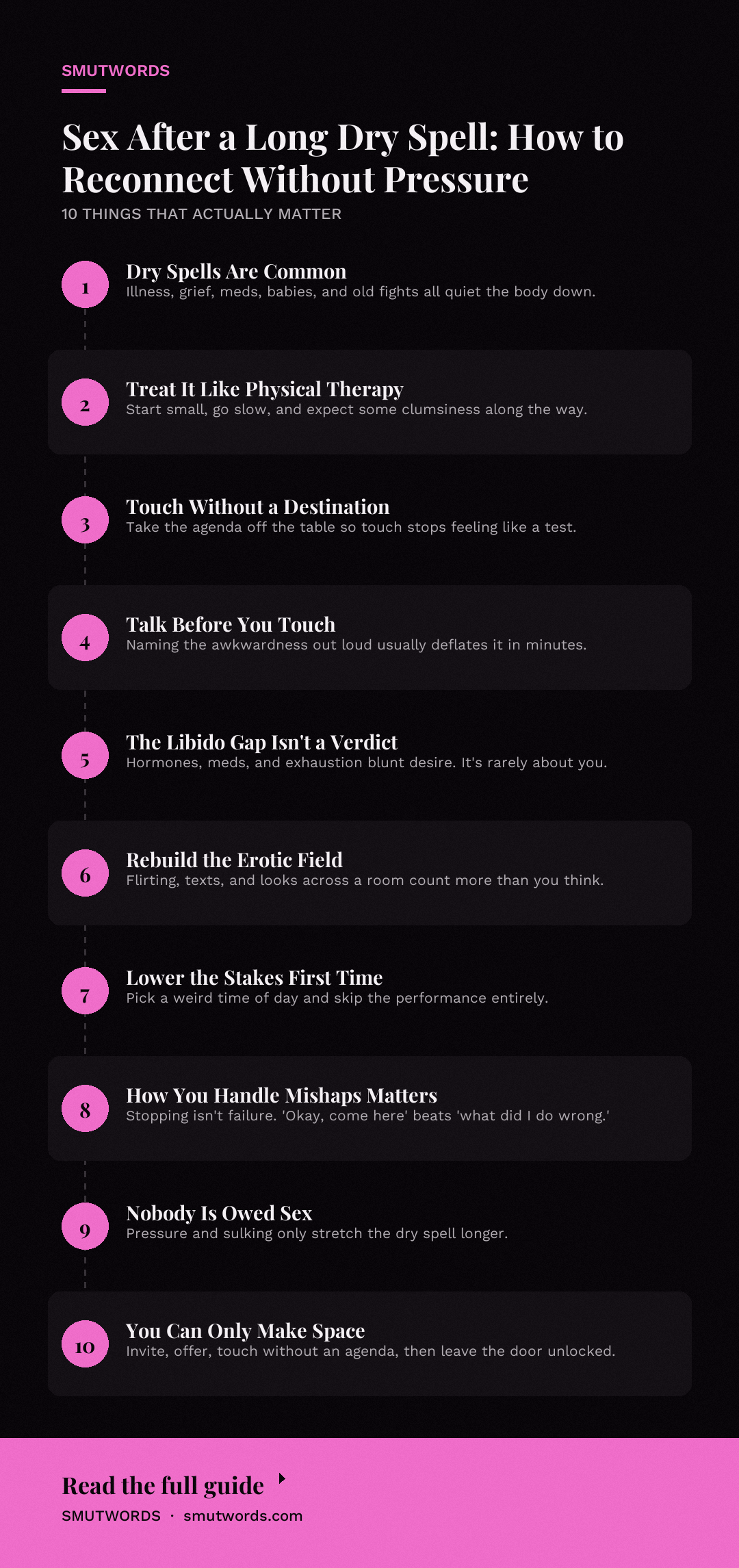
When they finally tried, she said they both just lay there. Her wondering if she still knew how, him afraid of doing the wrong thing. Nobody had told them that learning how to reconnect sexually after a gap that long works more like physical therapy than like a romance novel. You start small, you go slow, and you expect some clumsiness.
The good news, and it's genuinely good: the dry spell is common. Illness, grief, medication, postpartum recovery, a shift in antidepressants, a fight you never fully resolved, months of separate bedrooms because someone snores. Bodies go quiet.
What matters is knowing the return doesn't need to be a single big performance. It can be gradual. One small yes at a time.
Start With Touch That Has No Destination
A lot of couples skip straight to the bedroom and then wonder why it feels like an audition. The pressure comes from treating every touch as a runway to sex. If the first shoulder rub in eight months has an agenda attached, the whole thing starts to feel like a test. Take the agenda off the table for a while.
That means touching each other with zero expectation that it leads anywhere. Twenty seconds of a real hug, the kind with your chests pressed together and no pat on the back to signal it's over. Feet touching on the couch. A hand on a knee during a movie. Nothing here asks the body to do anything ambitious.
Some couples call this a touch ladder, and it's worth actually sketching out. A rough version:
- Week one: Non-sexual touch only, and be deliberate about it. Hug when you leave the house. Sit close. Hold hands in the car.
- Week two: Add longer contact. Back rubs with clothes on, feet in laps, cuddling on the sofa with the TV off.
- Week three: Skin. A massage with oil, showering together, a slow make-out session with an explicit understanding that it doesn't have to go further.
- Week four and beyond: Whatever you both actually want, decided out loud rather than assumed.
There is no rule that you have to follow a schedule. The ladder is a conversation starter, a way to lower the stakes so far that the body stops bracing. If a step feels wrong, you skip it and say so.
Talk Before You Touch
Most people avoid the conversation because they're afraid of making it weird, but the weirdness is already there. Naming it out loud usually deflates it.
Pick a neutral moment. A walk, the kitchen while the dishes dry. Then open with something plain: "I miss being physical with you and I don't know how to get back there, and I don't want to make it a big thing." That's it. That's the whole opener.
Conversation prompts that tend to actually work, in our experience asking people:
- "What's the last time you felt close to me that wasn't about sex?"
- "Is there anything that's making you nervous about starting again?"
- "What's one thing you'd want me to do that would feel good and low-pressure?"
- "What do you not want right now? I want to know so I stop guessing."
- "Are we okay not finishing, the first few times?"
Listen to the answer to number four especially. Someone recovering from an injury, on a new medication that kills libido, or raw from a hard season may want closeness and not want sex yet. Knowing that ahead of time is what keeps the attempt from turning into a rejection. Consent here is a real back-and-forth over weeks, not a checkbox you clear once.
The Libido Gap Isn't a Verdict
One of the most common situations after a dry spell is mismatched desire: one person suddenly keen and the other still flat. That gap has a way of feeling like a personal verdict.
It usually isn't. Testosterone shifts, thyroid issues, perimenopause, exhaustion, grief, and several common prescriptions all blunt arousal. If one partner's desire has been gone for months and doesn't return once the pressure lifts, a doctor's visit earns its keep.
For the higher-desire partner, the useful move is to stop treating sex as the goal and start treating it as one option among several. Masturbation is fine and nobody needs permission for it, but say that out loud.
A partner who feels responsible for every hard-on or every flutter of arousal ends up resentful. Say what you want, offer choices, and accept the no without a sulk. The sulk is what kills future yeses.
If You Want a Script to Borrow
Sometimes couples get stuck because neither of them knows how to break the abstinence politely. A little fiction helps here, not because it gives you a literal script but because it primes the mood without demanding a conversation about mechanics.
If your dynamic runs toward a dominant partner taking charge, the scene in Breed Me, General is one people come back to when they want to ease into the idea of being wanted again. If you'd rather read something where the wanting has a quieter timeline, Hitchhiker for Hire runs on chance and curiosity, which is closer to the mood most couples are trying to get back.
Reading something explicit together is a low-pressure way to find out what each of you is drawn to without committing to doing it. It's also a lot less embarrassing than staring at each other across the bed. If you want a reason to laugh while you're at it, the premise in Free Use Massage Parlor is a good conversation prompt: what part of that fantasy actually appeals, and what part is just fun to read? The answer is usually informative.
Rebuild the Erotic Field, Not Just the Bedroom
The sexual relationship doesn't live only in the hour you have sex. It lives in the flirting you do at 3 p.m., the text that says you're thinking about someone, the way you look at each other across a room. Most couples in a dry spell have let all of that go quiet along with the sex. Bringing it back is often the fastest route to wanting each other again.
Enjoyed this? Get a free book.
Join the list and we will send a complete free story straight to your inbox, plus new releases every week after that. No credit card, no catch.
This can be small. Sexting at work with no plan to follow through. Talking about a fantasy you've never mentioned, out loud, at dinner. Getting dressed for each other. Reading a scene together and comparing notes.
If you want a frame for what draws the two of you, our guide to primal instinct kink and the piece on clothed sex both start with the question of what the body wants and how to say it. The answer doesn't have to be anything exotic. A favorite shirt, a touch on the back of the neck in passing, a certain tone of voice. Notice what works and do more of it on purpose.
Lower the Stakes on the First Few Times
The first time after a long gap is not the moment to try the acrobatic thing you saw in a video, and it's not the moment to expect an orgasm. Take the performance off the menu. The only goal for the first few times is that it feels good and that you both want to do it again.
Practical moves that help:
- Have sex at a weird time of day. A random Tuesday afternoon is less loaded than Saturday night, which carries a whole "this is the night" build-up in some houses.
- Start with something familiar. A position or a touch that already worked. Novelty can wait until your body remembers that sex is enjoyable.
- Keep the lights low or on, whatever's actually easier. Don't perform a mood. If you're both self-conscious about bodies that have changed, say so once and move on.
- Lube. On the nightstand. Not in a drawer, not in another room. Bodies change after long gaps and after pregnancy and after a lot of things, and dry friction is a common reason a first attempt gets abandoned.
- Build in permission to stop. Say out loud before you start, "if either of us wants to stop, we stop, no big deal." Then mean it.
When Something Goes Wrong Mid-Attempt
The erection that won't cooperate. The body that won't warm up. The moment where someone laughs when they're nervous and the whole thing collapses. All normal parts of getting back into it.
The way you handle a mishap matters more than the mishap itself. If you can stay in the moment instead of apologizing, the awkwardness usually passes.
Stopping is not failure. If one person says they want to pause, the answer is "okay, come here," not "what did I do wrong." The second one puts the other person in the position of reassuring you while also feeling exposed. A little grace goes a long way.
And if things are going badly because someone is in pain, or one of you is doing something you didn't actually agree to, stop and talk about it outside the bedroom. That conversation is the safety net, and it's part of the how-to.
For couples whose dynamic runs darker, there's a difference between the texture of a fantasy and the reality of consent, and it's worth being clear about which one you're actually playing with.
The guide to starting a D/s relationship walks through that distinction in more detail. The premise in The Crimson Reclamation is a good example of a dynamic that stays firmly in the realm of fiction.
Reading about power exchange with a partner can be a great way to figure out what you actually want, as long as the scene is a conversation and not a surprise.
A Few Things to Keep in Mind
Nobody is owed sex. If a partner has been declining for a long stretch, the dry spell is a situation to work through together. Pressuring, sulking, or treating them as a problem to solve is going to make the gap longer.
If you're the one with lower desire and your body is genuinely not interested after months of trying, the honest answer might be a medical one. Talk to a doctor about the medication list, the thyroid, the hormones. The internet can't diagnose why you're not in the mood. Neither can we.
The guide to puppy play is worth a read if you and a partner have been circling a dynamic that neither of you has named yet. The bedroom can be a place for play, and play means the stakes are low. If your history together goes back decades, the childhood friends to lovers trope hits a nerve for a reason: familiarity isn't a dead end. It's the ground you build on.
If you're reading this in the middle of a very long gap, with a partner who feels far away, remember that you can't force closeness. You can only make space for it.
Invite. Offer. Touch without an agenda. Then leave the door unlocked, so to speak.
He Left the Door Unlocked runs on exactly that idea, an invitation a partner can accept or decline, and the fantasy works because the invitation is the point.
Final Thoughts
Start with a hug that means nothing and go from there. If you want a single book to keep on your nightstand while you and a partner ease back into it, Subroutine: Breed Her is the one we hand to couples who want something to read together in the weeks when the touching is still more about laughing than about finishing. The scene isn't the point. The conversation it opens is.







Loading comments…