
There’s a moment in every good size difference romance where the monster could crush the human without noticing. A hand the size of a dinner plate curling around a waist. A shadow that swallows the whole bed. The threat is structural, baked into the anatomy.
And then the monster speaks in a low, careful voice and asks if this is okay, and the entire fantasy snaps into focus.
The size difference romance trope gets misread as a fetish for scale alone. Readers don't stick around for the measurements. They stick around for the contradiction: a creature built to destroy who treats a fragile human like something precious.
The danger isn't the obstacle to the romance. The danger is the romance. The appeal comes from watching maximum threat meet maximum gentleness, and seeing which one wins.
Let's look at why that paradox does so much work in monster smut, and why the bigger the monster, the safer things tend to feel.
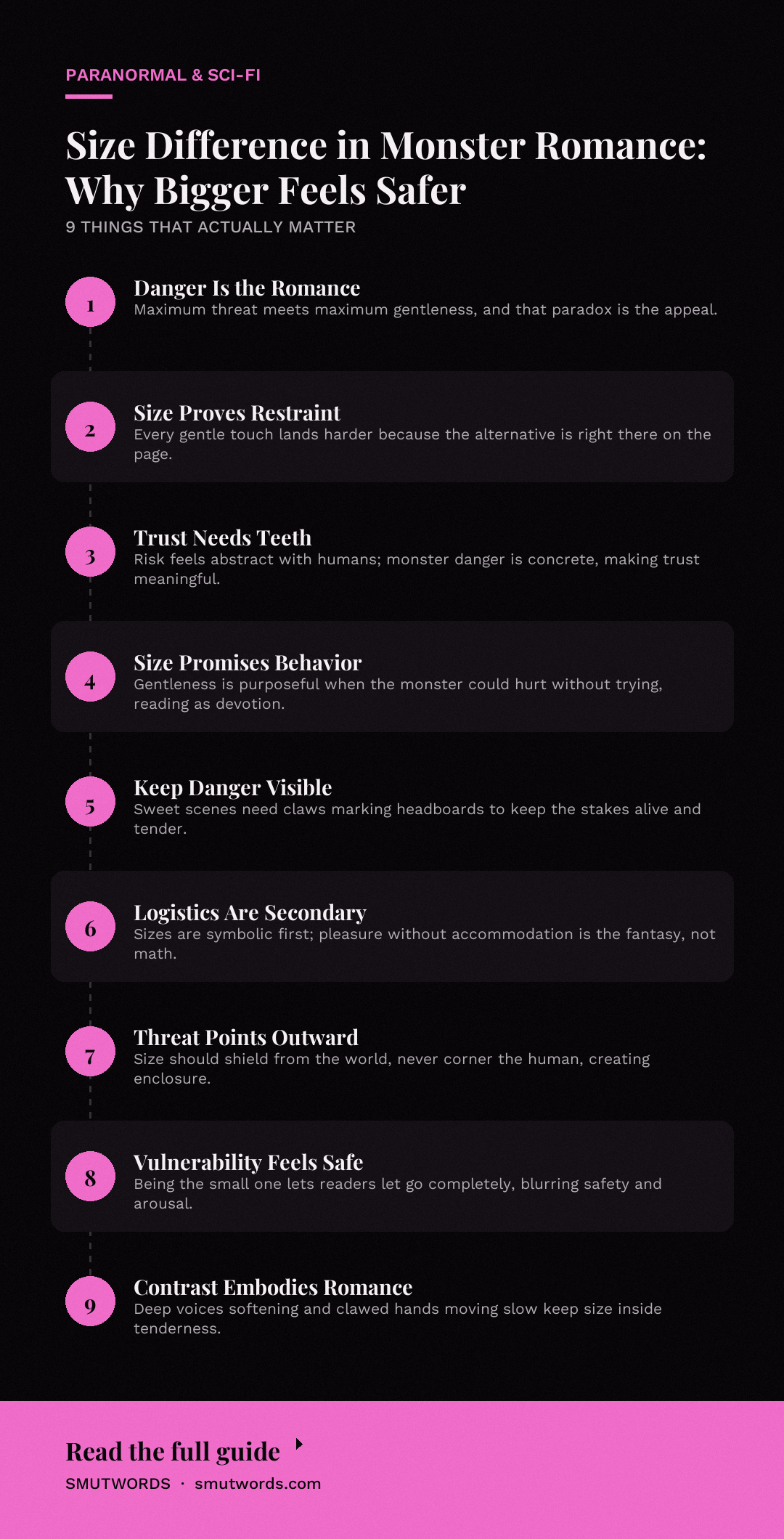
Why "Bigger Than Her" Means "Safer Than Everyone Else"
Human men in erotica have a size problem that has nothing to do with their bodies. They're unpredictable. They have egos, hang-ups, and a tendency to take rejection personally. Bigger heroines than average deal with entirely different anxieties in the human dating pool.
A monster sidesteps all of it.
When the love interest is a seven-foot alien or a stone golem or a tentacled thing from the deep, the sizes make the power imbalance visible. There's no pretending either of them has equal physical standing. The human is objectively, undeniably the smaller one. That enforced dynamic strips away the pretense of peer negotiation and replaces it with something more honest.
But here's the trade: because the monster could end the scene in a single careless movement, the story has to prove control. Over and over. The monster checks in mid-sentence, pulls back when the human flinches, braces a fist against the wall instead of grabbing what they want.
The size difference romance trope becomes a continuous demonstration of restraint. Every gentle touch lands harder emotionally because the alternative is right there on the page.
That's the real promise of the fantasy. Not a bigger partner, but a partner who has the power to be terrifying and chooses not to be. Size is the evidence that the choice matters.
The Reverse Comfort of Threat and Trust
There's a reason so many monster romance scenes include a moment where the human looks up and realizes exactly how outmatched they are. The ceiling of a ribcage should send anyone running. Instead, the genre reframes that terror as safety. The same body that could snap a femur is the body giving the gentlest kiss.
The paradox lands because trust only means something when it has teeth. A human partner who's close to your size could hurt you too, but the risk feels abstract. With a monster, the risk is a concrete fact the reader can picture. When that monster holds a human like they're made of glass, the contrast hits harder than any identical gesture between two humans would.
This is why the best scenes slow down at the threat. A clawed hand lifting to stroke a cheek, deliberately slow, so the human can see it coming and stay still. A mouth with fangs pressing against a throat, and the monster waiting one full beat for the human to say the word.
The size difference romance trope needs that hesitation. It's the difference between fear and kink, between horror and love story.
Size as a Promise, Not a Measurement
A lot of the conversation about this trope gets stuck on the dungeon-master statistics of it all. How big, exactly? What fits where? Those questions miss the narrative job the size is doing.
Size in these stories is a promise about behavior. A monster large enough to hurt someone without trying has to be gentle on purpose. That purposefulness reads as devotion. When a tentacled alien in a [captive breeding chamber](https://smutwords.com/star-sower-a-captive-in-the-tentacle-alien-breeding-chamber) takes extraordinary care to avoid overwhelming a human who can't leave, the caution is the erotic content.
The biology is just the delivery system.
Contrast that with a story where the monster's size is only an excuse for rough treatment. That version flattens the fantasy into mechanical spectacle. The reader isn't scared, excited, or charmed. They're just reading numbers.
The writers who get this trope right build the whole scene around the tension between capability and intention.
The Gentle Giant Is the Whole Point
Strip the tentacles and fangs away and the size difference romance trope is doing the same work as a classic gentle giant story. A creature with every reason to be violent isn't. The softer the monster acts, the more the reader feels the scale of what they're holding back.
The human side of that equation matters too. A human who looks up at a monster and decides to stay still, to say yes, to reach out first, is demonstrating a kind of courage that reads as love. It's the flip side of the monster's restraint. Both characters are taking a risk on each other's trust.
That mutual risk is why this trope feels safer than a standard human pairing even though it's objectively more dangerous. The threat is on the page where the reader can see it.
The reassurance has to be earned every time. A human partner's gentleness is baseline expected. A monster's gentleness is a miracle, and the story treats it like one.
Why the Danger Has to Stay Visible
A common rookie mistake in monster erotica is writing the monster as basically a large human with a weird dick. No threat, no alien instincts, no weight behind the scale. The size difference romance trope dies the second the danger disappears.
Readers came for the tightrope walk. If the wire is on the ground, there's no show.
Keep the danger visible even in the sweetest scenes. The monster's claws leave marks in the headboard because they're trying to hold still. The human's heartbeat is audible, either from arousal or panic, and the monster finds both acceptable responses. A tail wraps around a leg, not to trap, but to keep the human steady.
These details keep the stakes alive while the emotional register stays tender.
Enjoyed this? Get a free book.
Join the list and we will send a complete free story straight to your inbox, plus new releases every week after that. No credit card, no catch.
That tension is exactly what makes [alien breeding romance books](https://smutwords.com/alien-breeding-romance-explained) land so hard. The instinct to breed is possessive, primal, and potentially overwhelming. The genre's appeal is watching that instinct get redirected into worship. When a creature's biology screams one thing and their behavior demonstrates another, the gap between the two becomes the romance.
The "Can They Actually Fit" Question, Answered
Readers love to ask this. The logistics are half the fun. Here's the practical breakdown when you're reading or writing this trope:
- Monsters are usually written as anatomically cooperative. The author decides the fit works, often with extra effort required, and the difficulty becomes part of the scene rather than a stopping point.
- When the monster is extremely large, the story typically leans on oral, manual, or light breeding play instead of strict penetrative match. The intimacy doesn't require a perfect mechanical fit.
- The size difference romance trope frequently includes the human's literal inability to take everything, and that's the erotic point. Pleasure without accommodation is the fantasy, not a fully solved equation.
- Sizes in monster romance are symbolic before they are practical. The "how" matters less than the "why."
If the author handles the logistics with enough care to keep the suspension of disbelief going, the reader's brain fills in the rest. Stop worrying about the arithmetic and get back to the part where a monster whispers a question and waits, trembling with the effort of patience.
When Bigger Feels Like a Threat, Not a Promise
The trope fails when the monster's size is used as a weapon against the human's agency. Coercion is fine in free use erotica as a negotiated fantasy, but that's a different contract than the size difference romance trope. In the gentleness-driven version, the threat needs to be aimed outward, at the world, never at the human.
The monster's size should make the human feel protected, not cornered. A giant hand shielding a small body from the rain. A bulk that blocks the wind. The same scale that could hurt is the scale that makes a human feel hidden and kept.
Good writers use the size to create a sense of enclosure, a private pocket of space where nothing else can reach.
When the monster's size becomes a statement about the human's worth, the story clicks. A creature who could eat their partner doesn't. Instead, they kneel, or they curl up in a space too small for them, or they use one enormous hand to hold something delicate the human made. The contrast stops being about body measurements and starts being about value.
How Size Difference Shows Up Across the Genre
This trope is everywhere once you start looking. The touch-starved monster who's terrified of their own strength is a direct sibling to the size difference romance trope, and the two overlap constantly. A creature isolated by their scale, craving contact but convinced they can't have it without causing harm, is heartbreaking exactly because the size is the obstacle.
Monster romance has a whole spectrum of body types that create different flavors of this dynamic. A massive wolfish beast brings a predator-prey energy that gets defused through submission. A giant alien king brings an authority that gets softened through ceremony. A slime or amorphous creature has no size at all until they choose one for the human, which is its own kind of devotion.
In each version, the core promise is the same. You are small enough to be broken, and I will be the reason you never are. That's a sentence that would sound possessive and weird from a human partner. From a monster, it's a love declaration.
The Emotional Payoff of Being the Small One
There's a specific psychological comfort to being the smaller partner in an erotica scene that doesn't get enough acknowledgment. It mirrors the parent-child dynamic where protection is unconditional, but it adds adult pleasure to it. Safety and arousal get braided together until they're indistinguishable.
The reader gets to experience vulnerability as a gift rather than a risk. The human character doesn't have to be strong, competent, or in control. They get to be floored by someone else's strength while receiving the gentlest treatment possible.
It's permission to let go completely, as long as the story proves the monster has earned that trust.
That emotional payoff is the reason the size difference romance trope keeps appearing across alien, monster, and paranormal erotica. Titles like [Worship The Womb](https://smutwords.com/worship-the-womb) and [Planet Of Orgasms](https://smutwords.com/planet-of-orgasms) lean into this dynamic from very different angles, but both understand that the size is the setup, and the tenderness is the delivery.
How to Get the Balance Right
If you're writing this trope, or picking books that do it well, watch for these signals:
A good scene establishes the threat early and often. Don't let the monster go fully domestic. Keep reminding me what they could do.
Make the gentleness a continuous choice, not a one-time gesture. Small, repeated instances of care mean more than a single grand protective moment.
Let the human respond to the size honestly. Fear and arousal can coexist on the same page, and the best scenes let both be real without canceling each other out.
The contrast should be embodied. A deep voice that softens. A clawed hand that moves in slow motion. Massive teeth that never press down.
The size has to stay visible inside the tenderness.
How to write erotica belongs in any writing toolkit, and this trope specifically rewards showing restraint in the prose itself. If you describe the monster's bulk, then follow it with a delicate action, the reader feels the swing between those two registers.
Why the Fantasy Keeps Growing
The size difference romance trope has staying power because it's not really about size at all. It's about the comfort of being handled by someone who demonstrably has the upper hand and chooses to treat you like a treasure. The bigger the monster, the louder that message gets.
Readers keep coming back because the fantasy never gets old. Who doesn't want to be the one thing a terrifying creature can't bear to hurt? Who doesn't want to hear a voice like a rockslide ask permission like it's praying?
The paradox is the point. Maximum danger and maximum gentleness are the same story, seen from two sides. When the story gets both halves right, it hits a chord that plain human romance can't reach.
The monster's strength becomes proof of the love. The human's trust becomes the bravest thing on the page.
Final Thoughts
If you want to see this trope done exactly right, pick up [Extraterrestrial Heat](https://smutwords.com/extraterrestrial-heat). It understands that the threat and the tenderness aren't opposites. They're the same gesture, read from the outside and the inside.
When the monster's hand covers the human's whole body and the human feels nothing but protected, that's the entire fantasy in a single image. That's what bigger feels like when it means safer.
```





Loading comments…