
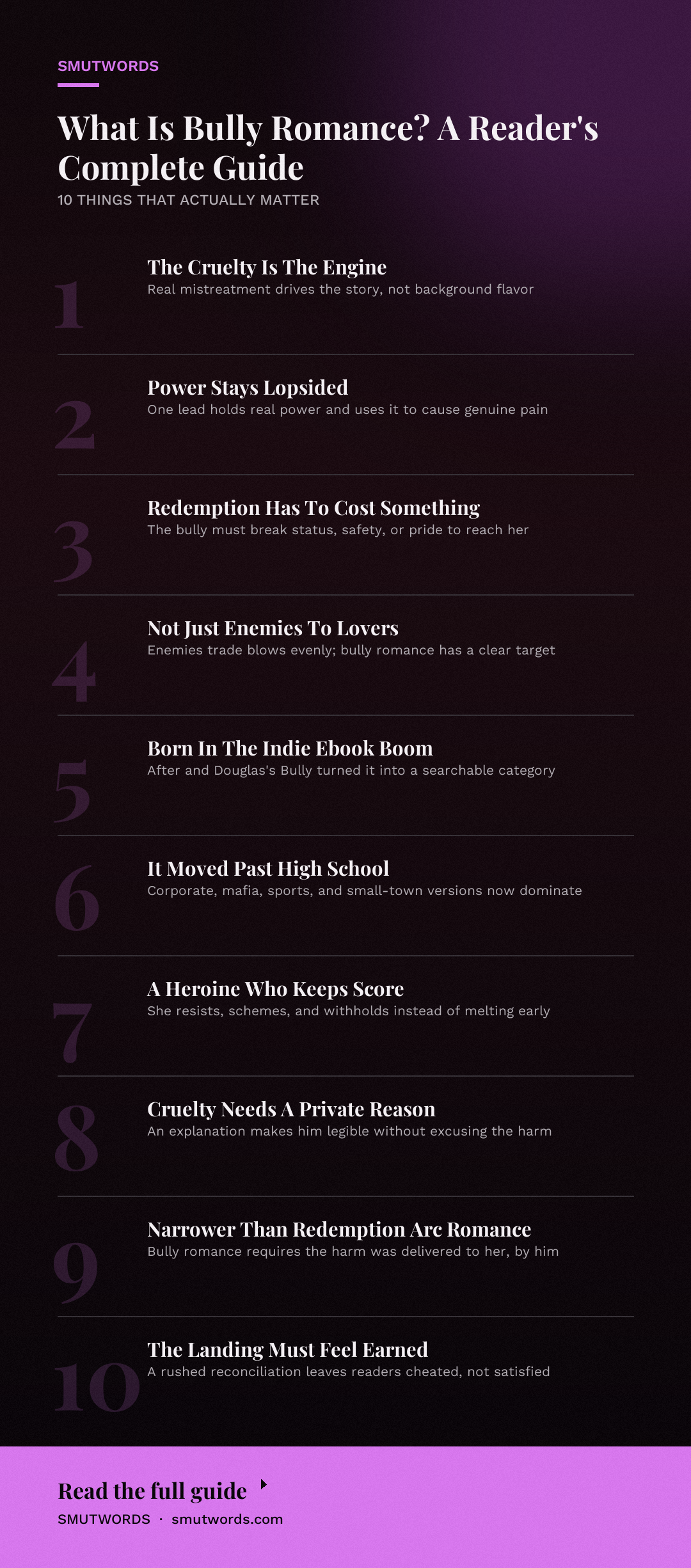
Bully romance is a romance subgenre where the love interest starts out as the protagonist's tormentor: the kid who shoved her into lockers, the boss who humiliates her in meetings, the rival who makes every day a small war.
The cruelty isn't background flavor. It's the engine. The story tracks the shift from genuine mistreatment into reluctant attraction, then into love, usually with the bully doing real work to earn forgiveness.
Readers come for the intensity, the power imbalance, the slow burn of watching a cruel figure turn devoted. They stay for the catharsis of a victim holding all the cards by the end. If you've ever finished a book at 3 a.m. furious at yourself for rooting for the guy who made the heroine cry in chapter two, you already understand the appeal.
What Bully Romance Actually Means
The term covers a specific dynamic: one lead has real power over the other, uses it to cause genuine pain, and the romance grows out of that history rather than despite it being conveniently forgotten. The cruelty has to matter. If the "bullying" is one sarcastic comment in chapter one and a smoldering look in chapter two, that's not bully romance. That's a grumpy hero with bad manners.
What counts: sustained psychological or social cruelty, a clear power imbalance (popularity, money, seniority, physical size, institutional authority), and a redemption that costs the bully something. What doesn't: a single misunderstanding, a prank that everyone laughs off, or cruelty that the narrative never lets the heroine be angry about.
Common misconceptions, since we hear them constantly:
- "It's just enemies to lovers with a meaner hero." Not quite. In enemies to lovers, both parties usually give as good as they get. In bully romance, the power is lopsided for a long stretch. One person is the aggressor and one is the target.
- "The heroine is always a doormat." The best ones aren't. She might be trapped by circumstance (same school, same office, same small town), but she's keeping score.
- "It's abuse apologia." That argument gets made a lot, usually by people who've never read one. Fiction about harm isn't endorsement of harm. Plenty of bully romance is explicit that the behavior was wrong and makes the bully pay for it.
- "It's all high school." The trope has fully migrated into adult settings: corporate offices, mafia families, small towns, sports franchises.
The name itself is plain and literal. "Bully" does the work. The "romance" is the promise that this ends in love, not in a restraining order.
Where Bully Romance Comes From
The trope's real ancestry is in gothic romance and the broader tradition of the dangerous, brooding love interest who treats the heroine badly before softening. Wuthering Heights is a bully romance with worse weather. Jane Eyre flirts with it. The Byronic hero archetype has been seducing readers with bad behavior for two centuries.
But bully romance as a recognizable, named category is a publishing phenomenon of the 2010s, and specifically of the indie and self-published ebook boom. The After series by Anna Todd, which started as One Direction fanfiction on Wattpad in 2013 before becoming a traditional publishing juggernaut, is the obvious inflection point. It put a hostile, controlling love interest in front of millions of young readers who had never encountered the dynamic framed that way in mainstream YA.
Around the same time, dark romance was exploding on Kindle Unlimited, and authors discovered that "bully" was a searchable, marketable label. Penelope Douglas's Bully (2014) gave the subgenre its modern template and its most-quoted title. By 2016, "bully romance" was a functioning category on retailer search bars, with its own cover conventions, its own reader communities, and its own dedicated Facebook groups where readers traded recommendations like contraband.
What changed as the decade wore on: the cruelty got harder, and the redemption got more scrutinized. Early entries were often content to have the bully apologize once and be instantly forgiven. Newer books do more work. Contemporary bully romance tends to show the heroine's anger in full, let her withhold for a real stretch of the book, and make the bully's change an ongoing process rather than a single grand gesture.
The subgenre also fragmented by setting. High school bully romance never went away, but college bully romance, mafia bully romance, sports bully romance, and workplace bully romance all carved out their own readerships. The label stopped being one thing and became a family of related dynamics, which is roughly where we are now.
How It Shows Up in Erotica
On the page, bully romance runs on tension that refuses to resolve early. The best versions understand that the cruelty and the attraction have to be intertwined at every point. If the heroine's body responds to the bully while her judgment stays furious about it, that friction is the whole point. The scene where she notices him watching her and hates how much she likes it is the subgenre's core unit of pleasure.
Here's what strong bully romance does well, and what flattens it into forgettable filler:
- Escalation that means something. Each cruel act should raise the stakes and reveal character. Random cruelty is just noise.
- A heroine with her own agenda. The ones who survive the book with their dignity intact are the ones who keep scheming, resisting, and keeping a private tally.
- Cruelty with a private reason. The bully usually has an explanation, not an excuse. A controlling parent, a family debt, a rivalry the heroine didn't know she was born into. The reason can't erase the harm. It just makes him legible.
- A real middle stretch where the heroine isn't won over. If she's melting by chapter five, the book has already spent its load.
- Redemption that costs the bully status, safety, or pride. He has to break something real to reach her.
- Physical intensity that reflects the emotional stakes. Bully romance tends to be rougher in bed than standard contemporary romance, with more claiming, more power negotiation, more of the dynamic worked out through bodies. If you want to understand how that register works in a related context, the claiming kink guide covers the general mechanics.
Common variations authors reach for:
- Reformed bully. The classic. Same person, changed behavior, an apology that costs him.
- High school bully. The origin form. Lockers, cafeterias, senior year, and a lot of pining disguised as loathing.
- Workplace bully. Corporate settings swap physical intimidation for professional humiliation. HR violations as foreplay, essentially.
- Mafia and crime family bully. The bully's cruelty is institutional. He can hurt her family, her business, her future. Higher stakes, meaner hero.
- Sports bully. Rival athletes, one teammate with a grudge, an entire male-dominated ecosystem that rewards aggression.
- Stepbrother and family-adjacent bully. Shared roof, no escape, everything complicated.
- Reverse bully. The heroine is the aggressor, or the power runs the other direction. Rarer, but growing.
Where bully romance tends to go wrong: the cruelty gets so extreme that the eventual redemption reads as implausible, or the heroine forgives on schedule rather than on feeling. Both failures come from the same place. The author treated the dynamic as a checklist instead of a live wire.
Enjoyed this? Get a free book.
Join the list and we will send a complete free story straight to your inbox, plus new releases every week after that. No credit card, no catch.
When it goes right, bully romance belongs in the same family as other high-intensity subgenres that build a whole world around a single charged dynamic. Hate to love is the closest cousin. Monster breeding romance runs a related engine with a nonhuman antagonist, if "he's dangerous and I want him anyway" is your specific drug. Rockstar romance and soldier romance borrow the same intensity and apply it to different archetypes.
One more craft note: aftercare matters here, even in fiction. When you've put a heroine through real emotional harm and then brought her back into the hero's arms, the landing needs to feel earned. If the reconciliation scene is rushed, readers don't feel satisfied, they feel cheated.
The aftercare guide is about real-world relationships, but the principle applies. The aftermath is the point, not an epilogue. If the power exchange itself is what hooks you, our guide to subspace explains what happens to a character once she stops fighting the pull.
Bully Romance vs Redemption Arc Romance
These two get confused constantly, and the confusion is fair because they overlap. Here's the line. Bully romance is defined by the specific harm the love interest caused to the protagonist. Redemption arc romance is broader: any story where a lead with a bad past or bad behavior has to earn their way back to a decent version of themselves and to the love interest's trust.
A bully romance is always a redemption arc romance. A redemption arc romance is not always a bully romance. The reformed rake, the ex-con, the man who cheated in his last relationship: none of them are bullies to the heroine specifically. Bully romance requires that the harm was delivered to her, by him, before the romance started.
That distinction matters when you're browsing for books. If you want the specific cruelty-to-love dynamic, search for "bully romance." If you want the broader forgiveness-then-love arc, "redemption arc romance" gets you the wider net.
Frequently Asked Questions
Is bully romance the same as dark romance?
Overlapping but not identical. Dark romance covers a broader range of morally gray leads and explicit content. Bully romance is a specific dynamic that can be written dark or light. A bully romance with a redeemable hero and a relatively hopeful tone isn't dark romance, even though it borrows some of the intensity.
Why do readers like bully romance?
The core appeal is the power shift. Watching someone with all the leverage end up on his knees for the person he hurt is a specific, potent fantasy. It offers catharsis too. Most readers have known a bully, and this genre lets them watch one lose.
Can a bully romance be healthy?
The relationship on the page, absolutely, if the redemption is real and the heroine's anger is respected. The relationships in the reader's life, that's a different conversation, and most readers are perfectly aware of the difference. Fiction exists to let people want things they wouldn't choose in real life.
What's the difference between bully romance and enemies to lovers?
Power balance. Enemies to lovers usually features two people who are roughly matched in their antagonism. Bully romance has a clear aggressor and a clear target, at least until the power evens out in the back half. The enemies to lovers glossary entry covers the broader trope.
Does bully romance always end happily?
In the romance genre, yes. Bully romance is still romance, which means a guaranteed happy ending, or at minimum a happy-for-now. The genre contract is that the heroine ends up loved and powerful. The path there can be brutal. The destination is fixed.
Is high school bully romance the only kind?
No, and it hasn't been for years. Some of the biggest sellers in the category are adult settings: corporate, sports, mafia, small town. Readers who thought they hated the trope because they only tried high school versions often find the adult ones land completely differently.
Final Thoughts
Bully romance works because it takes something ugly and refuses to look away, then slowly, painfully, turns it into something else. The cruelty is cruelty, right up until it isn't. If you've never tried the subgenre, pick an entry point that respects the heroine's anger as much as it respects the hero's change.
If you want something adjacent but even more unhinged, rockstar romance offers the same intensity with a different flavor of chaos. Start with one of the titles below and let it wreck you a little.






Loading comments…