Half the readers who search "soulbond vs imprinting" are looking for a distinction that actually matters. The other half just want someone to explain why the Twilight wolves were so weird about it. Fair. But once you start reading in the monster romance and paranormal chapters, the difference stops being trivia and becomes the whole reason a book works or falls on its face.
A soulbond is a two-way mystical tether that hooks two people together at once. Imprinting is an involuntary pull where one person gets locked onto another, often without warning and often without consent. Everything good and terrible about these tropes falls out of that difference.
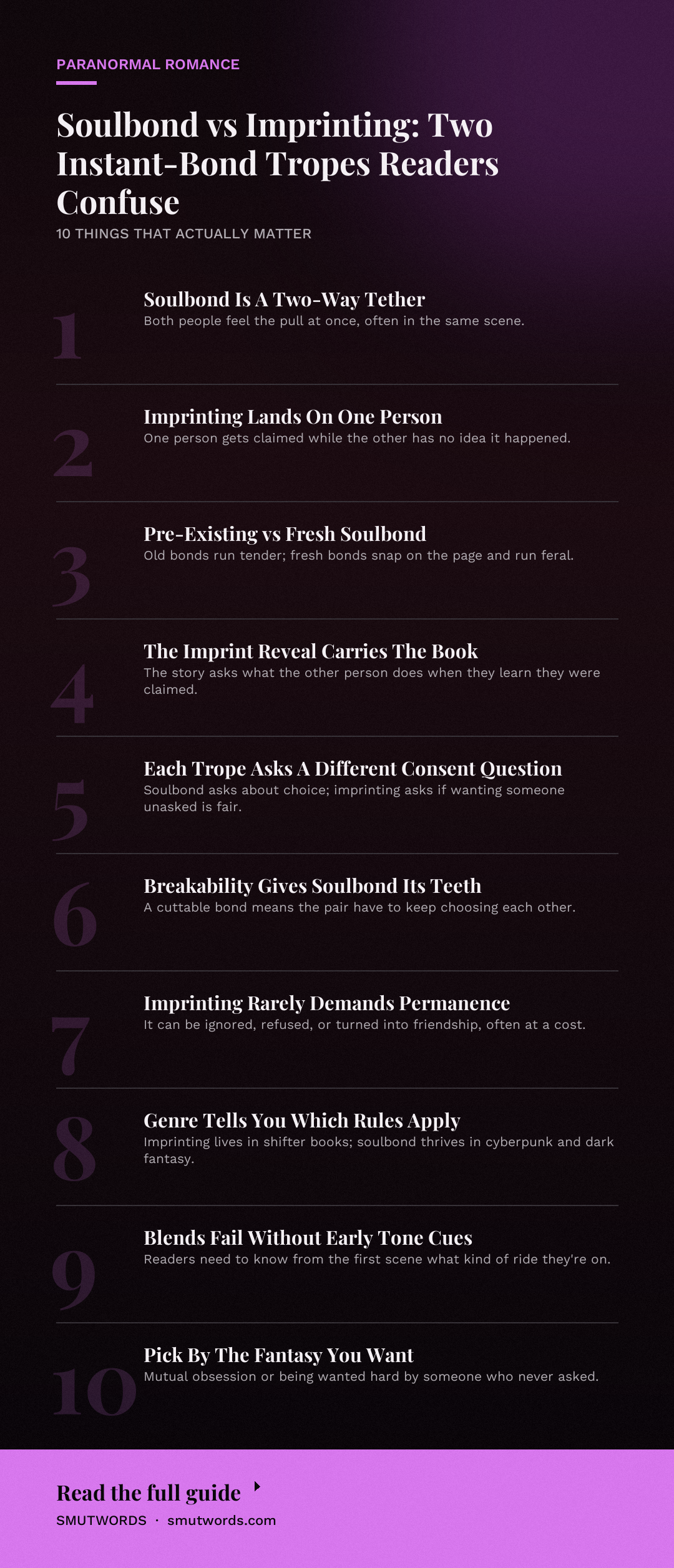
Here's the part readers keep mixing up: soulbonds usually hit both parties. The tether snaps tight on both ends, sometimes mid-fight, sometimes in a rescue scene, sometimes in a stranger's bed. Imprinting lands on one person like a curse and leaves the other party completely unaware they've been claimed.
Two people feeling the same pull at the same time reads one way. One person feeling it alone while the other has to be told reads another. The heat level and the ethics are different in each.
What a Soulbond Actually Does in a Romance Novel
The soulbond has a long leash. Authors use "soulbond" as shorthand for whatever mystical thread they need to justify characters who can't stay apart.
Sometimes it's literally a glowing cord between two chests. Sometimes it's a mating mark that flares when they touch. Sometimes it's a shared dreamscape where they meet every night and wake up tangled in their own sheets.
The mechanical details vary wildly, and so does whether the bond counts as fated romance with a side of destiny or a curse that two enemies would happily cut if they could find the scissors.
The one thing most soulbond books agree on: the bond is mutual. Both people feel the pull. That mutuality is what makes the trope tolerable as a fantasy. You get to enjoy the "we can't keep our hands off each other" heat without the sour aftertaste of wondering whether one of them would have chosen differently without the tether.
It's not that the consent issue disappears. A bond that overrides your judgment is its own ethical mess. But at least both parties are in the same mess together. The fantasy is being wanted that much by someone who feels the exact same amount of want.
The two flavors of soulbond you'll actually see
Romance authors keep pulling the same two levers, and knowing which one you're in changes how a book reads.
- Pre-existing soulbond. The characters were bound before the story starts, often as children or during a previous life. The book's project is them discovering the bond and figuring out what it means. Think old flames who never understood why they couldn't let go.
- Fresh soulbond. The bond snaps into place on the page, often under pressure. A near-death moment, a magical accident, a ritual someone botched. The book's project is the fallout, including the possibility that one of them hates it.
The pre-existing flavor tends to run tender. The fresh flavor tends to run feral, because one of them usually loses their mind a little in the first fifty pages.
Both work, but they ask different things of the author. A pre-existing bond needs a reason the characters never noticed it. A fresh bond needs a reason it chose now.
What Imprinting Actually Does
Imprinting is the one that gets the most confused with soulbond, because both get described as "the bond" and both make characters suddenly possessive. The mechanics are different in the part that matters: imprinting is unilateral. One person gets snapped onto another, and the other person has no idea it happened.
Sometimes they find out when the imprinted character starts following them around. Sometimes they never find out, and the imprinted character quietly rearranges their entire life around a person who thinks they're a friendly acquaintance.
That one-sidedness is the entire engine of the trope, and it's also where authors either commit or fumble. Write imprinting as if it were a soulbond and the book reads dishonest. The imprinted character's devotion hasn't been reciprocated or consented to; it's just been dropped on two people like a curse with a nice cover. Pretending otherwise flattens the exact discomfort that makes the trope worth reading.
The best imprinting books don't ask "will they end up together?" They ask "what does the other person do when they find out they've been claimed without knowing it?"
The signature imprinting beats
If you've read a handful of these, you've seen the same machinery:
- The imprinted character's nervous system goes haywire around the other person: heart rate spikes, scent fixation, inability to focus.
- The imprint snags in a crisis: a rescue, a combat scene, a moment where one person's life is briefly in the other's hands.
- The imprinted character starts changing their life to stay close, sometimes without realizing they're doing it.
- The other person eventually clocks the possessive behavior and asks what's going on.
- The reveal scene, where the imprinted character has to say out loud what they've been feeling alone.
Whether the reveal scene lands as swoony or unsettling depends entirely on how the author has handled the power imbalance up to that point.
A long slow burn where both parties actually know each other before the reveal? The scene lands as dramatic confession. A fast imprint where the imprinted character has been quietly orbiting a stranger for eighty pages? The scene lands as a warning.
Consent, the Actual Sticking Point
Soulbond and imprinting both raise consent questions, but they raise different ones, and that difference is what readers mean when they argue about which trope is "healthier." Soulbond asks whether a bond that removes someone's other options really counts as consent. A character in a soulbond can't choose not to want the other person.
A lot of authors dodge this by giving the pair a moment of genuine mutual choice before the bond tightens. When authors actually sit with the question, the book tends to read as a redemption arc romance where the fantasy is being chosen this hard, without having to do the exhausting work of being chosen in real life.
Imprinting asks a sharper question: is it fair to want someone who hasn't agreed to be wanted? The imprinted character isn't choosing to feel it, and the other person isn't choosing to be the object. The trope runs hot when the author lets that discomfort stay on the page, and cold when the author waves it away.
If you want to see how authors handle the ethics of talking about limits before a scene, Hard Limits vs Soft Limits: How to Actually Sort Yours Before a Scene is the same conversation in a different register; the language of limits is how careful writers keep a mystical pull from sliding into something the characters never agreed to.
The reader conversation around a soulbond vs imprinting comparison almost always drifts there. Readers who love the soulbond want the fantasy of mutual obsession.
Readers who love imprinting want the fantasy of being wanted that hard without having to have asked for it, and they usually want the other party to be a little bit afraid of it. Both are legitimate, both are horny in different directions, and neither is dishonest if the author is honest about what's on the page.
Can You Break the Bond?
Soulbonds, by the rules most authors keep, are hard to break and sometimes impossible. Breakability is where the trope gets its teeth.
Enjoyed this? Get a free book.
Join the list and we will send a complete free story straight to your inbox, plus new releases every week after that. No credit card, no catch.
A bond that can be cut means the characters have to actively keep choosing each other after the initial pull. That's the plot of a lot of slow-burn monster romance, where the third-act conflict is whether they sever it and stay anyway. A bond that can't be cut means the book has to make its peace with permanence, and the whole story becomes about whether the two characters can build something live inside a bond neither of them asked for.
Imprinting is usually more complicated. It can be ignored, sometimes with effort. It can be transmuted into friendship rather than romance in a few of the softer ones. It can be refused outright, often with consequences for the imprinted character's physical or mental state.
The trope itself doesn't demand permanence; it demands the imprinted character deal with the pull as an ongoing condition of their life, and that's what makes the reveal scene carry weight.
There's also a genre distinction that trips up new readers. Imprinting has a stronghold in paranormal and shifter stuff, where the pull is tied to animal instinct and the character has an internal wolf or hawk making decisions their conscious brain wouldn't. Soulbond lives comfortably in cyberpunk romance and darker fantasy, where the bond is often magical or technological and can be engineered, sold, or stolen.
When a book mixes the two, the authors usually clarify early which rules the world runs on. When they don't, the book reads like two halves of two different genres stapled together.
Which Authors Reach for Which
Soulbond writers tend to be the ones who want the fantasy to feel reciprocal. If you're reading a book where the pair discover the bond at the same time and immediately fall into bed with matching intensity, that's a soulbond author. The trope lets you write high heat without the awkwardness of one person having been picked without warning. Series that lean on it usually lean hard.
Imprinting writers want a one-sided heat. These are authors who are willing to write characters who call the imprinted lover a stranger, and then follow them anyway.
The trope has a fanbase specifically because it lets the author explore obsession without mutual agreement on the page. If you like the fantasy of being trapped by someone else's fixation, imprinting is the trope for that. If you like the fantasy of being pulled so hard you can't leave, soulbond is the trope for that.
One thing both tropes share: they're both about how much heat and tension an author can draw from the fact that the two characters are already bound together before they've sorted out whether they like each other. That's the same engine behind childhood friends to lovers, just with magic instead of a shared history. The heat comes from the pre-existing tie and the friction comes from both people figuring out what to do with it.
If you're coming to this from a reading list that includes redemption arc romance, you've probably already met a version of this dynamic where the bond is a second chance offered by a cosmic force rather than a fresh tether. Same machinery, different emotional register.
When an Author Blends Both
Some of the most interesting books in the last five years have been the ones that don't pick a lane. You'll get a soulbond that, it turns out, was actually created by a third party who imprinted on one of them as a way to force the bond; the pair have to figure out whether the thing they feel is theirs or the manipulator's.
Other books run the imprint first and have the second party develop a genuine bond on their own time, which is technically no longer imprinting but reads as a mid-book soulbond forming under the imprint's weight. These books are messy and often frustrating, and they're also where the trope has room to actually say something.
The main failure mode is a book that can't tell which trope it's in and keeps giving the reader the wrong genre cues. The imprinted character starts following the other home, the narrative gives it the swoony treatment, and the reader has to decide whether this is a dark book that knows what it's doing or a lighthearted one that doesn't.
When it works, it works because the author has spent earlier chapters setting the tone. When it fails, the second half of the book is spent reassuring the reader about something that should have been decided early.
Some of that tone work is the same kind of calibration romance authors do around kinks like vore fetish 101, where the reader needs to know from the first scene what kind of ride they're on. If the reader agrees to the ride, the darker beats land. If they don't, everything after is a broken promise.
Picking Which One You Actually Want to Read
A quick checklist if you can't tell from a blurb which trope you're holding:
- Pick soulbond if you want high heat, mutual obsession, and a fantasy where both people get swept up at once. You don't mind a plot that's mostly about the pair building a life inside a tie they can't easily cut.
- Pick imprinting if you want the one-sided pull, the reveal scene, and the discomfort of a person being claimed before they agreed. You don't mind a book that sits with the possibility that the bond isn't healthy for everyone in it.
- Blend or skip if your tolerance for the "which of us is really the one obsessed here?" conversation is high and you don't need the book to promise you a tidy resolution at the end.
Also worth flagging: neither trope has anything to do with group marriage arrangements or pack-bond books where the bond extends across a whole household. Those run their own rules. If you're curious about the pack version, group marriage is the glossary term to start with; the bond usually functions as the in-world justification for a household that would otherwise look structurally different to readers unfamiliar with the trope family.
And a note for anyone reading imprinting for the first time: it will be tempting to read the imprinted character's possessiveness as romantic gesture. Twenty pages in, slow down and ask whether the person they've imprinted on has actually said yes.
A book that respects the reader will make that question feel dramatic. A book that doesn't will make it feel like an annoyance to get past. The good ones welcome it.
A Few Books to Start With
If you want to actually see the difference on the page, pull two titles this week and read the first thirty pages back to back. The soulbond ones will give you both characters feeling the pull within a scene of each other. The imprinting ones will give you one character's nervous system reacting to someone who barely has a line yet.
That contrast is the whole trope argument in an hour of reading time, and it's why the "soulbond vs imprinting" question keeps coming up in reader forums. Both pull the same muscle. They just pull it in opposite directions.
If you like the political layer of the soulbond books and want more of that flavor, the soldier romance shelf has plenty of pairs bonded under fire. If you like the imprinting flavor and want something that pushes the one-sided obsession harder, the darker shifter titles are where you'll find the books willing to commit.
Final Thoughts
Read the two side by side and stop looking for one to win the argument. Soulbond is the fantasy of being chosen that hard by someone who feels the same pull. Imprinting is the fantasy of being wanted that hard by someone who never asked and can't stop.
Both are doing real work, and both have the audience they deserve.
Both also fall apart if the author fudges which rules they're playing by. If you're looking for a specific place to start, pick a book that puts the reveal scene on the page and lets the other person react with their whole body shivering, then decide whether you want to keep reading the trope or walk out of the room. That's the honest test, and it's the one the best authors in both camps have already passed.






Loading comments…