A heist romance is a love story built around a crew planning and pulling off a high-stakes theft. The romantic relationship grows in the pressure cooker of the job itself. The target, the timeline, and the people you're working with all create the conditions for attraction: forced proximity, shared danger, and the constant question of who's going to betray whom.
Heist romance moves fast, talks sharp, and treats trust as the most erotic currency on the table. The crime is the plot. The relationship is the point.
What separates a heist romance from a thriller with a love interest is where the emotional weight sits. In a heist romance, the score and the relationship are braided together so tightly that you can't pull one loose without unravelling the other.
The crew has to succeed for the couple to survive. The couple has to trust each other for the crew to succeed. Every scene does double duty.
What Heist Romance Actually Means
The name is literal: a romance structured around a heist. A crew assembles, a target is identified, a plan is drawn, complications arise, and the execution goes sideways in ways that force the characters to make irreversible choices about each other. The romantic arc runs alongside the criminal one, and the climax usually resolves both at once.
What counts: any romantic plot where the central action is a theft or con and the relationship develops through the planning, execution, or fallout of that job. The couple can be partners on the same crew, rivals competing for the same score, a thief and the person assigned to catch them, or a grifter and the mark they were supposed to fleece. The structure holds in all of those configurations.
What doesn't count: a romance where a character happens to have a criminal past but the plot is about something else. A mafia romance with one burglary scene is not a heist romance. A romantic suspense novel where the crime is a murder investigation doesn't qualify either. The heist has to be the engine of the plot, with the planning and execution taking up real page space.
Common misconceptions are worth naming. Heist romance is not a subgenre of crime fiction with romantic elements bolted on. It's a romance with a criminal plot structure, which means the relationship has to satisfy romance readers: real emotional stakes, an earned connection, and an ending that resolves the love story in a way that feels complete.
The crime can be ambiguous. The romance cannot.
Another misconception is that the couple has to be criminals together. Some of the strongest entries in the trope pair a thief with law enforcement, an insurance investigator, or a civilian caught in the middle. The tension of opposing loyalties is part of the architecture, not a deviation from it.
Where Heist Romance Comes From
The heist as a narrative form has deep roots in film and pulp fiction. The specific romance publishing category is younger. Heist romance as a recognizable shelvable trope took shape in the 2000s and gained real momentum through the 2010s, as romantic suspense expanded and indie publishing gave authors room to blend genres that traditional houses had kept separate.
Historically, crime fiction treated romance as a complication or a liability. The femme fatale was a warning, not a love interest. The thief's girlfriend was collateral. Heist films in particular used women as decoration or betrayal mechanics, and the emotional register stayed cool and ironic.
Romance publishing inverted that. The genre took the heist's structure (the crew, the ticking clock, the betrayal risk, the big score) and made the emotional stakes the main event. The irony got replaced by sincerity. The criminal plot stopped being a cautionary tale and became a pressure system designed to force intimacy.
Two publishing shifts matter here. First, romantic suspense as a category grew through the 1990s and 2000s, giving authors a home for crime-adjacent love stories. Second, indie and digital-first publishing in the 2010s let authors write heist romance without having to argue that a book about criminals could still be a romance.
The readership was already there. The gatekeepers were the obstacle.
The enemies-to-lovers heist variant gained particular traction as the trope's most popular configuration, partly because the structure already contains the conflict that enemies-to-lovers needs. A crew member who doesn't trust another crew member is doing the work of the trope for free, and the plotting gives that distrust somewhere concrete to live.
The rise of cyberpunk romance has also fed the heist romance's evolution, since cyberpunk plots so often involve data theft, corporate infiltration, and crews of specialists working against a system. The tech heist is now a well-established variant.
How It Shows Up in Erotica
Craft-wise, heist romance gives a writer an unusual toolkit: structural tools that generate heat without requiring characters to talk about their feelings directly. Most of the sexual tension lives in the job. This is the section where the trope either works or falls flat.
The plan as a proximity engine
A strong heist romance uses the plan as a proximity engine. Crew members are stuck in safe houses, surveillance vans, hotel rooms, backstage prep areas.
They rehearse their cover stories in each other's faces. They adjust each other's clothes before a con. They run through the mark's psychological profile in a shared hotel suite at 2am.
The writer who knows what they're doing lets the rehearsal stand in for the seduction, because it's the same act performed with a different target.
Enjoyed this? Get a free book.
Join the list and we will send a complete free story straight to your inbox, plus new releases every week after that. No credit card, no catch.
A flat heist romance treats the job as a plot the characters keep getting interrupted from so they can make out. The crime and the romance stay in separate lanes. The reader can feel the seams. The heat has no structural justification; it's just happening on top of the plot rather than coming out of it.
The variants and what each one does
- Enemies to lovers heist: Two crew members who distrust each other are forced to cooperate on the same score. Best for slow-burn, because the mistrust has to be worn down scene by scene.
- Rivals to lovers heist: Two criminals or two crews competing for the same target. Best for high-speed banter, public competition, and the moment they realize the rivalry was mutual respect all along.
- Cat burglar and detective: The thief and the cop assigned to catch them. The asymmetry of knowledge creates erotic tension (each one knows something the other doesn't) and structural tension (any intimacy risks exposure).
- Grifter meets their match: Two con artists recognize each other and decide to run a joint con. Best for readers who want both leads competent, both leads clever, and neither one a mark.
- Heist with a fake relationship: The cover story is a couple. The job requires them to perform a romance, so the romance has somewhere to perform itself. This variant leans on the same mechanics that make fake dating and forced proximity books so reliable, layered on top of the heist clock.
- Inside job / mark-and-thief: The thief seduces the mark to gain access, and the seduction turns real. Best for moral complexity and for readers who want the tension to sit at the exact moment the thief realizes the con has stopped working.
- Thief and civilian caught in the middle: An innocent person with useful skills (archivist, hacker, driver) gets pulled into the job. Best for outsider POV and for readers who want the world of the heist explained as it's experienced.
What makes the scene work on the page
The best heist romance scenes involve preparation. A crew member adjusts a partner's tie before a gala infiltration and the act carries more charge than any explicit scene would. Characters rehearsing a cover identity's flirtation and then finding it isn't rehearsal anymore. A near-miss during the job where one character has to physically move the other out of a guard's line of sight and neither breathes until they're in the stairwell.
The heat also comes from the inverted physics of trust. In a heist romance, trust is dangerous, because the wrong amount of it can get someone killed. A character who trusts another crew member with the plan's vulnerability is risking more than sex. The sex is a consequence of that risk, not a substitute for it.
Betrayal scenes are the strongest heat scenes in the trope when they're done well. A character who discovers the person they slept with last night has been feeding information to the mark has to process the professional violation (the plan is blown) and the personal violation (the intimacy was instrumentalized) at once. That collapse is the trope's emotional peak, and the erotic charge often lives there, in the moment of finding out.
Reading hundreds of these books, the pattern is clear: the entries that work let the heist infiltrate the sex, and the sex infiltrate the heist. The entries that don't work keep them quarantined, and the book reads like two novellas stapled together at the climax.
Practical craft notes
Pacing matters. Heist romance runs shorter than slow-burn contemporary because the ticking clock punishes the reader who lingers. A well-constructed heist romance typically moves through the crew assembly, the reconnaissance, the plan's outline, the first complication, the first real intimacy, the second complication, the betrayal or near-betrayal, the execution, and the aftermath, all in a tight arc.
Secondary characters have to function. A crew is a small ensemble. The secondary characters need to do work (safety, comic relief, a loyalty test, a temptation to defect) rather than crowd the page. Readers tend to develop favorites among the crew, which is why many heist romance series follow up with books about the other crew members.
Research pays off. Readers who love this trope tend to know what a casing is, what a fence does, what "the long con" means structurally. Authors who fake the mechanics lose the specialized reader in the first chapter. Authors who respect the mechanics get a reader who feels respected.
Where the trope overlaps with adjacent categories
Heist romance overlaps with soldier romance in the way both use a team structure and a mission clock to force loyalty questions. The soldier romance usually answers those questions under state authority. The heist romance answers them outside it. That difference matters for tone.
It overlaps with prince/princess romance when the target is a gala, an estate, or a private collection attached to a titled family. The cat burglar's infiltration of a palace or country estate is one of the oldest set pieces in the trope.
It overlaps with childhood friends to lovers in variants where the crew includes someone the protagonist has known since before the criminal life. The reunion scene has a specific flavor when one person remembers the protagonist before they became a thief and the other doesn't. If you're sorting out what kind of tension a book is actually promising, our breakdown of hard limits vs soft limits is a useful parallel exercise.
Heist Romance vs Cyberpunk Romance
Readers sometimes file heist romance under cyberpunk romance or vice versa, and the confusion is understandable because the tech heist sits at the intersection of both. The categories are different, though. Cyberpunk romance is defined by its setting (near-future, high-tech, corporate-controlled) and can contain any romantic plot inside that setting, including a heist. Heist romance is defined by its plot (a crew executing a theft), and the setting can be anything.
A heist romance can be contemporary, historical, paranormal, or cyberpunk. A cyberpunk romance can be a heist story, but it can equally be a slow-burn between a hacker and a corporate defector with no theft involved. If you're clicking through trying to decide which tag a specific book fits, the plot is the deciding factor for heist romance, and the setting is the deciding factor for cyberpunk.
Frequently Asked Questions
What is a heist romance novel?
A heist romance novel is a romance where the relationship develops around a planned theft. The crew, the target, and the job's timeline provide the pressure that drives the couple together. The love story and the criminal plot resolve together in the climax.
Is heist romance the same as romantic suspense?
Heist romance is a specific flavor of romantic suspense. All heist romances are romantic suspense, but not all romantic suspense is heist romance, since the category also includes murder mysteries, stalker plots, and witness protection stories. If the central action is a planned theft, it's a heist romance.
What are the most popular heist romance variants?
Enemies to lovers is the most common configuration, followed by cat burglar and detective, rivals to lovers, grifter meets their match, and heist with a fake relationship. Each variant uses the same structural mechanics with a different relationship dynamic layered on top.
Are heist romances always dark?
No. The trope ranges from light caper comedy (crew of misfits, banter-heavy, low body count) to darker romantic suspense (moral ambiguity, real stakes, betrayal that hurts). The tone depends on how the author handles the crime's consequences and how much the crew is allowed to be sympathetic.
Do heist romances always end happily?
As a romance, yes: the couple ends together. The crime plot can resolve in a range of ways (the crew succeeds, the crew succeeds but has to give the score up, the thief goes straight, the thief doesn't), but the relationship has to reach a genuine resolution. Readers who want the couple intact will get that in the trope.
Can heist romance be a series?
Yes, and many are. The crew structure makes series natural, since each book can focus on a different crew member and their romantic arc. Standalone heist romances exist too, but the ensemble format rewards serialization.
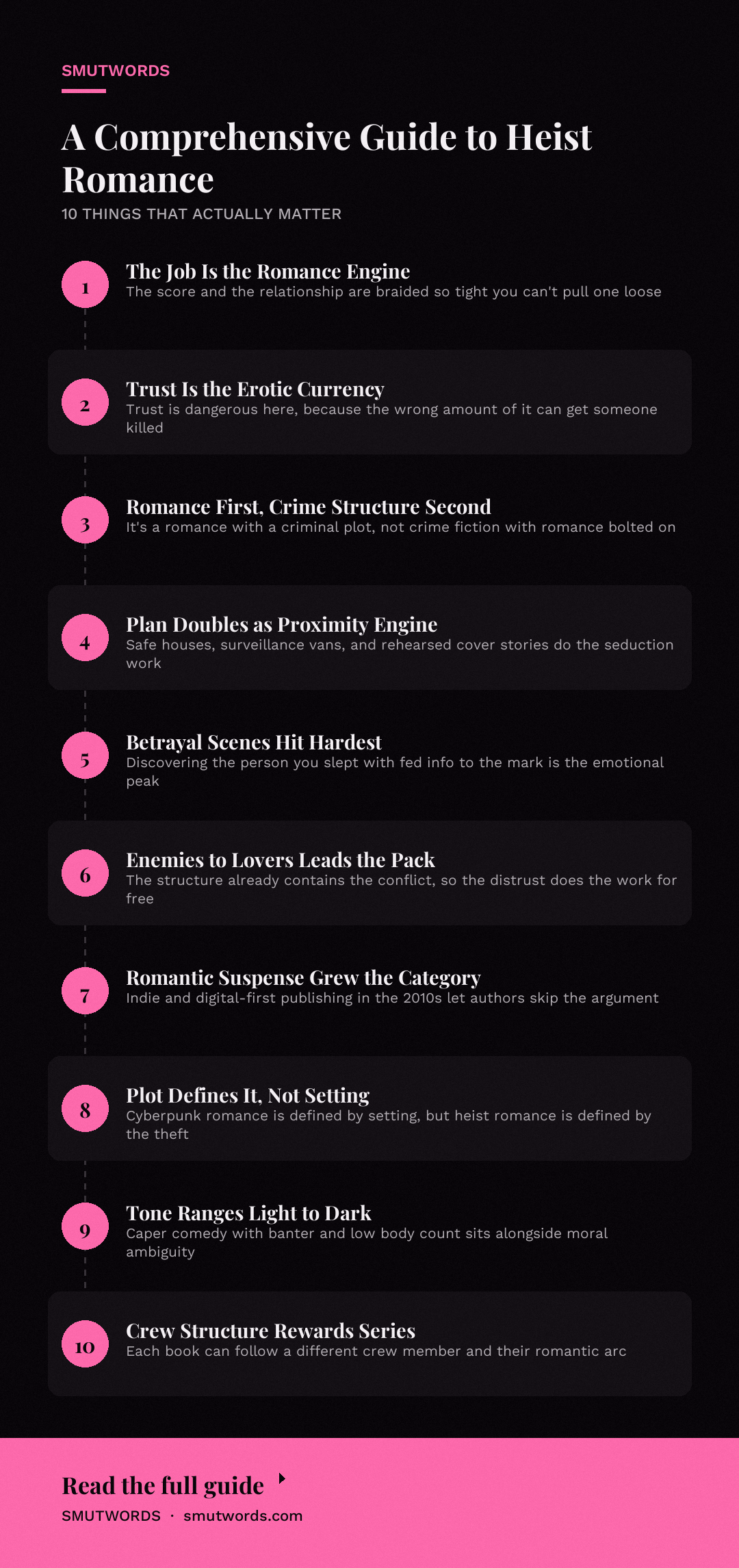
Final Thoughts
Heist romance rewards readers who want a love story with a pulse. The trope gives the relationship a reason to accelerate, a reason to hide, and a reason to matter. If you're new to the trope, start with a cat burglar and detective story (the stakes are already built in) and work your way toward the enemies-to-lovers crew entries once you know you like the rhythm. The list below has ranked picks from the SmutWords catalog to start with.





Loading comments…