
A threesome is a sexual encounter between three people at the same time, where everyone present is a participant: touching, being touched, watching, being watched. In erotica and romance, a threesome is never just a logistics problem with extra limbs. It's a plot about trust, jealousy, and what happens to a couple when a third body enters the room and changes the math.
The term covers everything from a playful MFM to a meticulous double penetration scene to the fraught couple-invites-a-third setup that keeps readers hitting the same search bar for more.
If you are here because you want the full picture, this is the page for it. What the word means, where the trope came from, how good authors actually write it, and what makes a threesome scene land versus fall flat. There is a real-world safety note woven in because this is one of the few kinks where the fiction and the practice have genuine overlap, and pretending otherwise would be dishonest.
What a Threesome Actually Means
The word itself is plain. Three people, one intimate encounter, no fourth party waiting in the hallway. The count is the whole definition, and everything else is variation.
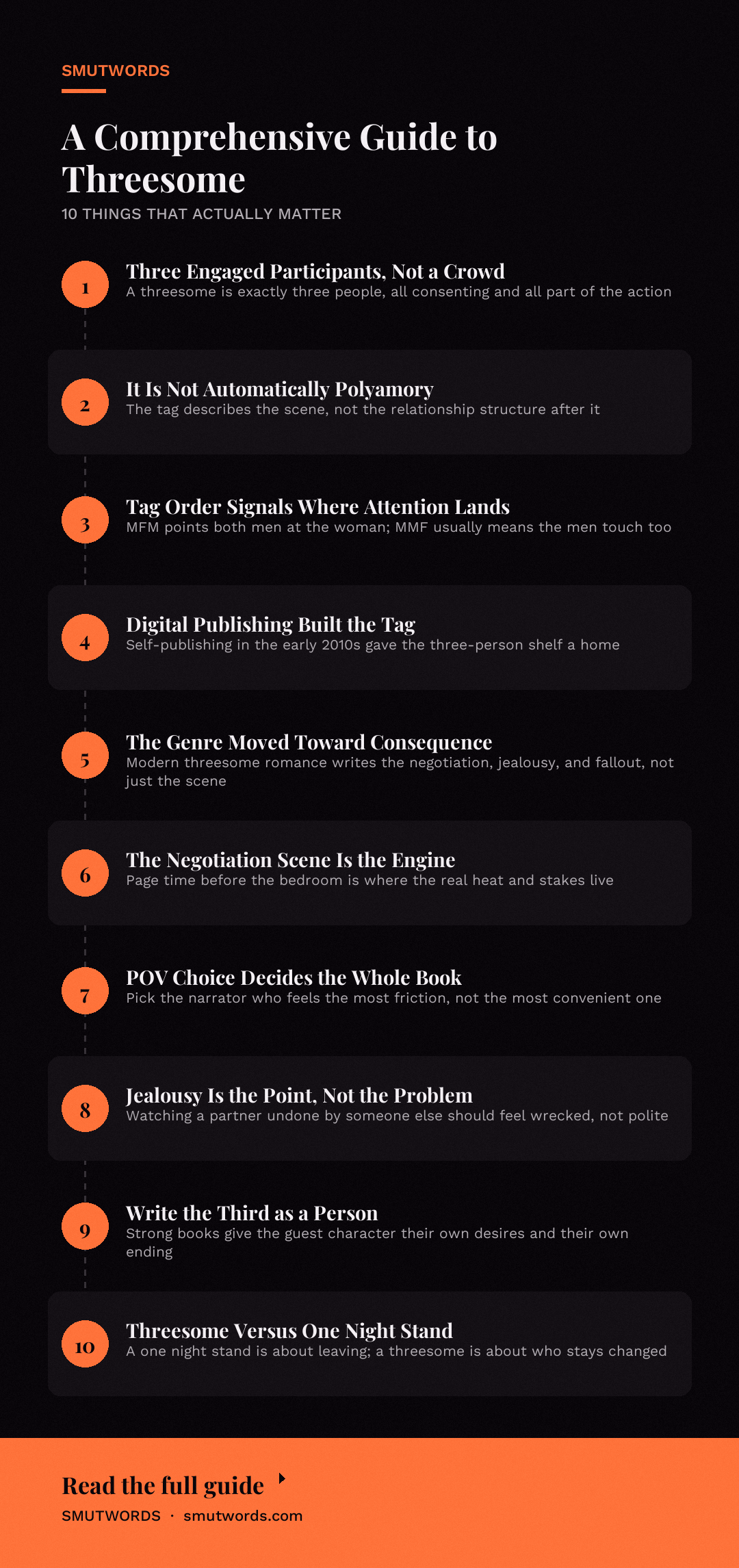
An MFM is two men and one woman. An MFF or FFM is two women and one man. The letter order in a tag often signals who focuses on whom, and readers who care about that order care a lot. Check the tags before you buy.
What does not count is a crowd. Once you cross into four or five or a dozen participants, you have an orgy, and the emotional logic changes entirely. A threesome is small on purpose. There are only three perspectives to track, only three sets of hands, and that tightness is where the tension lives.
It also does not count when one person is a passive observer who never wanted to be there. A threesome in fiction requires buy-in from all three. If one partner is blindsided, coerced, or checked out, you are reading a different story (infidelity, betrayal, hurt that needs healing), not the threesome dynamic itself. The scene might still contain three bodies, but the trope has been swapped for something darker.
Here is the short list of what actually qualifies:
- All three engaged. Mutual participation, mutual consent, whether stated on the page or clearly implied.
- A temporary formation. The encounter is the event. The three-way does not need to become a permanent triad for the trope to count.
- Emotional stakes attached. In romance specifically, the threesome usually carries negotiation, jealousy, possessiveness, and fallout. The heat and the feelings are sold together.
- Specific gender arrangements. MFM, MFF, FFM, and the rarer MMM or FFF versions, each with its own reader expectations and its own shorthand on the tags.
One common misconception: that a threesome in romance is automatically a polyamorous arrangement. It is not. A one-night three-person encounter can be pure heat with no follow-up, while a couple-invites-a-third plot might end with the third person walking away and the couple stronger. The trope describes the scene, not the relationship structure afterward.
Another misconception: that the threesome is a male fantasy first and foremost. The reader demand cuts both ways. Two men focused entirely on one woman is one of the most reliably searched configurations in the genre, and the FF-plus-M setup has its own dedicated audience. The tag tells you where the attention points.
Where the Threesome Comes From
The threesome is old. Older than the modern romance genre, older than pulp paperbacks, older than the novel. Ancient literature has three-person arrangements in it, and every century since has found a way to write about them with whatever euphemism was available at the time. The fantasy is not a recent invention, and pretending otherwise would be silly.
What is recent is the publishing history. The threesome as a tag, as a shelf, as a thing readers search for and authors deliberately build a book around, is a creature of the digital erotica boom.
When self-publishing opened up in the early 2010s, authors could publish short, high-heat, single-trope books directly to readers, and readers could tell the market precisely what they wanted by buying it. The three-person tag exploded because the appetite was already there and finally had a shelf to sit on.
Early digital threesome erotica leaned almost entirely on the scene. Short works, one encounter, minimal emotional aftermath beyond a satisfied sigh. That sold, and it still does.
The shift readers should know about is the move toward consequence. Over roughly the last decade, mainstream romance publishing and the bigger self-published names started treating the threesome as a full narrative engine: the negotiation before, the jealousy during, the fallout after, the relationship rebuilt or expanded in the final act. The scene stopped being the whole book and became the pivot the book turns on.
The couple-invites-a-third subgenre is the clearest example. That plot needs a full-length novel to work, because the entire appeal is watching two established partners figure out whether they can share and how it changes them if they do. You cannot get that from a four-thousand-word short. The market caught up to the emotional demand and the books got longer.
The other shift worth naming: reader tolerance for the "unicorn" figure. The trope of the bisexual third, usually a woman, brought in to complete a couple's fantasy and then politely dismissed, took a deserved beating from readers who wanted the third treated as a person. Contemporary writing handles that figure with more care, more interiority, and often gives the third their own ending rather than using them as a plot device.
How a Threesome Shows Up in Erotica
Craft time. The threesome looks easy to write and is not. Three bodies means three points of view competing for space, three sets of motives, and a geometry problem that defeats a lot of authors on the first draft. Here is what the strong versions do.
The negotiation scene is the real engine
The best threesome books spend as much page time on the conversation before the scene as they do on the scene itself. Who suggests it first? What are they afraid of? What are their limits, and are those limits stated plainly or nervously hinted at?
A couple agreeing to invite a third has to answer hard questions, and the answers are where the heat lives. See our breakdown of hard limits vs soft limits for the vocabulary these scenes actually need.
Do it weakly and you get a couple who agree for no reason, a scene with no stakes, and a resolution that rings hollow. Do it well and every touch in the bedroom afterward carries the memory of what was said at the kitchen table.
POV makes or breaks the configuration
Who is narrating? This is the single biggest structural choice.
A first-person POV from one half of the couple gives you the possessive ache and the guilt of enjoying the jealousy. A rotating three-way POV lets the reader see the third person as a full human being instead of a prop. Omniscient narration, rarely the right call for high-heat scenes, flattens everyone.
Strong authors pick the POV that exposes the most emotional friction. If the husband is the jealous one, the wife's POV is more interesting than his, because you watch her watch him. If the third is the one catching feelings, their POV is the book.
Enjoyed this? Get a free book.
Join the list and we will send a complete free story straight to your inbox, plus new releases every week after that. No credit card, no catch.
The vocabulary of the scene is specific and it matters
Readers of the subgenre know the terms. An MFM might be built around spit-roasting (one partner at the mouth, one at the other end), or a double penetration scene, or a more tender arrangement where the two men focus entirely on the woman. The tags tell you which. A monster cock kink overlay is common in fantasy threesomes where the physical proportions take on a mythic quality, and paranormal settings often use that shorthand on purpose.
The variations an author can run:
- MFM, partner-focused. Two men, one woman, both men devoted entirely to her pleasure. The female reader's fantasy engine.
- MFF or FFM, attention split. The woman between two partners, or between a partner and a new woman. Often where a character's queerness gets explored for the first time.
- Couple invites a third. The committed pair plus an outsider, with negotiation, jealousy, and a defined ending. The highest-stakes version.
- Three-way with strangers. No history, no aftermath, pure encounter. Closer to the one night stand emotional register but with three bodies.
- Three-way with a best friend. The friends with benefits problem turned up a notch: pre-existing trust plus a new sexual dynamic plus the fear of ruining the friendship.
There is a difference between a threesome as a relationship expansion and a harem romance, where the third becomes a permanent addition to an ongoing multi-partner household. Harem uses the threesome as a starting point and keeps growing; the threesome trope itself finishes with three people in a room and whatever ending they choose.
The jealousy is not a problem to solve
The mistake new authors make is trying to write jealousy out of the scene. They produce a threesome where nobody feels anything uncomfortable and everyone is gracious, and the scene dies on the page.
The jealousy is the point. The possessiveness is the point. A lover watching their partner come undone under someone else's mouth should feel wrecked, not polite. The heat comes from the conflict of wanting to share and hating to share and discovering which impulse wins in the moment.
What strong authors actually do
They write the third person as a whole character with their own desires, not as a delivery system for the couple's fantasy. They make the arrangement negotiable mid-scene, with a clear pause-and-check moment that shows consent in action. They end the book with someone changed: the couple stronger, the third with a future, or a clean, honest goodbye.
Weak versions treat the third as furniture, skip the emotional aftermath, and lean on a lot of gasping and very little interiority. If you read one and feel let down, that is usually why.
Where adjacent kinks fit
The threesome makes a natural home for a lot of specific play. A rough sex dynamic with two partners sharing intensity is common in the darker configurations. The primal, animalistic energy of primal play maps well onto a three-body chase scene.
A threesome with a rope-tying setup (one party shibari-bound and the other two working freely) is its own small subgenre. Keyholding can also appear in couple-plus-third plots where the established pair already has a D/s structure and the third enters as a guest in that structure.
Threesome vs One Night Stand
Both are temporary, often anonymous, and both resolve without lasting commitment (unless the author subverts that). The confusion is fair. The threesome has one defining difference: the third body.
An one night stand is about the risk of a single stranger and the vulnerability of a single encounter. A threesome is about the dynamics among three people, which almost always includes one established relationship or one established friendship that gets moved by the heat.
The one night stand is about leaving. The threesome is often about who stays, or who has been changed by what happened. If you want the pure stranger-heat version with one other person, read the one night stand. If you want the triangulation, read the threesome.
Frequently Asked Questions
What is the difference between MFM and MMF?
MFM (male-female-male) usually means the two men focus their sexual attention on the woman in the middle. MMF usually means the two men are also sexual with each other, not just with her. Tag order signals where the attention lands. Some publishers use the letters loosely, so check the specific book's warning tags if this distinction matters to you.
Do threesomes in romance always end in a triad?
No. Some do, and the triad ending has become a popular subgenre, especially in the contemporary and why-choose corners of the market. Many threesome romances end with the couple intact and the third person walking away, or with all three going separate ways.
The tag describes the scene. The ending is a separate promise you should check before you commit to a full-length book.
Is it cheating if the couple agreed to a threesome?
Not by definition, and the strong books make that distinction explicit. A threesome with prior, explicit, enthusiastic consent from all three participants is not infidelity, and authors who blur that line are usually writing a betrayal plot rather than the threesome trope. If the encounter was hidden, coerced, or a surprise, it is something else entirely.
What is a unicorn in threesome romance?
Unicorn is shorthand for the bisexual woman a couple brings in to complete an MFF or FFM threesome. The name comes from the idea that such a woman is rare, agreeable, and conveniently unattached. Contemporary romance has started to push back against the trope, treating the unicorn as a full character with her own needs, and letting her not be discarded at the end of a chapter.
What does DP mean in the tags?
Double penetration: one person being penetrated by two partners at once. It shows up in MFM and in some MMF configurations, and it is often flagged in the book's warning tags because it is a hard line for some readers. Check before you start if it is not your thing.
Do threesomes require safe sex discussion on the page?
In real life, absolutely, and in good fiction the conversation usually appears or is at least implied. Readers who care about realism look for it, and authors who skip it entirely can pull a reader out of the scene.
In a fantasy or paranormal setting, the discussion often gets compressed or replaced with world-building for the same reason: readers want to see that the characters gave it thought.
For a sense of how fantasy romance handles the boundaries conversation with the rules swapped out, our paranormal romance guide is a good place to see the pattern. If you are sorting out what belongs in a scene versus a limit, the hard limits vs soft limits piece walks through it plainly.
Final Thoughts
A threesome is three bodies and a negotiation. The heat comes from the trust required, the jealousy triggered, and the discovery of what a person wants when the rules of their usual coupling get suspended. Write it with the kind of interiority a full relationship gets, and it works. Skip the emotional toll and lean on the choreography, and it flattens fast.
If you want to start somewhere strong, read a full-length MFM contemporary romance with a well-reviewed negotiation scene and a defined couple-plus-third ending. The soulmate trope compression of that same dynamic is another route to the same tension when you want the universe to do the negotiating for you. Start with the list below and see what holds up.







Loading comments…