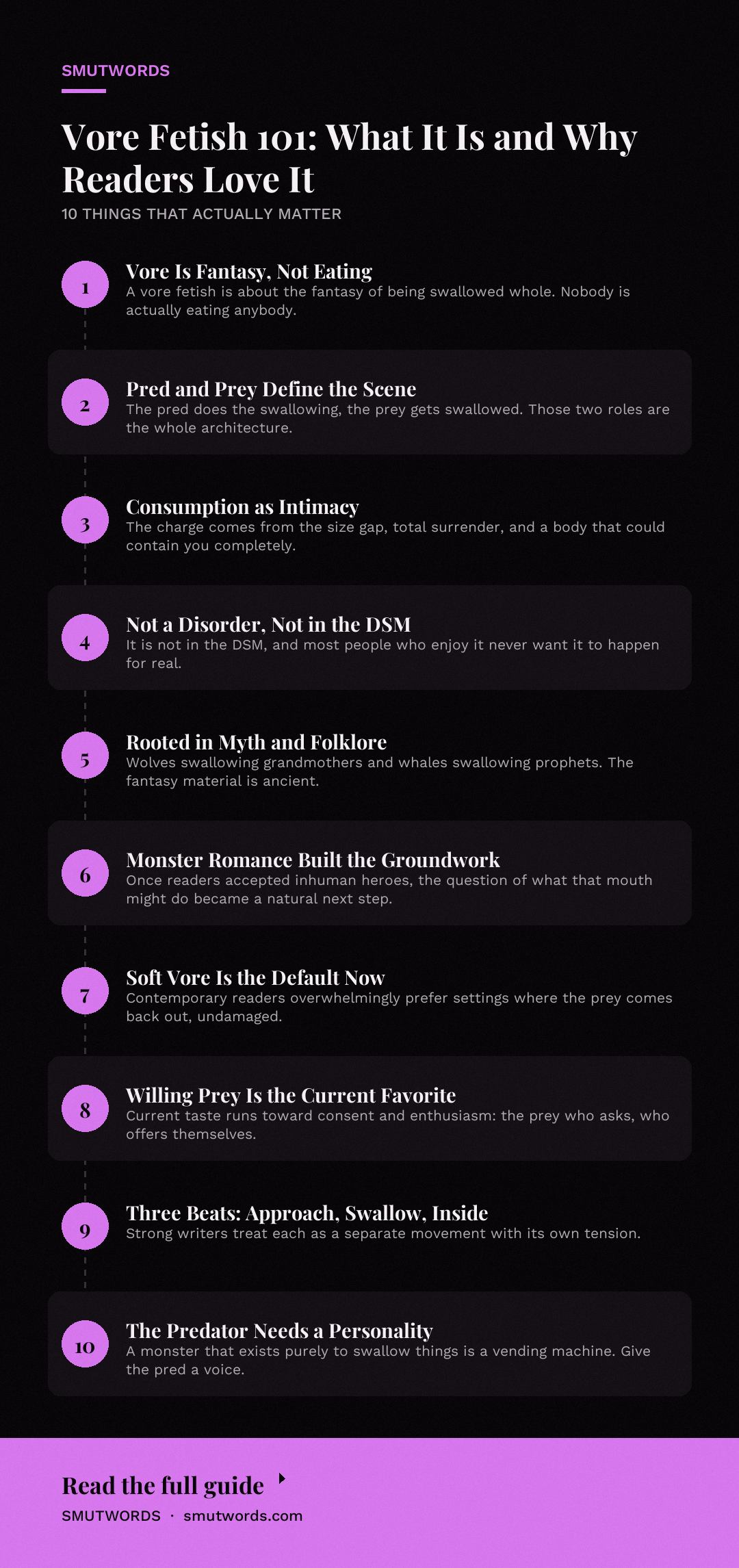
A vore fetish is a sexual interest in the fantasy of one being swallowing another whole. The word is short for "vorarephilia," from the Latin vorare, to devour, and in practice the vore fetish lives almost entirely in imagination, roleplay, and written fiction. Nobody is actually eating anybody.
What turns people on is the scenario: the size gap, the total surrender, the body that could contain you completely. In romance and erotica it shows up most often as monster, giant, or creature fantasy, sometimes played as horror and sometimes as the most intimate act two characters can share.
If you found this page after typing "vore fetish" into a search bar at an hour you'd rather not admit to, you're in the right place. This is the long version: the definition, the history, how authors actually write it, what separates a scene that works from one that leaves readers cold, and the practical questions about roleplay and limits that come with a kink that has zero real-world physical counterpart.
What Vore Fetish Actually Means
The core of vore is consumption as intimacy. One partner takes the other inside their body entirely, and the erotic charge comes from the scale of that, the finality of it, and the trust or helplessness involved depending on how the scene is set up.
The pred is the one doing the swallowing. The prey is the one being swallowed. Those two roles are the whole architecture of the kink.
Vorarephilia as a term circulates in fetish communities and eventually in academic writing about online sexual subcultures, where it gets grouped with other fantasies of transformation and bodily incorporation. It is not in the DSM, it is not a disorder, and the overwhelming majority of people who enjoy it never want it to happen for real. The fantasy is the point.
What counts as vore
Vore covers an enormous range, and the edges of the category are argued about constantly by the people who read and write it. Broadly, a scene counts as vore when one character is swallowed or ingested whole by another. Within that frame, everything from a gentle fairy-tale gulp to graphic monstrous devouring gets filed under the same word.
The shared element across every variant is the body boundary being crossed entirely. Other kinks play with fluids, textures, or parts of the body. Vore plays with the whole body disappearing into another one.
What doesn't count
A few things get mistakenly folded in. Cannibalism played for gore without the whole-swallow element is usually filed as something else, though hard vore overlaps with it. Mouth fetishism, biting, and general oral fixation are separate interests that can appear alongside vore without being vore.
Inflation is a close cousin and often confused with it. Inflation fetish is about the body swelling and being filled with something. Vore is about being taken into a body. The overlap is real, especially in pred-focused scenes where the predator's belly distends after a meal, but they are distinct fantasies with distinct appeal.
Common misconceptions
The biggest one is that vore fans want to eat people or be eaten. Almost nobody does. The genre's own vocabulary, pred and prey, is fantasy-role language, the same way "dominant" and "submissive" describe a scene rather than a legal status.
The second misconception is that vore is exclusively a horror kink. Soft vore, non-fatal vore, and willing-prey stories make up a huge share of what gets written, and the emotional register there is closer to paranormal romance than to monster horror. Readers come to it for extreme closeness, not for fear.
The third is that it's a niche so tiny it barely exists. Vore has one of the larger and more organized fan fiction communities of any fetish, with its own archives, tagging conventions, and decades of continuity. More on that below.
Where Vore Fetish Comes From
Vore as a named internet fetish goes back to the 1990s and the earliest days of Usenet, fetish webrings, and text-based archives, where vorarephilia got its own discussion groups and fiction collections. The term itself stabilized in that era.
Before the internet gave it a name, the imagery was already everywhere in myth and folklore: wolves swallowing grandmothers, whales swallowing prophets, witches fattening children in cages. The fantasy material is ancient. The organized community that named it is not.
In romance publishing specifically, it arrived sideways, through paranormal romance and monster romance, both of which normalized the idea of a human heroine paired with a being whose body does not follow human rules.
Monster romance is the genre that made vore-adjacent content publishable at scale. Once readers accepted a hero with tentacles, a tail, or a mouth that opens wider than physics allows, the question of what that mouth might do became a natural next step. Authors who never wrote explicit vore still built the scaffolding: the size gap, the threat that turns tender, the inhuman partner who could destroy the heroine and chooses not to.
How the trope has evolved
Two shifts are worth tracking. The first is from fatal to non-fatal as the default. Early internet vore fiction leaned heavily on digestion and permanence.
Contemporary romance and erotica readers overwhelmingly prefer settings where the prey comes back out, undamaged, often literally carried inside the predator for safekeeping. Soft vore became the dominant register.
The second is the rise of the willing prey. Older vore content often ran on terror and helplessness. Current taste runs strongly toward consent and even enthusiasm: the prey who asks, who offers themselves, who finds being swallowed the most peaceful place in the world. That shift mirrors the larger move toward negotiated, consent-forward kink writing across the whole genre.
Format changed too. Vore was born in text and it stayed textual longer than most fetishes, partly because illustration and live-action versions get censored fast and partly because the fantasy is easier to write than to depict. The result is a genre where the writing carries almost the entire load, which is why craft matters so much more here than in kinks that can lean on visual spectacle.
How It Shows Up in Erotica
On the page, a vore scene is built out of three things: the approach, the swallow, and the inside. Strong writers treat each as a separate movement with its own tension. Weak writers rush to the swallow and then have nowhere to go.
Enjoyed this? Get a free book.
Join the list and we will send a complete free story straight to your inbox, plus new releases every week after that. No credit card, no catch.
The approach is where the size gap gets established and the prey's reaction gets set. Is the prey terrified, curious, willing, or already begging? That choice determines the entire emotional register of the scene, and it needs to be made early. A scene that can't decide whether it's horror or tenderness reads as neither.
The craft beats that make a scene work
The swallow is the money shot and it rewards slow motion. Sensation is the tool here: the heat of the mouth, the pressure, the sound, the changing texture of the world as the prey moves deeper. Writers who linger on physical detail in a tight sequence of short sentences get far more out of this beat than writers who describe it in one abstract paragraph.
The inside is where the kink becomes something romance readers actually want to read. A dark, warm, enclosed space, the predator's heartbeat as a lullaby, conversation that can only happen here. This is where willingness pays off, because a prey who chose this is experiencing safety at the center of what should be the most dangerous place imaginable. Authors who can hold that contradiction give readers the thing the kink is really built to deliver.
Common variants authors use
- Soft vore is the default in romance and erotica. The prey is swallowed whole, survives, and comes back out. The tone ranges from tender to playful.
- Hard vore includes chewing and digestion. It's rarer in romance publishing and shows up mostly in the darker corners of fan fiction and horror-inflected erotica.
- Non-fatal vore means the predator's body simply accommodates this. Magic, alien biology, or a monster that doesn't work like anything on Earth explains the survival.
- Fatal vore ends with the prey not coming back. It's the higher-stakes version, and it needs careful handling in a romance context because dead partners usually break the genre contract.
- Willing prey is the current favorite. The prey offers themselves, asks to be swallowed, and experiences it as pleasure, safety, or intimacy.
- Unwilling prey runs on fear and being overpowered. It leans on the same appeal as other dark fantasy dynamics and, like all of them, is a roleplay scenario rather than a preference for real harm.
- Giant or macro vore pairs the swallow with a huge size difference. The predator doesn't need a special mouth; they need a human body small enough to fit in a hand. This is the version that most closely overlaps with monster romance.
- Monster vore puts the mouth on something non-human. Tentacles, extra jaws, and shifting anatomy all live here.
- Cock vore is exactly what it sounds like: the prey is drawn into a partner's cock rather than their mouth. It's a distinct sub-variant with its own dedicated readership, and it connects vore to the wider world of body fluid play.
The connection to other textures is real. A predator's mouth, the wet of it, the heat, all sit near the sensory territory of food play, and some writers lean into that deliberately by turning the swallow into a full sensory experience of taste and appetite and afterglow.
The size-gap element also hooks into muscle worship in its giant variant. A predator who is enormous and powerful and completely in control of their strength is the same fantasy object as a bodybuilder under worship. The difference is what happens to that body's power: in vore, it's used to enclose the prey.
What separates strong vore writing from flat vore writing
The strongest scenes make a decision about the emotional tone and commit. Terror, tenderness, reverence, hunger, or some deliberate mixture where the danger and the safety are both real. A scene that lands on one register and holds it gives the reader something to feel. A scene that hedges, softening its horror with jokes while undercutting its warmth with threats, reads as confused.
The second craft rule is that the predator needs a personality. The swallow is only as powerful as the being doing it, and a monster that exists purely to swallow things is a vending machine. Give the pred a voice, a reason, an appetite that has preferences, and the prey's choice to enter becomes a meaningful one.
Finally, the aftermath. A vore scene that ends the moment the swallow completes is missing the part that readers actually remember. Where does the prey go after? How are they held, returned, changed? What does the predator do with the intimacy once it's happened?
That last page of a scene carries the emotional weight.
Vore Fetish vs Food Play
The comparison worth making is with food play, because the two get confused often and the confusion is understandable. Both involve the mouth, appetite, and eating in an erotic context.
The difference is what's being eaten. In food play, actual food is the medium: chocolate, cream, fruit, the sensory and taste experience of them in bed. The mouth and appetite are the kink, not what disappears down a throat. In vore, the eating is symbolic of a body disappearing into another body, and the sensory pleasure of taste is a distant second to the size gap, the enclosure, and the predatory dynamic.
That's why, unlike food play, vore has essentially no real-world practice. It runs on fantasy in a way that very few fetishes do. Its safe-practice guidance therefore draws not from physical-safety rules but from the negotiation, check-in, and aftercare structure that underpins all kink play. If you're sorting out where your own lines are, the hard limits vs soft limits breakdown is the place to start.
Frequently Asked Questions
Is a vore fetish safe?
The fetish itself is safe because the practice never involves real flesh, real swallowing, or any physical risk. The things to negotiate are the roleplay elements: who plays pred, who plays prey, and what the scenario can and can't cover. If you're exploring this with a partner, the hard limits vs soft limits framework applies directly.
What's the difference between soft vore and hard vore?
Soft vore keeps the prey intact and alive, generally with the tone of warmth, safety, or playful consumption, and it dominates romance and erotica. Hard vore includes chewing, digestion, and permanent harm to the prey, and it's much rarer in published romance. The two audiences barely overlap, and writers who use either term usually know exactly which one they mean.
Can vore be a real-life kink practice?
Only as fantasy roleplay. No one is actually swallowing a partner, and the appeals of the fetish (total envelopment, being held inside another person, the size gap) can only be approximated in real life through roleplay, storytelling, tight physical enclosure, and similar symbolic substitutions. Most people who enjoy vore are content for it to exist entirely in fiction.
What's the difference between vore and inflation?
Inflation is about a body being filled and swelling from it. Vore is about a body being taken into another body.
The two overlap in pred-focused scenes where the predator's belly distends after swallowing someone, and plenty of people enjoy both, but the underlying fantasy is different. Inflation centers on the swelling. Vore centers on the enclosure.
Is willing prey the most common version in romance?
Yes, by a wide margin in current romance and erotica. The willing-prey setup, where the character offers themselves or asks to be swallowed and finds the experience peaceful or euphoric, lets the scene function as extreme intimacy. Unwilling-prey scenes still exist, but they lean on a darker fantasy and are more likely to be tagged with warnings.
Where do I find vore erotica?
Fan fiction archives with detailed tagging systems are the largest source, and a growing number of monster romance and paranormal romance novels include vore-adjacent scenes even without using the term. Look for tags like soft vore, non-fatal, and willing prey, and expect content warnings to do a lot of work. The list below this article is a good starting point from the SmutWords catalog.
Final Thoughts
Vore is a whole-body kink, and the writing that does it best never forgets it's about intimacy at the most extreme scale the imagination allows. The swallow is the headline. The appeal is being held somewhere the rest of the world can't reach.
If you're new to the genre, start with a willing-prey, non-fatal story where the predator has a real voice and the ending is soft. You'll know within one chapter whether the kink is for you, and you'll have a much clearer sense of which versions you want next.






Loading comments…