
Most people try blindfold play for the first time with a necktie and a vague sense of adventure, and most of them get away with it. But "get away with it" is a low bar for something that shuts off a whole sense.
The first time you do this properly, the room gets louder. The air on your arms registers. You hear your partner breathe from across the bed. That's the payoff, and it's worth doing right instead of fumbling it with a silk scarf that slips at the wrong moment.
So here's the practical version: how to choose something safe to wear, how to talk about the scene first, what can actually go wrong, and how to build intensity without skipping the parts that keep both of you okay.
What blindfold play actually is
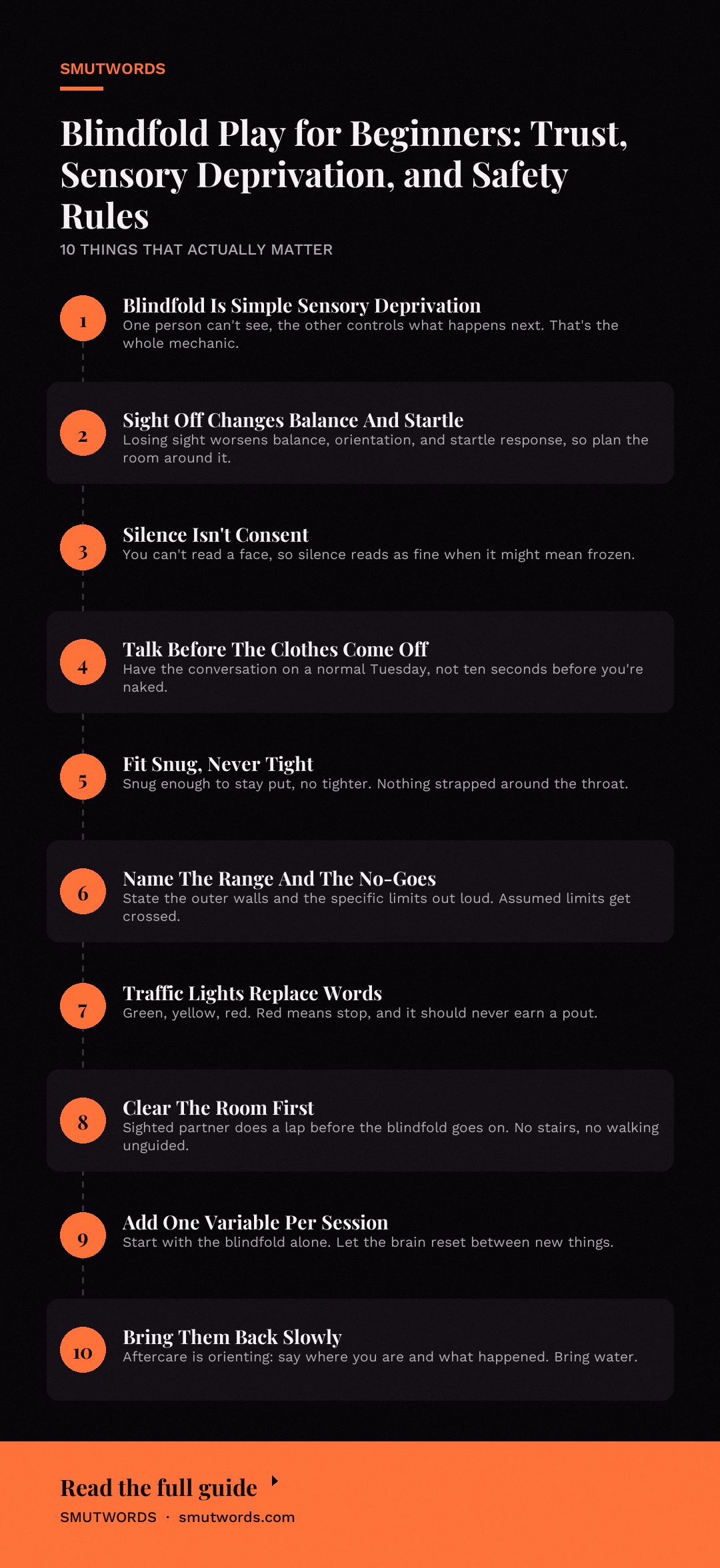
Blindfold play is sensory deprivation in its simplest form. One person can't see, and the other person controls what happens next. That's the whole mechanic. Everything else (the anticipation, the sound cues, the way a single fingertip on the wrist can land harder than it should) comes from that one removed sense.
People like it for different reasons. Some want the surrender. Some want to stop performing, because when you can't see anyone watching, you stop editing your face. Some just want the surprise, the not-knowing-where-the-next-touch-comes-from.
A lot of people find the blindfold is the thing that finally quiets the mental chatter. There's nothing to look at and nothing to think about except what's happening.
It's also one of the easiest entry points into a kink dynamic if your partner is curious but nervous. No rope, no gear to buy first, no equipment to learn. You fold a clean cloth, you put it on, you pay attention.
Why the blindfold is a beginner toy, but not a risk-free one
Here's where the necktie people go wrong. Blindfolding removes your sense of sight, which means balance gets worse, orientation gets worse, and startle response gets faster. If your partner is standing in an unfamiliar room, or near a stairwell, or on a bed with a hard frame, that loss of orientation is a real safety issue.
It also changes the communication channel. You can't read a face for discomfort, so the person wearing the blindfold has to say things out loud, and the person who isn't needs to actually listen instead of guessing. Silence reads as "fine" when it might be "frozen."
None of that is a reason to skip it. It's a reason to plan around it. The safety part of blindfold play is unglamorous, and it's where people who actually do this stuff differ from people who watched a video once.
If you want a wider frame for sorting what you're into before you ever put a cloth over anyone's eyes, the hard limits vs soft limits breakdown is the place to start. "I'm curious about being blindfolded" is not the same as "I'm okay with being blindfolded while you do X."
How to bring it up with a partner
Do it before the clothes come off. Blindfold play, like most sensory play, works best when the conversation happens on a normal Tuesday, not in the ten seconds before you're both already naked.
Try something plain: "I want to try being blindfolded with you. Nothing complicated. You put something over my eyes and I don't know what's coming next. I'd want to start slow, and I'd want a way to stop it that's easy."
That's it. No manifesto. The person on the receiving end can say yes, no, or "what does slow mean to you."
If you're the one who wants to do the blindfolding, say that instead. Either direction is fine. What matters is that both of you know who's wearing it before the scene starts, and that neither of you is negotiating mid-scene.
One thing worth being explicit about: blindfolding someone in a roleplay scene with strangers, a party, or a power dynamic where the person on the bottom is supposed to be overwhelmed on purpose. That works in fiction (the dynamic in a house party scene is basically built on that kind of controlled overwhelm), but the real-life version needs harder guardrails, not looser ones. Real sensory deprivation should never mean "surprise, you don't know who's in the room."
Choosing a safe blindfold
The cloth matters more than people expect. A few things to sort before you put anything on anyone's face:
- Fit and slippage. If it's loose enough to fall off, it's loose enough to fall onto a face during a kiss and end the scene. If it's tight enough to leave marks, it's too tight. You want it snug enough to stay put and no tighter.
- Breathability. Silk, cotton, and soft leather are all fine. Anything plastic or latex stretched tight over the nose is not. Anything that covers the mouth and nose together is off the table for a beginner blindfold. This is not a breath-play toy.
- No straps around the throat. A tie knotted at the back of the head is fine. Anything that sits low across the neck to hold the blindfold in place is a no. That's a breath restriction risk and it does not belong in a beginner scene.
- Nothing in the eye sockets. Padded eye masks can be comfortable, but a hard eye cup that presses on the eyelid is uncomfortable and, if it slips, an eye injury. Soft, flat cloth is your friend.
- Hair catch. Long hair plus a tight tie equals pain at the end of the scene. Ask before you put it on, and check before you take it off.
You can buy a proper sleep mask from any pharmacy for nine dollars and it'll do the job. You can also spend money on a leather blindfold from a real kink shop, which will look better and last years. Either one is fine.
What you should not do is grab a random scarf, knot it tight, and hope. A lot of cheap novelty blindfolds come with elastic that stretches out by the second use and eye cups that press. Read the description before you buy.
Negotiating what's coming before the blindfold goes on
This is the part that separates a good first session from a mediocre one. Even with a partner you've been with for a decade, the blindfold changes the game, because surprise is the whole point and surprise is also the thing that has to be pre-approved.
Here's the structure that works:
- Name the range. Not a script. A range. "Touch, teasing, some touching with an object if I'm into it, no impact." Or "I want to be teased for a while and then taken." The person doing the doing should know the outer walls before they walk inside them.
- Name the specific no-goes. Whatever it is: no tickling, no scratchy textures, no hands on the throat, no cold objects, no sounds loud enough to startle. Say them out loud, even if they feel obvious. Assumed limits get crossed more often than stated ones.
- Pick a stop signal. More on this below, but the short version is: agree on a word, and agree on what happens when someone says it.
- Agree on the check-in. Something like: "I'll squeeze your hand every few minutes and you squeeze back, and if you don't, I stop." That gives the blindfolded person a way to say "still here" without using words, and it gives the other person a way to check without breaking the mood every ninety seconds.
If you want a fictional model of what an ongoing power dynamic with actual negotiation looks like, a book like The Caregiver's Covenant treats the check-in as part of the intimacy. That's the right instinct. The check-in isn't the interruption. It's part of the scene.
Enjoyed this? Get a free book.
Join the list and we will send a complete free story straight to your inbox, plus new releases every week after that. No credit card, no catch.
The traffic-light signal, and why you need it
When you can't see, "no" becomes harder to say out loud. Not impossible. Harder. A lot of people freeze, especially in the first blindfold scene, because the combination of not-seeing and being turned on short-circuits language.
So you want a signal that doesn't require words and doesn't require sight. The standard is the traffic-light system, and it's standard because it works:
- Green means go, keep going, more of this.
- Yellow means slow down, ease up, I need to adjust or I need you to check in.
- Red means stop everything now.
What red actually triggers has to be pre-agreed. For most people it means the blindfold comes off immediately and you sit still for a minute. It should never mean "the scene is over and I'm annoyed." If a red word leads to a pout, the person on the bottom learns to stop using it, and then you have no signal at all.
For the person wearing the blindfold, the traffic-light word is the primary signal. For the person who isn't, the check-in is. Both need to be agreed on before anything goes over anyone's eyes. For more detailed negotiation language, the sensory-play version in the temperature play guide uses a near-identical structure, since the risk profile is the same shape.
Balance, orientation, and the room
Once the blindfold is on, the room becomes an obstacle course you can't see. Some practical rules:
- Stay on the floor or on the bed. No stairs, no standing in the middle of a room with furniture behind you, no leaning against anything that isn't a wall or a partner.
- Clear the path first. Before the blindfold goes on, whoever is sighted should do a lap. Phone on the floor? Book on the rug? Chair where it doesn't usually live? Move it.
- No walking unless you're being guided. If the scene involves moving rooms, the sighted partner walks beside and holds an elbow or a hand. The blindfolded partner should be able to feel an arm in front of them before they take a step.
- Sitting or lying is easier than standing. If someone feels dizzy or disoriented when the blindfold goes on (this happens, especially if they've had anything to drink), the fix is to sit, take the blindfold off, and drink water. Nothing dramatic.
- Cut the alcohol down or out. Blindfold play needs fast, clear signalling. Alcohol blunts all of it.
One thing to name plainly: if you're combining blindfold play with rope or restraint, you're no longer in beginner territory. Do the blindfold first, alone, across a bunch of scenes, before you add restraint on top. You want to know how your body feels when the sight goes off before you add another variable.
And if you do add restraint later, do it with someone experienced who can show you the ropes (literally) and the safety-release knots, not on a whim.
Building intensity gradually
The good news is intensity is easy. What gets people is not the big dramatic thing, it's the buildup. A few ways to build it without skipping steps.
Start with the blindfold alone. Nothing else on. Just a partner who touches you (a hand on the shoulder, a kiss on the neck) while you adjust to not seeing.
Some people need two or three sessions at this level before they want more. That's normal.
Then add one variable at a time. One session, maybe it's a feather or an ice cube (with the partner keeping the ice moving constantly and away from the eyes and the nose; the temperature play guide covers this if you want the full risk rundown). Another session, maybe it's a specific sound, or a piece of clothing. Choose one new thing per session and let the brain reset in between.
Later, if you and your partner are into it, you can add a light power dynamic on top. A voice in your ear, a directive, a game of guessing what's coming next. The dynamic from something like a soldier romance beat ("do exactly what you're told, don't ask why") is fun in fiction and can be fun in the bedroom. It just needs the same check-in structure on top.
If you want a fictional reference point for what it reads like when done well, the fiction is there. The safety rules are the same either way.
When to stop
A scene ends when one of you says it does. Practically, there are specific moments to stop or check in:
- The check-in squeeze doesn't come back. If your partner is supposed to squeeze back and doesn't, stop and take the blindfold off. Immediately.
- Yellow doesn't get a check-in. If yellow gets said and the scene keeps going at the same pace, the signal is dead. Every yellow should be acknowledged out loud.
- Any sign of panic, freezing, or unexpected crying. Not because crying is inherently bad in a scene, but because a blindfolded person crying without being able to see their partner is a specific kind of frightening. Take the blindfold off and check in.
- Dizziness, nausea, or a headache. Take it off, sit down, water.
- Anything that would break a limit if it happened a second time. Stop and talk it through after.
The post-scene part matters as much as the during. Aftercare for blindfold play is mostly orienting. The person who was blindfolded comes back to the room slowly. Say where you are, what happened, what day it is.
Bring water. Don't fill the quiet with a full postmortem unless they want one. The next day, when you're both calm, is when you talk about what worked.
A note on what to read if you like the dynamic
Some readers come to blindfold play because the fiction got there first. If you want books where the same sense of being led-and-trusted is the whole engine, there's a lot to pick from.
The dynamic in The Pleasure Drone Experience runs on controlled overwhelm, which is the psychological version of the blindfold. The living gene vault angle goes in for a very different kind of surrender. None of it is a how-to. All of it is a fun place to sit with what you want before you bring it up to a real person.
Final Thoughts
If you want one concrete next step: buy a real sleep mask, not the scarf, and use it for one scene with nothing else added. No restraint, no toys, no game. Just the blindfold, a pre-agreed check-in squeeze, and the traffic-light word.
Sit with what shifts in the room when one sense goes off. If it's good, you'll know exactly what to add next, and you'll have already built the habit of checking in. If you're a reader who wants to see the dynamic done well before you try it, the negotiation-as-intimacy beat in The Caregiver's Covenant is the closest thing on our shelf.







Loading comments…