
The scene ends. The restraints come off, the flogger gets put away, and everyone involved is fine.
Except the dominant is shaking on the bathroom floor at 3 a.m., convinced they're a monster. Except the submissive is crying into a pillow because the world has gone flat and gray and their partner looked at them funny an hour ago. This is drop, and it's the part of a kink scene most erotica gets wrong or skips entirely.
If you're writing kink fiction and want the scene to actually land, you need to know how to write sub drop in fiction with the same attention you give to the scene itself. The crash is where the characters get real. Get it right and readers will reread the scene for the emotional payoff, not the punishment. Get it wrong and you've written torture that fizzles.
Let's start with what drop actually is, because a lot of writers treat it as a plot device or a way to make a character cry for dramatic effect. It's neither.
What Drop Actually Is (and What It Isn't)
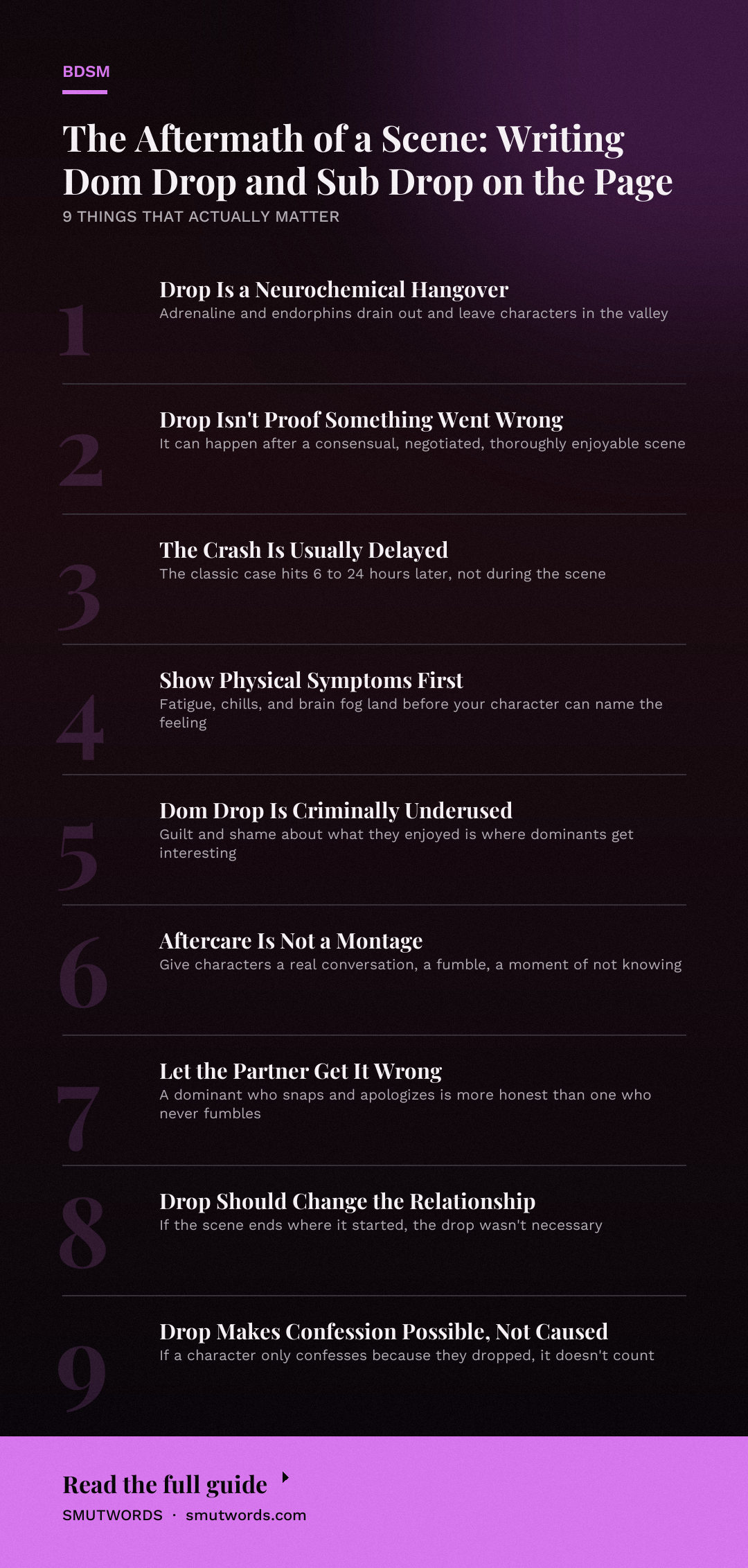
Drop is the emotional and physical crash that can follow intense play, and it hits dominants and submissives differently. It's a neurochemical hangover. Your character spent hours in a state of heightened arousal, adrenaline, endorphins, and vulnerability, and now the chemistry is draining out and leaving them in the valley.
For a submissive, sub drop usually shows up as moodiness, tearfulness, self-doubt, shame, a sudden sense of worthlessness, physical exhaustion, or feeling disconnected from their partner. Sometimes all at once.
For a dominant, dom drop looks different but has the same root: guilt, fear of having harmed their partner, shame about what they enjoyed, a sudden need for reassurance that they aren't a bad person. A dominant who just spent an hour calling their submissive a worthless bitch and meaning it may spend the next hour convinced they've ruined someone.
Both can happen even when the scene was consensual, negotiated, and thoroughly enjoyable. Drop isn't proof that something went wrong. It's proof that something went right enough to shake the nervous system.
What drop isn't: a punishment for bad behavior, a sign that the characters aren't compatible, or a convenient way to force a confession scene. If your dominant breaks down and admits their love solely because of drop, that's manipulation with a diagnosis.
Timing: When Drop Actually Happens
Most writers put drop in the wrong place.
It doesn't happen during the scene. It doesn't even reliably happen immediately after. The nervous system has a buffer, and the crash often comes hours later or the next day, sometimes two days later once life gets quiet again.
- Immediate drop (minutes to an hour after): less common for submissives, more common for dominants who rush aftercare or realize mid-session that they're overwhelmed.
- Delayed drop (6 to 24 hours): the classic case. The submissive wakes up the next morning feeling hollow or clingy or weepy and can't explain why.
- Late drop (a day or two after): shows up when the submissive is alone, at work, or dealing with something stressful that compounds everything.
That timing is the gift for pacing. If you're writing a slow-burn kink romance, a delayed drop the morning after a heavy scene can be the turning point where the dominant shows up with food and a bag of frozen peas and asks how the submissive actually is. That scene lands like a declaration of love because it's one.
If you want a heavier dose of scene-then-caretaking dynamics, Absolute Surrender is worth reading for how it handles the immediate aftermath instead of skipping straight to the next chapter.
Symptoms, Physically and Emotionally
Drop symptoms are often physical before they're emotional, which is useful for writers because you can show the crash before your character can name it.
Physical symptoms: fatigue, chilliness, headache, muscle aches, feeling shaky or weak, appetite swings (either ravenous or nothing sounds good), difficulty sleeping or sleeping for twelve hours straight, brain fog, and sometimes a feeling that their body isn't quite theirs.
Emotional symptoms: sudden tearfulness, irritability, self-critical spiraling, clinginess or the opposite (pulling away), flatness, feelings of worthlessness, shame, and a kind of free-floating dread that doesn't attach to anything in particular.
The key is specificity. A writer who says "she felt sad after" has written nothing. A writer who says she sat on the bathroom floor for forty minutes and couldn't figure out whether she wanted to be held or left alone, and when her partner knocked she answered "fine" in a voice that even she knew was wrong, has written drop.
The emotional drop is a mood sink, not a mood swing. Write it that way.
Enjoyed this? Get a free book.
Join the list and we will send a complete free story straight to your inbox, plus new releases every week after that. No credit card, no catch.
Writing the Dominant's Crash
Dom drop is criminally underused in kink fiction, and that's a shame because it's where dominants get interesting. A dom who is perfectly composed after the scene hasn't been fully written yet.
The dominant's crash often runs: "I hurt them." "They flinched and I didn't stop fast enough." "I liked it, which means something is wrong with me." "I didn't hold them long enough after." "They're going to leave." The dominant may spiral harder than the submissive because they're often the least practiced at receiving care. They're the one who planned the scene, negotiated the rules, and stayed steady. Asking for reassurance is its own kind of submission.
Some doms crash in private. They wait until the submissive is asleep, then sit on the balcony and smoke a cigarette they don't usually smoke. They get weirdly aggressive the next morning and the submissive can't figure out why. That's drop in a dominant, played as irritability, and it's a scene I'd like to see more of.
If you want a reference for the harsh version of scene dynamics and the aftermath that has to repair them, genital torture play in fiction goes nowhere without the return-to-care sequence. The care is the payoff. Readers are here for it.
What Partner Response Looks Like on the Page
Aftercare is where a lot of kink fiction falls apart because writers hit the "cuddle and chocolate" beat and stop. Aftercare is not a montage. Aftercare is a character saying "can you tell me what you need right now?" in a voice that sounds genuinely uncertain, and the submissive not knowing, and both of them sitting with that.
The most common aftercare moves, in scene form:
- Physical grounding: a blanket, water, food the submissive will actually eat, physical touch (or not, depending on the character's preference).
- Verbal reassurance: "You did well." "I've got you." "That was a lot, and I'm right here." Specific, not generic.
- Debriefing: the "what worked, what didn't" conversation, usually later, sometimes over breakfast, sometimes days later when the drop is over.
- Presence: staying in the room, staying through the night, not leaving until the submissive is genuinely settled.
The partner's response to drop is a different beast. They're not just delivering aftercare, they're being a witness. They might have to reassure their submissive that the scene was okay. They might have to reassure themselves.
They might also get it wrong. Snap at the wrong moment, apologize, try again. That version is more honest than the one where the dominant never fumbles.
If your characters are in a situation where consent or care is complicated (a fake relationship where the power exchange was supposed to be temporary and then became real, a couple with something to prove), the drop scene forces the "do we actually care?" question into the open without a single speech. The drop is the test. The care is the answer.
Drop and Relationship Type: It Changes the Scene
The shape of a drop scene depends heavily on what kind of couple you're writing. A drop hit between two characters in a marriage in trouble hits different than a drop hit between two strangers who've just done their first scene together.
In a marriage in trouble story, the drop can be the first genuine vulnerability either of them has shown in years. The dominant who crashes after a scene, and lets their spouse see it, is doing something they've never done before. That's a turning point in a way a straight apology scene never would be.
In a soldier romance, drop has an extra layer: a character trained to compartmentalize and push through, now dealing with an emotional crash they can't tactical their way out of. The submissive may have been through actual trauma, and now their body is responding to a consensual scene like it's real. The care scene becomes a question of whether the dominant can be trusted to see them like this.
If you're reading for examples of the range, the best BDSM books list has a handful where the drop is written honestly and a handful where it's skipped entirely. The contrast is instructive.
The Mistakes Writers Make
Here are the failure modes I see most often, and what to do instead.
- Instant drop for dramatic effect. The submissive bursts into tears the second the rope comes off because the scene was intense. This flattens the scene into melodrama. Let the crash be delayed, or let the immediate reaction be physical (shaking, nausea, dissociation) rather than a speech.
- Dom drop treated as a plot twist. The dominant's guilt is revealed as a shocking secret. Real dom drop happens in the open, in the form of withdrawing, snapping, or needing reassurance, and the submissive can usually tell something is off even if they can't name it.
- Aftercare as montage. A paragraph of "he gave her water and chocolate and held her." That's a shopping list, not a scene. Give the characters a conversation, a fumble, a moment of uncertainty.
- Drop as a confession device. "She only told him how she felt because she dropped." Then it doesn't count. The drop should make the confession possible, not cause it.
- Skipping it entirely. The scene ends, aftercare happens, everyone's fine, next chapter. This is the most common mistake, and it leaves the kink scene feeling like a set piece rather than an intimate act.
How to Make It Land: A Checklist
When you're drafting a drop scene, ask yourself:
- Whose point of view is it in? Drop hits differently from inside vs. outside. The dominant watching the submissive crash is a scene; the submissive inside the crash is a different scene.
- What specific symptom shows up first? Pick one physical detail and one behavioral one.
- What does the partner say, and what do they get wrong? A fumble makes it real.
- What's the resolution? Not "they cuddled" but "they understood each other a little better."
- Does it change the relationship, or does it reset? Drop should alter the balance. If it ends where it started, it wasn't necessary.
Final Thoughts
If you want to see a drop written with real care and a dominant who fumbles and keeps showing up anyway, read Absolute Surrender and pay attention to the morning after. The scene's final act tells you whether the kink was love or just a power trip. The drop scene is where the author proves they know the difference.








Loading comments…