
Most couples who try d/s rules and rituals for the first time make the same mistake: they design the protocol they saw in a book, or the one that turns them on most on a Tuesday night, and it collapses inside three weeks. Not because the fantasy was wrong. Because the rules were built for a version of them that doesn't exist on a Thursday morning when one of them has a cold and both of them are running late.
Protocols that stick are boring in all the ways a good relationship is boring. They're small, they're specific, and they're designed around the actual lives of the people doing them. Here's how to build a set of rules and rituals that survives contact with a real calendar.
What D/s Rules and Rituals Actually Are
A rule is a behavior. A ritual is a repeated act that marks something. "Send a message every morning by 9am" is a rule. The morning message functioning as an opening to the day and a small acknowledgment of who has the power between you is a ritual.
Most good protocols are both at once.
People want them for a few reasons. They create continuity in a dynamic that might otherwise only show up on weekend nights. They make submission tangible, something you can point to. They give the dominant partner something to actually do besides inventing scenes from scratch.
And for a lot of couples, the rules are the erotic engine itself: the small daily reminder that the power exchange is still switched on.
They also fail constantly, which is fine. A protocol that breaks down and gets rebuilt is more useful than one that runs so loose nobody notices it exists.
How to Bring It Up Without Freaking Out Your Partner
Do not open with the full list. If you arrive with a spreadsheet, your partner hears an ultimatum. Start with the feeling you're after, then let the rules catch up.
Try something concrete: "I've been thinking about the stuff we do on weekends and wishing some smaller version of it bled into the rest of the week. I want to try a few little rules and see what fits. Can we talk about it?" That's a conversation. Then actually have the conversation, outside the bedroom, when neither of you is turned on and neither of you is tired.
The negotiation itself is where the protocol gets decided. The dominant partner doesn't get to hand down the list unilaterally, at least not on the first pass. The submissive partner should have named what they want from it too: which rules they find hot, which ones feel like chores, which ones would humiliate them in a way they don't actually want.
A rule that only works because you're not allowed to object isn't a rule, it's a chore with a collar.
If you're both fictional-dynamic readers and you've been circling this for months, some of what you're chasing probably came from a book. A story like She Made the First Move shows the slow negotiation side of a power exchange where the rules accumulate before either party has named them. Useful to notice: the characters in good dynamic fiction are mostly not obeying a protocol, they're inventing one by accident.
Starting Small: The Three-Rule Ceiling
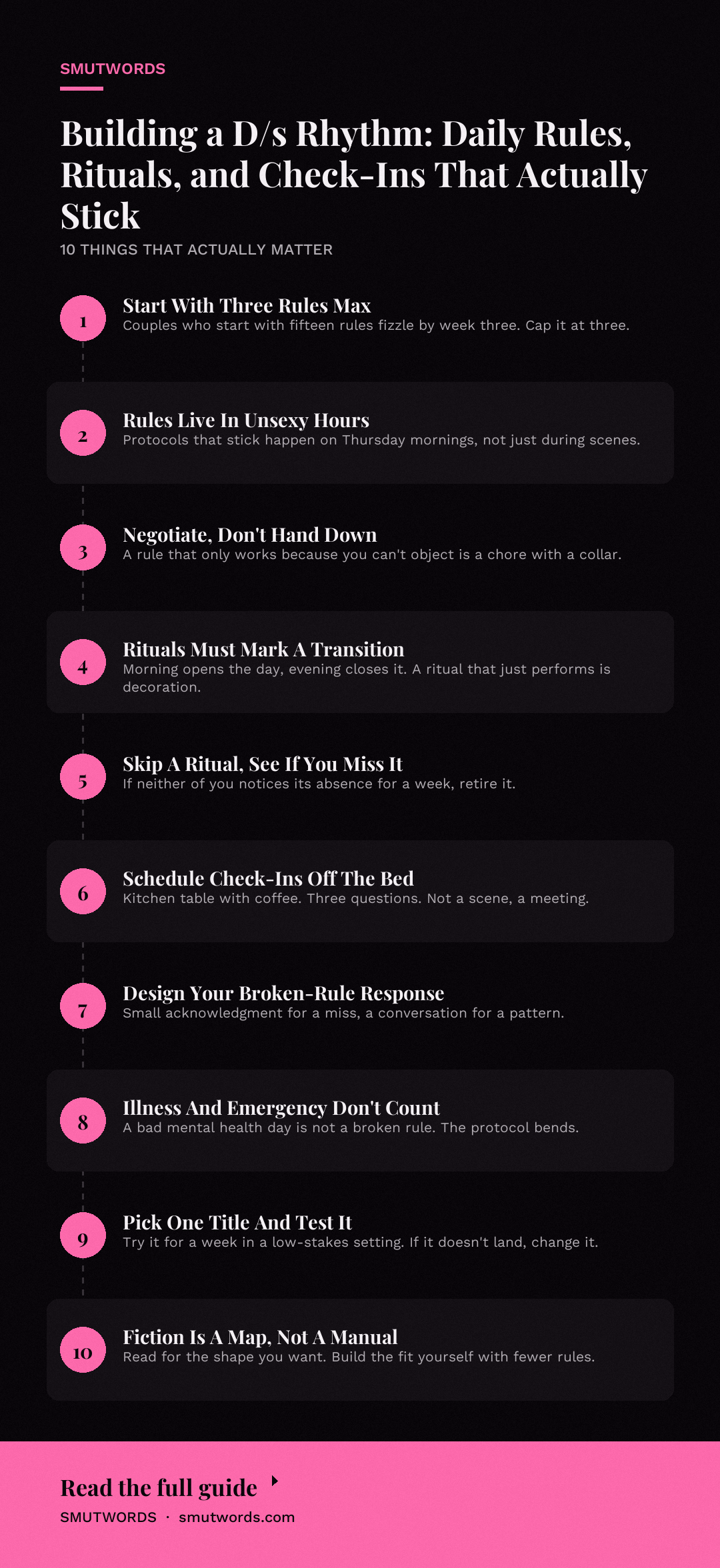
Pick three rules for the first month. No more. Nine out of ten couples who start with fifteen rules fizzle by week three, usually because the protocol was a second job dressed up as intimacy.
Start in one category. Morning and evening routines are easiest because they run on rails you already have. Something like:
- A daily message with a specific format: one line about the day, one line that acknowledges the exchange. "Good morning, sir. Today is X. I'm ready."
- A single evening check-out: naming one thing from the day you'd have done differently, said out loud before bed.
- One weekly task that has a real outcome, like a written note or a prepared decision about something that weekend.
Notice that none of those are about sex. The protocols that stick live in the unsexy parts of the day. If every rule in your set only fires during a scene, you don't have a rhythm, you have a schedule.
Rituals That Mean Something vs. Rituals That Perform
The failure mode of ritual is when it turns into theater. A collaring every Sunday night that neither of you feels anymore. A formal greeting that becomes a game of who forgets first. A safeword tied to a specific phrase that hasn't been used in six months and is now just a prop.
The test is simple. Stop doing the ritual for one week and see if you notice. If neither of you misses it, the ritual was decorative. Retire it and try something else.
If one of you misses it and can name why, it's doing real work.
Rituals that tend to hold up have two features. First, they mark a transition, not a state. Morning ritual opens the day; evening ritual closes it; a weekly ritual marks the weekend.
Second, they have a physical component that isn't dependent on being in the right headspace. A specific order of two sentences, a small object that gets picked up, a position held for ten seconds. The body does the ritual, the brain catches up.
If you've read dynamic fiction, you've seen this done well and done badly. Rituals in stories like The Embassy Breeding Pact land because they're tied to the plot's actual stakes, not because the author stacked them up. The rule exists because the character needs it to exist. Same logic for you.
Check-Ins: The Thing Most Couples Skip
Here is the part that makes or breaks a protocol. Schedule a check-in on the calendar, one per week minimum, and hold it somewhere neutral. Not the bedroom. Not in bed.
Sitting at the kitchen table with a coffee qualifies. Walking the dog works. The format doesn't matter as long as you both show up not already mid-scene.
Three questions are enough:
- Which rule is working and why?
- Which rule is starting to feel like a chore, and do we keep it, change it, or drop it?
- Is anything about this bothering me that I haven't said yet?
If nothing is bothering anyone, say so out loud. Silence on question three doesn't count as an answer, and the check-in is where you find out the protocol has been quietly grinding someone down for two weeks.
Do not treat the check-in as a scene. It's a meeting. If either partner starts using the check-in to test the other, or starts letting the power exchange shape the answers (a submissive who can't say "I hate this rule" because saying it feels like disobedience), the check-in has stopped working.
The submissive partner's ability to give an honest answer in that meeting is the safety valve. If they can't, the protocol has to pause until they can.
Enjoyed this? Get a free book.
Join the list and we will send a complete free story straight to your inbox, plus new releases every week after that. No credit card, no catch.
When a Rule Gets Broken
Rules will get missed. What matters is that the response to a missed rule is designed in advance and is proportionate. Sending a message at 10:15am when it was supposed to be sent at 9am doesn't merit the same response as ignoring a rule for a week and hiding it.
A useful structure:
- Have a small acknowledgment for a first or accidental miss: a redo, a sentence named out loud, a short task that ends the incident.
- Have a separate, slower correction for a pattern: more than two misses in a week is a conversation at the check-in, not an escalating punishment.
- Have a hard rule that a miss due to illness, emergency, or a bad mental health day is not counted. Life happens; the protocol bends.
- Have a safeword that pauses the whole protocol, not just the moment. Any partner saying it gets a check-in immediately, and nothing resumes until both of you want to resume it.
Punishment is a loaded word and the risk here is that people use "punishment" to mean a thing that causes real harm. If the correction carries physical risk, this is where you need to be honest: heavy restraint, breath play, anything that prevents a person from signaling a problem, all carry real injury risk and none of it belongs in a correction for a missed text.
Those belong in a negotiated scene with spotters, prior practice, and a plan for the worst case. They are not punishments for late messages.
If you're going to include anything physically intense, know what you're doing first, and read something like our Suspension Bondage 101 piece before you assume the pictures are the practice.
Titles and Names: Small, Load-Bearing Decisions
What your partner calls you isn't a cosmetic choice. The title does work. "Sir" and "Mistress" and "pet" and your own name said in a specific tone all land differently, and the difference compounds because you hear it every day.
Pick one. Don't stack up four titles because none of them felt right on the first try. Try one in a low-stakes setting for a week. If it doesn't land in the body, change it at the check-in.
If it does land, keep it, because a title that's become an internal signal is worth more than a title that sounds impressive.
The dominant's title gets the same scrutiny. Some people hate being called "Master." Some people hate it so much it kills the mood. That's information, not a compatibility problem.
The Trap of Porn-Ready Protocols
A lot of the protocols that break are ones modeled on fiction. Fiction compresses years of negotiation into four pages and drops the parts that aren't fun to read. A dynamic in a book like Inserted by the Mainframe runs on rules because the plot needs tension, and the tension is the point.
The same story, run in real life on a real couple with a dog and a job and a sick mother, needs fewer rules, more check-ins, and a way to stop.
The trap isn't reading the fiction. The trap is forgetting that the fiction isn't the manual. Read for the shape of what you want and build the fit yourself.
If the shapes you're drawn to run to things like The Caregiver's Covenant or Free Use Dungeon Master's Harem, that's a direction. It's not an instruction. And the pet play and genital torture play guides are useful for the same reason: read to see the mechanics and the safety logic, not to copy the scene.
If you want to see a dynamic protocol that has actually been negotiated, log it. A shared document with three sections: current rules, retired rules, and open questions. The document is more valuable than the rules. It proves the protocol is a living thing that both of you wrote, not a play you're staging.
When to Stop or Rebuild
The protocol has to be stoppable. That's not a footnote; it's the safety structure. A few signs it's time to stop and rebuild:
- One partner is going through the motions. They can't name a rule they actually like.
- The formal correction is starting to feel like the point more than the rule is. If the dynamic is now mostly about getting caught or getting punished, the ritual got eaten by its own enforcement.
- Physical or emotional symptoms are showing up that weren't there before: dread before the morning message, anxiety on Sunday night, a hollow feeling at the check-in.
- Either partner uses the word "should" about the protocol rather than "want."
Stop means stop cleanly. Pause the rules, keep the titles if that's still working, and do a bigger check-in than usual.
The protocol can come back smaller. Most of the time it should. The version you started with was the rough draft.
If the dynamic is creating real distress, that's a signal to talk to a kink-aware therapist, not to power through. Real distress isn't kink. It's something that needs different tools. The kink community has good referrals; the website you're reading doesn't replace them.
Building the Rhythm, Not the Rules
The couples who make d/s rules and rituals last a decade aren't running complicated protocols. They're running small ones they actually like, and they're changing them every few months. The Tuesday-night version of the protocol is almost certainly not the version that survives next year.
That's fine. The whole point of building a rhythm is that it can be rewritten without taking the relationship down.
If a specific dynamic is what you're drawn to (a soulbond-style instant power exchange, a slow-negotiation version, or something odder), the protocol is where you find out whether it's fantasy or something you can actually live inside.
Start with three rules. Check in weekly.
Retire what stops working. Stop when it stops being wanted.
That's not a lesser version of the dynamic. It's the whole thing.
Final Thoughts
Read Hitchhiker for Hire next, not as an instruction manual but as a study of a dynamic that builds rules by accident and keeps them because they earn their place. Then set a calendar reminder for Sunday night and write down the three rules you're actually going to try this month. If you can't name three, that's the answer to the first check-in.








Loading comments…