
Genital torture play is consensual BDSM practice focused on the genitals: controlled pain, impact, pressure, clamping, wax, ice, or electrical sensation applied to the most nerve-dense and psychologically loaded part of the body. In erotica and romance, it shows up almost exclusively inside negotiated Dominant/submissive dynamics. There it works as the sharpest available test of trust and a route to the deepest kind of submission a character can offer.
If you landed here from a scene that made you put the book down for a second, this guide covers what the term means, where it came from, how authors actually write it well, and how it works safely in real life.
What Genital Torture Play Actually Means
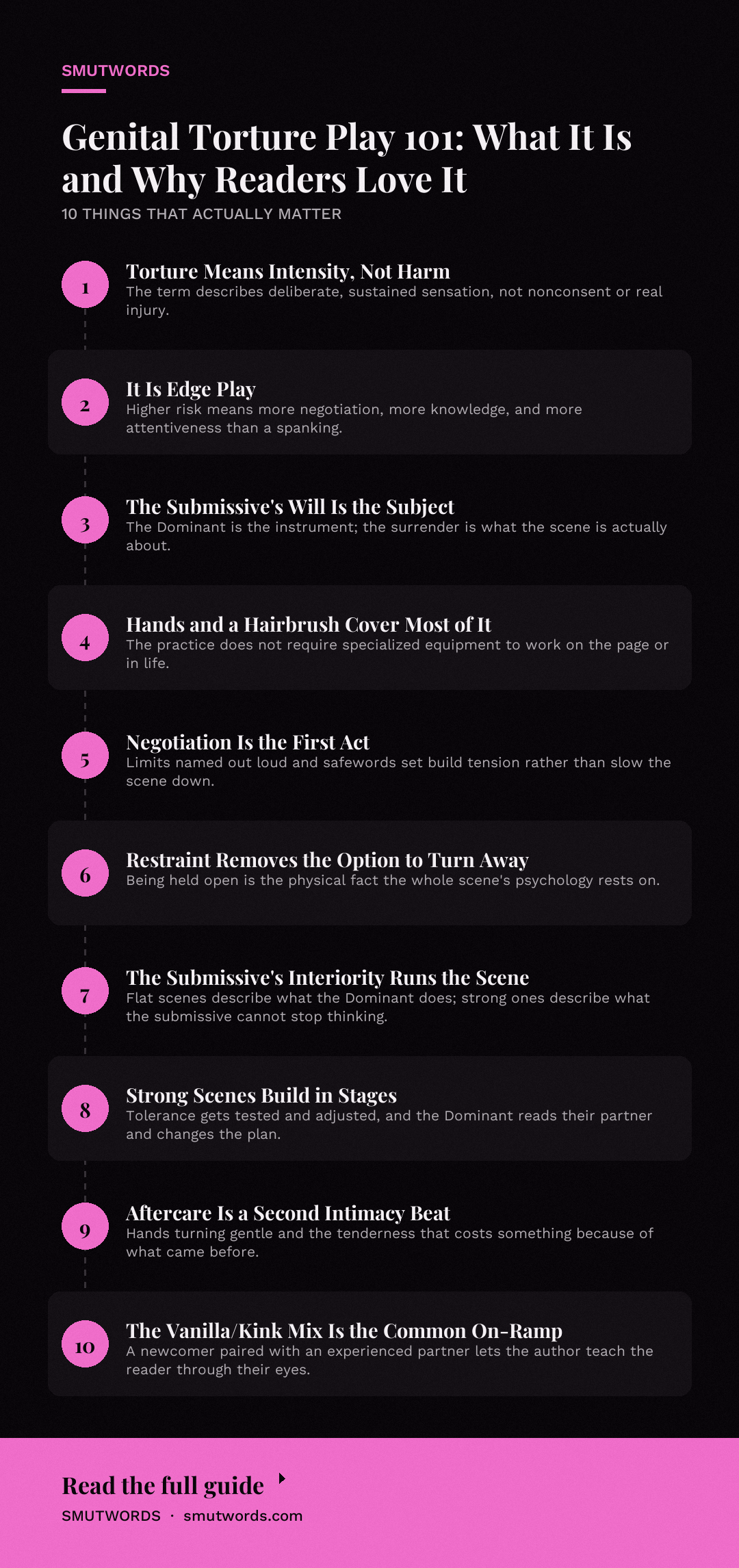
The name is blunt on purpose. "Torture" here refers to the intensity of sensation and the deliberate, sustained application of it, not to nonconsent or genuine harm. The practice sits under the wider umbrella of edge play: activities that carry real physical or psychological risk and therefore demand more negotiation, more knowledge, and more attentiveness than a spanking scene does.
What counts as genital torture play is broad. Impact to the genitals with a hand, crop, or flogger counts. Clamps and weights count. Wax, ice, and chemical sensation like ginger count. Electrical stimulation counts. Even prolonged overstimulation past the point of orgasm, the kind that turns pleasure into something a submissive has to endure, belongs in the category.
The common thread is targeted sensation on the genitals with an intensity or duration beyond what ordinary sex involves. What does not count matters just as much. Rough sex is not automatically genital torture play, and neither is a single hard grab during a scene that is otherwise about something else. The term describes deliberate practice with its own negotiation and its own arc.
One persistent misconception is that the practice is about a Dominant's cruelty. In almost every well-written version, and in real practice, it is about a submissive's willingness. The Dominant is the instrument; the surrender is the subject.
Another misconception is that it requires equipment. Hands, a hairbrush, and a partner who knows what they are doing cover most of it.
Where Genital Torture Play Comes From
In real-world BDSM communities, genital-focused play has been a recognized edge activity for as long as organized kink has existed, and the acronym CBT (cock and ball torture) entered common usage through leather and fetish subcultures in the late twentieth century. The female-bodied equivalent was discussed less openly for years, which is one reason the literature on it skews male-bodied.
The publishing history is more interesting for readers. Genital torture play entered erotic fiction through the same channel as most hard BDSM: underground pulp and specialty presses in the 1970s and 1980s, where it appeared as a marker of extremity rather than as a studied dynamic. The scene existed to prove how far a story would go.
The shift came with the mainstreaming of BDSM romance in the 2000s and 2010s. Once Dominant/submissive dynamics became a full genre with character arcs and emotional payoff, genital torture play stopped being shock material and became a plot tool. Authors started writing it as the moment a submissive's trust is proven, which meant writing the negotiation before it and the aftermath after it.
The most recent evolution is toward specificity. Earlier books gestured at pain. Contemporary ones name the implement, describe the anatomy, track the submissive's internal state through the scene, and treat aftercare as part of the scene rather than an epilogue. Readers now expect the mechanics to be accurate, and authors who fudge them get called out in reviews.
How It Shows Up in Erotica
A genital torture scene on the page is usually doing one of three jobs: proving trust, breaking a character open emotionally, or dramatizing a power exchange that the rest of the book has only implied. The physical action is the surface. What an editor looks for is whether the scene earns its intensity.
The negotiation is the first act
The strongest versions of this trope spend real page time on consent negotiation before anything happens. Limits get named out loud. Safewords get established. A good author uses that conversation to build tension rather than to slow the scene down, because a Dominant asking careful questions while a submissive gets more and more exposed is its own kind of foreplay.
When negotiation is skipped, the scene reads as reckless, and the trust it is supposed to demonstrate never gets established.
Restraint changes the scene
Many authors pair genital torture play with restraint, and how they do it matters. A submissive spread and held open on bondage furniture produces a different scene than one bound in suspension bondage, where the vulnerability includes being off the ground. The restraint is not decoration. It removes the submissive's ability to close their legs or turn away, which is the physical fact the whole scene's psychology rests on.
Sensory deprivation and the loss of anticipation
Blindfolds and ear protection are common companions, because a submissive who cannot see the next strike cannot brace for it. The craft payoff is that every sensation arrives without warning, and the reader experiences that same loss of anticipation. Our guide to blindfold play covers how authors use that deprivation to build trust on the page, and the same logic applies here at higher intensity.
Enjoyed this? Get a free book.
Join the list and we will send a complete free story straight to your inbox, plus new releases every week after that. No credit card, no catch.
Common variants authors use
- Impact on the genitals: hands, crops, and floggers. The most common version in print, and the easiest to write with clear physical detail.
- Clamps and weights: nipple clamps are the familiar entry point; genital clamps and weighted attachments escalate it. The delayed pain when a clamp comes off is a favorite beat.
- Wax play: hot wax dripped onto sensitive skin. Authors love it for the visual and for the anticipation of each drip. It overlaps heavily with temperature play, which covers the wider craft of heat and cold.
- Electrostimulation: TENS units and violet wands. Harder to write accurately, and the books that do it well get specific about the sensation: a buzz, a jolt, a muscle twitching without permission.
- Overstimulation: forced orgasms past the point of pleasure. Often the most psychologically brutal version because it weaponizes the submissive's own arousal.
- Sounding: a niche insertion practice involving the urethra. Rare in mainstream romance, meaningful in hard kink fiction. Our glossary covers sounding on its own terms.
What makes a strong version work
The best scenes keep the submissive's interiority running the whole time. A flat version describes what the Dominant does. A strong version describes what the submissive cannot stop thinking, and how each sensation changes the shape of their submission. The pain is the language; the character's response is the sentence.
Flat versions also tend to skip the plateau. They go from first strike to shattered climax in two paragraphs, which reads as wish fulfillment rather than as a scene. Strong versions build in stages, with the submissive's tolerance tested and adjusted, and with the Dominant reading their partner and changing the plan. That responsiveness is what makes the power exchange feel real.
Aftercare is where most weak scenes fall apart. A scene this intense needs an aftermath that reflects its weight, and authors who cut to the next morning lose the emotional payoff. The best use of impact play aftercare in a genital scene is as a second intimacy beat: the Dominant's hands turning gentle, the submissive shaking, the tenderness that costs something because of what came before.
The vanilla/kink mix angle
A popular framing in romance puts a newcomer with an experienced partner, which lets the author explain the practice to the reader through the newcomer's eyes. That structure draws heavily on the dynamics of a vanilla/kink mix relationship, where one character's discovery becomes the reader's education. It is the most common on-ramp for genital torture play in contemporary romance.
Genital Torture Play vs Aftercare
These are not the same thing and are not in tension, but the confusion is common enough to address. Genital torture play is the scene; aftercare is what follows it. In real practice they are a matched pair, negotiated together, and in fiction a scene written without its aftermath reads as incomplete.
Aftercare after genital work often looks different from aftercare after a spanking. The sensitivity and the psychological exposure can leave a submissive more raw, so authors who write it well give the aftermath more room: slower, quieter, more attentive. If the scene's intensity was the point, the aftercare is where the book proves the intensity was safe.
Frequently Asked Questions
Is genital torture play safe?
It can be practiced safely with real knowledge, negotiated limits, safewords, and awareness of anatomical risk, particularly nerve damage and circulation problems from tight clamps or striking. The risks are real and the practice is edge play, so it requires more preparation than most other kink. In fiction, accuracy about those safeguards is part of writing it well.
How is genital torture play different from rough sex?
Rough sex is spontaneous intensity inside a sexual encounter; genital torture play is deliberate, negotiated practice with its own structure. The difference is intention and planning. A scene has limits discussed beforehand, a safeword, and an arc from escalation to resolution, which rough sex does not necessarily have.
Why do romance readers seek out genital torture play scenes?
Because the vulnerability maps directly onto emotional surrender. Handing over the most sensitive part of the body is the physical version of the trust the whole story has been building toward. Readers want the scene that proves the dynamic is real, and this is the scene that does it.
What is CBT in erotica?
CBT stands for cock and ball torture, the male-bodied form of genital torture play, and it is the version most frequently written in hard kink fiction. The acronym predates the fiction by decades and comes from real-world fetish communities. Contemporary authors use it as one variant among several, not as a synonym for the whole practice.
Does genital torture play have to involve a Dominant and a submissive?
The power dynamic is the usual frame, but not the only one. Some versions appear in switch scenes, in partners who trade control, or in sadomasochistic arrangements that emphasize sensation over hierarchy. The core element is consensual intense sensation on the genitals, and the relational structure around it can vary.
How much negotiation detail should a novel include?
Enough to establish that the characters have limits, a safeword, and awareness of what they are doing, without turning the scene into a checklist. One well-written exchange does more work than a page of procedural detail. Readers need to see the trust built, and they need to believe the Dominant would stop on request.
Final Thoughts
Genital torture play is the sharpest tool a kink romance has for showing what a submissive will hand over and what a Dominant will hold carefully. Written flat, it is shock. Written well, it is the scene the entire book was building toward, and it earns the intensity only if the negotiation and the aftercare carry equal weight.
If you want a book that takes that obligation seriously, pick up a title where the Dominant asks the questions before anything else happens. That first careful conversation tells you whether the rest of the scene will be worth your time.








Loading comments…