
Suspension bondage is rope work that takes a partner off the floor entirely. The body is tied into a harness, hooked to a hard point overhead, and left hanging, so the submissive carries none of their own weight and the dominant carries all of it.
In romance and erotica, suspension bondage is the showcase scene: the moment a book stops talking about trust and physically demonstrates it, with a human being held in the air by knots and someone else's attention.
It shows up in contemporary BDSM romance, in dark romance, in kink-forward erotic novellas, and in anything with a competent rigger love interest. The appeal is blunt and visual. A body held aloft, rope crossing the skin, the submissive unable to stand, walk, or catch themselves. Every gram of safety depends on the person holding the other end.
What Suspension Bondage Actually Means
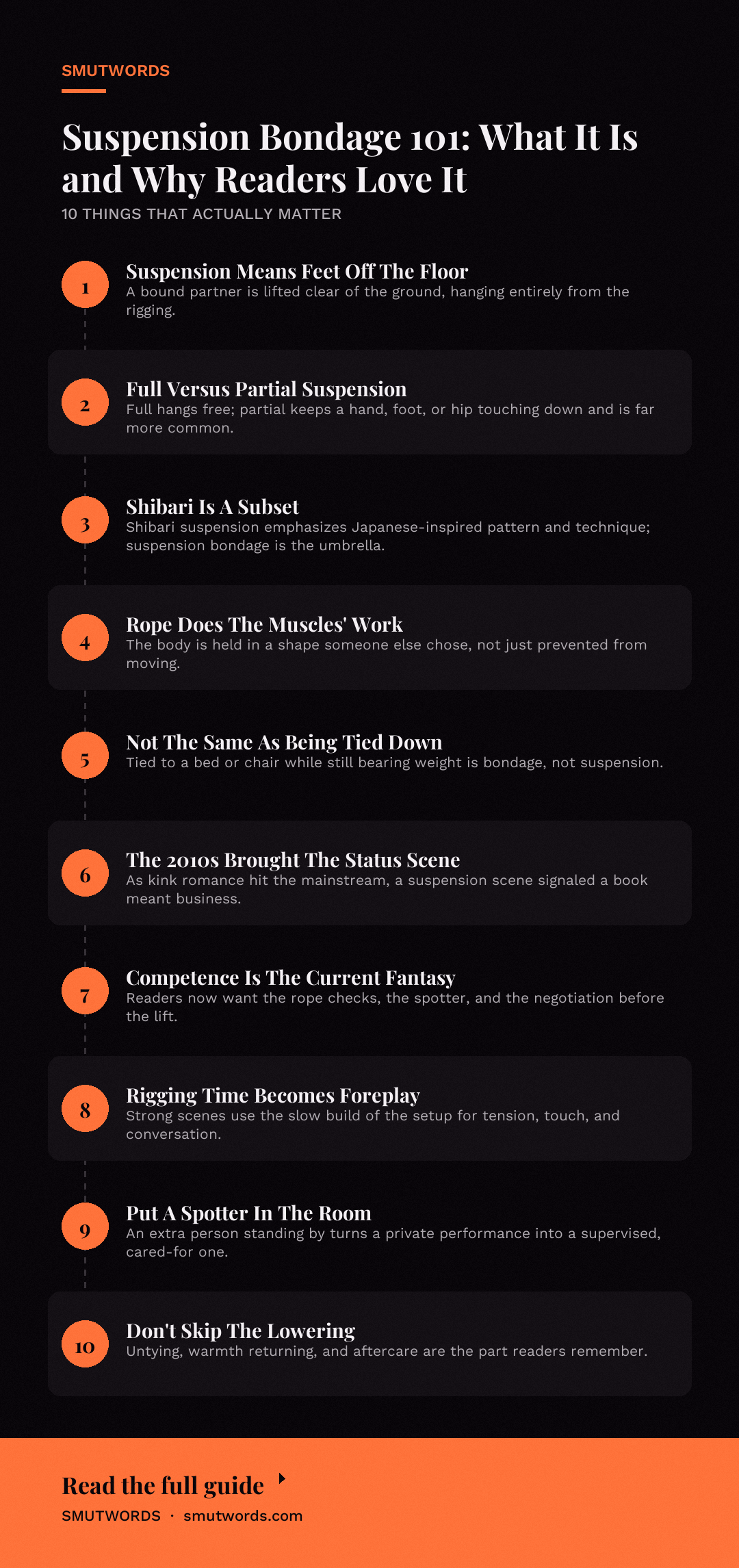
The term describes a bondage practice where a partner is bound and lifted clear of the ground, suspended from a frame, beam, ceiling hard point, or freestanding rig. Rope is the classic material for suspension bondage, but straps, leather harnesses, and purpose-built slings all count. What makes it suspension is the lift: the bottom's weight hangs from the rigging, not from the floor.
The practice splits into two broad categories. Full suspension means the entire body hangs free, with no part touching the ground.
Partial suspension keeps a hand, a foot, or a hip in contact with the floor, and it is far more common in real practice because it is easier on the body and easier to control. Erotica often writes full suspension because it looks more absolute, and because "not a single part of her touched the floor" is a sentence authors enjoy typing.
The word itself is plain and descriptive, which is typical of kink vocabulary. "Suspension" comes from the Latin suspensio, a hanging, and the BDSM usage is literal: the body is hung.
"Shibari suspension" folds in the Japanese term for rope tying, shibari, which entered English-language kink writing through the 1990s and became a shorthand for decorative, intentional rope work. The two terms overlap heavily. Shibari suspension emphasizes aesthetic pattern and Japanese-inspired technique; suspension bondage is the broader umbrella.
What counts as suspension bondage
- A partner tied in a chest or hip harness and lifted so their feet leave the floor
- A partial lift where one leg is raised and the body's weight shifts onto rope
- A suspended cradle, sling, or hammock rig the body rests in while hanging
- Static scenes where the submissive hangs and waits, and dynamic scenes where they are moved, spun, or lowered
What does not count
Being tied to a bed, a chair, or a frame while still bearing weight on the floor is bondage, not suspension. Wrist suspension where the arms take the full load is a real practice but a distinct one, and a book that describes "hanging by her wrists" is writing something far more dangerous and far less common than standard harness suspension.
A common misconception is that suspension means the submissive dangles passively and nothing else happens. On the page, the suspension is usually the setup for everything that follows: sensation play, teasing, impact play, and long stretches of helpless waiting. The rig is the stage, and the scene happens on it.
Another misconception: that suspension is purely about restraint. The rope is doing work that muscles normally do, and the body is held in a shape someone else chose. That shaping is half the point. The submissive is not just prevented from moving; they are arranged.
Where Suspension Bondage Comes From
The honest history here is thinner than kink publishing likes to imply. Rope bondage as a recognizable practice has Japanese roots in hojojutsu, the historical restraint techniques used on prisoners, and in the 20th-century erotic photography of artists like Itoh Seiu that turned restraint into an aesthetic. The modern shibari scene grew from that lineage in Japan and crossed into Western kink communities in the 1990s and 2000s through workshops, photography, and early internet forums.
But the version readers encounter in books is a publishing phenomenon as much as a practice. Suspension bondage entered romance and erotica as a visual set piece, and the timeline runs through three overlapping waves.
The 2000s: niche and instructional
Early appearances were confined to niche BDSM erotica, often written by authors embedded in kink communities, and to instructional and photography books. Suspension showed up as a marker of expertise: the dominant who could rig was the dominant who had clearly done this before.
The 2010s: the mainstream kink romance boom
When BDSM romance broke into mass-market popularity in the early 2010s, suspension scenes became a status symbol within the genre. A book could signal seriousness by staging one. The trouble was that many authors had never seen a rig and wrote scenes that would hospitalize a real person. Publishing caught up slowly, and reader communities started calling out implausible rigging the way they call out implausible sword fights.
The 2020s: competence as a kink
The current era treats the rigger's skill as the erotic center of the scene. Readers want the checklists, the rope inspection, the spotter standing by, the negotiation before the lift. Competence has become part of the fantasy.
A suspension scene where the dominant is careless now reads as horror, and authors know it. The shift mirrors a broader move in kink romance toward showing the unglamorous safety work as part of the intimacy.
The vocabulary evolved alongside the scenes. "Aerial bondage" and "suspension rigging scenes" appear in newer blurbs, and "harness suspension" has become the default phrase for the standard chest-and-hip configuration. The genre borrows the language of the real practice and then stretches it, which is normal for erotica and worth knowing before you read a scene and wonder whether any of it is accurate.
How It Shows Up in Erotica
A suspension scene on the page is a logistics scene wearing an erotic costume. The rig has to be built, the rope has to be checked, the submissive has to be lifted, and then the author has to fill however many pages of hanging time with something worth reading. The strongest versions know this and turn the logistics into foreplay.
What a good scene actually does, mechanically:
- Slows the pace down. Rigging takes time. Skilled authors use that time for tension, touch, and conversation, which is why anticipation play and suspension pair so naturally.
- Tracks physical detail. Rope bite, the ache in a shoulder, the pressure of a hip harness, the cold of a hook, the sound the rig makes. Specificity sells the lift.
- Moves the power exchange into the body. The submissive's inability to stand is the metaphor made physical: they are supported entirely by the dominant's competence and attention.
- Uses height for psychological effect. Being lifted changes the power geometry of a room. Eye contact has to be earned by someone looking up.
- Builds in a release. The lowering, the untying, the warmth returning to the limbs, the moment the submissive gets their feet back and their legs don't work yet.
Common variations on the page
Static suspension keeps the submissive hanging in one position for the duration of the scene. It is the most common variation in erotica because it is the easiest to write and the easiest to eroticize: a hanging body, a dominant circling it, hands available from any angle.
Harness suspension is the standard configuration, usually a chest harness plus a hip harness distributing weight across the torso. Authors who know the practice will name the specific harness. Authors who don't will still describe the shape, and the shape is usually what the reader came for.
Partial suspension keeps one foot or hand on the floor, and it is a favorite in slower, dialogue-heavy scenes because the submissive can still be moved, posed, and teased in a way that full suspension makes awkward.
Suspension plus sensory deprivation layers a blindfold or earplugs onto the rig, which is a real combination and one that blindfold play coverage explains well. The submissive hangs, cannot see, and has only the rope and the dominant's voice for information.
Suspension as punishment or prolonged denial places the scene inside a longer scene play structure, often with teasing, denial, or genital torture play once the submissive is fully immobilized. The rig becomes the thing that makes the rest of the scene possible, since the submissive's hands are entirely out of commission.
Enjoyed this? Get a free book.
Join the list and we will send a complete free story straight to your inbox, plus new releases every week after that. No credit card, no catch.
Adjacent practices show up in the same books and get confused with suspension by readers. Mummification also removes mobility and creates total dependence, but with wrap rather than height. Bondage furniture use can produce a similar "held in place" feeling without any lift. Both are worth knowing if suspension is your entry point into the genre.
What separates a strong scene from a flat one
Strong: the author knows what the rope is doing. The chest harness distributes weight. The submissive's arms are positioned so they don't take the full load. The rigger checks knots twice. Someone is watching.
The submissive's body is described as heavy in a way that is unfamiliar to them. The scene takes time.
Flat: the submissive is "hoisted effortlessly" in two paragraphs, hangs by the wrists, feels no discomfort, and is lowered twenty pages later with no aftercare. The scene is a costume change, not a scene. Readers who know the practice spot it instantly, the same way readers who know temperature play spot a wax scene written by someone who has never held a candle.
One specific edit that lifts almost any suspension scene: put a spotter in the room. An extra person standing by, watching, ready to take weight, turns the scene from a private performance into a supervised one, and supervision reads as care. It also gives the author a second set of eyes to describe the submissive with, which is a gift for point of view.
The scene should also acknowledge consent negotiation somewhere, even briefly. Not as a lecture, but as a beat. A sentence about what was agreed before the ropes came out does more for the eroticism than any amount of purple prose, because it tells the reader the submissive chose this and the dominant has a mandate.
And the aftercare is not optional. Rope suspension leaves marks, soreness, and a drop that can hit hours later. A scene that ends at the lowering misses the most emotionally loaded part of the sequence, and the part readers remember. The aftercare beat is where a suspension scene pays off everything it built.
A note on the real-world risk
Real suspension carries serious physical risk. Nerve compression, circulation loss, falls, and shoulder injury are all live possibilities even in competent hands. The rope that holds a body in the air has to hold it correctly, and the person tying has to know what to do when something goes wrong.
For readers who are only reading, this matters mostly as fictional realism. For the small subset who want to try it, the requirements are not optional and not negotiable.
A physically capable rigger with real training. Prior negotiation of limits and safewords. Full attention throughout, ideally a spotter.
And attentive aftercare that lasts well past the lowering. The fantasy is being held up entirely by someone else. The reality requires someone who can actually do the holding.
Suspension Bondage vs Bondage Furniture Use
These two get confused in review threads because both produce a body that cannot move and a dominant with full access. The difference is where the body's weight goes.
In bondage furniture use, the submissive is fixed to a piece of equipment, a bench, a frame, a cross, a chair, while the floor or the furniture takes their weight. They can't get up, but they're resting on something. In suspension bondage, there is no resting surface at all. The rig is holding them, and if the rig failed they would fall.
That distinction changes what the scene can do. Furniture allows longer scenes, easier dialogue, and more physical freedom for the dominant.
Suspension is shorter, riskier, and more total. Both are worth reading. They are not interchangeable, and an author who writes one and claims the other will get caught.
Frequently Asked Questions
What is suspension bondage?
A bondage practice where a bound partner is lifted off the ground and hangs from ropes, straps, or a harness attached to an overhead rigging point. The submissive's weight is held entirely by the rig, which makes them completely dependent on the dominant's skill.
Is suspension bondage the same as shibari?
Shibari is the Japanese-influenced rope tradition; suspension bondage is the broader category of hanging a bound body. Shibari suspension is a subset of suspension bondage with an emphasis on pattern, aesthetic, and technique. Many books use the terms interchangeably, though they aren't identical.
What is the difference between full and partial suspension?
Full suspension leaves no part of the body touching the floor. Partial suspension keeps a hand, foot, or hip in contact with the ground, which reduces physical strain and is far more common in real practice. Erotica tends to write full suspension because it reads as more absolute.
Why do readers like suspension bondage scenes?
The image is total: a body held in the air, unable to stand or catch itself, relying entirely on one person's competence. It dramatizes trust more vividly than dialogue can. The visual drama and the intimacy of careful rigging are both doing work.
Is suspension bondage dangerous?
Yes. Real suspension involves falls, nerve compression, and circulation risk even with an experienced rigger. Fiction usually softens this. Anyone considering the real practice needs proper training, a physically capable rigger, negotiated limits and safewords, and attentive aftercare.
Where can I read good suspension bondage erotica?
Look for authors with kink-community ties or a reputation for researched scenes. Reader review communities are the fastest way to find out whether an author knows what a chest harness actually does. The best scenes show the rigging, the checking, and the lowering, not just the lift.
Final Thoughts
The best suspension scene in the genre treats the rope as a sentence about trust and writes the whole sentence: the negotiation, the rigging, the lift, the hang, the lowering, the care that follows.
Start with a book that gets the aftercare right. If you're new to the practice on the page, our guide to heist romance is a useful reference for how competence-based dominance reads in other subgenres, since the same mechanics apply.
Pick the next suspension book by checking whether any reviewer mentioned a spotter.








Loading comments…