
The pregnant and alone trope is exactly what it sounds like: a character finds out she is carrying a child and faces the pregnancy, the birth, and the first fragile months of parenthood without the baby's other parent. Sometimes he walked out. Sometimes he died.
Sometimes he never knew, because she chose not to tell him, or someone made that choice for her. The pregnancy is the engine, the solitude is the pressure, and the whole book runs on whether she builds a life and a love that can hold her.
This is one of the most reliable emotional machines in romance and erotica. It puts a protagonist at her most exposed, gives her no easy out, and then rewards her with something earned. Readers come for the ache and stay for the arrival of a person who shows up and keeps showing up.
What the Pregnant and Alone Trope Actually Means
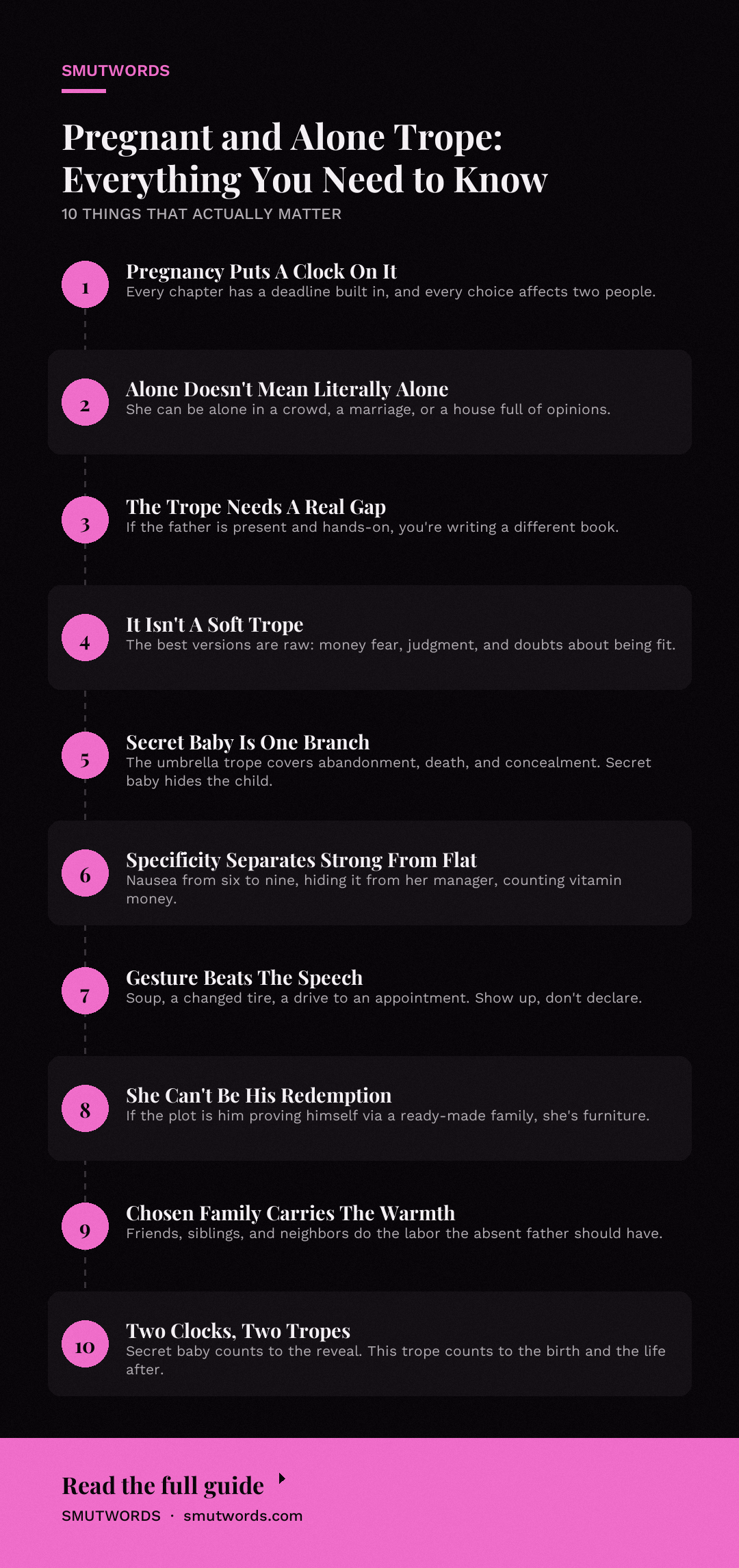
Strip away the plot mechanics and the pregnant and alone trope is a study in vulnerability with a countdown attached. Pregnancy gives the story a clock. Every chapter has a deadline built into it, and every decision the protagonist makes carries the extra weight of a second person who has no say in any of it.
The "alone" half of the phrase is doing more work than readers often notice. It doesn't require literal isolation. A woman can be pregnant and alone in a crowded city, in a marriage of convenience, in a house full of relatives who all have opinions.
What defines the trope is the absence of the one person whose presence would have made the situation ordinary: the other parent, at the moment they were needed most.
What counts as pregnant and alone
- The other parent abandons her before or shortly after she learns she's pregnant.
- The other parent dies, leaving her to carry both the child and the grief.
- She conceals the pregnancy or the child's existence, often because telling him would put someone in danger.
- He never learns about the pregnancy because he left before she knew, or because she couldn't find him.
- She is alone by circumstance rather than choice: deployment, imprisonment, distance, a family that disowned her.
What doesn't count
A pregnancy that unfolds inside an intact relationship does not belong here, even if it's complicated. Neither does a story where the father is present and active from the start and the "alone" refers only to some inner emotional isolation she's working through.
The trope needs a real gap where a partner should be. If the father is around, hands-on, and simply annoying, you're writing a different book.
Common misconceptions
The biggest one is that this is a soft, cozy trope. It isn't. The best versions are raw. They involve fear about money, about telling people, about whether she's fit to do this, and about what it means to want things for herself while someone else's whole life depends on her.
Another is that the trope is automatically a "sweet" romance. Some of the darkest and most explicitly erotic books in the genre run on it. The pregnancy doesn't sanitize the heat. If anything, the physical changes and the charged intimacy of a body that's visibly carrying a secret give writers a lot to work with.
And one more: readers sometimes assume the trope is always about a woman. It usually is in traditional publishing, but queer and trans versions exist and are growing, and the emotional architecture transfers cleanly.
Where the Pregnant and Alone Trope Comes From
This trope is old, older than the romance genre as we currently shelve it. The unwed mother, the widow with child, the woman left behind by a sailor or a soldier: these figures run through nineteenth-century fiction as objects of either pity or moral warning. The difference is that historical literature rarely let them win.
Genre romance changed the ending. Once the form settled into its promise of a couple united by the final page, the pregnant and alone setup became a very efficient way to make that promise feel expensive. You could stack the odds against her, then deliver.
The secret baby lineage
The trope's most famous branch is the secret baby, where the child's existence is hidden from the father for years and the book's real drama is the reveal. Secret baby has been a category romance staple since at least the 1980s, when series lines were churning out dozens of titles a month and editors needed high-conflict premises that could be summarized in one sentence on a cover.
A woman pregnant and alone was a premise an editor could sell. A secret child arriving on a billionaire's doorstep was even better.
The two tropes grew up together and are frequently confused, which is why the next section exists. But the pregnant and alone trope is the broader category, and secret baby is one of its most popular configurations.
How the portrayal shifted
Early versions leaned hard on shame and redemption. The protagonist suffered, was judged, and often had to prove herself worthy of a good man's love. The 1990s and 2000s pushed toward self-sufficiency: she had a job, a plan, and a spine. The man who arrived was a bonus she could afford to refuse, which made the romance more interesting.
Recent years have added two things. First, more space for her to be genuinely angry, including at the father, without the narrative punishing her for it. Second, more acceptance of chosen family: friends, siblings, found relatives, and hired help who step in and become permanent parts of the protagonist's world rather than plot devices.
Contemporary versions also deal with the father's absence more honestly. Sometimes he's a villain. Sometimes he's a decent man who made a bad choice. Sometimes he's dead and the grief is the story's real subject.
How It Shows Up in Erotica
On the page, this trope is about contrast. A body that's changing, a secret that's swelling, a desire that doesn't politely wait until the situation is sorted out. The protagonist is often at her most physically aware just when she has the least bandwidth for it, and good authors exploit that tension instead of smoothing it over.
What separates a strong version from a flat one is specificity. Vagueness kills this trope faster than any other. "She was pregnant and scared" is a premise. "She was nauseous every morning from six to nine, hid it from her manager, and spent her lunch break calculating whether she could afford the good prenatal vitamins" is a scene.
The variations that dominate the category
- Secret pregnancy. She knows and he doesn't. The reader lives inside her secrecy, and every scene with him crackles because he's operating on incomplete information.
- Surprise baby with a stranger. A one-night stand, a blind date, or a hookup with someone who leaves before he knows. For the blind date romance version, the discovery is often the reveal that reopens the whole relationship.
- Widowed and expecting. The father is dead, often a husband or partner who mattered. The grief and the pregnancy run on parallel tracks, and the new love interest has to earn his place without erasing the lost one.
- Abandoned and rebuilding. He walked out, or worse. The story is about her clawing her way back to stability and choosing a partner from strength.
- Protective concealment. She hides the pregnancy to keep him or the child safe. Common in mafia and stalker contexts, and in soldier romance, where the father is deployed or presumed dead.
- Paranormal and monster variants. The monster breeding romance uses the same emotional architecture with a very different biology, and the "alone" becomes stranger and often more literal.
What a strong version does differently
The strong version does three things. It makes the pregnancy physically real: appetite, fatigue, tenderness, the discomfort of a body she's negotiating with. It gives her at least one person who sees her clearly before the love interest does. And it lets the love interest show up in concrete ways rather than sweeping declarations.
A man who brings soup, changes a tire, and drives her to an appointment is more convincing than a man who says he'll never leave. Gesture over speech, every time.
Enjoyed this? Get a free book.
Join the list and we will send a complete free story straight to your inbox, plus new releases every week after that. No credit card, no catch.
The weak version makes her a vessel for his redemption. If the plot revolves around how the love interest proves he's a good guy by taking on a "ready-made family," she's furniture. The book should be about what she wants, including the specific and sometimes selfish things she wants.
The heat problem
Authors sometimes get tentative about sex in a pregnancy book. That's a mistake. The genre has room for everything from tender, careful first-time-after-discovery scenes to desperate, urgent encounters that feel stolen from time. The body is changing, and change is erotic when it's written with attention.
Readers who like sensory-heavy, body-attentive writing will find a lot to enjoy here, and the best-written examples borrow the same discipline as blindfold play scenes: trust negotiated, sensation described precisely, partners paying close attention to what each other can handle in the moment. The choreography is different. The care isn't.
The chosen family engine
The trope's second half is nearly always about who steps up. A best friend who shows up with groceries. A mother-in-law who refuses to hate her. A gruff neighbor, a sibling, a boss who surprises her.
These characters do the emotional labor the absent father was supposed to do, and the book gets much of its warmth from them. That found family is where the trope overlaps with other subgenres.
The lumberjack romance loves this dynamic, with a taciturn man next door who fixes things and doesn't ask questions. The rockstar romance and prince/princess romance versions often put the protagonist in a world of wealth and fame she didn't plan for, and her pregnancy becomes either a scandal or a safeguarded secret, sometimes both.
The stalker and danger variants
Some of the most intense versions push the trope into stalker romance territory. The protagonist is alone and pregnant and someone is watching her. The tension is doubled: she's vulnerable in a way that makes intrusion terrifying, and the person who ultimately protects her is often the same person who scared her first. This is not everyone's taste, but for a reader who wants the trope at maximum intensity, it's where the volume goes.
Similar machinery shows up in heist and redemption plots, where the love interest is a man with a criminal past and the question is whether a child can be safely placed in his hands. If you want to see how a heist structure handles an emotionally loaded premise without losing the heat, the comprehensive guide to heist romance is worth a read for comparison.
Pregnant and Alone Trope vs Secret Baby
These two get confused constantly, and it's worth separating them because the difference changes how a book should be structured.
Secret baby is a story where the existence of the child is hidden from the father for a significant stretch of time. The reveal is the climax. The pregnant and alone trope is the umbrella category, and it can include books where the father knows throughout and is simply not present, or where she's alone because he's dead.
A book can be both, and many are. A book can also be secret baby without being pregnant and alone, if the father was never actually out of the picture and the secret is more about the relationship than about who supports whom.
The practical difference for a writer: secret baby needs a clock counting toward the reveal. Pregnant and alone needs a clock counting toward the birth and the new life that follows. Sometimes those clocks sync up. Sometimes the mystery of the pregnancy carries the first half and the negotiation of fatherhood carries the second.
If the instant-bond mechanics around secrecy are what pull you in, the breakdown of soulbond vs imprinting covers a similar problem of two closely related tropes that readers keep mixing up.
Frequently Asked Questions
What is the pregnant and alone trope?
It's a romance or erotica storyline where a character is pregnant and the baby's other parent is absent, whether through abandonment, death, or a secret kept for protection. The plot follows her through the pregnancy and early parenthood while she builds a life and a new love on her own terms.
Is the pregnant and alone trope the same as secret baby?
No. Secret baby is one specific configuration where the child's existence is concealed from the father. The pregnant and alone trope is broader and covers books where the father knows, is dead, or was never told for reasons that have nothing to do with secrecy as a plot device.
Why do readers love a pregnancy-in-peril story so much?
Because the stakes are concrete and the protagonist has no way to walk it back. Readers get to watch someone at her most vulnerable find the strength to keep going, and then watch someone else choose to stand beside her. That combination of fear and earned comfort is hard to beat.
Are there pregnant and alone books where the father isn't the hero?
Plenty. In abandoned-and-rebuilding plots, the father is often the villain or a nonentity, and the hero is someone new. In widowed-and-expecting stories, the dead partner is mourned and honored, and the new love is a second chapter rather than a replacement.
Do these books always include a romantic partner by the end?
In romance, yes, the genre promises a couple together on the final page. In erotica the ending can be looser, with some books centering on chosen family and self-sufficiency instead of a romantic pairing, or leaving the romance open while the pregnancy resolves.
Where does the pregnant and alone trope overlap with other subgenres?
Constantly. Soldier romance runs on the father deployed or missing.
Monster breeding romance maps the trope onto non-human biology. Rockstar and prince/princess romance use it for scandal and secrecy. Stalker romance applies it to danger-driven plots. The emotional core stays the same across all of them.
Final Thoughts
The pregnant and alone trope works because it takes away every easy option and then makes the protagonist build a life anyway. The pregnancy raises the stakes, the solitude strips out the crutches, and the book either earns its ending or it doesn't. The versions that earn it are the ones that stay concrete: real bodies, real money problems, real friends showing up with groceries at the right moment.
If you're reading your first book in this trope and want something with a slow build, a man who behaves himself, and a protagonist who actually has a life before he arrives, start with a widowed-and-expecting variant. The grief makes the new love earn its place, and you get to feel every step of it.






Loading comments…