
A fake relationship is a romance trope in which two characters agree to present themselves as a couple, usually for a concrete practical reason, and then spend the rest of the book failing to keep it pretend. The fake relationship is one of the most durable engines in the genre because it manufactures everything readers want at once: forced proximity, a shared secret, a public audience, and a running countdown to the moment the lie either collapses or turns real.
The agreement is always transactional on the surface. One party needs a date to a wedding, a fiancé for a green card interview, a plus-one to disarm a board of directors, or a decoy to keep an ex from circling back. The other party gets something equally concrete: money, a promotion, a place to live, an introduction. What neither of them negotiates is the part where they start meaning it.
What Fake Relationship Actually Means
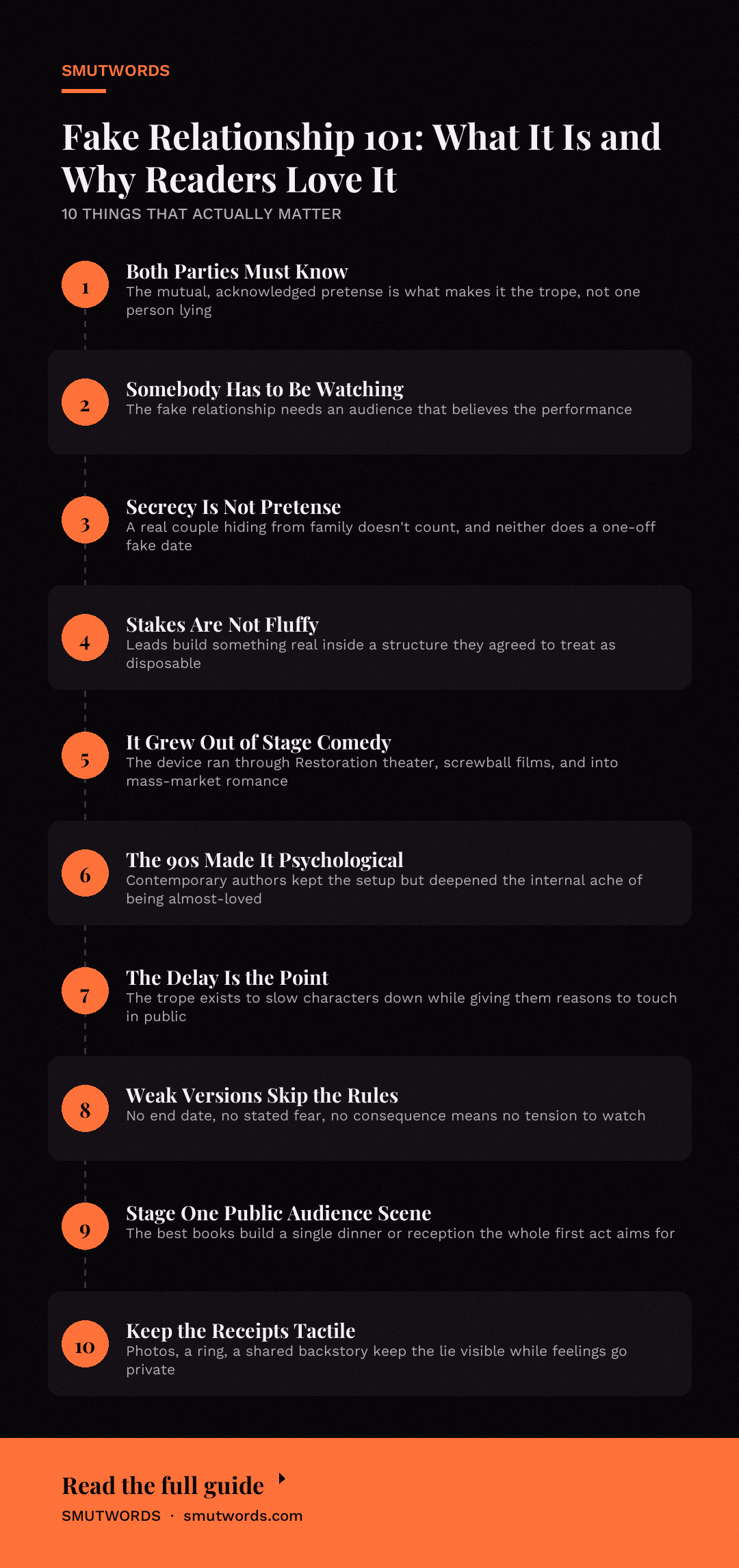
The name describes the setup, not the outcome. A fake relationship is defined by a deliberate, mutual, and openly acknowledged pretense between the two leads, sustained over a stretch of time, with a stated goal that has nothing to do with falling in love.
That mutual acknowledgment is the load-bearing wall. Both characters know the rules. Both know it ends on a specific date or once a specific objective is met.
That shared knowledge is what separates the trope from adjacent setups where one person is being deceived.
Several things look like a fake relationship but aren't. A setup where one character genuinely believes the romance is real is a deception plot, and it carries a very different emotional charge. A marriage of convenience that both parties enter openly as a business arrangement, with no performance for an outside audience, sits closer to the contract-marriage end of the spectrum.
The fake relationship specifically requires an audience. Somebody has to be watching and believing.
The term also covers the whole family of variants: fake engagement, fake marriage, fake date, fake boyfriend, fake girlfriend, contractual relationship, green card marriage. What they share is the performance of coupledom aimed at a third party. What differs is the stakes and the length of the con.
A quick field guide to what does and doesn't count:
- Counts: Two coworkers pretend to date so a homophobic client will sign. Two strangers pose as a couple at a destination wedding. Two friends fake an engagement to satisfy a dying grandmother's wish.
- Counts: A green card marriage entered as a deal, performed for immigration officers, roommates sharing a bed to keep the story straight.
- Doesn't count: One character lying about having a partner and the other finding out. No mutual agreement, no trope.
- Doesn't count: A genuine relationship that the couple happens to hide from their families. Secrecy isn't pretense.
- Doesn't count: A one-off fake date with a stranger that never develops beyond the single scene, usually folded into a blind date romance structure instead.
The single most common misconception is that the fake relationship is a low-stakes fluffy trope. Readers who've actually read widely in it know the stakes are brutal. The whole point is that the two leads build something real inside a structure they've both agreed to treat as disposable, and then have to survive the moment the structure gets demolished.
Where Fake Relationship Comes From
The trope's roots in English-language publishing run through stage comedy. Restoration and eighteenth-century theater ran on exactly this mechanic: two people feign attachment to fool a parent, a rival, or a guardian, and the audience waits for the mask to slip.
The device survived into nineteenth-century sensation fiction and then into the screwball comedies of the 1930s and 1940s, where the fake-couple setup became a reliable comic engine for films like The Awful Truth and later How to Marry a Millionaire.
Mass-market romance picked it up early and never put it down. Category romance lines in the 1970s and 1980s already ran on the trope, usually dressed as a marriage of convenience with a family-pressure or inheritance angle. Those books treated the fake relationship as a plot device first and an emotional engine second. The confession at the end arrived as a surprise to both leads.
The real shift came in the 1990s and 2000s, when contemporary romance authors started writing the fake relationship as psychological realism rather than situational comedy. The setup stayed the same, but the internal arc deepened. Leads started choosing the fake relationship out of genuine need: visa problems, health insurance, custody battles, professional survival. The book became less about the comedy of the performance and more about the ache of being almost-loved on purpose.
Indie publishing accelerated the trend around 2012 and never looked back. Self-published contemporary romance made fake-dating setups a mainstay of series branding, usually with a title, cover, and blurb built explicitly around the fake-boyfriend or fake-fiancé premise. The format proved reliable for a specific reason: it gives a reader an instant, legible promise of slow-burn payoff without needing to explain the premise.
In the last decade the trope has spread sideways. It shows up in celebrity romance, where PR-driven contracts between stars are now a subgenre in their own right. It's a workhorse of rockstar romance, where a "fake girlfriend" arrangement often masks a record label's image-management interest.
It fits neatly inside heist romance, where couples pose as spouses to case a mark. And it's become a standard opener in lumberjack romance, usually with a city outsider pretending to a small-town relationship to fend off a pushy ex.
How It Shows Up in Erotica
On the page, the fake relationship is almost always a delay engine. It exists to slow the characters down while giving them a hundred plausible reasons to touch each other in public. The best writers in the trope understand that the delay is the point.
Structurally, the strongest versions move through a recognizable rhythm. First the negotiation, usually rendered as banter with an undertow of real desperation. Then the rules, listed out loud, sometimes literally on a napkin or in a text thread, often including a "no feelings" clause both parties privately know is nonsense.
Then the performance in front of an audience. Then the private scene that breaks the rules. Then a near-miss where the truth almost surfaces. Then the collapse and the reconciliation.
Where a weak version goes wrong is almost always at the rules. If the characters agree to a fake relationship with no clear end date, no clear consequences, and no stated fear, the resulting tension is thin. The reader has nothing to watch for. The negotiation scene has to plant the exact fear that the rest of the book will exploit.
A strong version puts something specific on each character's side of the deal. She needs the fiancé so her mother stops setting her up with her ex. He needs the girlfriend because his inheritance depends on appearing settled. Now every kiss in front of the family costs them something, and the reader can feel it.
Some of the specific variations that appear most often on the page:
- The weekend-only fake: A destination wedding, a family reunion, a corporate retreat. Short, high-intensity, almost always ends with the couple sleeping together before the weekend ends.
- The long-con fake: A green card marriage, a year-long engagement, roommates sharing an apartment. Slower bleed, more stolen domestic moments, heavier guilt when feelings arrive.
- The professional fake: Publicists, agents, or record-label execs brokering the arrangement. Usually requires contracts, NDAs, and a lot of accidental intimacy in cars and green rooms. Common in ghostwriter romance, where the fake relationship often doubles as a cover for the real work arrangement.
- The family fake: Usually a prince/princess romance or small-town setup. The audience is a specific family with specific expectations, which makes the performance much more intimate.
- The protective fake: A decoy relationship to defuse a stalker or a dangerous ex. This variant overlaps with stalker romance and tends to be higher-heat and higher-threat.
- The fake-to-real marriage in trouble: The couple already faked a relationship, and now the book opens years later with the marriage falling apart. This is where the trope intersects with marriage in trouble, and the emotional stakes escalate considerably.
Two craft moves separate the top-shelf versions from the rest. The first is the audience scene. The best fake relationship books build one specific public moment the whole first act is aiming for, usually a dinner or a wedding reception, and stage it in full detail.
Enjoyed this? Get a free book.
Join the list and we will send a complete free story straight to your inbox, plus new releases every week after that. No credit card, no catch.
The couple is performing for a room, but the reader is watching them perform for each other. Every touch becomes loaded because both characters know it's being watched by both the room and the other person.
The second is the private scene that breaks the rules. Every strong fake relationship book has one. It's the scene where the couple is alone and the pretense is technically suspended, and yet they choose to act married anyway.
The car ride home after the wedding. The shared hotel bed the next morning. The moment one character makes the other coffee without being asked, then realizes the other one noticed.
The fake relationship also pairs well with sensory play, because the trope gives characters a socially acceptable reason to explore each other's bodies under the pretense of research or rehearsal. A couple that "needs practice" for a public kiss can spend an entire chapter on technique.
This works remarkably well with a scene involving blindfold play, where the character being guided is told it's to help them relax in front of the audience. The intimacy of the blindfold is the opposite of public, and that gap is exactly what the trope wants.
The heat level of the trope also rises naturally with proximity. Two characters who share a bed for a week because a hotel room only had one bed available are going to end up touching each other, and the writer can choose how explicit that becomes.
What makes it land in erotica specifically is the internal monologue: both characters noticing, in real time, that the performance has stopped being a performance, and lying to themselves about it for as long as the plot can bear.
The best versions also play with the receipts of the fake relationship. Photos on a phone. A fake engagement ring that the wearer starts fiddling with when nervous. A story they both have to remember. Text threads establishing a public backstory.
These artifacts do more work than any single sex scene, because they keep the lie tactile and visible while the feelings go private.
Fake Relationship vs Celebrity Romance
These two get confused because so many celebrity romance books use the fake relationship as a plot device, and because both put the couple under an audience's gaze. The distinction is structural. Celebrity romance is about a character who is already famous, and the story's pressure comes from the public's relationship to the famous person. The fake relationship can happen to anyone, famous or not, and the pressure comes from the specific third party the couple is trying to fool.
A book can be both. Most PR-contract celebrity romances are.
But if the fake relationship were removed from a celebrity romance, you'd still have a story about a famous person falling for someone. If the fake relationship is removed from an actual fake relationship book, there's no plot left. That's the test.
Read the celebrity romance glossary entry for the full breakdown of the adjacent trope.
Frequently Asked Questions
What is a fake relationship in romance?
A fake relationship is a trope where two characters agree to present themselves as a couple for a specific practical goal, then develop real feelings that neither of them planned for. The agreement is mutual and openly acknowledged on both sides, with a stated end point. The book's tension comes from watching the pretense crack.
What are the most common fake relationship variants?
The most common are fake dating, fake engagement, fake marriage, fake boyfriend/girlfriend, contractual relationship, and green card marriage. The differences usually lie in the length of the arrangement and the consequences of it falling apart. Weekend fake dates move faster; year-long fake marriages burn slower and carry higher stakes.
Why is fake relationship so popular in erotica?
The trope creates a built-in excuse for physical and emotional intimacy without requiring the characters to admit they want it. Forced proximity, public performance, and stolen private moments stack the heat across many chapters. Readers get the slow burn of watching two people lie to themselves while their bodies do the truth-telling.
What's the difference between a fake relationship and a marriage of convenience?
A fake relationship involves pretending to be a couple for an audience; the relationship itself is the pretense. A marriage of convenience is a real, legally binding marriage entered as a practical arrangement, with no need to deceive anyone about its nature. Many books blend the two, pairing a real marriage license with a public pretense about being in love.
How does a fake relationship usually end?
Almost always with a public reveal where the lie collapses, followed by one character confessing that they want the relationship to be real. The best versions let the confession arrive at the worst possible moment for one lead and the best possible moment for the other, so the scene has genuine emotional weight. Bad versions rush the reconciliation and skip the aftermath.
Can a fake relationship book be enemies to lovers too?
Absolutely, and many are. Two coworkers who already can't stand each other deciding to fake a relationship is a classic combinatorial setup, letting the author run both tropes at once. The enemies-to-lovers friction makes the negotiation scene sharper and the first real kiss harder to justify.
Final Thoughts
The fake relationship survives because it captures something true about how real love tends to begin, which is badly, under the wrong conditions, and while everyone involved is insisting it's nothing serious. A good version of this trope doesn't flinch from that. It lets the lie run long enough for both characters to actually fall, then charges them the full price for the pretense.
If you read one book in the trope to calibrate your tastes, look for a version that stages an audience scene with real stakes and lets the private-rule-break chapter breathe.
Soulbond vs Imprinting: Two Instant-Bond Tropes Readers Confuse is a useful companion read if you want to see how other tropes handle the same problem of wanting without admitting it. The best fake relationship books are the ones where you can feel the moment both characters realize the performance has become the only true thing in the room.








Loading comments…