
Best friend's sister is the romance setup where the hero wants the one woman he's been explicitly, implicitly, or bro-code forbidden to touch: the sister of the man who trusts him most. The appeal isn't complicated. It's a collision between two things men are supposed to protect and never mix, and the books that do it well let that collision run all the way through the plot instead of resolving it in chapter three.
This guide covers what the trope actually means, where it came from, how it plays out on the page, and why it keeps outselling half the tamer premises on the shelf.
What Best Friend's Sister Actually Means
The core configuration is simple to state and surprisingly elastic in practice. A hero has a best friend. That friend has a sister. The hero wants her, sometimes from the moment he meets her, sometimes after years of not noticing her, and the rest of the book is the cost of that wanting.
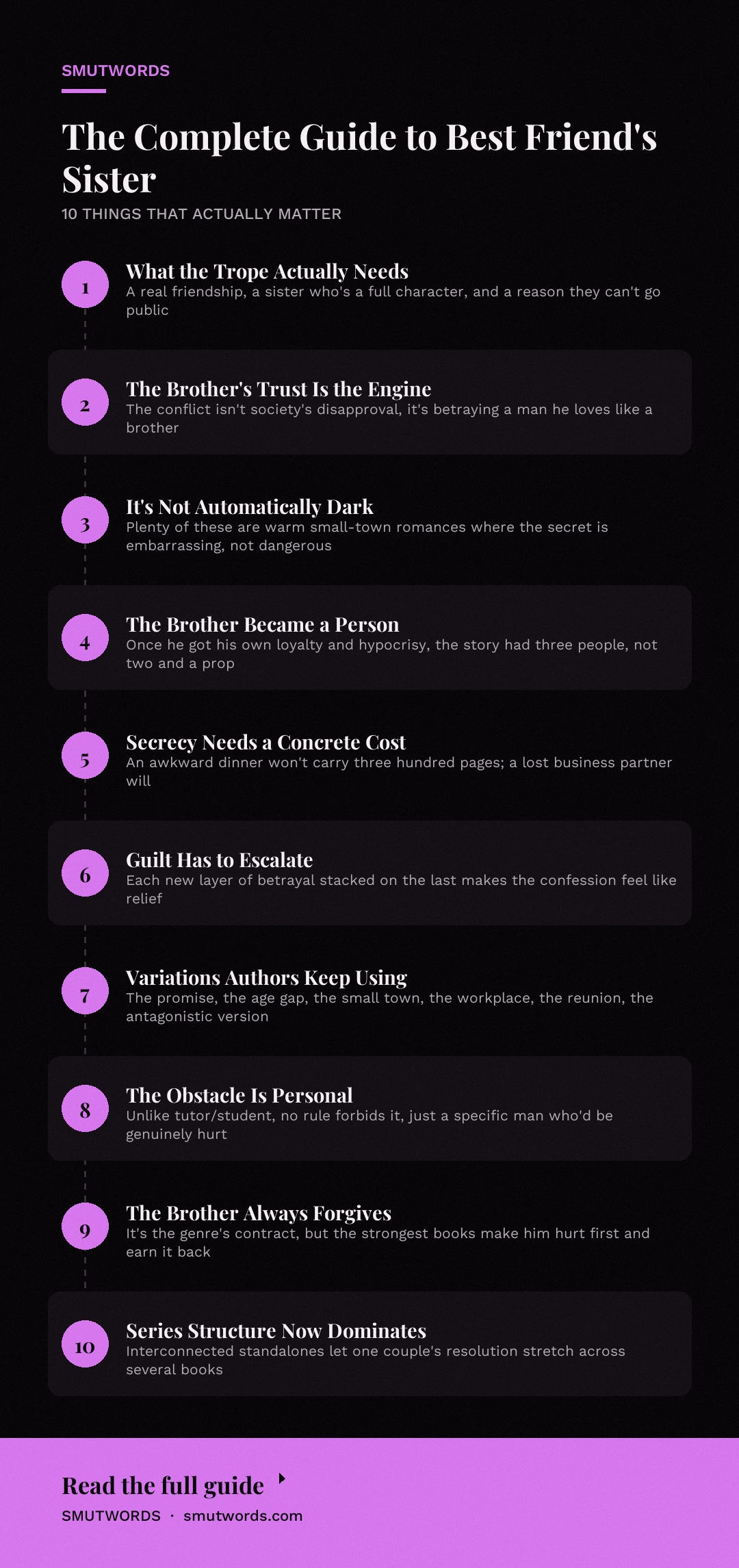
The label gets applied loosely, so it helps to draw the line. For the trope to actually function, three elements need to be present: an existing friendship that carries real weight in the story, a sister who is a full character rather than a prize, and a reason the two of them cannot simply announce the relationship and move on.
The third element is where most of the tension lives. That reason can be loyalty, a promise made years ago, a professional entanglement, an age gap, or the simple fact that the brother has a temper and everyone knows it. Remove the obstacle entirely and you're just writing a friends-to-lovers book with a family tree attached.
Two common misconceptions are worth clearing up. First, the trope is not automatically dark. Plenty of best friend's sister books are warm, funny, small-town romances where the secret is more embarrassing than dangerous.
Second, it is not the same as forbidden romance in the broad sense. Forbidden romance can be built on a boss, a priest, a stepbrother, or a rival. This trope has one specific engine: the brother's trust.
That trust is the whole machine. The hero isn't sneaking around because society disapproves. He's sneaking around because a man he loves like a brother would feel betrayed, and the hero knows it.
Where Best Friend's Sister Comes From
The setup is older than the modern romance industry, and its publishing history tells you a lot about why it works. In twentieth-century category romance, the sibling of a friend was a standard device for generating conflict in a short page count. A Harlequin needed a clean external obstacle, and "her brother is my best friend" delivered one without requiring a villain.
Those early versions were often framed as a warning. The hero was reckless for wanting her, the sister was naive, and the resolution arrived when the brother either gave his blessing or proved himself irrelevant to her happiness. The woman's agency was frequently the last thing the book cared about.
The shift came as romance publishing moved toward longer single-title books and, later, indie publishing. Two changes mattered. First, heroines got interiority, so the sister stopped being a source of conflict and started being a participant. Second, the brother got a personality.
That second change is the one that turned best friend's sister from a plot device into a trope people search for by name. Once the brother became a character with his own loyalty, jealousy, and occasional hypocrisy, the story had three people in it instead of two and a prop.
Contemporary versions have leaned harder into the secrecy. In the 2010s and 2020s, the trope merged heavily with small-town romance, sports romance, and the kind of series structure where each brother gets his own book. That series format is why the trope now has its own dedicated readership rather than showing up as a subplot.
Its cousin, brother's best friend, developed along a parallel track and is often shelved in the same category. The two are mirrors, and readers frequently read both in the same week. If you write in either lane, the structural tricks in Only One Bed: Everything You Need to Know translate almost directly, since both tropes live or die on forced proximity and a secret neither party wants to name first.
How It Shows Up in Erotica
On the page, this trope is a machine for generating specific, repeatable beats. The most skilled authors treat those beats as a structure to hang real emotion on, not a checklist. Here is what the good ones do with each.
The Recognition Scene
Somewhere early, the hero has to actually see her. In a strong version, that scene is doing double duty. She is not just attractive; she is a person he suddenly cannot categorize, because the version of her he filed away years ago under "my buddy's kid sister" has been replaced by someone whose life he doesn't control.
Weak versions rush this. He sees her, he wants her, and the book moves on. Strong versions let the discomfort linger, because the discomfort is the product.
The Secrecy Structure
Secrecy is where the trope either works or falls apart. A book that keeps the secret because nobody wants to have an awkward conversation will feel thin. A book that keeps the secret because there is an actual consequence, a business deal, a custody arrangement, a friendship that is also the hero's entire support system, will feel earned.
This is the same craft problem authors run into with any high-tension premise, and it is worth studying how other subgenres handle it. The techniques in Writing Sex Scenes That Matter to the Plot apply directly here, because in this trope the sex scenes are doing structural work. The first time they sleep together is usually the moment the lie becomes active.
Enjoyed this? Get a free book.
Join the list and we will send a complete free story straight to your inbox, plus new releases every week after that. No credit card, no catch.
The Guilt Rhythm
Guilt needs to escalate, not repeat. If the hero feels equally bad in chapter five and chapter twenty, the reader gets bored. The strongest versions layer in new reasons to feel worse: the brother confides something, the hero accepts a favor, the sister asks him to lie to her brother directly.
Each new layer is a small betrayal stacked on the last one. That stacking is what makes the eventual confession feel like relief rather than melodrama.
Common Variations Authors Use
- The promise. The hero made a deathbed or deployment promise to protect her, and now protection and desire are the same problem. Works well with soldier romance framing.
- The age gap. He knew her as a kid, she grew up, and the timeline itself is the obstacle. Requires careful handling so the hero doesn't read as predatory.
- The small town. Everyone knows everyone, so the secret has a ticking clock attached. Often paired with lumberjack romance or blue-collar settings.
- The workplace. He hired her, or she hired him, and the friendship predates the job.
- The reunion. They had one night years ago, never told the brother, and now they're back in the same room. Frequently paired with a secret baby.
- The antagonistic version. He and the sister can't stand each other, and the friction is the foreplay. This is the hate to love engine dropped into a family loyalty plot.
- The revenge version. The friendship has already soured, and the hero pursues the sister specifically to hurt the brother. A dark revenge romance variant that requires a very careful redemption.
The mirrored version, brother's best friend, flips the point of view. Instead of the hero wanting his friend's sister, it's the sister wanting her brother's best friend, and the power imbalance tilts the other way. Both versions sell, and many authors write both.
What Separates a Strong Version From a Flat One
The flat version has three problems. The brother is a cardboard obstacle who exists to be angry. The secret has no real cost, so the reader never believes anything is at stake. And the heroine wants the hero mainly because he is the hero.
The strong version gives the brother a coherent reason for his objection, makes the cost of discovery specific and concrete, and gives the sister her own ambitions that the relationship might threaten. When all three are present, the book has something to resolve in the third act that isn't just a misunderstanding.
One more craft note: the confession scene is the payoff readers came for, and it deserves real estate. Rushing the brother's reaction to a single page of yelling and instant forgiveness wastes thirty thousand words of setup. The best versions let him be genuinely hurt, because that hurt is the proof the friendship mattered.
Best Friend's Sister vs Tutor/Student Romance
These two get shelved together often, and the confusion is understandable. Both are structured around a relationship that a specific person or institution would object to, and both run on secrecy and a power differential.
The difference is where the objection comes from. In a tutor/student romance, the obstacle is a role, a hierarchy, a professional line that exists whether or not anyone personally disapproves. Remove the tutorship and the obstacle evaporates.
In best friend's sister, the obstacle is a personal relationship. Nobody outside the triangle has a rule against it. The entire conflict is that one specific man, who is genuinely good and genuinely loved by both parties, would be hurt.
That means the resolution differs too. Tutor/student books often end by removing the role or waiting it out. Best friend's sister books end with a conversation, a forgiveness, and a rebuilt friendship. The emotional payoff is relational rather than institutional.
Frequently Asked Questions
Is best friend's sister the same as brother's best friend?
They are mirror images and frequently shelved together, but the point of view and the power dynamic differ. In best friend's sister, the hero is the one breaking loyalty to his friend. In brother's best friend, the heroine is the one risking her relationship with her brother, and she often has less social leverage to do it. Some books are both at once, though that takes careful handling.
Why is this trope so popular in small-town romance?
Small towns make secrecy expensive. Everyone talks, the brother is always nearby, and the couple can't simply avoid each other. The setting supplies a natural ticking clock that urban versions have to manufacture. It also makes the eventual discovery public rather than private, which raises the stakes of the third act automatically.
Does the brother always have to forgive them?
In romance, yes, and the genre's contract requires it. He doesn't have to forgive quickly, and some of the strongest books make him earn his way back to the friendship on his own terms. A permanently broken friendship reads as tragedy and violates reader expectations, so if you want that ending, you're writing something other than romance.
Can the heroine be the one pursuing the hero?
Absolutely, and it changes the whole tone. When she initiates, the trope shifts from a man's guilty secret to a woman deciding she won't be managed by her brother. That version often reads more feminist and more defiant, and it usually requires the hero to be the one who hesitates.
How do you keep the secrecy from feeling contrived?
Give the secret a concrete cost. If discovery means losing a business partner, a place to live, a custody arrangement, or the only person who showed up when things were bad, the secrecy makes sense. If discovery just means an awkward dinner, readers won't buy three hundred pages of hiding.
Is this trope usually a standalone or a series?
Both, but series structure has become dominant. The friend group or family gives each book a built-in cast and a ready-made next couple, which is why so many of these are sold as interconnected standalones. That structure also lets the author delay one couple's resolution across several books, which builds anticipation and reader retention.
Final Thoughts
Best friend's sister works because it puts two legitimate goods in conflict: the love a man has for his friend and the love he has for the woman that friend is supposed to protect. Books that respect both sides of that equation, and that make the reader feel the weight of the betrayal before they feel the relief of the confession, are the ones that stick.
If you want to see the trope at full strength, start with a title that gives the brother real page time and lets the guilt build past the midpoint. That's where the trope stops being a premise and becomes a story.







Loading comments…