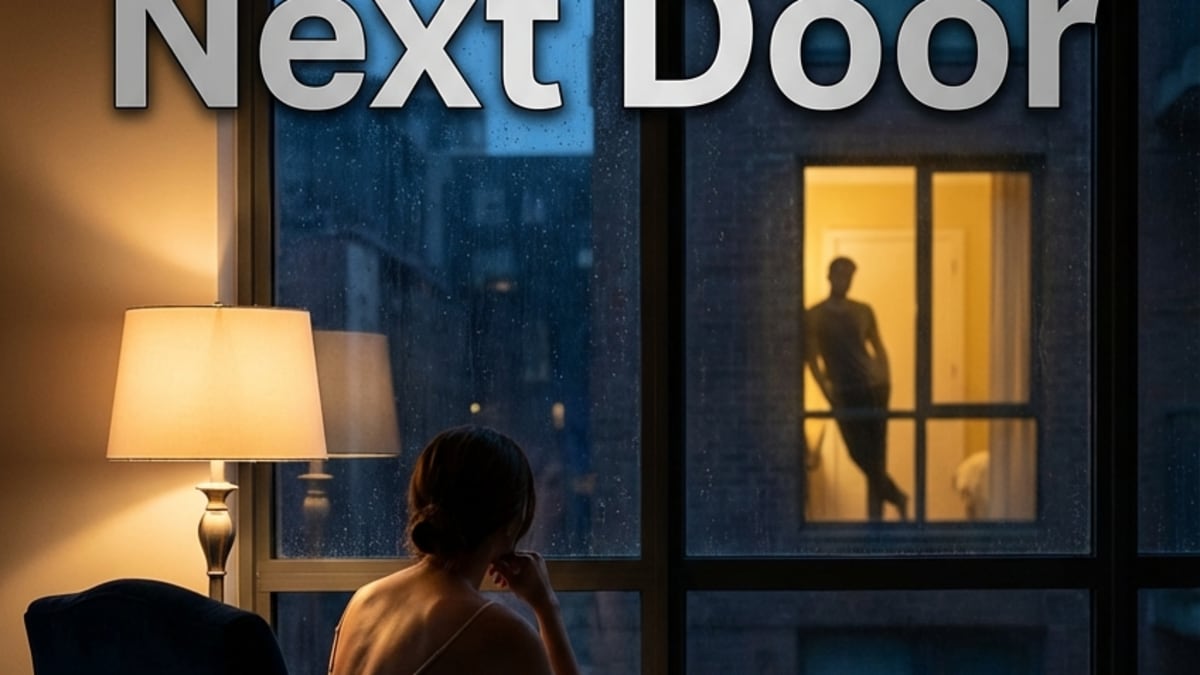
Voyeurism is the kink of getting off on watching. One person observes another in a sexual or intimate moment, and the watching itself is the turn-on, sometimes more than whatever is being watched.
The person being watched might know about it, might be performing for it, or might have no idea anyone is looking. That last version carries the sharpest charge in fiction, because the story gets to sit inside the head of someone who is seeing something they were never meant to see.
The reader gets to sit there too. Voyeurism in erotica is rarely just a camera angle. It is a power position, a secret, and often the first crack in a character's self-control.
This guide covers what voyeurism actually means as a kink and as a narrative device, where it came from in the genre, how authors build scenes around it, and how it differs from the tropes readers most often mix it up with. If you have ever finished a book where the hottest chapter was the one where nobody touched anybody, you already understand why this kink has outlasted every trend cycle in erotic publishing.
What Voyeurism Actually Means
The word comes from the French voir, to see, by way of voyeur, literally "one who sees." In clinical language it gets pathologized, filed under paraphilias and treated as a disorder when it involves non-consenting subjects. In kink and erotica, it means something narrower and far less clinical: sexual arousal from observation.
The watcher is the protagonist. The watched is the object of attention. The gap between them, physical or social or both, is where all the heat lives.
What counts as voyeurism in a story is broader than most readers assume. A few examples:
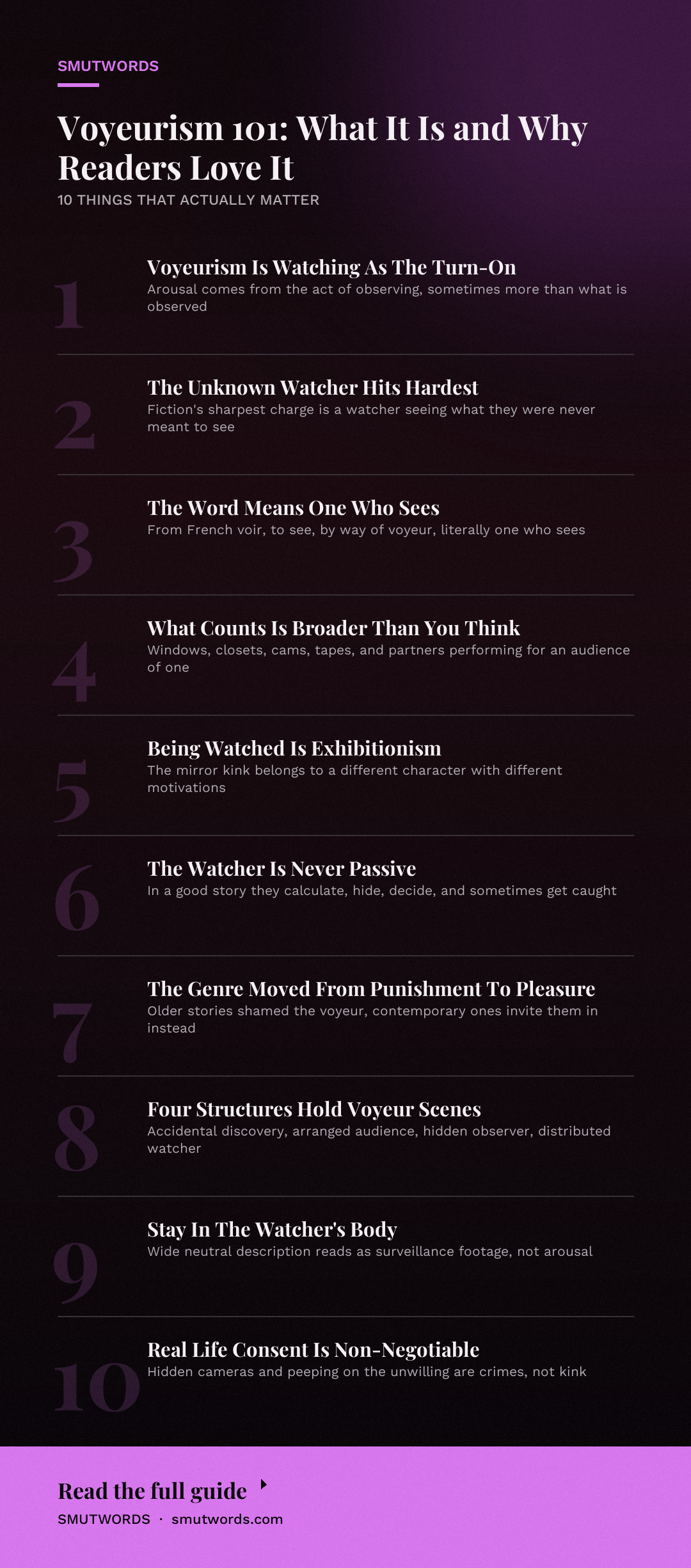
- A character watching a neighbor through a window, unseen.
- A character watching their partner with someone else, with full knowledge and encouragement.
- A character walking in on something and staying to watch instead of leaving.
- A character watching a live cam stream, a sex tape, or a recording left deliberately where they would find it.
- A character hidden in a closet, behind a door, or under a bed while something happens inches away.
- A character watching a partner undress, masturbate, or sleep, with the partner's permission or without it.
What does not count, strictly, is being watched. That is exhibitionism, the mirror kink. The two almost always appear together in erotica, but they belong to different characters with different motivations.
The exhibitionist wants to be seen. The voyeur wants to see. A scene can serve both at once and often does, but the POV determines which kink the book is actually selling.
There are a few common misconceptions worth clearing up. Voyeurism is not inherently passive. The watcher in a good story is doing something: calculating, hiding, deciding, getting caught.
It is also not inherently non-consensual, even though the taboo version is the one that generates the most tension. Many of the most popular voyeur scenes in published erotica involve a partner who knows exactly what is happening and is performing for an audience of one.
And it is not the same thing as watching porn, which is a solo activity with no relational stakes. Voyeurism in fiction matters because there is a person at the other end of the gaze. Compare that to a related dynamic like no strings attached, where the whole point is that nobody is watching and nobody has to care.
Where Voyeurism Comes From
Voyeurism is one of the oldest kinks in written erotica, older than the novel itself. Ancient Greek and Roman literature is full of gods watching mortals, and the punishment for the mortal who sees a god bathing is usually the point of the story. The taboo of the forbidden glimpse is baked into Western narrative from the start.
In modern English-language erotica and romance, voyeurism became a recognizable trope in the mid-twentieth century, when mass-market paperbacks gave writers room for explicit scenes and readers a private place to enjoy them. The window-watching husband, the peeping neighbor, the girl who discovers her roommate's secret: these are stock figures from that era and they never really went away.
The genre shift that matters most is the move from punishment to pleasure. In older stories, the voyeur usually gets caught, shamed, or worse. In contemporary erotica, the voyeur usually gets off, gets invited in, or gets exactly what they were watching for.
The taboo stayed. The consequences softened into negotiation, and the result was a kink that could be enjoyed without the reader feeling like they had to root for something awful.
Three publishing developments in the last two decades pushed voyeurism further into the mainstream of the genre:
- The rise of the voyeur husband trope, in which a married man deliberately arranges for his wife to be watched or to be with someone else. This gave voyeurism a domestic, emotionally complex frame that appealed well beyond the hardcore kink audience.
- The explosion of reverse harem and why-choose romance, which routinely includes group scenes where at least one character is watching rather than participating, and the watching is treated as its own form of intimacy.
- The normalization of cuckolding, hotwifing, and open relationship structures in romance, which made the consenting-voyeur setup legible to readers who would never have picked up a book about a peeping tom.
Today, voyeurism shows up across nearly every subgenre of erotica. It is a scene mechanic in contemporary romance, a plot engine in romantic suspense, and a whole identity in kink-focused erotic romance. The trope has proven unusually durable because it solves a structural problem every erotic writer faces: how to get a character into a room where something explicit is happening, and keep them there, without having to justify every step.
How It Shows Up in Erotica
On the page, voyeurism lives and dies on sensory restraint. The watcher usually cannot move, cannot speak, cannot intervene. That constraint is the whole engine.
A skilled author slows everything down: the breath, the sound, the specific detail the watcher fixates on. The reader gets the same limited view the character does, and the limited view is far hotter than an omniscient description of the same scene.
The four main structural variations
The first is the accidental discovery. A character stumbles onto something they were not supposed to see. The heat comes from the decision point: do they leave, or do they stay? Staying is the erotic beat.
Leaving is a different book.
The second is the arranged audience. The watched knows about the watcher and performs for them. This is the version that runs through most contemporary voyeur husband stories and much of what gets filed under the voyeur husband trope. Consent is established, the performance is deliberate, and the charge comes from the intimacy of being watched by someone who loves you.
The third is the hidden observer. Nobody in the scene knows the watcher is there. In fiction this is where the taboo peaks, because the story can have it both ways: the reader knows the watcher is present, and the characters being watched are free to be unguarded.
This variant requires care on the page. The tension only works if the writing keeps the stakes in the watcher's body, not in the possibility of discovery alone.
The fourth is the distributed watcher. Multiple people watching a single scene, or one person watching a group, or everyone watching everyone. This is where voyeurism folds into orgy territory and into swinging dynamics, where the watching-and-being-watched rhythm is part of the choreography rather than a separate kink.
What separates a strong voyeur scene from a flat one
Strong voyeur scenes commit to the watcher's interiority. The reader is not just being shown something explicit. They are inside the head of someone whose entire nervous system is lit up by proxy.
The flat version describes what is happening and skips the watcher. The strong version stays in the watcher's senses until the scene is over.
Enjoyed this? Get a free book.
Join the list and we will send a complete free story straight to your inbox, plus new releases every week after that. No credit card, no catch.
Strong versions also respect the asymmetry. The watcher is not the center of the scene they are watching. They are peripheral, and the writing should feel peripheral: partial views, muffled sounds, angles that do not quite work.
Restriction is not a problem to solve. It is the entire erotic mechanism.
Strong versions rarely end with the watcher simply relieved. They end with a change in the relationship between the watcher and the watched. The voyeur crosses a line, gets caught, gets invited in, or realizes something about themselves that alters the plot. The kink is the doorway, not the destination.
The exhibitionist mirror and why they almost always appear together
Pure voyeurism as a standalone trope is rarer in published romance than voyeurism-plus-exhibitionism. The reason is structural. A book needs both characters to want something, and a voyeur watching an unwilling subject is a hard sell as a romance. The workaround is almost always to give the watched character their own kink: exhibitionism, or performance, or the specific pleasure of being seen.
That pairing is what makes the voyeur husband, the public play scene, and the cam-girl-meets-devoted-viewer arc all function as romance rather than horror. Both people are getting fed by the same event. The book can commit to the heat without asking the reader to root for a violation.
There are other kinks that frequently fold into voyeur scenes on the page. A viewer watching a partner get degraded by someone else, for instance, gets two layers of charge at once. A discovery scene set in a one night stand context, where the watcher sees their own past lover with someone new, turns the kink into an emotional gut-punch. And in certain primal or feral play scenes, the voyeurism of watching someone lose control entirely is its own reward.
Craft notes for writers
If you are writing a voyeur scene and it feels slow or repetitive, the problem is almost always that you have described the action and skipped the watcher's body. Give the watcher a physical constraint to work against: a position they cannot shift out of, a sound they have to swallow, a clock running down.
Give them a specific thing they cannot stop watching. Not "the whole scene," but the exact detail: the way a hand moves, the sound of a name being said, the shift of weight between two people. Fixed attention on a small thing reads as arousal. Wide description reads as reportage.
Also decide early whether the watcher gets caught, and if they do, whether being caught is a punishment or the entire point. The answer determines the tone of the whole book. A caught-voyeur scene that resolves into shame wants one kind of language. A caught-voyeur scene that resolves into an invitation wants a completely different one.
Real-world consent and the safety frame
In real-life play, consent and privacy are non-negotiable. Every person involved in a voyeuristic setup needs to be fully aware and fully agreeing, whether that means a partner who knows they are being watched, a stranger who has agreed to be observed in a club setting, or a cam performer whose job description is being looked at.
Hidden cameras, secret recording, and peeping on someone who has not agreed to be seen are not kink. They are crimes, and they are not what this trope is about.
For anyone actually exploring a consensual voyeur dynamic with a partner, the same tools that keep every other kink safe apply. Clear conversations beforehand. A primal play style check-in if the scene involves surprise or intensity.
A safeword that pauses things if either party hits a limit. Then a debrief after. The fantasy of being watched without knowing can be safely recreated with role-play and clear ground rules. The fantasy of actually being watched without knowing is not a fantasy anyone should be subjected to.
Voyeurism vs Exhibitionism
These two get confused constantly, so it is worth being precise. Voyeurism is the kink of watching. Exhibitionism is the kink of being watched. In a single scene, both can be in play, and often are.
But the POV character determines which kink the book is selling. A book told from the watcher's perspective is voyeur fiction, even if the person being watched is clearly an exhibitionist. A book told from the perspective of someone deliberately performing for an audience is exhibitionism, even if the audience is only one person. The two kinks rarely get separated in a scene, but they are always separable in terms of whose arousal the reader is tracking.
Voyeurism also gets mixed up with cuckolding and swinging, which are not the same kink but often run through the same scenes. Cuckolding is a specific dynamic, usually involving a committed partner watching or facilitating their partner's sex with someone else. Swinging is an umbrella for a range of consensual partner-swapping arrangements.
Both can include voyeuristic pleasure, but neither is defined by it. The voyeur husband trope is the crossover point where all three tend to blur. If you want the full breakdown of that adjacent territory, breeding kink vs impregnation kink is a good example of how two kinks that share scenes can still be doing completely different things.
Frequently Asked Questions
Is voyeurism the same as cuckolding?
No. Voyeurism is the arousal of watching someone in a sexual situation. Cuckolding is a specific relational dynamic involving a committed partner and a third party, and it may or may not involve the primary partner watching. A cuckold scene almost always includes voyeuristic pleasure, but plenty of voyeur scenes have nothing to do with cuckolding.
Why is voyeurism so common in romance even when readers do not identify as kinky?
Because it is a narrative mechanic first and a kink second. It gets a character into a room where something explicit is happening without breaking the plot, and it flatters the reader with the same privileged view. Readers who would never describe themselves as into voyeurism still respond to the tension of watching something they are not supposed to see.
Is non-consensual voyeurism ever okay to write about?
In fiction, yes, and it is common. The taboo version is where a lot of the heat comes from. What matters is that the book makes clear what it is doing: the reader knows this is a transgressive fantasy, not a how-to manual. In real life, watching someone without their knowledge or consent is sexual harassment at best and a crime at worst, and the fantasy version is not a license to do that.
What is the voyeur husband trope?
It is a specific romance trope in which a married man arranges for his wife to be seen, or to be with someone else, and gets off on watching or facilitating. The dynamic usually involves deliberate consent, complex emotions about possession and generosity, and a marriage that gets both tested and reaffirmed by the experience. You can read more about how it functions in the voyeur husband trope glossary entry.
How do I write a voyeur scene that does not feel creepy in the wrong way?
Stay in the watcher's body and commit to their specific, limited view. Creepy-in-the-wrong-way usually means the writing has drifted into omniscient description, or has stopped tracking the watcher's arousal and started cataloguing body parts. Small, fixed, obsessive detail reads as hot. Wide, neutral description reads as surveillance footage.
Can voyeurism be a romantic dynamic and not just a casual kink?
Yes, and the best voyeur romances treat it that way. When the watched character is performing specifically for the watcher, or when both partners have negotiated the setup, the observation becomes a form of intimacy rather than a violation. That relational frame is what makes the dynamic work as a central romance arc instead of a scene-level spice beat.
Final Thoughts
Voyeurism endures because it is one of the few kinks that gives a reader a job. You are positioned somewhere specific, with a limited view, watching something that is not for you, and the entire erotic charge comes from that position. A strong voyeur book does not need to escalate to be intense. It needs to stay close to the watcher's senses and trust the restriction to do the work.
If you want to see how far the trope can go inside a full-length romance, start with a voyeur husband novel where the watching is not a scene but the entire emotional architecture of the marriage.
That is where the kink stops being a spice beat and starts being a thesis about what it means to know someone, and to let them be seen. And if ghosts and watchers-from-beyond are more your speed, the complete guide to ghost romance relationships runs a similar tension from the other side of the veil.






Loading comments…