
Firefighter romance is a love story built around a professional whose job is to run toward the thing everyone else is running from. The hero (or heroine, though the genre still skews male hero hard) pulls people out of burning buildings, cuts them out of cars, and then comes home to fall in love with someone who has to live with the fact that he might not come home next time.
That collision of adrenaline and tenderness is the entire engine. Readers who search out firefighter romance are not looking for a quiet story. They want heat that is literal on the page and figurative in the bedroom, a hero with scorched knuckles and a soft center, and a relationship that gets tested by a pager going off at the worst possible moment.
What Firefighter Romance Actually Means
The name is plain and the subgenre is exactly what it says: a romance where a firefighter is the central love interest, and the firefighting is not wallpaper. The job shapes the plot, the pacing, and usually the emotional stakes. A firefighter romance without fire is just a contemporary romance with a calendar of shirtless men tacked to the wall.
What counts is fairly broad. You can have a big-city engine company, a small-town volunteer department, a hotshot crew working wildfire season, or a smokejumper dropping into backcountry blaze. The romance can be the A-plot or threaded through a suspense plot where the fire is a villain. The one constant is that the danger of the work is real to the story.
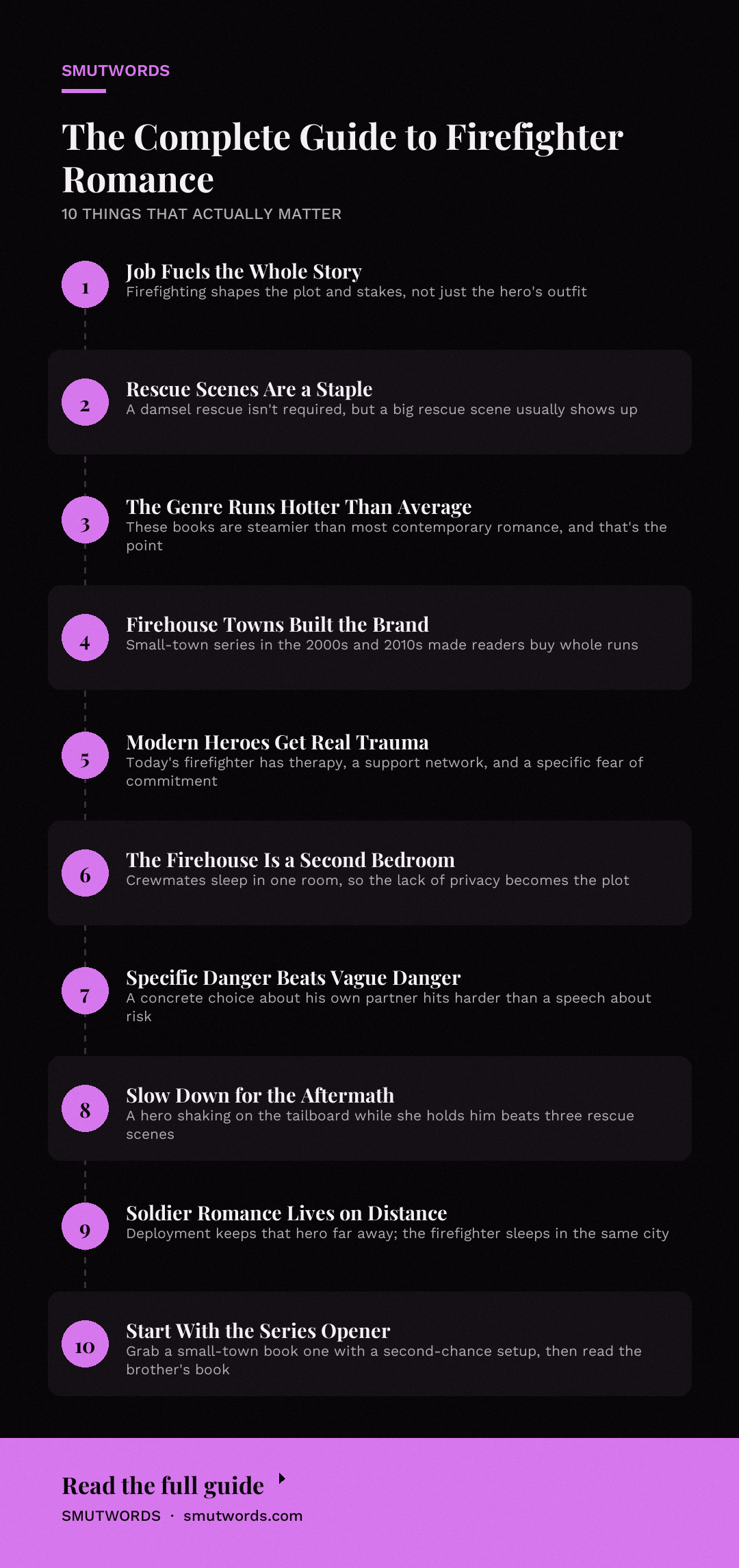
A few common misconceptions are worth clearing up. Firefighter romance is not automatically a workplace romance, though it often is. It does not require a damsel rescue, though a rescue scene is a staple.
It is also not the same thing as romantic suspense with a firefighter side character. The job has to matter to the love story. Decoration doesn't count.
The heat is also not only metaphorical. These books tend to be steamier than average contemporary romance, and the physical intensity of the hero's body is part of the appeal. A firefighter romance that stays entirely behind closed doors is possible, but it fights the genre's own grain.
Where Firefighter Romance Comes From
The genre history here is publishing history, and it is short enough to trace honestly. Firefighter heroes started showing up as a recognizable category in mass-market romance in the 1980s and 1990s, riding the same wave that gave readers cop heroes, cowboy heroes, and Navy SEAL heroes. Category lines like Harlequin and Silhouette loved an occupational hero with a uniform and a dangerous shift schedule.
The real acceleration came with the rise of small-town contemporary romance in the 2000s and 2010s. Series set in fictional firehouse towns became their own brand, and readers began buying whole runs of them for the recurring cast of brothers and crewmates. The trope also got a boost from the way cover design changed: a helmet, a set of turnout gear, and a bare chest became an instantly legible package.
The wildfire and smokejumper variants are newer and reflect real shifts in how firefighting is publicly understood. As fire seasons lengthened and wildland crews entered the news cycle more often, authors started writing them. That branch of the genre skews more rugged and more isolated, with long stretches in the backcountry and fewer crowds to hide in.
What has changed most is the hero's interior. Early versions were stoic to the point of silence. Modern firefighter romance gives the hero trauma, therapy, a support network, and a reason he is afraid of commitment that is specific rather than generic. The job is still the obstacle, but it is no longer the only thing he is allowed to feel.
How It Shows Up in Erotica
On the page, a strong firefighter romance is a study in contrast management. The author has to keep the job present without letting it swallow the romance, and has to keep the hero physically capable without making him a cartoon. The best books do this by treating the firehouse as a second setting for intimacy, not just an action location.
The heat usually comes from three places. First, the physical description of the hero after a shift: soot, sweat, and the specific tiredness of a body that just did hard work. Second, the rescue or near-miss, which gives the couple a moment of raw honesty and often the first kiss. Third, the forced proximity of the firehouse itself, where crewmates sleep in the same room and have no privacy to spare.
What separates a strong version from a flat one is whether the danger is specific. A vague "it's a dangerous job" speech is weak. A scene where the hero has to choose between finishing a rescue and getting to a call about his own partner is strong, because the conflict is concrete and the stakes are personal rather than announced.
Common variations authors use:
- Second-chance firefighter: the hero and the love interest have history, and the job is the reason it fell apart the first time. This pairs naturally with marriage in trouble if the couple is already married, or with a redemption arc romance if he needs to earn his way back.
- Single-dad firefighter: the hero is raising a child alone, and the love interest has to win over both of them. The child becomes a source of tenderness and a source of new danger.
- Firefighter and teacher: the classic pairing of the dangerous job with the safe, nurturing one. The teacher is often the one who has to sit with the fear while he is on shift.
- Smokejumper: the hero deploys into remote wildfire, which means long absences, no phone signal, and a love interest who has to trust in silence. The isolation raises the emotional stakes.
- Forced proximity firehouse: the couple is stuck together at the station overnight or during a storm, and the privacy problem becomes the plot.
- Wildland firefighter: a seasonal, nomadic version where the hero moves with the fire season and the relationship has to survive the off-months.
Strong firefighter romance also tends to handle the aftermath well. A hero who walks out of a burning building and immediately wants sex is a fantasy; a hero who does it and then sits on the tailboard shaking while the love interest holds him is a scene. The hurt-comfort exchange is where the trope earns its reputation, and writers who slow down for it get more heat out of one quiet scene than out of three rescue set pieces.
Enjoyed this? Get a free book.
Join the list and we will send a complete free story straight to your inbox, plus new releases every week after that. No credit card, no catch.
That same dynamic of care and surrender shows up in service submission relationships, where the giving and receiving of care is itself the erotic charge.
There is also a reliable overlap with the reunion and history tropes. The firefighter who comes back to his hometown and finds the girl he left behind is a childhood friends to lovers setup with a dangerous job bolted on, and it sells because readers already know the emotional debt is there before page one.
Firefighter Romance vs Soldier Romance
These two get compared constantly, and the confusion is real. Both are occupational romances with a uniformed hero and a job that can kill him. The difference is in the shape of the danger and the shape of the homecoming.
A soldier romance is built on deployment and distance. The hero is gone for long stretches, often in a place the love interest cannot picture, and the central tension is absence: letters, video calls, a reunion that may or may not happen. The romance has to survive the gap.
Firefighter romance runs the other direction. The hero is local. He sleeps at the firehouse but he is in the same city, and he can come home to a burnt dinner and a shared bed between shifts.
The danger is close and sudden rather than far and prolonged, and the tension comes from the pager going off mid-conversation. Both use the same hurt-comfort machinery, but the firefighter version keeps the couple in the same room far more often, which changes what the writer can do with it.
Frequently Asked Questions
What is firefighter romance?
It is a romance subgenre where the love interest is a firefighter and the job is central to the plot and the emotional stakes. The work provides both the action and the reason the relationship is hard, and the physical intensity of the hero's body is usually part of the appeal.
Are firefighter romance books steamy?
Generally yes. The subgenre runs hotter than average contemporary romance, and the literal heat of the job blends with the figurative heat of the relationship. Some titles are closed-door, but they are the exception rather than the rule.
What is the difference between firefighter romance and soldier romance?
Soldier romance is built on deployment and long absence, with the hero far away and the relationship strained by distance. Firefighter romance keeps the hero local and the danger sudden, so the couple spends far more time in the same space and the tension comes from interrupted moments rather than months apart.
What are the most common firefighter romance tropes?
Second chance, single dad, firefighter and teacher, forced proximity at the firehouse, and the wildland or smokejumper variants. Rescue scenes, near-miss injuries, and the firehouse as a second home appear across all of them.
Do I need to read firefighter romance series in order?
Usually not strictly, but series set in one firehouse share a recurring crew, and reading in order helps you track the supporting cast. Many readers start with book one anyway because the crew relationships build across the run.
Is firefighter romance always about a male hero?
Mostly, yes, but the genre is widening. Female firefighters, including wildland crew leads, now anchor their own books, and so do male love interests paired with them. The core dynamic of dangerous work and tender homecoming stays the same.
Final Thoughts
Firefighter romance works because it puts a body that can take real punishment next to a heart that is not nearly so tough.
And then it makes the reader wait to see which one gives out first. If you want a starting point, look for a small-town series opener with a second-chance setup, because that combination gives you the crew, the history, and the danger all in the first hundred pages. Then read the next one in the series for the brother, who is always the better book.





Loading comments…