
A rags to riches romance follows a lead who starts with nothing (money, connections, status, or all three) and ends the book with plenty, the love interest arriving somewhere in the middle of the climb. The term covers both directions of the fantasy: the scrappy underdog who builds a fortune, and the wealthy lead who watches that rise and decides to bet on it.
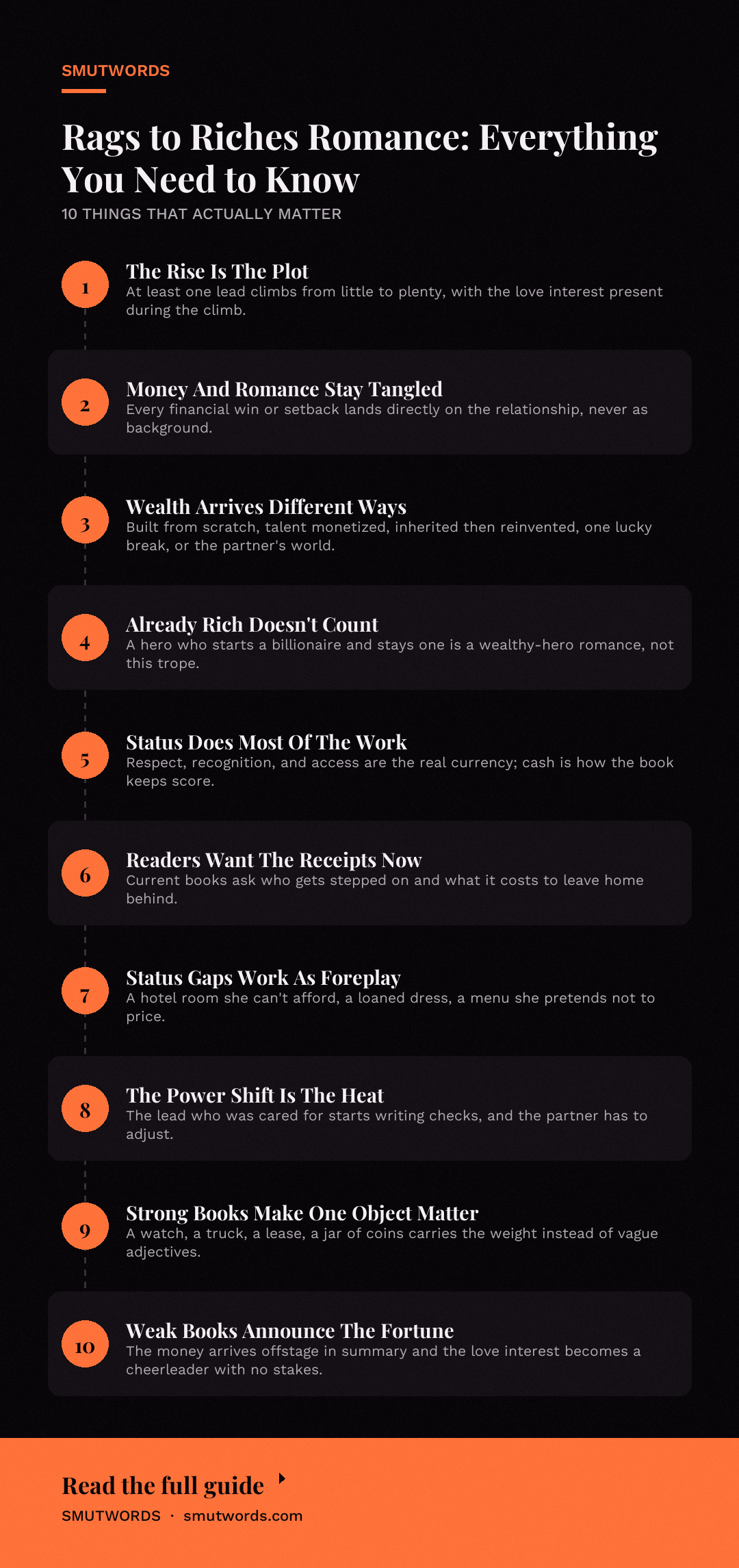
The money is never just set dressing. In the best books in this category, the couple's relationship and the lead's ascent are tangled together, so every financial win or setback lands on the romance directly.
The trope has been a genre engine for over a century, and it is currently having one of its loudest moments. Self-made billionaires, small-town girls who make it in the city, overnight celebrities from nowhere: the variations are endless, and readers keep buying them because the core promise holds up. Someone sees your worth before the world does, and the world eventually has to catch up.
What Rags to Riches Romance Actually Means
The phrase borrows from the old Horatio Alger story shape: a protagonist of modest means climbs to comfort or wealth through grit, luck, and character. Romance took that arc and added a second engine. The climb has to pay off emotionally through the relationship, and the relationship has to survive the climb.
The wealth can arrive in a few different ways, and the method shapes the whole book:
- Built from scratch: a business, an invention, a trade, a restaurant, a farm that finally turns a profit. The lead earns it on the page.
- Talent monetized: a singer, chef, athlete, painter, or writer whose gift becomes a career. This overlaps heavily with star-making stories.
- Inherited then reinvented: a modest inheritance, a failing family business, or a rundown property that the lead turns into something real. The money existed; the success did not.
- One fortunate break: a contest, a viral moment, a discovery, a job offer that changes everything. The lead still has to be ready for it.
- The love interest's world: the rich partner provides access, and the lead has to prove they belong in it on their own terms rather than as a plus-one.
What does not count: a book where the hero is already a billionaire on page one and stays one throughout, with no financial arc for either lead. That is a wealthy-hero romance, a different trope with a different pleasure. Nor does a story where the money arrives entirely by accident and nothing about the lead's character changes to earn it. The climb needs elbows and choices, even if luck is involved.
A common misconception is that the trope requires literal poverty. Plenty of rags to riches romances start in working-class stability and end in genuine wealth; the gap between the two is what matters, not the absolute low of the starting point. A small-town bookkeeper who becomes a cosmetics mogul covers the same emotional territory as a hero who grew up hungry.
The other frequent misread is that the trope is inherently about money. Status does most of the work. Respect, recognition, and access are the real currency, and cash is how the book keeps score.
Where Rags to Riches Romance Comes From
As a publishing phenomenon, the trope predates modern romance by a wide margin. Nineteenth-century serial fiction was full of clerks who marry the boss's daughter and orphans who discover a title; the rise was the plot, and the marriage was the reward. When category romance took shape in the twentieth century, publishers quickly learned that the ascent storyline sold, especially to readers living through economies that felt stacked against them.
Genre romance's specific version of the trope took off in the 1980s, when the self-made tycoon became a standard hero. He usually started as the rags half of the equation, often offstage, and the heroine entered his polished present.
The 1990s and 2000s flipped it: heroines got the arc, and small-town-to-big-city stories became a reliable shelf category. Chick lit's boom years ran on exactly this, with a young woman, a modest paycheck, and a city that either eats her or makes her.
The last fifteen years brought the biggest shift. Indie publishing turned out to be the perfect delivery system for self-made billionaire series, and the volume exploded.
Then readers started asking harder questions about the climb itself: who gets to make it, who gets stepped on, and what it costs to leave a small town behind. The current generation of rags to riches romance is more interested in the receipts than the previous one was. The wealth still arrives, but the book spends real page time on the price.
One more publishing note worth knowing: the trope's close cousin, the self-made billionaire, is now effectively its own subgenre, with its own bestseller charts and its own conventions. Series branding leans on it hard because readers buy the promise with a single click. That commercial logic shapes how these books get structured, from the guaranteed happy ending to the way book one has to end with a visible win.
How It Shows Up in Erotica
On the page, rags to riches romance is a pacing problem before it is anything else. The arc has two shapes to manage (the money and the love) and they have to peak close together or the book feels like two stories stapled at the spine. The strongest versions braid them so tightly that you cannot separate the win from the kiss.
Here is what a scene actually does with this material. Early chapters lean on material texture: a coat that is too thin, a landlord's note, a checking account balance the lead does not want to look at. This is where the book builds the rags half in physical detail rather than summary, and the good ones make you feel the cold.
The love interest typically appears during a specific pinch of scarcity, and their attention lands like both rescue and threat. That tension is the engine of the first act.
The middle act is where most of these books live or die. The climb starts working, the lead gets a taste of the next tier up, and the relationship has to absorb the change.
Strong versions use status gaps as foreplay: a hero who books a hotel room the heroine cannot afford, a dress that is a loan rather than a gift, a dinner where the lead has to pretend the menu prices do not register. Money becomes a form of intimacy and a source of friction at the same time.
The rise also rearranges the couple's power dynamic, and that is where the erotic charge lives. A lead who was being taken care of becomes the one writing checks, and the love interest has to adjust.
Books that handle this well do not reassure the reader that the money changes nothing. They let the change happen and make it hot. It is closer to the dynamic in a hate to love book than readers expect: proximity, friction, and an attraction the leads keep failing to talk themselves out of.
Enjoyed this? Get a free book.
Join the list and we will send a complete free story straight to your inbox, plus new releases every week after that. No credit card, no catch.
Common variations authors reach for:
- Small town to big city: the lead leaves home for the dream, and the love interest is either the one left behind or the one waiting in the new city. The tension is between where they came from and where they are going.
- Poverty to celebrity: a talent gets discovered. This structure overlaps with the rockstar romance, where the ascent is public and the relationship is the private holdout.
- White collar climb: the lead fights for a promotion, a partnership, a seat at the table. The love interest is often a rival or a mentor.
- Self-made billionaire: the hero or heroine builds an empire and the partner arrives mid-build, usually before the final valuation is known.
- Inherited fortune reinvented: a failing family business or a contested estate becomes the project that saves both leads. Legal family drama is a frequent subplot, and a secret baby reveal is a common complication in the wealthier branches of this trope.
- Overnight success: the break comes fast, and the book is about surviving the whiplash together. This one also shares DNA with the celebrity romance.
What separates a strong version from a flat one comes down to a few habits. The best books give the love interest something to do besides admire. They let the lead be genuinely difficult on the way up rather than noble and grateful.
They also make one material object carry a lot of emotional weight (a watch, a truck, a lease, a jar of coins) rather than describing wealth in vague adjectives. And they write the final win as a relationship event, not a solo triumph.
Flat versions share a recognizable set of failures. The money arrives offstage and the reader finds out about the fortune in a summary paragraph. The love interest becomes a cheerleader with no stakes of their own.
Then there is the cost. The lead's old life evaporates with no grief and no bill attached. And the book treats wealth as the ending rather than asking what the couple has actually built together.
One thread worth calling out: the working half of these books. When the lead's climb is manual, physical, or rooted in a place, the story gains grit that money-only plots lack. A lumberjack romance can carry a quiet rags to riches arc (the struggling cabin becomes a thriving business) without ever naming the trope.
The material world does the work. There is a useful craft lesson in that for anyone writing a wealthier version: make the assets physical, nameable, and earned.
The relationship's emotional high point also needs to happen on the climb's worst day, not its best. A book that puts the confession of love and the funding offer in the same scene is signaling to the reader that the two things are inseparable, which is the whole point of the trope. Drop one without the other and the scene feels hollow.
Rags to Riches Romance vs Celebrity Romance
Readers mix these up constantly, and the confusion is real. Both deliver a sudden rise from modest beginnings to public visibility, and both usually include a partner who is present before the big break. The distinction is what the book is actually about.
A celebrity romance centers on the visibility itself: the cameras, the fans, the management, the leaked photos, the strain of a private love under a public lens. The rags half may be present, but the book is not primarily tracking the climb. It is tracking the cost of being seen.
A rags to riches romance centers on the climb: the bank balance, the business, the promotion, the property. Status and recognition matter, but the scorekeeping is material. Strip the paparazzi from a celebrity romance and you have a different book; strip the fortune from a rags to riches romance and there is nothing left to trace.
There is also a third term that gets pulled into the mix: the prince/princess romance overlays with the trope when the ascent runs through a literal title, which the glossary entry covers in more detail. The wealth in those books arrives with a crown attached and a set of courtly obligations the lead has to navigate, and the emotional work is closer to belonging than building.
Frequently Asked Questions
What counts as a rags to riches romance?
A romance where at least one lead starts with limited money or status and achieves substantially more by the end, with the love interest present during the climb. The rise has to be earned on the page through choices, work, or a break the lead is prepared for. Already-wealthy heroes who stay wealthy throughout are a different trope.
Is rags to riches romance the same as self-made billionaire?
The self-made billionaire is one popular variation, not the whole category. A rags to riches romance can end with a modest small business, a working-class lead who buys a house, or a talented performer who makes a living from their art. The trope measures the distance traveled, not the final number.
Why is this trope so popular with readers?
It gives readers a partner who recognizes the lead's worth before anyone else does, which is a strong emotional fantasy, and it delivers an underdog payoff that lands hard. The money also supplies built-in external conflict: every raise, investor, or breakthrough is a relationship test in disguise.
What are common complications in rags to riches romance?
Money stress, family loyalty, imposter syndrome, a mentor-turned-rival, a public mismatch between the couple's worlds, and the question of whether the love interest is here for the person or the potential. A friends with benefits arrangement is sometimes used to delay the commitment while the climb plays out.
Does the trope work in erotica as well as romance?
Yes, because the power shifts of the ascent map neatly onto erotic tension. A lead who gains money also gains leverage, and that changes what the couple can ask of each other. Authors who lean into the power shift write hotter versions than those who treat the money as background.
How can I tell a strong rags to riches book from a weak one?
The strong versions let the lead be difficult on the climb, give the love interest real stakes, and let one material object carry emotional weight (a lease, a watch, a truck). The weak versions announce the fortune in summary and keep the love interest off the business pages of the story entirely.
Final Thoughts
The rags to riches romance remains one of the most reliable engines in the genre for one reason: it puts a partner at the bottom of the ladder as well as the top. That first witness, the person who saw the lead before the money did, is the reason these books work.
Find one that commits to the climb on every page, with a lead who sweats for it and a love interest who earns the view from the top, and you will understand why this structure refuses to go out of fashion.





Loading comments…