
A switch is someone who plays both sides of a power exchange: topping and bottoming, domming and submitting, taking the lead in one scene and handing over the reins in the next. The term comes straight from the hardware world, where a switch is a single device that flips between two states, and erotica borrowed it because it captures the same idea.
A switch is not confused about their role. They enjoy both roles, often with real deliberateness, and which one shows up on a given night depends on the partner, the mood, and the scene. That flexibility is why the switch has quietly become one of the most popular character types in modern kink fiction.
What Switch Actually Means
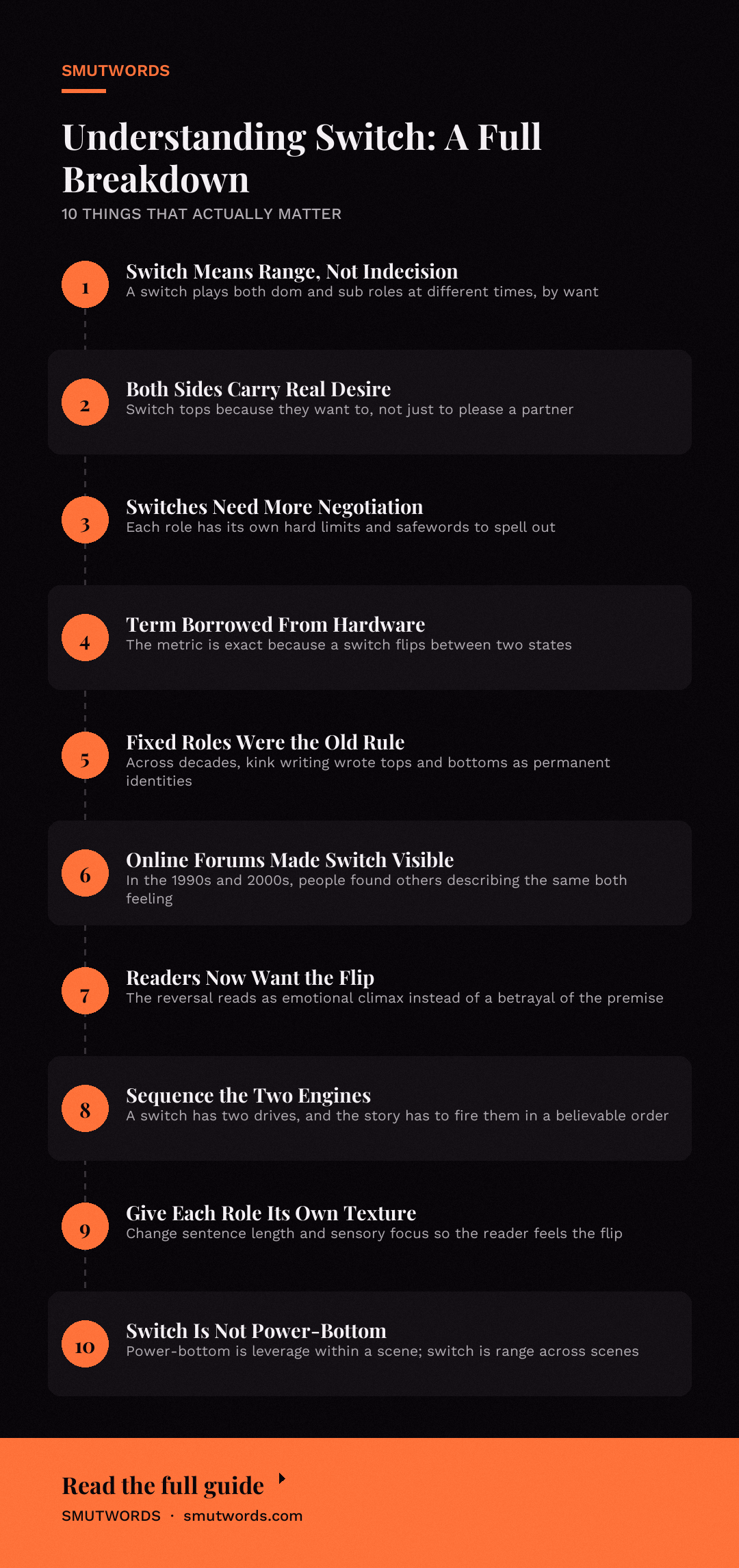
In the glossary sense, a switch is a person who occupies both the dominant and submissive ends of the spectrum at different times. The label describes range, not indecision. A switch who tops one weekend and bottoms the next is exercising the same core trait both times: they get off on both sides of the exchange.
The term itself is borrowed from electrical hardware, where a switch flips between two states. Kink communities picked it up decades ago because the metaphor is exact. A switch is a whole player who can flip states, not half a dom and half a sub.
What counts as a switch
Someone who tops one partner and bottoms with another. Someone who takes the dominant role in public scenes and submits privately, or the reverse. A character who starts a book as a confident top and discovers, with the right person, that they want to kneel.
Someone who enjoys directing a scene and then, later, being bound and talked down to. All of these are switch behavior, whether or not the character ever uses the word.
What does not count
A switch is not simply a sub who tops occasionally to please a partner, though that person might be a service top and might also be a switch. The difference is desire. A switch tops because they want to, not only because someone asked.
A switch is also not someone who cannot commit to a role, and it is not a beginner's label for someone who hasn't figured themselves out yet. Plenty of switches have decades of experience and a precise sense of what each side gives them.
And a switch is not a dominant who sometimes submits as a birthday favor. One-off role flips happen in plenty of relationships. Switch is the label for people who live across both sides regularly.
Common misconceptions
- Misconception: switches are less dominant or less submissive than "real" doms and subs. Reality: a skilled switch can read and command a room as well as anyone; they simply also enjoy the other chair.
- Misconception: switching means no limits, no rules, no structure. Reality: switches need more explicit negotiation, not less, because both roles have their own hard limits and safewords.
- Misconception: a switch will always eventually pick a side. Reality: many switches stay switchy for life and find partners who like the flip.
- Misconception: "switch" is a personality description. Reality: it's a role preference. Plenty of switches are quiet, controlling people in daily life, and plenty are easygoing outside the bedroom.
Where the Term Comes From
Switch entered kink vocabulary through the same channels as the rest of the leather-era lexicon: mid-twentieth-century grassroots communities that built a shared language for role play long before it reached print. The hardware metaphor was useful because everyone already knew what a switch did. It flips.
For decades, in both community culture and early kink writing, the dominant and submissive roles were treated as fixed identities. A top was a top. A bottom was a bottom. Early BDSM-focused fiction rarely presented characters who moved between the two, and when it did, the move was usually framed as a character flaw or a one-time exception.
The term's use as a positive identity marker, rather than a hedge, expanded steadily through the 1990s and 2000s as online kink forums gave broader communities a place to talk. People who had assumed they had to pick a side discovered a large group of others describing exactly the same "both" feeling.
Mainstream romance and erotica lagged behind, and then arrived on a specific, revealing timeline. For years, virtually every bestselling BDSM romance featured a fixed dominant hero and a fixed submissive lead. The 2010s saw that formula become so standardized that reviewers began openly asking for versions with the roles reversed, softened, or shared.
The past ten years have seen the switch move from a background curiosity to a recognizable character type. Books that begin with a rigid power exchange now frequently introduce a scene or a chapter in which the roles reverse, and readers have grown to see that reversal as the emotional climax rather than a betrayal of the premise. Publishing language followed the readers. The label became something authors advertised on covers and blurbs rather than slipped in quietly.
How Switch Characters Show Up in Erotica
The craft question with a switch character is sequencing. A fixed top has one engine: control. A switch has two, and the story has to fire them in a believable order. When a book gets that order right, the flip lands like a plot twist and feels inevitable at the same time.
The strongest writing lets the switch's identity come out through small, specific detail before any scene brings it to the surface. A character who keeps a perfectly organized toy drawer while otherwise living in chaos. A character who gives orders easily at work and finds excuses to defer at home. These details prime the reader without announcing anything.
Common variations authors use
- The role-fluid lead. A character whose preference shifts with the partner, the setting, or the phase of the relationship. Often the emotional through-line of a slow-burn.
- The versatile partner. Two switches who trade roles scene by scene, the toggle itself becoming the erotic engine of the book.
- The power-bottom. A character who submits physically while driving the scene from below, steering with their demands and reactions. Not the same thing as a switch, but often written by the same author for the same reason.
- The service top. Someone who takes the dominant role primarily to give a partner what that partner needs. Service tops may or may not identify as switches, and the ambiguity is fertile ground.
- The reversal arc. A fixed character in the first half who discovers the other side of themselves with a specific partner, the switch as character development rather than premade identity.
- The dual-role scene. A single encounter in which the partners trade control mid-scene, usually written with a negotiation beat before the flip.
Some of these show up naturally alongside stranger kinks. A switch couple who stage an encounter with a voyeur joining the room is a common setup, and the voyeur husband trope plays well with a switch who wants to be watched in two different roles.
An orgy scene gives a switch the chance to change position within a single night without anyone questioning it. And a one night stand is one of the few setups where a switch's dual nature can be revealed inside a single evening.
What makes a strong switch character work
Strong switch writing tends to do three things. First, it gives each side of the character its own sensory texture. The dominant half might be written in short sentences and direct sight; the submissive half in longer ones, more interior and touch-focused. The reader can feel the flip before the dialogue makes it explicit.
Second, it keeps a specific vulnerable detail in each role. A switch who is careful and controlling on top and quietly needy underneath is a character. A switch who is merely confident on both sides is a cardboard stand-in.
Third, the best books let the flip be negotiated on the page. A short exchange, a sentence or two, a nod to the subspace and domspace each partner drops into, the safeword named out loud. That beat reliably makes the reversal hotter for readers, because the strip of negotiation is what makes the trust visible.
Enjoyed this? Get a free book.
Join the list and we will send a complete free story straight to your inbox, plus new releases every week after that. No credit card, no catch.
What makes a flat one
Flat switch writing usually does one of two things. It treats the switch as a generic "they can do anything" hero with no specific texture per role, or it flips the roles for shock value with no setup and no aftermath. The scene reads like a role change rather than a character reveal, and readers clock it immediately.
Another common failure is using switching as an excuse to skip negotiation. A chapter where the characters simply trade places without any communication tells the reader that the switch is a plot convenience. A short exchange of who's in control and who has the safeword costs a paragraph and adds a whole layer of charge.
Kinks and practices that pair naturally with switching
A switch scene does not require a particular kink, but some practices read especially well with it. Shibari is often used to mark a switch's bottoming side, with rope work that shows who is currently in charge in a single image. Keyholding can flip unexpectedly, with either partner holding the keys this week. And primal play suits switches well, since the animal roles are built to be fought over rather than assigned.
Other practices have natural dual versions that a good author can toggle within a single relationship. Service submission can belong to either partner on any given day, especially when a switch likes giving and receiving care work. And the two halves of chastity play and orgasm denial are both available to a switch, one side per scene, which gives an author real variety across a series.
How switches handle the practical side
The real-world consideration authors handle well is communication about which role is active. A switch and their partner need a quick check-in before a scene about who is running things and who has the safeword. In fiction, that check-in can be a single line of dialogue: "You or me tonight?"
A single safeword that both partners can use, regardless of who is on top, is the standard arrangement. Switch characters in the best books treat this as a normal part of the setup. The reader sees it as care, and the scene is hotter for it.
Switch vs Power-Bottom
Readers confuse these two more than any other pair of terms in the switch's orbit. They are different things.
A power-bottom is a submissive who organizes and steers the scene from the bottom. Picture a character who kneels and yet tells the top exactly what to do. The power-bottom holds the submissive role and the dominant leverage at the same time.
A switch is a person who plays both roles across scenes. They are genuinely dominant in some encounters and genuinely submissive in others. The switch's distinguishing feature is range over time; the power-bottom's is leverage within a single scene.
Many switches are also power-bottoms when they bottom, which is the source of the confusion. A bottoming switch who enjoys steering is doing both things at once, and authors sometimes blur the labels because the combination is effective on the page. Still, the labels point at different questions: power-bottom describes how someone bottoms; switch describes whether they also top at all.
Primal play sits near this comparison too, because a switch scene that involves chasing and wrestle-and-take-down games can look like a power-bottom beat when the bottom momentarily gains the upper hand. The cleanest distinction: a switch who wants to win is a switch. A power-bottom who wants to win is a power-bottom still playing their role.
Frequently Asked Questions
Is a switch the same thing as being bisexual in kink terms?
No. Bisexuality is about which genders someone is attracted to. Being a switch is about which side of a power exchange someone enjoys. A switch can be straight, gay, bisexual, or anything else, and the two traits are independent.
Can a switch have one primary role they prefer?
Absolutely. Plenty of switches lean dominant or lean submissive and switch less often than the label suggests. A "75 percent dom" switch is still a switch, and books that show the ratio honestly tend to read more like real people.
How do two switches decide who tops in a given scene?
They talk about it. Some pairs alternate by night, some by mood, some by who initiates first. In well-written fiction, that impromptu negotiating beat is one of the hottest parts of the scene, since each partner gets to be courted rather than assigned.
Is switching a sign of being new to kink?
No. Newcomers do sometimes try both roles to figure out what they like, but a large number of switches are veteran practitioners who have known their range for years. Switching is a stable identity for many, not a phase on the way to a favorite side.
Does a switch need a different safeword when bottoming?
Not usually. Most switch pairs use one safeword that works in both directions, spoken by whoever is currently holding less control. The key requirement is that everyone in the scene knows which word it is before anything starts, and that the word is honored instantly regardless of who's topping.
Why do readers like switch characters so much?
Two reasons. A switch lets a book explore both sides of a power exchange without splitting the protagonist into two characters. And the moment a character flips, readers get to feel like they've learned a secret about someone they thought they knew, which is one of the reliable pleasures of any romance or erotic novel.
Final Thoughts
The switch is the most natural next step for readers who have gone through a few dozen dominant-and-submissive books and started wondering what happens when the roles trade hands. The best switch writing pairs the flip with a specific, vulnerable detail on each side of the character, so the reader feels the change before the dialogue names it.
Look for a book that lets the switch happen mid-relationship, with a negotiation beat and a shared safeword on the page. The flip lands hardest when the trust is visible first.






Loading comments…