
A JOI game is a scripted jerk-off instruction scenario: one person gives timed, specific commands for masturbation while the other follows them, reports back, and plays by the rules the dominant sets. It runs in person or across text and audio. In erotica it turns a solo act into a two-person power exchange with structure, checkpoints, and stakes.
The JOI game is one of the most reliable tension machines in kinky fiction because it makes the reader wait, follow along, and squirm through every rule. It also happens to be one of the easiest kinks to write badly, which is why it deserves a real guide.
What JOI Game Actually Means
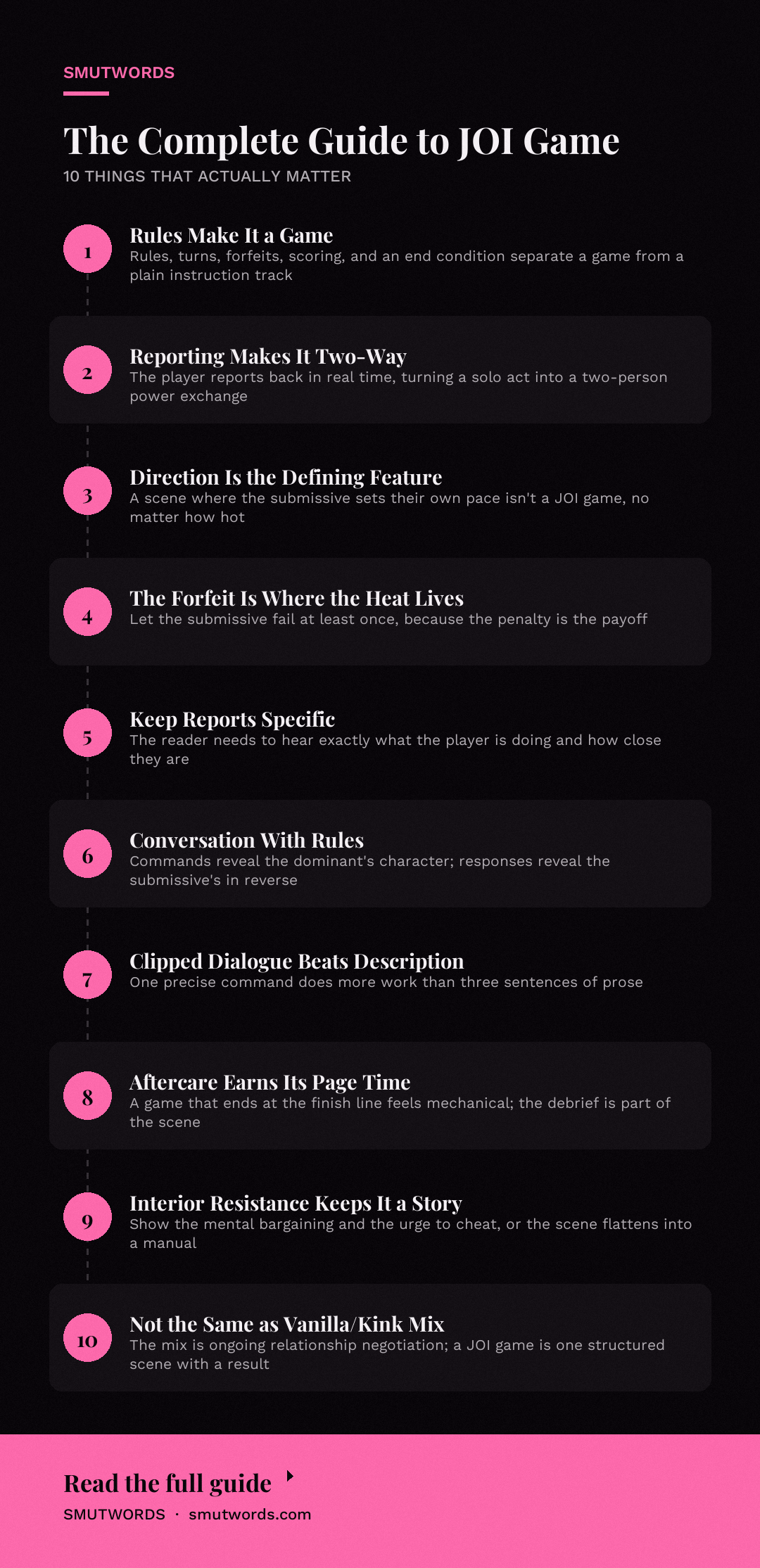
JOI stands for jerk off instruction. The acronym came out of amateur audio and webcam porn communities, where performers recorded guided sessions and posted them for listeners. The "game" part is what separates it from a plain instruction track: rules, turns, forfeits, scoring, and a defined end condition.
A JOI game typically includes a few recognizable components. A director (partner, dominant, or voice on a recording) issues commands. A player follows them in real time. Reporting is built in, which is what makes it a two-way scene rather than a solo session.
Then there's the consequence structure: edging penalties, denial, praise, humiliation, or a set finish.
What counts as a JOI game is broader than people assume. A five-minute audio file with a single edge and a countdown qualifies. So does a two-hour text exchange with numbered tasks, photo check-ins, and a forfeit for breaking a rule.
What doesn't count: plain mutual masturbation with no direction, a one-line sext that says "touch yourself," or a scene where the submissive sets their own pace. The game requires an external script and someone enforcing it.
Common misconceptions are worth clearing up. A JOI game doesn't require nudity on camera or any video at all; plenty of players use voice notes or text reports. It isn't inherently humiliating, though humiliation is a popular flavor. And it isn't the same as edging for its own sake, since edging is one possible rule inside a game, not the whole structure.
Where JOI Game Comes From
The history here is a publishing and internet phenomenon more than an ancient practice. JOI as a recognizable format grew out of early-2000s amateur audio porn, where performers recorded guided sessions and sold or shared them on clip sites. The acronym consolidated in forums and tube sites during the 2010s as tags made the format searchable.
What changed with the "game" framing was interactivity. Early JOI was a monologue: a performer told you what to do and you did it. Once creators built in branching choices, timers, and forfeits, the format became something the listener could lose. Losing is what made it fiction-ready.
Erotica picked it up through fanfiction and original serial fiction, especially in spaces where chat-log and text-message formats were already common. Writers realized the format solves a structural problem: two characters can be intimate while physically apart, and messages and commands break the page into natural paragraphs.
The shift over the past decade has been toward emotional stakes. Earlier JOI stories leaned on pure command-and-obey heat. Contemporary versions spend more of their word count on negotiation, the submissive's internal resistance, and aftercare. The interactive JOI game format in particular has pushed writers to design scenes readers feel they could follow along with.
Real-world JOI play relies on negotiated limits and safewords, especially in remote or timed scenarios. A player can stop the game at any point. Good partners build in check-ins and aftercare the same way they would for any scene play. Fiction that skips this step reads as careless to experienced readers, and it's usually the first thing an editor flags.
How It Shows Up in Erotica
The craft appeal of a JOI game is that it externalizes desire. A character can't just want; they have to obey, report, and wait. That structure lets a writer build slow-burn anticipation through rules and check-ins instead of jumping straight to the act, which is why the format pairs so well with slow-burn romance.
On the page, JOI scenes break down into a few recurring shapes. Chat logs and text-message exchanges are the most common, because the format is inherently paced by messages. Audio transcripts and voice notes come next, and they let a writer capture tone, pauses, and the sound of a command.
In-person versions use the same structure but add physical staging: a chair, a timer, a partner across the room giving directions. Writers who want a physical surrender element sometimes bring in props, and the format sits naturally alongside bondage furniture use when a scene wants the player restrained while following voice commands.
The strongest versions of this trope share a few traits. First, they give the dominant a clear reason for running the game, whether that's control, curiosity, punishment, or a deliberate test of the submissive's obedience. Second, they let the submissive fail at least once, because the forfeit is where the heat lives. Third, they keep reporting specific, so the reader hears exactly what the player is doing and how close they are.
Enjoyed this? Get a free book.
Join the list and we will send a complete free story straight to your inbox, plus new releases every week after that. No credit card, no catch.
Weak versions flatten into a checklist. If every command gets instant compliance and no interior resistance, the scene becomes a manual rather than a story. The fix is interiority: show the player's mental bargaining, the urge to cheat, the fear of being caught breaking a rule.
Common Variations Authors Use
- Timed games. A countdown or interval structure where the player has to hold, edge, or wait a set number of seconds. Timers create visible stakes and make pacing easy to control on the page.
- Edge-and-deny. The core edging game: the player is allowed close and then commanded to stop, repeated until the dominant grants permission. Denial is the engine here, and the payoff is the release.
- Task-based play. The game assigns discrete tasks with check-ins, sometimes with photo or written proof. Each task is a small scene, which suits serial fiction.
- Remote JOI. The dominant and player are apart, communicating by text, call, or recording. Distance raises the voyeurism and the risk of being caught.
- Audio JOI. A recorded or live voice guides the player. Writers who use this format get to play with tone, tempo, and the intimacy of a voice in the ear.
- Command games with forfeits. Breaking a rule triggers a penalty, from denial to a humiliating report to a physical consequence. Forfeits are where the humiliation or praise dynamic gets its teeth.
- Guided masturbation with a witness. The player performs while someone watches in person. Voyeurism is the point, and the reporting becomes live.
Two adjacent variants deserve a note. Breath play JOI folds controlled breathing and hold instructions into the command structure, and it demands more explicit safety language than a standard game because the stakes are physical. Cock warming sits at the other end: a cock warming scene can run as a JOI game where the "command" is stillness and the forfeit is movement.
What Makes a JOI Scene Work on the Page
The best JOI scenes treat the game as a conversation with rules. The dominant's commands reveal character: what they choose to forbid, what they praise, how they handle a player who pushes back. The player's responses reveal the same thing in reverse.
Pacing matters more here than in almost any other kink. A JOI game has a natural rhythm of command, compliance, report, and consequence. Writers who break that rhythm every paragraph with interior monologue kill the tension. Writers who let the reports do the emotional work keep it alive.
Dialogue should stay clipped and specific. "Slow down, two fingers, tell me when you're at seven" does more than three sentences of description. The command's precision is what makes the control feel real, and precision is also what makes the scene readable.
Finally, aftercare earns its place on the page. A game that ends at the finish line feels mechanical. A game that ends with the dominant checking in, praising, or holding the player lands the emotional payoff, and it mirrors the real-world need for impact play aftercare even when no impact happened. The debrief is part of the scene.
JOI Game vs Vanilla/Kink Mix Relationship
These two get confused because a JOI game often happens inside a couple where one partner is kinky and the other isn't. The vanilla/kink mix relationship describes the broader dynamic: two people with different appetites negotiating how much kink enters the relationship. A JOI game is one specific activity those partners might play.
The distinction matters for writers. A vanilla/kink mix story is about ongoing negotiation, compromise, and the relationship's terms. A JOI game story is about a single structured scene with rules, commands, and a result. You can write a JOI scene inside a vanilla/kink mix relationship, but they aren't interchangeable, and treating them as synonyms flattens both.
For a related angle on how desire and conflict tangle up in the same relationship, our piece on angry sex vs makeup sex covers the dynamic that often sits behind a vanilla/kink negotiation.
Frequently Asked Questions
What does JOI stand for?
JOI stands for jerk off instruction. It refers to guided masturbation where one person directs another through commands, usually with timing, rules, and reporting, and a JOI game adds a formal structure with forfeits and an end condition.
Is a JOI game always remote?
No. Remote JOI is one popular variant that uses text, calls, or recordings, but in-person JOI games are just as common in fiction. The defining feature is direction, not distance, and the format works whether the dominant is in the room or on the other side of a screen.
What's the difference between a JOI game and edging?
Edging is a technique: bringing yourself close and stopping. A JOI game is a structure that can include edging as one of its rules. Every edging game is a kind of command game, but not every JOI game is built around edging.
Can a JOI game include humiliation?
Yes, and it's one of the most common flavors. The reporting structure creates natural openings for praise or humiliation, depending on what the dominant chooses to say. The strongest humiliation scenes also show the player's reaction and the dominant's care afterward.
How do writers handle consent in JOI fiction?
Good writers show it explicitly, through a negotiation beat, a safeword exchange, or check-ins during the game. Real-world JOI play relies on clear negotiated limits and safewords, and readers who know the practice notice when a story skips them.
Why is JOI so popular in slow-burn romance?
The format builds tension naturally through rules, waiting, and check-ins. It lets two characters be intimate while delaying the physical payoff, which is the core mechanic of slow-burn. The waiting is the point.
Final Thoughts
A JOI game is one of the most flexible structures in kinky fiction: it works across distance, across formats, and across heat levels. If you want to see the format done at full length, start with the complete guide to interactive JOI games, which walks through the rules, the pacing, and the negotiation beats that separate a scene from a checklist.





Loading comments…