
A landlord/tenant romance puts two people on opposite sides of a lease and lets the paperwork turn into foreplay. One character owns the building or the house. The other pays to live there.
Every repair request, every late rent text, every knock about a leaky faucet is a reason for them to end up in the same room again, and the genre milks that arrangement for everything it's worth. The power imbalance is built into the premise before either character says a word, which is exactly why so many authors reach for it.
The trope shows up across contemporary romance, small-town romance, and full erotica, and it works because the conflict is structural rather than manufactured. Nobody has to invent a reason for these two to keep colliding. The lease does that for them.
What Landlord/Tenant Romance Actually Means
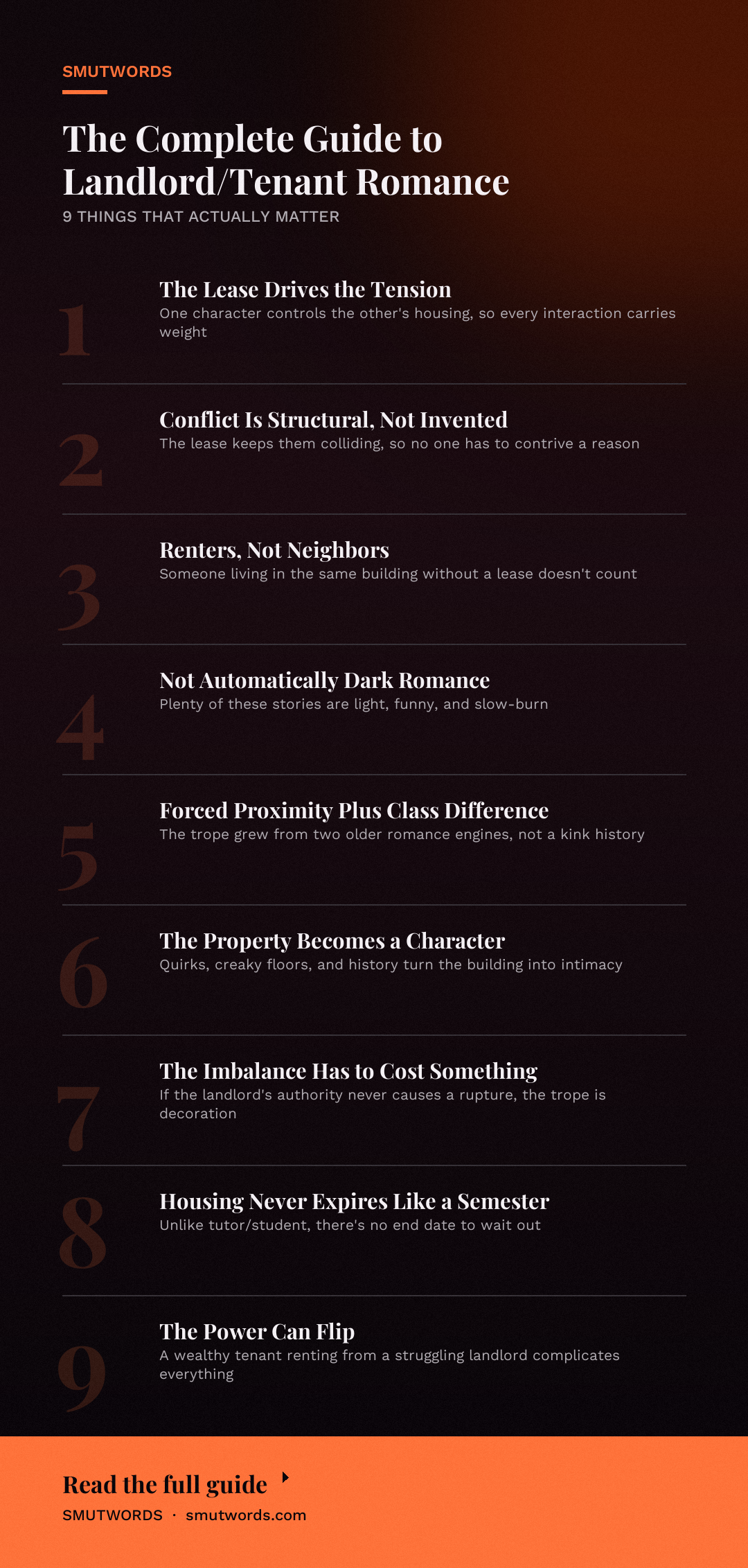
A landlord/tenant romance is a romance in which the central relationship runs along a property line. One party has authority over the other's housing, and that authority shapes how they meet, how they negotiate, how they fight, and eventually how they fall for each other.
The term describes the setup rather than any single plot. The landlord can be a grumpy man who owns six buildings and hates everyone. The tenant can be the woman who accidentally paid rent three days late and now can't stop thinking about the way he looked at her on the front step.
What counts: any story where one character's control over the other's home creates the romantic friction. That includes the small-scale version (a guy renting out his basement apartment) and the institutional version (a property manager who technically works for a faceless company but holds all the real power on the ground).
What doesn't count: a romance where someone happens to live in a building the love interest also lives in, with no ownership or lease relationship between them. Neighbors aren't landlords. Roommates splitting rent as equals aren't landlords either, though the "roommate agreement" variant sometimes blurs that line and the genre knows it.
The misconception worth killing early: this trope is not automatically a dark romance, and it is not automatically about coercion. Plenty of landlord/tenant stories are light, funny, and slow-burn, with the imbalance treated as awkward tension rather than threat. The heat comes from proximity and dependency, not from anyone being trapped.
Where Landlord/Tenant Romance Comes From
The honest history here is a publishing history, not a kink history. There's no ancient tradition of landlord erotica to trace. What exists is a recognizable modern trope that grew out of two older romance engines: forced proximity and class difference.
Forced proximity has been a romance staple for as long as the genre has existed. Put two people in a confined space and the tension writes itself. The landlord/tenant setup is one of the cleanest modern versions because the confinement is legal and ongoing. You can't just leave the elevator.
Class difference is the other parent. Romance has always been fascinated by a wealthy or powerful character paired with someone who has less, and the landlord/tenant frame updates that dynamic for a world where most people rent. The power isn't aristocratic title or inherited estate. It's a key, a lease, and the ability to raise the rent.
The trope's real boom tracks the rise of contemporary romance in the 2010s and the explosion of self-published erotica on digital storefronts. Authors needed settings that felt immediate and low-fantasy, and rental housing was right there. The genre has since refined the trope considerably, moving away from pure villain-landlord plots toward more complicated arrangements where the landlord is gruff rather than cruel.
That shift mirrors what happened across romance more broadly, which is worth reading about in the state of erotica publishing right now. Readers increasingly want the power imbalance acknowledged and then complicated, not simply wielded.
How It Shows Up in Erotica
On the page, this trope lives and dies by the small domestic details. The landlord who shows up to fix the water heater himself instead of sending a contractor. The tenant who bakes something and leaves it on his desk as an apology. The maintenance call that runs long because neither of them wants to end the conversation.
A strong landlord/tenant romance uses the property as a third character. The apartment has a history. The building has quirks. The landlord knows which floor creaks and which tenant complains, and that knowledge becomes a form of intimacy long before anyone touches anyone.
Here are the variations authors reach for most often:
- The grumpy landlord: he's curt, he's efficient, he fixes things without chatting, and the heroine slowly realizes the gruffness is armor. This is the most common version and the easiest to sell.
- The eviction threat: one character is behind on rent, and the other has to decide whether to enforce the lease or bend it. High tension, high stakes, and a built-in moral question.
- The maintenance call: a broken appliance or a plumbing disaster forces physical proximity in a small space. Often the first real conversation happens here.
- The roommate agreement: the landlord-tenant line softens into cohabitation. One of them moves in, or they were already sharing the unit, and the power dynamic shifts as they negotiate space.
- The inheritance twist: the tenant inherits the building, or the landlord discovers the tenant is the rightful owner of something. The power flips and both characters have to recalibrate.
What separates a good version from a flat one is whether the power imbalance actually costs something. If the landlord's authority never creates a real problem, the trope is just decoration. The best stories let the imbalance cause a genuine rupture, then earn the reconciliation.
Enjoyed this? Get a free book.
Join the list and we will send a complete free story straight to your inbox, plus new releases every week after that. No credit card, no catch.
The other craft note: the genre rewards specificity. A landlord who owns "some buildings" is boring. A landlord who owns the corner storefront and the two apartments above it, who knows every tenant's name and every tenant's dog, is a person. Detailed property equals detailed character.
This is also where the trope overlaps with enemies to lovers. Many landlord/tenant stories start with resentment on both sides and use the lease as the thing that keeps them in each other's orbit until the resentment turns into something else. The difference is that the lease never expires, so the forced proximity has no natural end.
Authors who want a sharper edge sometimes borrow pacing tricks from darker subgenres, and the slow build of dread used in cosmic horror romance translates surprisingly well to a story about a man who holds the keys to your home and knows it.
Landlord/Tenant Romance vs Tutor/Student Romance
These two tropes get confused because both run on a structural power imbalance, but the machinery is different in ways that matter to how a story plays out.
In tutor/student romance, the imbalance is about knowledge and authority within a defined, temporary role. The tutor has expertise the student needs, and the relationship usually has an end date built in. Once the exam is passed or the semester ends, the structure dissolves.
In landlord/tenant romance, the imbalance is about housing, which is permanent and unavoidable. The tenant can't just stop needing a place to live, and the landlord can't hand back the keys. The dependency is ongoing, which raises the stakes and changes the tone. There's no semester to wait out.
Both tropes ask the same underlying question (can a relationship survive a power imbalance that started before the romance did?), but landlord/tenant stories have to answer it while the imbalance is still in force. That's the harder version, and the more interesting one.
Frequently Asked Questions
Is landlord/tenant romance the same as forced proximity?
No, though it's a subset of it. Forced proximity is the broader category where two people are stuck near each other by circumstance. Landlord/tenant romance is a specific version where housing is the reason. The lease makes the proximity ongoing rather than temporary, which is what separates it.
Can a landlord/tenant romance have a happy ending without the power imbalance being resolved?
Yes, and the best ones often do exactly that. The resolution usually comes from the landlord voluntarily giving up some authority, or the tenant gaining enough footing that the relationship stops being lopsided. Nobody has to sell the building for the ending to land.
Does the tenant always have to be the less powerful character?
Not always. Some stories flip it, with a wealthy tenant renting a modest unit from a landlord who's struggling to keep the property afloat. When the money runs the other direction from the title, the dynamic gets more complicated and usually more interesting.
Is this trope considered a dark romance?
It can be, but it doesn't have to be. The setup lends itself to darker plots because the power imbalance is real, but plenty of stories play it as light, funny, or slow-burn. The tone depends entirely on how the author handles the landlord's authority.
Why do readers like the maintenance call setup so much?
Because it forces physical closeness in a small, private space with a built-in excuse for the visit. Nobody has to contrive a reason for the two characters to be alone together. The broken sink does the work, and the intimacy that follows feels earned rather than convenient.
What's the difference between a grumpy landlord and an enemies-to-lovers setup?
The grumpy landlord is a personality type. The enemies-to-lovers arc is a plot structure. Plenty of grumpy landlords are paired with tenants who never actually become their enemy, and plenty of enemies-to-lovers stories have no property involved. The two overlap often, but they aren't the same thing.
Final Thoughts
Landlord/tenant romance works because it takes something mundane, a lease, a rent check, a leaky pipe, and turns it into the engine of a whole relationship. The power imbalance is baked in from page one, and watching two people negotiate their way through it is the entire pleasure.
If you want to see the trope handled with real care, start with a story where the property has a personality and the landlord has a reason for every rule he enforces. That's where the trope stops being a setup and starts being a love story.








Loading comments…