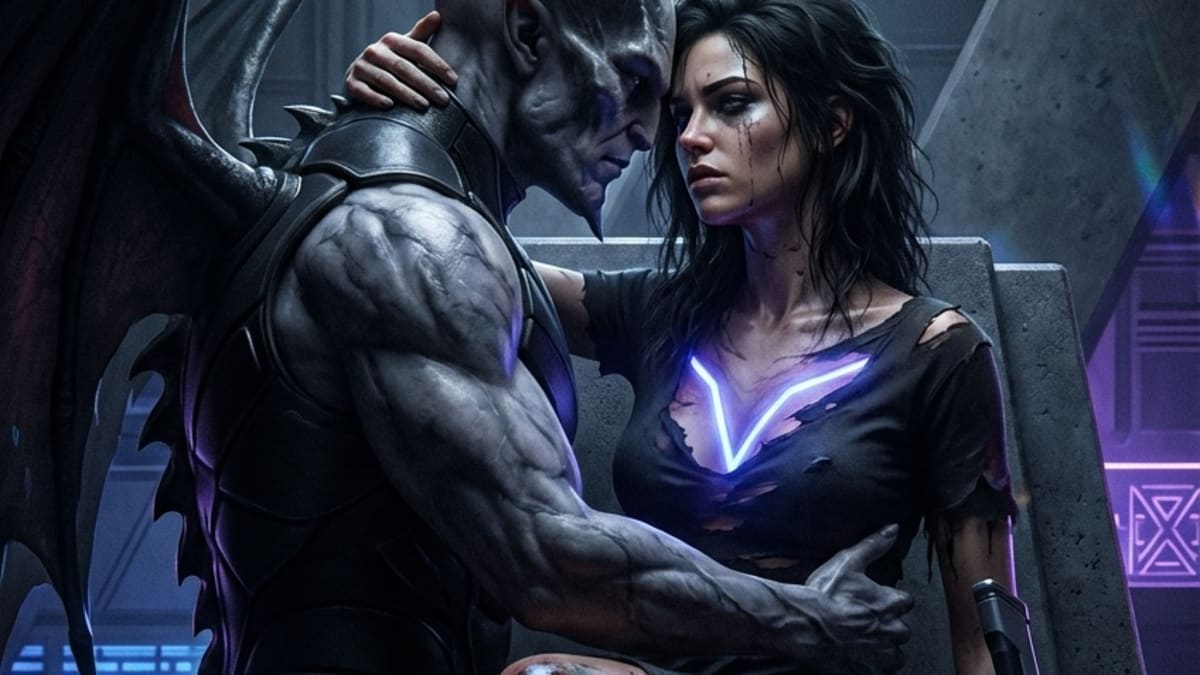
Cosmic horror romance is the subgenre where the love interest is something ancient, vast, and functionally beyond human comprehension, and the story still demands a happy ending for the couple. That's the whole trick of it.
You take the dread engine of Lovecraftian fiction, the swollen indifferent god and the screaming void, and you point it at the romance plot instead of away from it. The tentacles become hands. The void learns your name. The apocalypse is a meet-cute.
Cosmic horror romance is not a mashup for shock value. It's a real, distinct, and wildly popular mode of erotic storytelling, and it rewards a reader who knows what they're getting into.
What Cosmic Horror Romance Actually Means
The short definition covers the basics: the terror of the unknowable fused with a romantic plot, where the love interest is often an inhuman, ancient being whose existence defies comprehension.
That's accurate but thin. The real definition has three load-bearing parts, and a book only fully qualifies as cosmic horror romance when it hits all three.
First, the love interest is cosmically scaled. Not just powerful, not just immortal. Ancient. Vast.
Operating on a timescale where human lives are a blink and a geography where a single human body is an address, not the whole map. The entity might present as a man, a woman, or a shape, but the story never lets you forget that the presentation is a courtesy. The real thing underneath has an age counted in epochs.
Second, the romance is genuine. This is where cosmic horror romance parts ways with horror that merely flirts with erotic subtext.
The love interest wants the protagonist, and the protagonist wants them back. There is no ironic distance, no winking at the reader. Readers came for the romance and the story delivers it.
Third, the connection is existentially destabilizing. Being loved by something this large reorganizes the protagonist's sense of self, of reality, of what a person is for. The love is real and the love is also a kind of dissolution. Both things stay true at once.
What Doesn't Count
A vampire who's three hundred years old is not cosmic horror. A demon prince with wings and a grudge is not cosmic horror, no matter how many skulls he has. The scale has to be wrong for the human frame in a way the story keeps noticing. If the reader can comfortably imagine sitting across a dinner table from the love interest and having a normal conversation, the cosmic element is cosmetic.
What also doesn't count: horror with a tragic ending. The genre earns the word romance by requiring the couple to land somewhere real, together, alive in the ways that matter to them. Cosmic horror romance bends the cosmos to make room for the relationship. It doesn't use the relationship as a sacrifice to the void.
Common Misconceptions
- That it's always grim. Many of the best-loved entries are funny, tender, and even sweet. The horror is structural, not tonal.
- That the love interest has to be a tentacled god. The entity can be a star, a sentient ocean, an institution, an AI with a reach that swallows civilizations. If it references AI romance territory but at a scale where the AI has outlived species, you're in cosmic horror romance with a machine instead of a squid.
- That it's a niche curiosity. It's one of the fastest-growing corners of the indie romance market, with dedicated reader communities, review blogs, and conventions of its own.
- That the human is always the submissive one. Power flows in strange directions in these stories, and the entity is often the more emotionally vulnerable party, undone by a feeling it has never had to make room for before.
Where Cosmic Horror Romance Comes From
The publishing history here is real but compressed, and it's worth telling honestly rather than reaching back to Lovecraft and calling it a direct ancestor. Lovecraft himself had no interest in romance. His cosmic horror was built on the premise that human love, human attachment, and human meaning are all trivial next to the indifferent universe. He used the void to argue that intimacy doesn't matter.
Cosmic horror romance picks up that exact aesthetic and argues the opposite, which is why it works as a genre rather than a contradiction.
The first wave of shared DNA came through fan fiction in the 2000s and early 2010s, where writers took eldritch aesthetics and pointed them at romance with no interest in preserving the philosophical bleakness. Cthulhu got a boyfriend. The King in Yellow got a long-term partner. These stories circulated in fandom spaces, built a readership, and proved that the aesthetic had emotional range the original texts never bothered to explore.
Original indie publishing picked it up in the mid-to-late 2010s. Small presses and self-published authors started shipping tentacled gods and ancient star-creatures as love interests, at first in short novella form and then in full series. Reader enthusiasm did the rest.
The audience for this was larger than anyone expected, and it grew through word-of-mouth, review communities, and the kind of specific fanatical loyalty that publishers can't manufacture. For a broader picture of how indie romance reaches readers through channels like Kindle Unlimited, see Going Wide vs Kindle Unlimited for Erotica Authors, which is useful context for anyone trying to trace where these books find their audience.
The genre also evolved alongside adjacent niches. As alien abduction romance matured and readers wanted love interests further from human, cosmic horror romance absorbed that appetite. Where alien romance keeps the love interest biologically compatible at some level, cosmic horror romance lets them be a category of being that doesn't share a biology at all. The two subgenres sit next to each other on shelves and often share readers, but they are not the same thing.
The most significant shift in the last five years: the love interests have gotten warmer. Early cosmic horror romance leaned hard on the dread side, with ancient entities that remained frightening throughout. The current crop increasingly portrays the entity as capable of real emotional growth, tenderness, and even vulnerability.
The terror stays. The relationship gets gentler. Readers drove that shift, and it shows.
How It Shows Up in Erotica
On the page, the genre has to solve a problem every scene: how do you write intimacy with something that shouldn't fit a human frame? The strongest books solve it with specificity. Vague cosmic awe is boring. Specific cosmic awe is erotic.
The love interest's physical form gets attention. A tentacle that is somehow also a tongue. A hand with too many joints that still knows how to hold. Wings, tendrils, a mouth that opens in a direction the protagonist's brain can't fully process.
The prose slows down at these moments and gives the reader something concrete to picture, even if the picture is a partial one. This is where the subgenre overlaps with size difference romance, except the scale gap is not just physical. It's metaphysical.
The dialogue carries the emotional weight. Ancient entities speak in registers that no human uses, and good authors use that register to make the love interest seem foreign, then slowly teach them to say a normal sentence. The first time a god says "I missed you," and means it in a way that gestures at a thousand years of waiting, is often the emotional peak of the book. The reader has been waiting for exactly that line.
Enjoyed this? Get a free book.
Join the list and we will send a complete free story straight to your inbox, plus new releases every week after that. No credit card, no catch.
The horror stays loaded in the background even during the romance. A scene of tenderness interrupted by the protagonist catching a glimpse of what their partner actually is. A sentence that starts as affection and ends as dread. The best moments in the genre are both at once and the author doesn't flinch from the doubleness.
This is also why these scenes are harder to write than typical erotic scenes. The author has to hold two contradictory tones in a single paragraph without letting either one collapse.
Common Variations Authors Use
- Bound god. The entity is imprisoned or diminished and the human protagonist is either the accident that frees it or the reason it wants to stay bound.
- Cult raised. The protagonist was raised to worship or serve the entity, and the romance reframes devotion as desire.
- Detective / academic. The protagonist investigates the entity, and the investigation becomes an intimacy.
- Contract / bargain. A trade of some kind binds them together, and the romance grows out of the obligation.
- Transformation arc. The human protagonist gradually becomes something less human themselves, and the romance holds through the change.
- Modern setting. An ancient entity navigates a human world of apartments, jobs, and coffee, with the horror built into the juxtaposition.
Each variation changes what the romance has to do. The bound god variant leans on vulnerability. The cult-raised variant leans on guilt and awakening.
The detective variant leans on discovery. The transformation variant is the darkest, and often the most rewarding, because it refuses the premise that the human stays human.
What Makes the Strong Version Work
The strongest cosmic horror romance novels share a set of craft choices that separate them from books that just have a spooky love interest. The entity has a clear, specific interior life. The protagonist has real agency, even when outmatched.
The horror beats land on the page as horror, not as decoration. And the ending is earned, meaning the couple has paid a real price for the relationship across the arc rather than arriving at a happy ending by authorial fiat.
A weak version of the trope usually fails in one of two directions. It either leans so hard on the eerie register that the romance feels theoretical, or it lets the entity become so humanized that the cosmic element drops out entirely.
The fix in both cases is the same. Keep the romance specific and keep the cosmic element specific. Vague dread and vague affection cancel each other out.
A note for writers working in this space: What Amazon Actually Allows for Erotica: A Practical Guide covers the content guidelines that shape what can be published where, which matters for cosmic horror romance specifically because the subgenre walks right up to the line on non-consent, body horror, and taboo dynamics.
Cosmic Horror Romance vs Cryptid Romance
These two get confused often because both involve non-human love interests and both lean on the eerie. The difference is scale and knowability. Cryptid romance centers on creatures that are strange, elusive, and often local: a Mothman, a lake serpent, a thing in the woods with cryptic rules. The creature is weird but the universe it lives in is basically the one we know.
Cosmic horror romance centers on entities large enough to have shaped reality or to exist outside it entirely. The creature is not just weird; its existence implies that the entire structure of the world is smaller than the protagonist was raised to think.
Cryptid romance plays with folklore. Cosmic horror romance plays with metaphysics. Both are good; they're just doing different work, and readers who love one sometimes find the other doesn't scratch the same itch.
Frequently Asked Questions
Is cosmic horror romance the same as Lovecraftian romance?
Close, but Lovecraftian specifically points at the aesthetic and mythology Lovecraft built: the Elder Gods, the sanity-shattering revelations, the New England dread. Cosmic horror romance is a broader tent. It includes Lovecraftian stories but also entities that have nothing to do with his mythology, like sentient stars, unfathomable institutions, or original creations by authors who never read Lovecraft.
Can cosmic horror romance have a happy ending?
It has to. That's part of the definition. If the book ends with the protagonist mad, dead, or dissolved, it's cosmic horror with a romance subplot, not cosmic horror romance. The genre bends the cosmic to accommodate the couple, which is its central creative move.
Do I need to know anything about Lovecraft to read these books?
No. Most contemporary cosmic horror romance novels are written for romance readers, not horror scholars. You'll pick up the aesthetic quickly: ancient entities, vast indifference, a human who is small but chosen. The mythology is a mood, not a prerequisite.
Is it always horror, or does the horror fade?
The horror usually stays, but its role changes. Early in the book it's the thing keeping the couple apart. Later it becomes the texture of the relationship itself. The dread doesn't evaporate; it becomes something the protagonist learns to live inside, which is a more interesting arc than the dread going away.
Is cosmic horror romance the same as monster romance?
Monster romance is the wider category and cosmic horror romance is one of its most extreme wings. If the love interest is a werewolf, you're in monster romance. If the love interest is a being older than the concept of "wolf," you're in cosmic horror romance. The territorial shifter trope sits far on the other end of that spectrum, with stakes measured in pack politics rather than eons.
Where should a new reader start?
Start with a novella. The length lets you test whether you click with the register before committing to a series, and the best novellas in the subgenre are tight, intense, and give you the full flavor in a single sitting. Then follow the recommendations at the bottom of the page into the longer series once you know you want more.
Why is this subgenre so appealing to readers who didn't expect to like horror?
Because the horror isn't aimed at the reader. It's aimed at the protagonist, and the reader gets to watch them survive it and be loved through it. The terror creates vulnerability, and vulnerability creates intimacy. Readers who feel exposed by the genre often find that the exposure is exactly where the pleasure lives.
That dynamic also connects cosmic horror romance to other emotionally intense niches. The same reader appetite that fuels angel romance and fae romance shows up here, except the entity on the other side of the romance is not just otherworldly, it is fundamentally indifferent to the categories the protagonist uses to understand the world. For readers drawn to fierce possession across impossible distance, pack mates romance trades the same intensity at a much smaller scale.
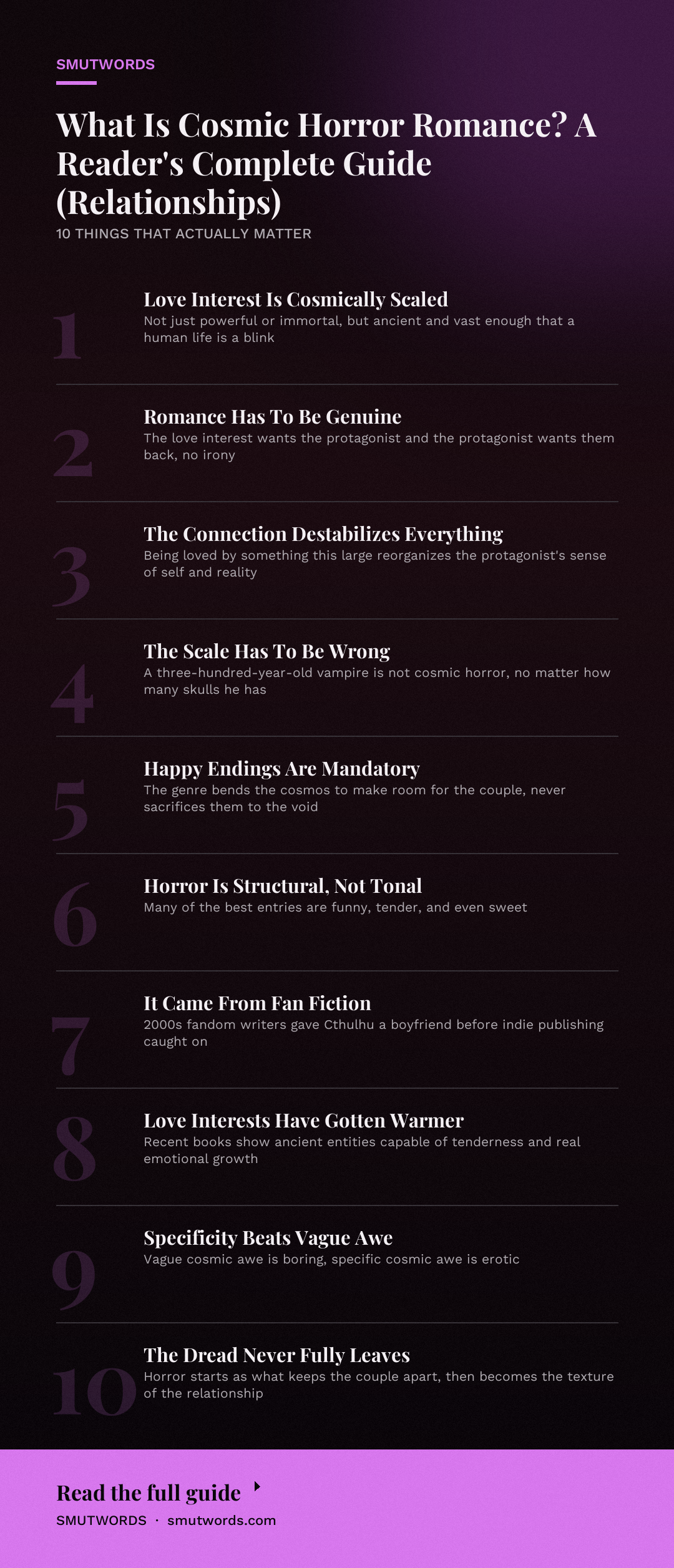
Final Thoughts
Cosmic horror romance is the genre that asks what happens when the void looks back and likes what it sees. It's not for every reader, and it's not supposed to be.
For the readers it lands with, it lands deep, because the central promise of the subgenre is that even the oldest and most indifferent thing in the universe can be changed by a human who refuses to be small. If you're new to it, pick up a novella first and let the register settle, then follow the recommendations below into one of the longer series.
And if you're exploring the themes personally rather than just reading, remember that intensity on the page is not a substitute for grounding in real life. Give yourself time after a heavy book, and if you're reading with a partner, talk about what landed and what didn't. The genre is safe precisely because it's fiction. Keep it that way.





Loading comments…