
A pheromone bond is a fictional mechanism in romance and erotica where scent triggers an intense, often involuntary attraction or lifelong commitment between two characters. The bond overrides conscious choice, sometimes immediately, sometimes through a slow biological pull the characters cannot reason their way out of.
It shows up most often in shifter romance, alien romance, and omegaverse stories as a fated pairing device. It exists to solve a specific problem: how to make two people certain about each other without the messy, human work of getting there.
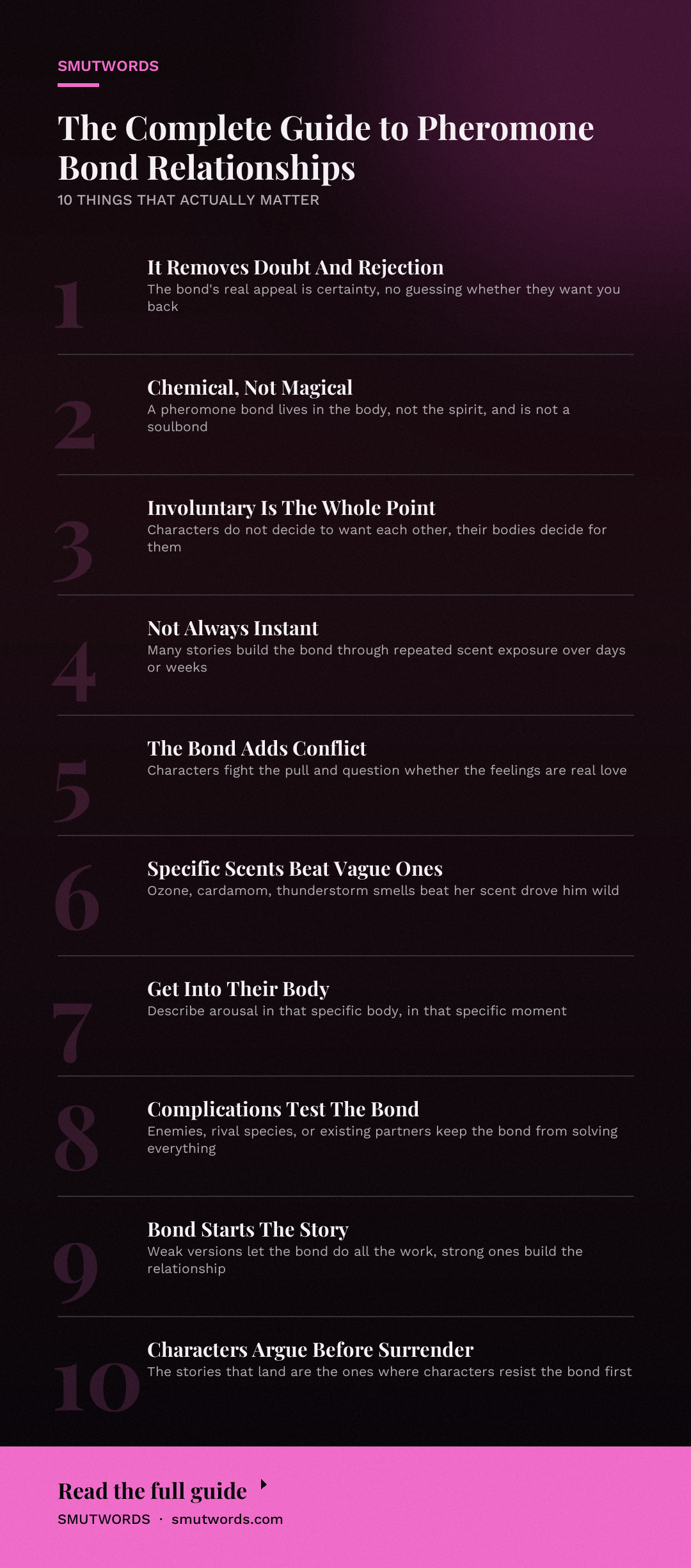
The appeal is straightforward. A pheromone bond removes doubt. It removes rejection. It removes the exhausting calculus of modern dating where you never quite know if the other person feels the same way you do.
In a pheromone bond story, the body knows before the brain catches up. That certainty is the fantasy.
What Pheromone Bond Actually Means
The term combines two real concepts into one fictional package. Pheromones are chemical signals animals release to communicate, attract mates, mark territory, and trigger behavioral responses in others of their species. A bond, in romance terms, is a permanent or near-permanent connection between two characters that cannot be undone. Put them together and you get a biological imperative that functions as both attraction and commitment device.
What counts as a pheromone bond varies by subgenre. In shifter romance, it usually means a wolf, bear, or big cat recognizes their mate by scent alone, often before they even see the person.
In omegaverse, it is the heat-and-rut chemistry between alphas and omegas, where scent compatibility determines everything from who they want to who they can physically tolerate. In alien romance, it might be a species-specific chemical signature that identifies a compatible partner across a crowded room or an entire galaxy.
The key element is involuntariness. A pheromone bond is not a choice. Characters do not decide to want each other. Their bodies decide for them, and the rest of the story is about what they do with that information.
It is not the same as love at first sight, though the two overlap. Love at first sight is visual and romantic. A pheromone bond is olfactory and biological. It hits the nervous system before the conscious mind registers what is happening.
It is also not the same as a soulbond, though the two are frequently confused. A soulbond is typically metaphysical or magical. It connects two souls, often with telepathy, shared pain, or emotional entanglement.
A pheromone bond is chemical and animal. It lives in the body, not the spirit.
Common misconceptions about pheromone bonds include the idea that they are always instant. In many stories, the bond builds over time through repeated exposure to the other person's scent. The first meeting might trigger recognition, but full bonding takes days, weeks, or multiple sexual encounters.
Another misconception is that a pheromone bond eliminates conflict. It does not. The best pheromone bond stories use the bond as a source of conflict.
Characters fight the pull. They resent the lack of choice. They worry the bond is not real love but just biology, and they have to figure out whether the feelings that grow alongside the bond are genuine or just chemical aftereffects.
Where Pheromone Bond Comes From
Pheromone bonds as a romance trope grew out of two separate traditions that merged in the early 2000s. The first is the fated mates trope in paranormal romance, which has roots in Gothic fiction and the broader romantic tradition of destined love. The second is the biological mate-recognition device in shifter fiction, which became a staple of the werewolf romance boom in the 1990s and 2000s.
Early shifter romance often used scent as a simple recognition tool. A wolf character would smell their mate and just know. The bond was assumed rather than explored. It was a plot shortcut, a way to establish the central pairing without spending chapters on courtship.
Omegaverse fiction, which developed in fanfiction communities in the early 2010s and later moved into published romance, changed the game. Omegaverse made the biological mechanics explicit. It built an entire world around pheromones, heats, ruts, scent marking, and chemical compatibility. The pheromone bond became not just a recognition device but a full system of sexual and social dynamics.
The rise of alien romance in the 2010s and 2020s pushed the trope further. Alien protagonists often have completely nonhuman biologies, which means their pheromone bonds work differently than human or shifter ones.
Some alien species bond for life after a single scent exposure. Others require multiple exposures. Others bond only during specific biological windows.
In the last decade, the trope has expanded into hybrid shifter romance, where characters are part human and part animal, and into cryptid romance, where the mate recognition device applies to beings like mothmen, bigfoot, and other creatures outside the standard wolf-and-bear lineup.
What has changed most over time is the level of consent and agency given to characters. Early pheromone bond stories often treated the bond as something that simply happened, with characters going along with it because biology said so.
Contemporary stories more often interrogate the bond. Characters question whether they would have chosen each other without it. They negotiate what the bond means for their autonomy, their other relationships, and their futures.
The tension between biology and choice has become the defining dramatic question of the modern pheromone bond story. Readers who grew up on the older, simpler version often find the newer, more conflicted version more satisfying.
How It Shows Up in Erotica
On the page, a pheromone bond does specific work. It gets two characters into sexual proximity quickly and gives them a reason to keep coming back to each other even when the relationship is messy. It also provides a biological justification for intense physical responses: racing pulse, slickness, arousal that cannot be talked down, and an almost painful need to be near the other person.
What makes a pheromone bond scene work is specificity. Vague descriptions of "her scent drove him wild" do very little. Strong pheromone bond writing describes what the scent actually does to the body. It describes where the character feels it, how it changes their breathing, what it makes them want to do, and how much they hate or love that loss of control.
Authors use several common variations on the trope:
- Instant recognition. The first scent encounter triggers immediate mate recognition, often with physical symptoms like dizziness, arousal, or an overwhelming urge to claim. Common in shifter romance and some alien romance.
- Slow-building compatibility. The bond develops through repeated exposure, often over days or weeks. Characters notice they feel better near each other before they understand why. Common in omegaverse and contemporary paranormal.
- Heat-triggered bonding. The bond only activates during a specific biological event, like an omega's heat or an alpha's rut. Common in omegaverse.
- Forced proximity bonding. Characters are trapped together, often in an enclosed space, and the constant scent exposure accelerates the bond. Common in alien abduction romance and survival scenarios.
- Bond rejection. One or both characters try to refuse the bond, often with severe physical or emotional consequences. This variation drives conflict across an entire book or series.
- Bonded but unclaimed. The bond exists but has not been consummated, creating sexual tension that can last for chapters. Common in slow-burn paranormal romance.
The strongest pheromone bond stories use the bond as a starting point, not an ending. The bond creates the initial pull, but the actual relationship has to be built. Characters still have to learn to trust each other, communicate, and decide whether they want the bond to define their lives.
Enjoyed this? Get a free book.
Join the list and we will send a complete free story straight to your inbox, plus new releases every week after that. No credit card, no catch.
Weaker versions of the trope treat the bond as a substitute for relationship development. If the bond does all the work, the story has nowhere to go after the first sex scene. The reader gets the fantasy of certainty but not the satisfaction of watching two people actually choose each other.
Authors who handle the trope well often add complications that test the bond. A character might already be in another relationship. A character might be from a species or culture that does not recognize pheromone bonds. The bond might connect two people who are enemies, rivals, or otherwise incompatible in every way except biology.
Territorial dynamics often intersect with pheromone bonds. A character who has bonded may become aggressively protective or possessive, which ties into the territorial shifter trope. The bond can also interact with size difference romance, especially when the bonded partner is physically much larger or more powerful, creating a power imbalance the characters have to navigate.
Some stories push the trope into darker territory by making the bond nonconsensual or forced. This overlaps with forbidden erotica territory, where the bond is something the characters are not supposed to have or are not allowed to act on. Other stories use the bond as a workplace complication, similar to how office sex and workplace free use fantasies use professional settings to create tension between desire and propriety.
In alien romance, pheromone bonds often intersect with alien abduction romance, where the abduction itself is justified by the alien's need to find a compatible mate. The bond provides the biological reason for the abduction and the emotional arc of the story, as the human character has to decide whether to accept a bond they did not choose.
Writers who want to make a pheromone bond feel fresh often change the sensory details. Instead of the standard wolf-and-forest scent palette, they use something unexpected: ozone, metal, rain on hot pavement, cardamom, the smell of a thunderstorm. The scent itself can do a lot of character work. A bond triggered by the smell of woodsmoke and pine tells you something different than a bond triggered by the smell of clean linen and citrus.
The best pheromone bond scenes are also sensory without being overwhelming. They describe the physical response in precise terms. They do not just say the character was aroused. They describe what arousal felt like in that specific moment, in that specific body, under those specific circumstances.
Pheromone Bond vs Soulbond
These two terms get confused constantly, and the confusion is understandable. Both describe an intense, often involuntary connection between two characters. Both are frequently permanent. Both show up in paranormal romance, shifter romance, and omegaverse.
But they are not the same device, and the difference matters for how a story works.
A soulbond is metaphysical. It connects two people at the level of soul, spirit, or consciousness. Soulbond stories often include telepathy, shared emotions, shared physical sensations, and a connection that persists across distance or even death. The soulbond is magical or spiritual in origin, even when the story is otherwise grounded.
A pheromone bond is biological. It connects two people through scent, chemistry, and animal instinct. It does not require magic or metaphysics. It works because the characters' bodies recognize each other as compatible mates, and that recognition triggers a cascade of physical and emotional responses.
Some stories use both. A character might have a pheromone bond with one person and a soulbond with another, creating a love triangle. Or the pheromone bond might be the physical manifestation of a soulbond, with the scent recognition serving as the body's way of finding the person the soul already knows.
For readers, the practical difference is in how the bond feels on the page. Soulbond stories tend to emphasize emotional and mental intimacy.
Pheromone bond stories tend to emphasize physical and sensory intimacy. Neither is better. They scratch different itches.
Frequently Asked Questions
Is a pheromone bond the same as a fated mate bond?
They overlap heavily, but they are not identical. A fated mate bond is a broader category that can include pheromone bonds, soulbonds, magical bonds, and other destiny-based connection devices. A pheromone bond is specifically the biological, scent-driven version. All pheromone bonds are fated mate bonds, but not all fated mate bonds are pheromone bonds.
Can a pheromone bond be broken or rejected?
In most stories, yes, though the process is painful. Bond rejection is a common plot device in shifter and omegaverse romance. Characters who reject a bond often experience physical symptoms like nausea, headaches, and a persistent sense of wrongness until the bond is either restored or permanently severed.
Some stories allow permanent severing. Others do not.
Why is pheromone bond so popular in omegaverse?
Omegaverse is built on biological hierarchy and scent-based attraction, so pheromone bonds fit the subgenre's core mechanics. The bond provides a reason for alphas and omegas to be drawn together even when social rules or personal conflicts would keep them apart. It also creates high stakes for consent and compatibility questions, which omegaverse readers tend to enjoy.
Does a pheromone bond always lead to sex?
In most erotica, yes, usually within the same book and often within a few chapters. But the timing varies.
Some stories delay consummation for most of the book, using the bond as a source of tension. Others resolve it quickly and focus on the relationship that develops afterward. Slow-burn pheromone bond stories are a popular variation, especially when the characters have reasons to resist the bond.
Can pheromone bonds happen between same-sex characters?
Yes. Pheromone bonds are a fictional device, and authors apply them to every configuration of gender and sexuality. Some stories specifically explore how the bond works between two alphas, two omegas, or two characters of the same gender, often using the bond to complicate or subvert the usual alpha-omega dynamic. The bond is flexible enough to support any pairing an author wants to write.
What is the difference between a pheromone bond and a mating bite?
A mating bite is a physical act that often finalizes or seals a bond. A pheromone bond is the underlying biological connection that the bite acknowledges or completes.
Some stories use the bite as the moment the bond becomes permanent. Others treat the bond as already existing and the bite as a ceremonial or instinctual confirmation of it. The two devices often appear together but do different narrative work.
Final Thoughts
A pheromone bond works when the story treats it as the beginning of a question, not the answer to one. The bond creates the pull. The characters still have to decide what to do with it.
When an author respects that distinction, the trope delivers one of the most visceral fantasies in romance: the certainty of being wanted, combined with the freedom to want back. If you want to see it handled well, look for stories where the characters argue with the bond before they surrender to it. Those are the ones that make you feel the pull yourself.






Loading comments…