
Reincarnation romance is a love story built on the premise that the people falling for each other have done it before. One or both partners carry memories, echoes, or physical traces of a past life, and the present-day relationship is shaped by unfinished business from that earlier existence: a vow, a betrayal, a death that came too soon.
The genre's core promise is that this love survived dying once and came back for another attempt. That premise gives the trope its particular charge. Every kiss carries the weight of a previous ending, and every conflict has a historical wound underneath it.
It's one of the more demanding tropes to write well. The dual timeline has to earn its place, the past-life material has to matter to the present-day plot rather than decorate it, and the eventual revelation has to land with enough force to justify the build. When it works, reincarnation romance delivers a kind of emotional permanence that single-lifetime stories can't replicate. When it fails, it reads like two books stapled together.
What Reincarnation Romance Actually Means
At its simplest, a reincarnation romance features partners who have loved each other in at least one prior life, and whose current relationship is informed by that history. The mechanism varies wildly across the genre. Some books use explicit past-life memories that surface through dreams, hypnosis, or triggered recall. Others use subtler signals: a scent that undoes one character for no reason they can name, a recurring nightmare, a scar that matches a wound from another century.
The term sits inside the broader category of paranormal and speculative romance, but it isn't strictly supernatural in execution. Plenty of reincarnation romances are set in the contemporary world with no magic system at all, treating past lives as a psychological or spiritual fact rather than a fantasy element. Others lean hard into the metaphysical, with soul bonds, cosmic contracts, and lovers who recognize each other across centuries.
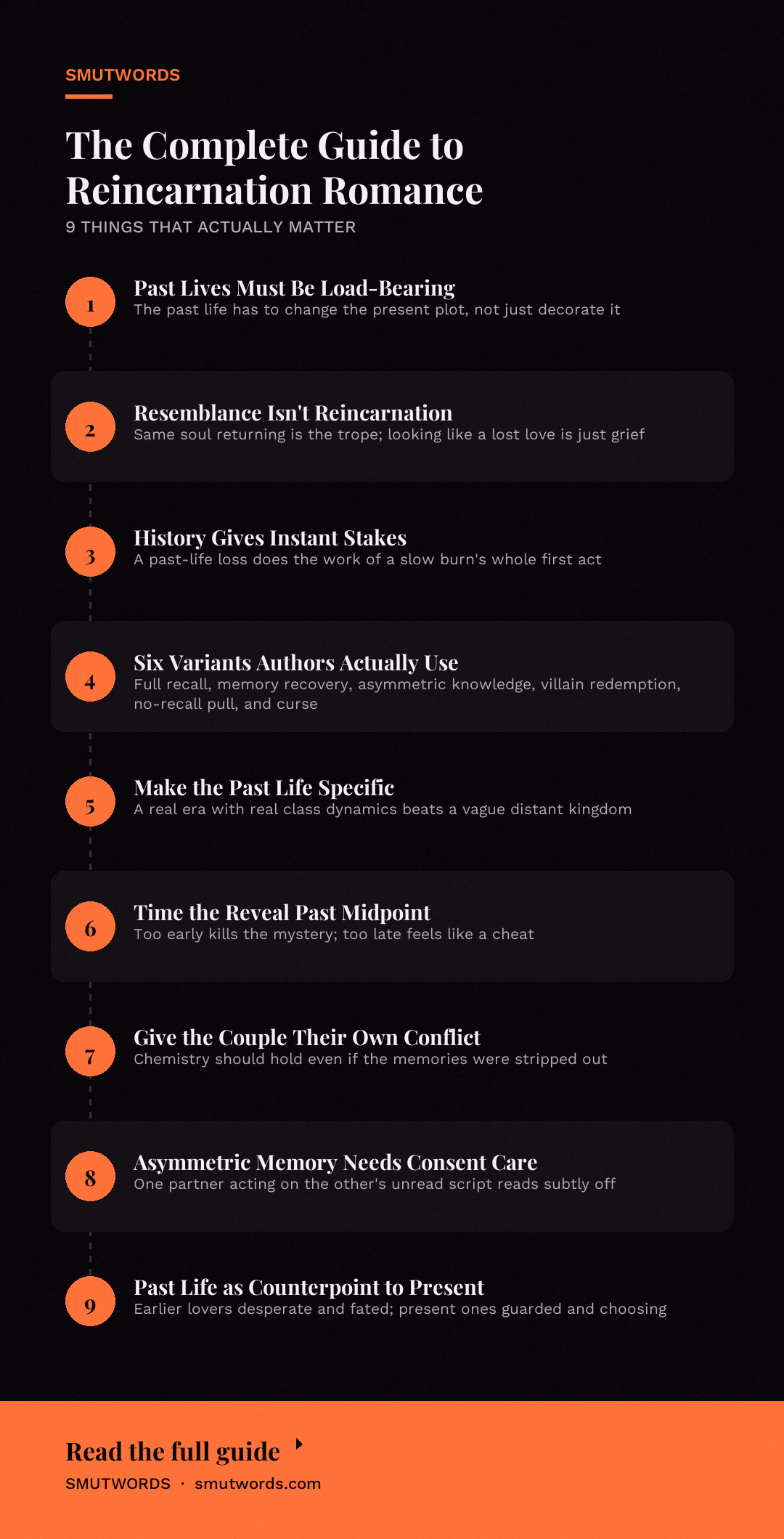
What doesn't count: a story where one character merely resembles someone the other loved before. That's grief and resemblance, not reincarnation. The trope requires the same soul or the same essential self returning, and it requires the past life to be load-bearing in the present plot.
A novel where a character has a vivid dream about a Victorian ancestor and then never thinks about it again isn't a reincarnation romance. The memory has to change something.
Keep the trope separate from its adjacent cousins, too. A childhood friends to lovers story has history, but a shared childhood isn't a shared past life. The chemistry comes from familiarity rather than from destiny, and the stakes are about growing up rather than about paying off a debt across lifetimes. Reincarnation romance uses the same "we've always known each other" feeling but routes it through the uncanny.
Where the name comes from
Reincarnation itself is an ancient concept with roots in Hindu, Buddhist, and several other religious and philosophical traditions, but the romance genre's version of it has a more specific lineage. The trope entered Western popular fiction through nineteenth-century spiritualism and the theosophical movement, which popularized the idea that souls return repeatedly and that love can persist across incarnations.
From there it migrated into Gothic fiction, then into twentieth-century popular romance, where the reincarnation plot became a reliable engine for stories about fate and recovery.
The term "reincarnation romance" as a marketing category is newer than the trope itself. Publishing picked it up once the paranormal romance boom of the 2000s and 2010s made readers hungry for anything with a supernatural hook. It has since become a searchable subgenre label in its own right.
Where Reincarnation Romance Comes From
Genuine historical record on when reincarnation romance "began" is thin, because the trope didn't originate in a single book or author. What can be traced is its history as a publishing phenomenon. That history is interesting enough on its own.
In the nineteenth and early twentieth centuries, the idea of lovers reuniting across lifetimes appeared in poetry, Gothic novels, and spiritualist writing, usually as a tragic device. The past life was a source of sorrow and separation rather than a promise of reunion. The love was doomed twice over.
The twentieth century shifted the balance. Mid-century gothic romance paperbacks used reincarnation as a suspense engine, with heroines haunted by dreams of a previous self and a present-day mystery to solve. The trope was closely tied to the stalker romance structure for decades, with an ominous male presence who might be a lover, a killer, or both.
The 1990s and early 2000s brought the mystical-soulmate version into mainstream romance, and the 2010s paranormal romance boom pushed it into new territory. Contemporary authors started using past-life material less as spooky suspense and more as an emotional and sexual catalyst. The memories surfaced during intimacy, not just during nightmares. The revelation became a source of heat rather than only dread.
More recently, self-publishing and digital-first romance have picked up the trope with unusual enthusiasm, partly because the plot structure is so clean. Past-life loss gives you immediate emotional stakes and immediate reasons for two characters to fall into bed and into conflict at the same speed. The past life does the work of a slow burn's entire first act.
The reincarnated villain redemption variant deserves its own note here. Once enemies-to-lovers became the dominant romantic dynamic of the 2010s and 2020s, writers began using reincarnation to give a villain a literal second life to make amends in. The past self's crimes become a debt the present self has to pay, and the love interest's choice to trust again becomes the central moral drama. That structure barely existed in the genre twenty years ago.
How It Shows Up in Erotica
The reincarnation plot does extraordinary work in erotic romance specifically, because it lets a writer arrive at intimacy fast without it feeling unearned. Two strangers can fall into bed on page thirty with total conviction if the reader knows there's a century of history underneath it. The heat reads as recognition rather than recklessness.
On the page, the strongest writers handle the dual timeline as a balance problem. The present-day plot needs its own momentum, its own villain or obstacle or internal conflict, and the past-life material needs to interrupt it at the right moments.
When the reveal happens too early, the mystery dies. When it happens too late, the reader feels cheated. The sweet spot is usually somewhere past the midpoint, with enough crumbs along the way that the reader has started to suspect before the characters do.
The past-life scenes themselves are where the trope either soars or sags. They should feel like real scenes with real sensory detail, not like summaries.
Heat in the past life often functions as a counterpoint to the present, so the earlier lovers might be more desperate, more fated, less careful with each other, while the present-day versions are more guarded and have to choose each other consciously. The contrast is the point.
Variants authors actually use
- Full recall: one or both characters remember the past life from early on and the plot is about what to do with it.
- Memory recovery: the memories surface gradually through dreams, hypnosis, or artifacts, and the reveal is the story's central turn.
- Asymmetric knowledge: only one character remembers, which creates immediate power imbalance and betrayal potential.
- Reincarnated villain redemption: the past-life self did something unforgivable, and the present self has to earn forgiveness from someone they once harmed.
- Soulmate across time with no recall: neither character remembers, but both feel the pull and can't explain it, and the mystery becomes a shared investigation.
- Reincarnation as a curse: the lovers have to break a cycle of dying together, which gives the plot a ticking clock.
The secret baby trope turns up in reincarnation stories more often than you'd expect, usually in the form of a child lost in the past life and somehow restored or replaced in the present one. Similarly, marriage in trouble dynamics map onto the trope almost perfectly, because you can have a couple whose present-day marriage is failing specifically because their past-life wounds are bleeding into it.
Enjoyed this? Get a free book.
Join the list and we will send a complete free story straight to your inbox, plus new releases every week after that. No credit card, no catch.
The past-life scenes often have a ritual quality to them, especially when the earlier relationship had a power dynamic that the present-day lovers are unknowingly trying to recreate. Writers who choreograph that carefully can learn a lot from guides like Building Rituals in a Power-Exchange Relationship: Small Rules That Actually Stick, because the present-day couple often reinvents a dynamic without realizing it's the one they lived in a century ago.
Pacing follows the same rule, as spelled out in How to Write a JOI Game: Pacing, Choices, and Escalation That Actually Works: reveal too much too fast and the tension collapses.
What makes a strong version work
A strong reincarnation romance does three things. It makes the past life specific rather than generic. It gives the present-day couple a conflict that would exist even if there were no memories at all, so the past is enrichment rather than the only reason they're together. And it commits to a real emotional cost for the remembering.
Specificity matters most. A past life that happened "long ago in a distant kingdom" is flat. A past life in a specific era, with specific class dynamics, specific sexual rituals, specific ways of speaking, gives the reader something to hold onto and makes the present-day echoes satisfying when they arrive. Historical research pays off disproportionately in this subgenre.
A flat version makes the past-life material do all the work, so the present-day characters have no chemistry independent of it. It also tends to lean on prophecy or destiny to fix problems, which removes agency. A reader wants the lovers to choose each other now, not just to fulfill a cosmic plot.
The strongest contemporary books also handle the reveal with restraint. When the memory finally surfaces, the best writers let it happen through a physical detail.
A scar. A gesture. A song. A specific sentence spoken in a language the character shouldn't know.
That's where the trope earns its tears.
Past-life material and consent
The trope runs into an interesting problem that the best writers address head-on. If one character remembers a past life and the other doesn't, the one who remembers has knowledge that changes the dynamic of the relationship. That asymmetry requires care, because the character with the memories is essentially acting on knowledge the other person hasn't consented to be affected by.
Some books are explicit about this, having the remembering character grapple with whether to disclose. Others embrace the tension and make the imbalance part of the erotic charge. Either approach works, as long as the writer is aware the dynamic exists. Books that ignore it tend to feel subtly off, like an intimacy scene where one person is operating from a script the other person hasn't read.
Reincarnation Romance vs Soldier Romance
Two tropes that surprisingly overlap: reincarnation romance and soldier romance. Both are built on separation, danger, and the sense that love has to be wrenched out of a world that's trying to destroy it. Both lean on promises of return and the possibility that the return won't happen.
The difference is structural. Soldier romance is about a specific deployment or a specific war, and the tension lives in the present-day uncertainty of whether the partner comes home. Reincarnation romance is about whether the same person can be loved again, in a different body, with a different life. The separation is cosmic rather than geographical.
A surprising number of reincarnation romances use a past life that took place during a war, which is one reason the two tropes brush against each other so often. A writer starting from soldier romance can borrow the past-life framing to add weight to the current separation. A writer starting from reincarnation can borrow the soldier trope's concrete stakes to keep the story grounded.
Frequently Asked Questions
What is reincarnation romance?
A romance where one or both partners remember or rediscover a past life, and their present relationship is shaped by unfinished business from that earlier existence. The past life is plot-critical: it changes the present-day emotional stakes, the sexual dynamic, or the central conflict. Popular variants include memory recovery plots, reincarnated villain redemption arcs, and full-recall stories where the memories are already intact from page one.
What is the difference between reincarnation romance and second chance romance?
Second chance romance is a broader category that includes any story where partners reunite after a breakup, divorce, or other separation in this lifetime. Reincarnation romance is a subset that routes the second chance through an entirely different life. Some readers use the terms interchangeably, but the past-life element is what makes reincarnation romance its own trope.
How common is the reincarnated villain redemption variant?
It has grown significantly in the last decade, riding the popularity of enemies-to-lovers. The pattern is usually a character who did something unforgivable in a past life returning with either full or partial memory, and their current love interest is someone they harmed. The plot is about whether they can earn trust and whether the harmed person can find a reason to give it.
Do reincarnation romances always involve memory recovery?
No. Full-recall stories are common, especially in paranormal and fantasy settings where past-life memory is a worldbuilding feature. Memory recovery plots are one variant, not the definition. Some stories have neither character remember and use the pull between them as an unexplained mystery that gets solved through shared investigation.
Is reincarnation romance always paranormal?
No. Many reincarnation romances are set in the contemporary world with no magical or supernatural system at all, treating past lives as a spiritual or psychological reality. Others lean hard into fantasy and paranormal romance conventions with soul bonds, magic rules, and literal ghosts. Both approaches are well represented in the genre.
What kinds of past-life settings work best?
The most effective settings are specific and researched. A story set during a documented historical period, with real social class dynamics and real sexual expectations, gives the present-day echoes more texture than a vague "once upon a time" setting. Readers respond to concrete sensory detail in the past-life scenes, and the contrast with the present day is what makes the trope land.
Final Thoughts
Reincarnation romance asks the reader to believe in something that's difficult to put into a pitch: that love is durable enough to survive death, and that the person you're falling for has been falling for you, badly or well, for a very long time. That's a heavy ask. When a book pulls it off, it earns a kind of emotional satisfaction that single-lifetime stories can't quite match.
If you're going to start somewhere, look for books where the past-life scenes feel like they could stand alone as their own story. That's usually the tell for whether the writer has done the work. The rest of the catalog is below, ranked by what readers actually reach for.




Loading comments…