Most JOI game drafts fail for the same reason a bad party fails: the host keeps announcing what's going to happen next instead of letting anything happen. You've got the instructions down. Strip. Stroke. Slower. Edge. But somewhere between the third "now do this" and the fifth "good," the reader stops feeling played and starts feeling processed.
Learning how to write a JOI game that actually holds someone is mostly a problem of pacing and choice. The writers who get it right treat the scene less like a chore list and more like a hand on the back of the neck, steering without ever saying "turn left here."
This is the craft side of it. If you're still sketching what a JOI game even is, the beginner's walkthrough covers the basics before you read the rest of this. For everyone else, let's get into structure.
What Makes a JOI Game Feel Like a Game
A game has stakes, a state that changes, and a player who has to actually pay attention. Your reader is the player. The instructions are your rules. The moment those rules become predictable, the game turns into a metronome.
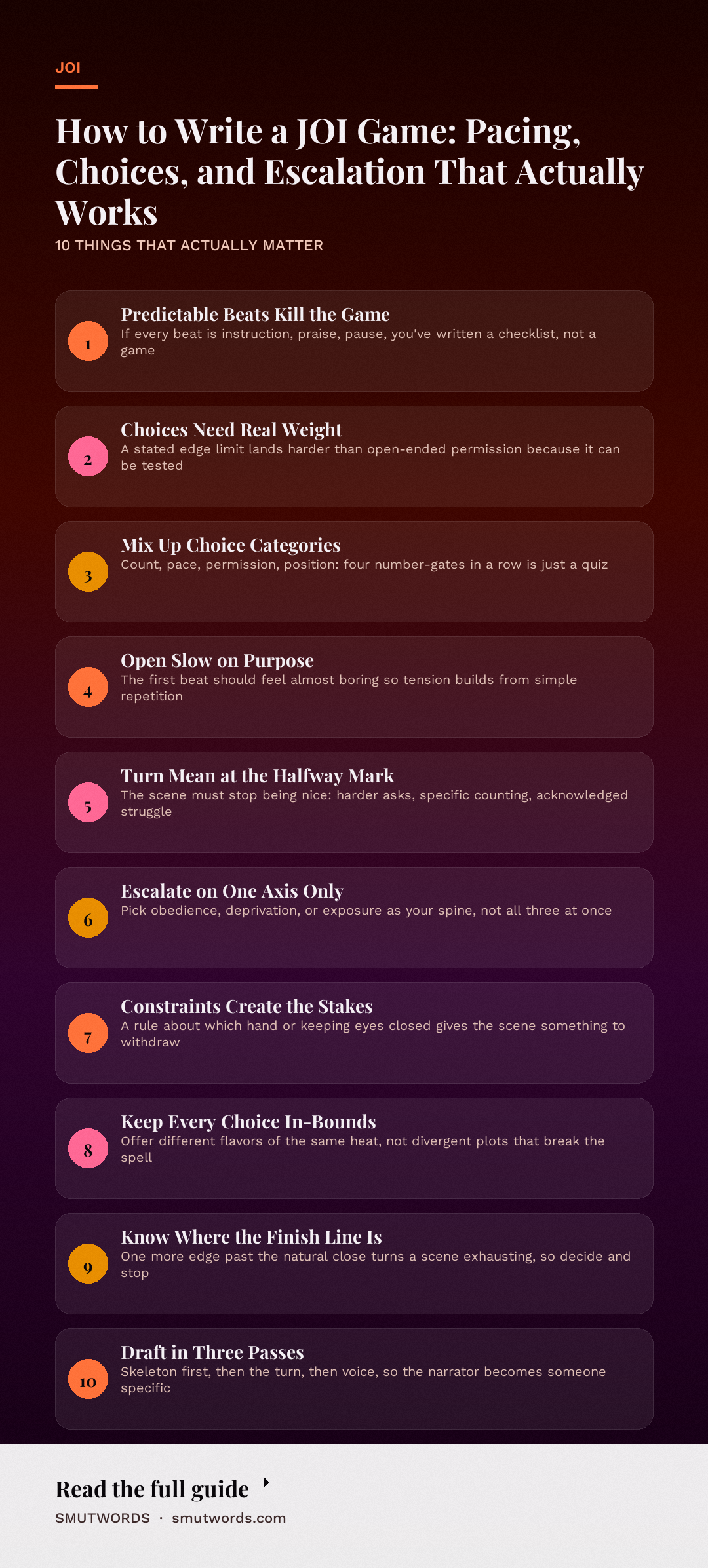
The tell is easy to spot in your own draft. Read a page out loud. If every beat follows the same shape (instruction, praise, pause, instruction, praise, pause) you've written a checklist with extra steps. Real play has friction: a choice, a consequence, a moment where the reader isn't sure they're allowed to keep going.
There's a second failure mode too, and it's subtler. A scene that escalates perfectly and predictably is technically "a game" the way solitaire is technically a game. It works. It just doesn't surprise anyone.
Give the reader a decision that matters
Choices in a JOI game are load-bearing. Not "do you want to go left or right" filler, but decisions that change the temperature of the scene. If she tells the reader to pick how many edges they're allowed before they're permitted to finish, that number has to mean something. A stated "three edges, no more" lands harder than "edge as much as you like" because it gives the reader a limit to test against.
Vary the kind of decision, though. Four "pick a number" gates in a row is just a multiple-choice quiz. Try mixing the category of choice:
- Count choices: "Three, five, or seven edges. If you pick wrong, you start over."
- Pace choices: "One stroke a second, or two. You'll regret the second."
- Permission choices: make the reader ask out loud to continue, and have the narrator decide whether to grant it.
- Position choices: let them pick kneeling or flat on their back, and then hold them to the difference.
Each category changes what the reader is doing, not just what they're saying. That's the difference between a game and a survey. The complete guide to interactive JOI games digs further into branch structure if you want to build something with actual forks.
Pacing: The Part Most JOI Authors Rush
Pacing is the hardest thing to teach and the easiest thing to feel when it's wrong. A rushed JOI scene reads like a to-do list assigned by someone in a hurry. A patient one reads like the narrator has all night and no intention of using it on you.
Think in beats, not paragraphs. A beat is one instruction and its consequence. A good JOI game has maybe six to ten real beats in a typical scene, and each one should change the reader's state: hotter, more frustrated, more embarrassed, more obedient. If a beat doesn't change anything, it's filler.
Slow down at the start, ruthlessly
The first 300 words are where most readers bounce. New JOI writers want to get to the "good part" fast, so the scene opens already at full throttle with no ramp. That's a mistake.
The first beat should be almost boring on purpose. A slow count. A single instruction repeated until it's a habit. The tension comes from the reader doing something simple over and over while knowing it's about to get worse.
One working opener: the narrator tells the reader to stroke at half speed for sixty seconds while listing out loud, out loud mind you, everything they'd be doing if the narrator were in the room. The gap between the imagined scene and the solo one is the engine. That gap does more work than any amount of praise.
Then start the turn
Somewhere around the halfway mark, the scene has to stop being nice. The instructions get harder, the counting gets more specific, and the narrator starts acknowledging that the reader is struggling. This is where a JOI scene earns its reputation. A well-built scene will make the reader check the clock and realize they've been holding a position for four minutes and no one told them to stop.
The breathplay JOI angle works well here, though it needs real care to write safely. The breathwork and jerk-off instruction safety guide is the reference to read before you put anything like that on the page. Almost every JOI writer eventually wants to borrow a breath beat, and almost every one of them borrows it badly without reading that first.
If you write for a female or non-masturbation audience, the turn looks different. The piece on JOI games for women covers why the "do this for me" dynamic ages better than "you're going to do this" for many readers.
Escalation: How to Build a Scene That Goes Somewhere
Escalation is the arc of a JOI game, and it has to be visible. A reader should be able to look back at the opening beat and feel the distance from it. If the first instruction and the last instruction are the same temperature, you've written a very long instruction manual.
Enjoyed this? Get a free book.
Join the list and we will send a complete free story straight to your inbox, plus new releases every week after that. No credit card, no catch.
Build the escalation along one axis at a time. The three axes that do the most work:
- Obedience: start with easy asks, end with a demand that the reader would have refused at the top of the scene.
- Deprivation: edges, holds, denials. The reader gets less, not more.
- Exposure: the narrator sees more of the reader's reaction, and comments on it specifically instead of in general.
Pick one as your spine. If you escalate all three at once the scene becomes noise. Obedience is the easiest spine to write well on a first attempt because every step is a clean before-and-after.
Use constraints to make the stakes real
Stakes in a JOI game come from restrictions the reader can't talk their way out of. Say the narrator forbids the reader from moving their hands off their thighs until they're given permission. That's a stake. It gives the scene something to withdraw, and it gives the reader a reason to want the next instruction.
Constraints work best when they connect to something physical and small. A rule about which hand is allowed. A rule about keeping eyes closed. A rule about how loud they can count.
The bondage playbook is a useful reference even if you're not writing bondage, because it teaches the mechanics of held positions and how a small restriction can carry a huge amount of heat. The comprehensive guide to bondage is worth a skim for exactly this reason.
Writing Choices Without Breaking the Spell
Interactive choices are where JOI drafts go wrong most often, because authors don't plan for a reader who takes the wrong option. If the reader picks "I want to keep going" but the scene needs them to stop, you either ignore the choice (spell broken) or turn every paragraph into a fork. Neither works.
Write choices that are all in-bounds. The narrator offers two options that lead to different flavors of the same heat, not two divergent plots. The reader gets the dignity of deciding; the author keeps control of the shape. If you want a genuine fork, cap the scene at one and put it late, where the reader has already invested.
Let the reader fail on purpose
There's a whole subgenre of JOI where the narrator gives a rule that's impossible to follow, then punishes the reader for breaking it. This only works if the punishment is affectionate and the rule was clearly impossible from the start. "Don't make a sound" followed by an instruction designed to force a sound is the same beat every time, but it still works because the reader gets to act surprised.
Don't over-explain the trick on the page. Let the narrator's pretend shock do the work.
Common Mistakes That Kill a JOI Scene
The word count of a JOI game is not a measure of quality, and the scenes that get bookmarked tend to be shorter than the ones that get abandoned. Here's the list of the mistakes that show up most in drafts:
- Too much praise. "Good" stops meaning anything after the sixth time. Use it once, near the end.
- Adverbs in every instruction. "Slowly," "gently," "firmly." Name the speed instead: "one stroke every two seconds."
- Missing the reader's body. A scene that never mentions the reader's hands, breath, or posture stops feeling physical fast.
- Interchangeable beats. If two beats can be swapped with no loss, one of them is unnecessary.
- A different point of view in every paragraph. Keep the narrator's voice consistent, even when the instructions change temperature.
One more: the reader needs to know when it ends. A JOI game that keeps offering "one more edge" past the natural close becomes exhausting. Decide where the finish line is, write it, and stop.
Building the Scene in Layers
The authors who write the best JOI games draft in passes, not in one sitting. First pass is the instruction skeleton: bare bones, just the beats. Second pass is the turn, and that's where you decide where the scene starts getting mean. Third pass is the voice, and that's where the narrator stops being a generic dominant and becomes someone specific.
The specifics are what make the scene land. Is the narrator a stranger on the other end of a call? A friend who knows too much? Someone who's been holding a command over the reader for years?
A soldier writing to a lover back home is a trope that works beautifully for this; the soldier romance glossary entry lays out the expected beats and what readers want from them. Swap in the narrator the reader responds to and the whole scene tightens.
If your scene runs long, look at the pacing before you cut the words. Most bloated JOI drafts aren't too long; they're too even. Compress the slow half and let the middle run. The reader's attention is the resource you're managing, and a scene that slows where it should speed up will lose them even if the writing is clean.
Final Thoughts
If you want to see what it feels like from the inside, pick up the interactive JOI games guide and read it with a notebook. Mark every place the narrator gives the reader a real decision, and note how often that happens. That's your pacing model. Build your own scene with one clear spine, one real choice, and a finish line, and you'll already be ahead of most of what's out there.



Loading comments…