A scar fetish is an erotic interest in scars, the stories behind them, and the bodies that carry them. On the surface, it looks like an attachment to damaged skin. In practice, it usually runs deeper.
The scar itself is the anchor. The fixation tends to include the texture under a fingertip, the history of violence or survival the mark represents, and the vulnerable moment when a partner lets you ask about it. In erotica, the scar fetish shows up as a character who traces a healed wound with their tongue, demands the story behind a knife mark, or feels a possessive surge of heat at the sight of a partner's permanent reminder of a past they did not share.
This is not a niche that requires blood or fresh injury. Most scar fetish content sits firmly on the side of healed tissue, emotional intimacy, and the aesthetic of permanence. The appeal is less about pain, more about ownership of a private history. A scar is proof that someone survived something. For many readers, that proof is the single most arousing thing a body can carry.
What a Scar Fetish Actually Means
A scar fetish, in its most precise definition, is a persistent sexual attraction to scars or to the act of interacting with them. That interaction can be visual, tactile, or narrative. Some people are drawn to specific types of scars: surgical lines, burn scars, claw marks from an animal attack, or the thin white lines left by a knife. Others are not particular about the source and simply respond to any permanent mark on the skin. The common thread is that the scarred tissue itself becomes an erotic focal point, not just an incidental feature of an otherwise attractive partner.
What does not count as a scar fetish is worth stating plainly. A passing appreciation for a rugged character in a romance novel who has a facial scar is not the same thing as a fetish, though it can be a gateway.
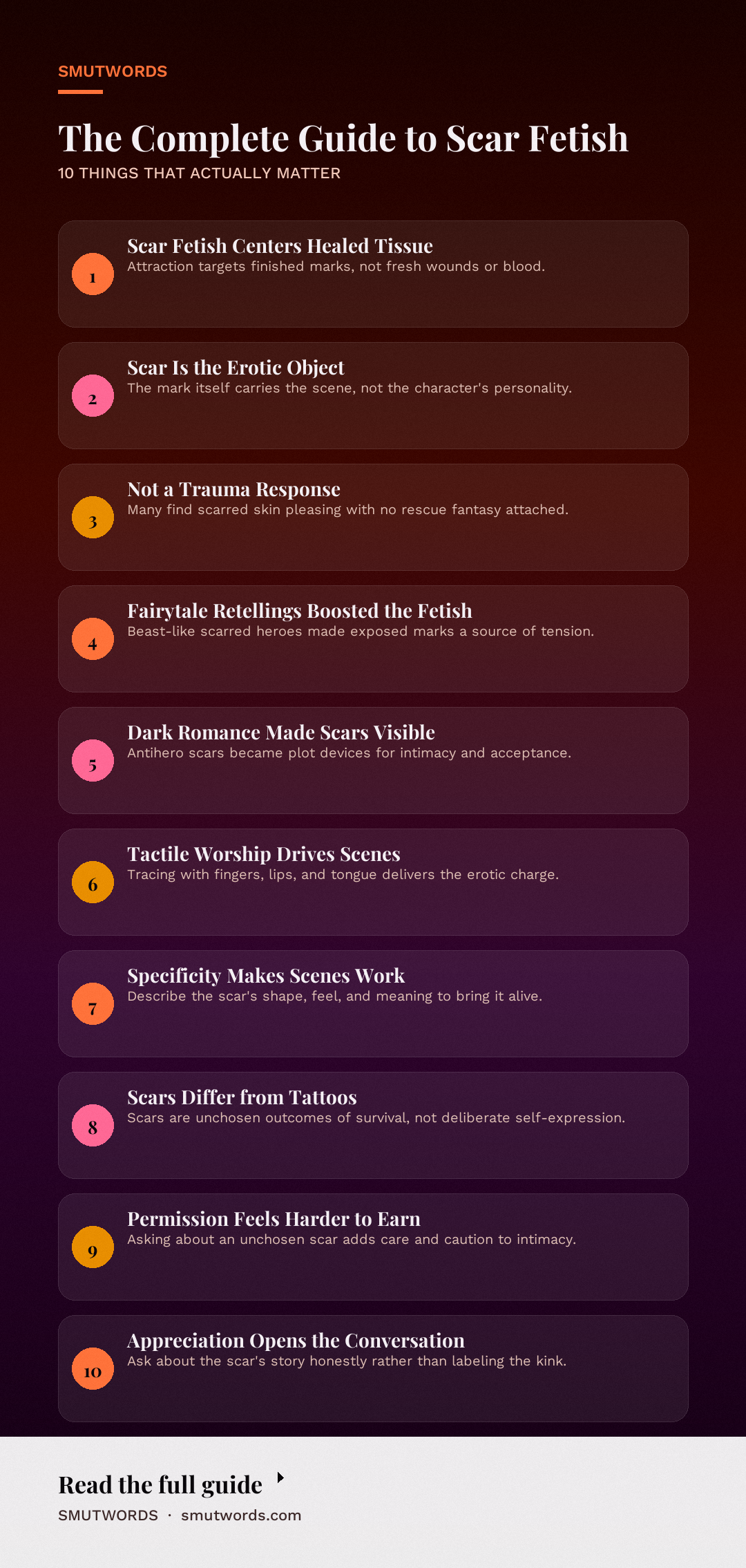
Casual readers who find a battle-hardened hero more interesting because of his visible history are responding to the trope, not the tissue. A true scar fetish centers the mark itself as the erotic object. The character could be bland in every other way, and the scar would still carry the scene.
Misconceptions about this fetish are common. The most frequent one assumes that a scar fetish implies a desire to inflict wounds or an attraction to fresh injuries. That assumption mistakes the fetish for sadism or for a blood kink.
In fiction and in practice, the overwhelming majority of scar fetishism is oriented toward healed tissue. The scar is a finished product, not a process.
Another misconception is that it is necessarily tied to trauma or to a dark psychological need to fix a partner. Some people do eroticize the vulnerability of a partner opening up about how they got hurt. Many others simply find the texture and visual contrast of scarred skin intensely pleasing, with no rescue fantasy attached.
The fetish overlaps with other body-focused interests more often than people expect. A character who is obsessed with a lover's hands might find themselves equally drawn to the scar across those hands, because the two fetishes share a tactile core. The same goes for a foot fetish paired with a scar on the ankle or arch. The scar becomes a detail within the larger geography of the body, and the fetish magnifies it.
Where the Scar Fetish Comes From
The scar fetish as a recognizable erotic interest has existed as long as written erotica has, but it has changed shape over time. In early adventure romances and pulp fiction, scars were shorthand for masculinity and danger. A hero with a scar across his cheek was a man who had survived violence, and his attractiveness was tied to the implied story.
The heroines in those texts rarely had scars. When they did, the marks were usually hidden or treated as flaws to be accepted by a loving partner.
That asymmetry began to shift in the late twentieth century as romance and erotica moved toward more equal power dynamics and more complex female characters. The rise of the fairytale retelling genre gave the scar fetish a major boost. Characters like the Beast from "Beauty and the Beast" are heavily scarred, and the erotic tension in those stories often centers on the moment the hero allows himself to be seen with his scars exposed.
The modern erotica market has run with that template, producing a steady stream of scarred heroes and, increasingly, scarred heroines whose marks are sources of power rather than shame.
The publishing phenomenon of "dark romance" in the 2010s accelerated the fetish's visibility. Antiheroes in those novels are routinely covered in scars from their violent pasts, and the sex scenes often feature explicit attention to those marks. The scar became a plot device for intimacy: a way for the love interest to demonstrate acceptance and desire by touching what others flinch from.
This is where the scar fetish crosses over into the possessive sex territory that dominates much of that genre. The possessive partner claims the scarred body as theirs specifically because of what the scars represent.
In real-world BDSM and kink communities, the scar fetish has a different but related history. Permanent play and branding exist as practices, but they are separate from the broader attraction to pre-existing scars. The online erotica community, particularly on platforms like Archive of Our Own and dedicated fanfiction spaces, has been instrumental in normalizing the fetish.
Fanfiction writers take canonical characters who have scars, either from their source material or added through headcanon, and build entire erotic arcs around the act of tracing, kissing, or worshipping those marks. This fan-driven body of work has influenced professional erotica significantly, pushing publishers to include scar-focused scenes in original fiction as a matter of course.
How a Scar Fetish Shows Up in Erotica
The scar fetish appears in erotica across nearly every subgenre, from historical romance to sci-fi to contemporary BDSM. The most common way it manifests is through tactile worship. A scene will pause the action so one character can trace a scar with their fingers, then their lips, then their tongue. The act is slow, deliberate, and loaded with meaning.
The author uses the scar as a conduit for emotional intimacy, letting the physical touch communicate acceptance, desire, and curiosity all at once.
The strongest versions of this scene succeed because they treat the scar as a story, not just a texture. A flat version of a scar fetish scene reads like a checklist: character sees scar, character kisses scar, character moves on. The better versions integrate the scar into the dialogue and the power dynamics. The character with the scar decides how much of the backstory they share, and the partner's response to that story becomes the erotic core.
If the scar came from a fight, the partner might respond with possessive heat. If it came from a childhood accident, the partner might respond with tender reverence. The scar is a key that unlocks a specific flavor of arousal, and the author's job is to make that flavor distinct.
Variations on the scar fetish in erotica include:
Enjoyed this? Get a free book.
Join the list and we will send a complete free story straight to your inbox, plus new releases every week after that. No credit card, no catch.
- The first-time reveal, where a character hides a scar out of shame and finally allows a partner to see it in a moment of extreme vulnerability. The partner's reaction, whether fascinated or hungry, determines the tone of the rest of the scene.
- The matching scars dynamic, where both characters carry marks and they compare stories, turning the act into a form of mutual exposure.
- The scar as a map to past lovers or past violence, which feeds into jealousy or possessive arousal when the current partner realizes the scar is all that remains of someone else's claim.
- The aesthetic appreciation version, where the scar is treated less like a wound and more like a beautiful imperfection, with the narration waxing poetic about its color, shape, or placement.
- The power exchange version, where the scarred partner submits and invites the dominant partner to trace and kiss the mark as an act of submission, giving explicit permission to touch what would otherwise be off-limits.
- The transformation arc, where a character who was once self-conscious about their scar learns to see it through their lover's eyes, and the sex scene marks the moment their self-image shifts.
What makes a strong version of the scar fetish work is specificity. The author needs to tell the reader what the scar looks like, how it feels, and what it means. A generic mention of "a scar on his chest" will not do. The reader wants to know if it is raised and jagged or flat and silver. They want to know if the character flinches when it is touched at first, or if they lean into the contact. They want to know what the scarred character thinks about when it is being worshiped. Without those details, the fetish never comes alive on the page.
The genre also uses the scar fetish as a shortcut for character development. A character with visible scars is immediately coded as someone with a past. The scar does the narrative work of establishing that this person has survived violence, illness, or accident without requiring an extended flashback. When the erotica scene then focuses on the scar, it tells the reader that the partner is interested in the whole person, including the parts that other people might have rejected.
That dynamic is why the scar fetish pairs so well with leather fetish and latex fetish content, where the contrast of shiny, impermeable material against the permanent texture of scarred skin creates a striking visual and tactile juxtaposition.
Humor also has a place in scar fetish erotica. Not every scene has to be gravely serious. A character who has a ridiculous scar story, like a kitchen accident while making toast, provides a comedic counterpoint to the usually dark or tragic scar narratives.
The eroticism in those scenes comes from the intimacy of shared laughter and the acceptance of an imperfect body. The scar is no less central to the fetish just because the tone is lighter.
Scar Fetish vs Tattoo Fetish
The scar fetish and the tattoo fetish are frequently lumped together, but they pull at different threads. Both fetishes are attracted to permanent body modifications, but the meaning behind those marks is completely different.
A tattoo is chosen. It represents an identity the person wanted to claim, an aesthetic preference, or a memory they wanted to display on purpose. A scar is usually not chosen. It is an outcome of something that happened to the person, whether an accident, an illness, or an act of violence.
That distinction changes the erotic charge of the scene. With a tattoo, the partner can ask questions about why the person chose that image, and the answers are about taste and personal history. With a scar, the questions are about survival and vulnerability. The partner does not know if the story is one the scarred person wants to tell, which creates a layer of caution and care that does not exist with tattoos.
The scar fetish is often more intimate because the permission to touch feels harder to earn.
Both fetishes share a tactile component. Tattoo aficionados often enjoy tracing the lines of the ink just as much as scar enthusiasts enjoy tracing the raised tissue. But the visual aesthetics diverge. Tattoos are usually dark, deliberate, and colorful. Scars are typically lighter than the surrounding skin, puckered, or sunken.
The scar fetish has a closer relationship to body horror and to the grotesque, while the tattoo fetish skews toward body art and decoration. A reader who loves one may not love the other, and conflating them in a story can alienate an audience that came specifically for the mark type.
The two do intersect in characters who have both, and authors who write for the scar fetish market often use tattoos as a red herring. A character will show a partner their tattoos, expecting interest there, and the partner will instead be drawn to an old scar hidden beneath or beside the ink.
That moment of redirected attention is a powerful narrative beat because it signals that the partner is not just attracted to deliberate self-presentation but to the involuntary marks of a life lived.
Frequently Asked Questions
Is having a scar fetish the same as being attracted to self-harm?
No. A scar fetish is an attraction to healed tissue and the history it represents. Self-harm scars can be part of that attraction for some people, but the fetish itself does not require them, and it is not the same as wanting to see fresh wounds or encouraging harmful behavior. Most scar fetish content in erotica involves scars from accidents, fights, or surgery.
Why do people find scars attractive?
Scars signal survival and a story. On a primal level, a healed scar suggests the person is tough enough to have taken damage and recovered. The attraction often involves curiosity about the event that caused the scar, and the intimacy of being allowed to ask about it and touch it creates a strong bond between partners.
Can a scar fetish be a sign of trauma?
It can be, for some individuals, but it is not inherently a trauma response. Many people with scar fetishes have no significant history of injury or abuse themselves. Like any fetish, it exists on a spectrum, and the psychological underpinnings vary widely from person to person. In fiction, the scar fetish often serves as a vehicle for processing themes of vulnerability and resilience rather than as a direct reflection of the author's psychology.
Do people with scar fetishes only like ugly or heavy scars?
Not at all. Scar fetishism covers everything from a tiny scar above an eyebrow to a massive burn scar covering half a torso. The intensity of attraction does not correlate with the severity of the scar. Many people are drawn to the visual contrast of a pale scar against darker skin, or to a raised keloid that provides distinct texture under the fingertips.
What is the difference between a scar fetish and a wound fetish?
A wound fetish is oriented toward open injuries, healing processes, or the act of being wounded. A scar fetish is exclusively focused on the healed result. These are related but distinct interests. Someone with a scar fetish generally has no desire to see the moment of injury; they want to interact with the permanent mark that remains afterward.
How do I bring up a scar fetish with a partner?
Start with the appreciation rather than the kink label. If your partner has a scar, ask if they are comfortable telling you the story, and be honest that you find it attractive. Many people are surprised that a scar they feel self-conscious about is appealing to someone else, and the honesty often lands well. If your partner does not have scars and you are interested in the idea, treat it as a fantasy conversation, not a prompt to get hurt.
Final Thoughts
The scar fetish works because it takes something that culture usually tells us to hide and turns it into the most desirable part of a body. It rewards the reader with intimacy: the moment a character allows their most vulnerable mark to be seen and touched, and the partner responds not with pity or flinching but with hunger.
The best stories do not stop at the surface of the skin. They follow the scar down to the memory that made it, then bring the reader back up to the present moment where two people are sharing something real.
If you want to see a masterclass in this exact dynamic, pick up the scene in any cuckold story where the bull notices a scar the husband has never bothered to ask about. That single moment of attention, where a stranger values what the longtime partner ignored, explains the entire appeal of this fetish in one stroke.





Loading comments…