
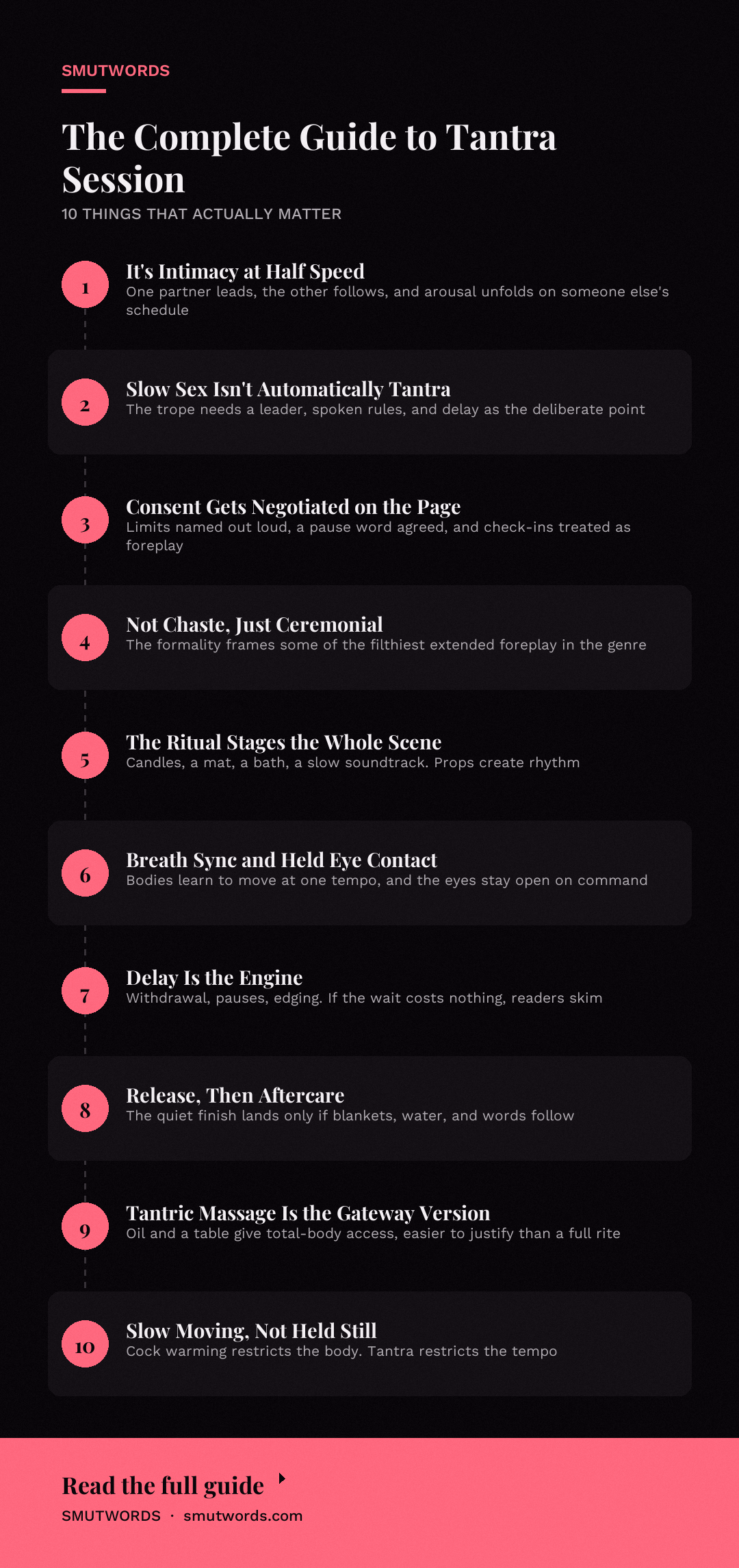
A tantra session, in romance and erotica, is a structured intimate encounter where two people slow everything down on purpose: breath, eye contact, touch, the pace of arousal itself. One partner usually leads. The other follows, surrenders, and lets sensation arrive on someone else's schedule.
It gets called a tantra session, tantric massage, tantra ritual, or guided session depending on the book, but the mechanics stay steady: extended buildup, ritualized attention, release delayed until delay becomes the point. If you have read a scene where the hero lights three candles, tells the heroine to breathe with him, and spends forty pages on her collarbone before anything else happens, you have already met the trope.
What a Tantra Session Actually Means
The word comes from tantra, a family of South Asian spiritual and ritual traditions that long predate anything in a paperback. Erotic romance borrowed the term the way it borrows most vocabulary: loosely, for the aesthetic of ceremony, breathwork, and sacred slowness, then bent it toward the page. In genre fiction, a tantra session is a plot device and a mood engine. It is not a theology seminar.
What counts as a tantra session in a book is narrower than the real-world practice and easier to spot. It needs structure. Someone proposes or books the session. Rules get set.
It needs a leader too, which is the same instinct that powers scene play in kink fiction, dressed in incense and a yoga mat instead of a paddle and a safe word. And it needs delay as a deliberate feature. The encounter is organized to stretch arousal out, not sprint to orgasm.
Breath is paced. Touch is mindful. Eyes stay open at moments when characters would rather close them.
Here is what does not count, at least not cleanly. A couple having slow, tender sex is not automatically a tantra session, even if the prose is pretty. A tantric massage scene where the massage is really just foreplay with a timer is halfway there, but it lacks the ritual spine.
And a tantra session is not a free pass past consent. Real-world tantra practice with a partner or a paid practitioner calls for clear consent, agreed limits, and a way to pause or stop at any point, because sessions can involve intense sensation and real vulnerability. Good erotica knows this and usually shows the negotiation on the page, because negotiated rules are half the heat.
A common misconception: readers assume tantra in romance means spiritual, chaste, or somehow less explicit. The opposite is often true. The formality is a frame for some of the filthiest extended foreplay in the genre.
The characters are not having less sex. They are having sex in slow motion with the brakes cut.
Where the Tantra Session Comes From
Honest history: the tantra session as an erotic fiction device is a recent arrival, and its publishing lineage is easier to trace than its spiritual one. Western esoteric writers spent the twentieth century repackaging tantra as sexual mysticism for a Western audience, and that repackaging is what eventually leaked into romance.
By the 1970s and 80s, "tantric sex" had become a magazine-cover phrase, heavy on claims about marathon sessions and ecstatic states. That is the version the genre inherited: not the tradition, but the legend of the tradition, already pre-loaded with drama.
Erotic romance picked it up properly once the Fifty Shades-era boom made kink-adjacent structure mainstream. Authors needed ways for a dominant character to be attentive rather than merely rough, and a guided tantra session was ready-made. The hero gets to be commanding and reverent at once. The heroine gets to receive without having to perform.
The portrait has shifted in three visible ways. Early appearances treated tantra as exotic set dressing, all musk and mysterious foreign teachers. Then the wellness era arrived, and sessions moved into spa suites, boutique retreats, and private villas, with characters booking them the way they book a facial.
Most recently, contemporary romance has gotten better at the consent mechanics: safewords, check-ins, and post-session care now get written on the page rather than skipped. That shift tracks a broader change in how readers want kink-adjacent fiction written. Ritual is hot. Sloppy paperwork is not.
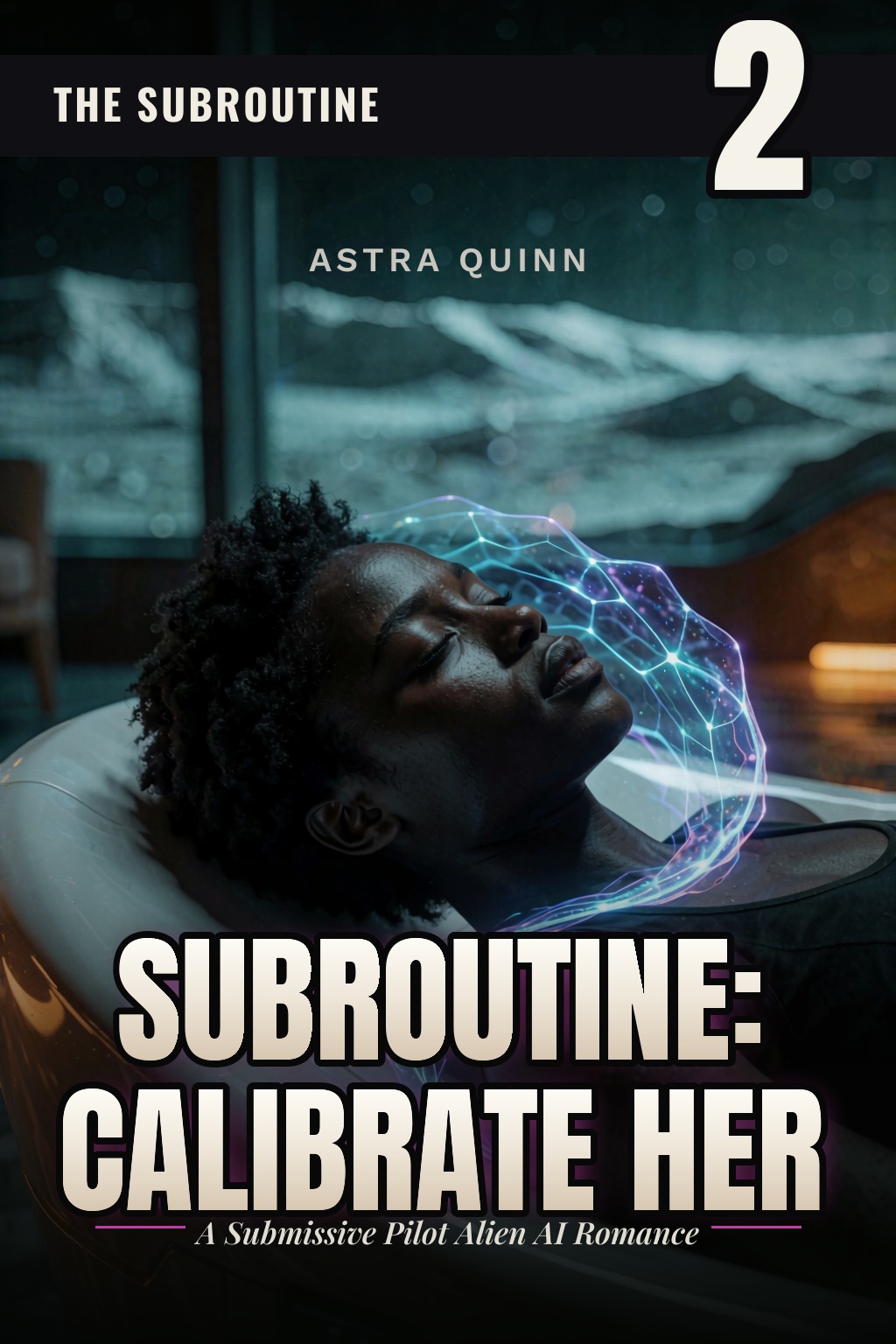
One more publishing note, because it explains demand. The trope performs extremely well in slow burn and in any subgenre where an uptight character needs to be unbuttoned by procedure. That is why you find tantra sessions in contemporary billionaires, small-town retreat stories, and even sci-fi romance, where the ritual gets rebuilt as alien bonding practice.
The structure transplants cleanly into any setting. That portability is the tell that it is a craft device, not just a kink.
How a Tantra Session Shows Up in Erotica
On the page, this is a scene architecture. Authors build it in recognizable beats, and knowing the beats is how you tell a strong rendition from a flat one.
- The proposal: someone suggests, books, or dares the session. This sets stakes and gives the reader a reason the characters cannot just fall into bed.
- The rules: limits named out loud, a pause word agreed, sometimes clothing specified. Negotiation is foreplay here, and readers notice when it is skipped.
- The opening ritual: candles, a mat, a bath, a slow soundtrack. Authors love staging tools because props create rhythm.
- Breath synchronization: the moment where bodies literally learn to move at the same tempo. Close to what real practice involves.
- Sustained eye contact: the squirm beat. Almost every strong scene has a countdown or a command to keep the eyes open.
- Deliberate delay: withdrawal, pauses, edging, cooling touch. Often overlaps with anticipation play, and its job is to make the reader feel the wait.
- Surrender and release: built only after all that. Frequently the release is quieter than the buildup, which the best writers know is the point.
- Aftercare: blankets, water, a wrapped robe, words. Care post-session is as erotic as the session, and skipping it reads as corner-cutting.
The craft question: what holds a scene up
Strong versions ground every sensation in concrete physical detail: the temperature of the room, the slip of oil, the exact count a character is told to breathe to. Flat versions reach for adjectives and stop, describing everything as "intense" and "transcendent" while the actual bodies go unmentioned. The body detail is what earns the heat.
Strong versions also use anticipation as the engine. If the delay has no express cost for a character, the reader will start skimming. The lead partner should be following someone else's rules, not just spontaneously being attentive.
Enjoyed this? Get a free book.
Join the list and we will send a complete free story straight to your inbox, plus new releases every week after that. No credit card, no catch.
Tantric massage: a variation with range
Tantric massage is the most common variant, because it gives a scene total-body access with a ready excuse for oil, tables, towels, and forty pages of skin. Writers use it as a gateway session, easier to justify than a full ritual for characters not quite ready to admit they booked one.
Some authors push it into muscle worship territory, where the massage becomes reverence for a specifically trained body: shoulders, back, thighs. The related thigh and breast fetish writing works on similar machinery, though without the breath rules layered on top. If your taste runs to a body being studied and celebrated at length, tantra practice is the structured vehicle, and that whole genre overlaps happily with leg fetish territory when the session starts at the ankles and works upward.
Other names, same structure
Tantra ritual: a full ceremony framing, often used in fantasy and paranormal romance where the practice doubles as bonding rite. Tantric workshop: the group-retreat version, popular for forcing characters into close proximity and into performing desire under observation. Guided tantra session: the format that most clearly establishes one leader, one follower, and the stakes of being told exactly when to breathe.
Mindful touch scene: the literary, low-key variant, sometimes not labeled tantra at all, where slow touching is the entire workout. And slow-sensation ritual: the kink-adjacent version, closer to scene play with oil, ice, and blindfolds, where the "tantra" branding is sometimes just the set dressing. Every variant shares the spine: someone leads, someone receives, the clock runs slow, and the rules are said out loud first.
Surrender, without the word "boundaries"
Surrender in a tantra session reads as relinquishing the tempo, not relinquishing personhood. The character who leads is trusted precisely because the limits are clear and a stop word exists. That is the same logic that makes a ritual special in books about ritual collaring ceremony fiction: the ceremony holds because everyone agreed to it first.
Compare it to other long-duration practices, and the difference is pacing. Cock warming is about held stillness; a tantra session is about held attention.
Mummification restricts the body. Tantra restricts the tempo. Writers sometimes blend them, and blends are exactly as hot as they sound.
The trope stretches best for readers who want their intensity delivered in slow drips. One more craft note worth stealing: rituals built around care and attention pair naturally with post-scene care writing. A tantra session that ends with a towel and a whispered count of breath lands with the same satisfaction as proper aftercare done well, which is to say: it is not the comedown, it is the finish.
Tantra Session vs Cock Warming
These two get confused because both are slow, both are about duration, and both get recommended to the same reader. The actual difference is simple: cock warming keeps bodies joined and still, so the heat comes from the held position and the boring friction of waiting. A tantra session keeps bodies moving, just very slowly, so the heat comes from breath, eye contact, and deliberate touch.
Pick cock warming when you want stillness and possessiveness. Pick a tantra session when you want choreography. Many writers recommend reading them in the same weekend precisely because they scratch the same itch in opposite directions.
One related point on negotiation, since both are practices that can look gentle and feel intense: a good tantra session page shows the same care with rules that a smart vanilla/kink mix relationship story shows about pace differences. Getting the ground rules explicit is part of the pleasure, not a paragraph to edit out later.
Frequently Asked Questions
What happens in a tantra session?
A structured intimate encounter built around slow breathing, prolonged eye contact, mindful touch, and delayed release rather than goal-driven sex. One person usually leads while the other receives, and rules are set before anything starts. Real practice also involves agreeing on limits, a way to pause, and care afterward.
Is a tantra session the same as tantric sex?
Mostly, in genre usage. Tantric sex is the umbrella phrase for slow, ceremony-adjacent sex, and a tantra session is a specific scripted version with a booked occasion, a leader, and negotiated rules. In fiction the session is more formal, with breaths, pauses, and explicit terms.
Do tantra sessions have to be sexual?
In real practice, not always; sessions can focus on connection and sensation with or without sex. In erotica they almost always are, though the best ones use the ceremony to stretch arousal rather than skip ahead. The build-up is where the heat lives, which is why the trope is so often written in slow burn.
Why do readers like slow tantra sessions so much?
They deliver focused, unhurried attention, and they turn anticipation itself into the payoff. The formality creates a reason for prolonged foreplay, and the leader character reads as deliberate rather than simply rough. For many readers that combination hits harder than a fast scene ever could.
Is a tantric massage the same thing?
It is the most popular variant. The massaging format gives a scene total-body access and a reason for oil and extended touching, which is why authors use it as a gateway session. Many tantric massage scenes still follow the same arc of rules, breath, delay, and care.
Can a tantra session go wrong in fiction?
Yes, and it is often written that way. A session with no negotiated limits, a partner who steamrolls a pause, or an abrupt ending with no care lands as bad practice, and many authors use that failure as a plot turn. Written well, the rules and the pause word are part of the erotic furniture, and the couple gets those conversations because they want them.
Final Thoughts
A tantra session is a ceremony of attention: one person who sets the pace, one who hands over the clock, and a rulebook both of them keep. When romance writers get it right, the delay is the seduction and the surrender sits on top of clearly spoken consent, which is exactly where the heat is.
Read it next. If you are ready for the structure done well, let the catalog send you to a book that sets its breathwork early and earns its slow build. Wait for the unbuttoning. The best pages are the ones where a character is told to count their breaths and does exactly as they are told.




Loading comments…