
Fox shifter romance is a subgenre of paranormal romance in which one half of the central couple is a fox shifter: a character who can move between human and fox form. Often with multiple tails, heightened senses, and a long lifespan that makes them a little bit other. These books run on the tension between a cunning, playful, seductive surface and a fierce, almost feral loyalty underneath.
That combination is the engine. It is why the trope sells, and why readers who find one good fox shifter romance tend to go looking for a dozen more.
The short glossary version gets the basics down. What it doesn't say is that fox shifters occupy a very particular niche in shifter romance: less macho than wolves, less mournful than bears, less openly dangerous than big cats. They are the tricksters of the shifter shelf. That changes everything about how the romance works on the page.
What Fox Shifter Romance Actually Means
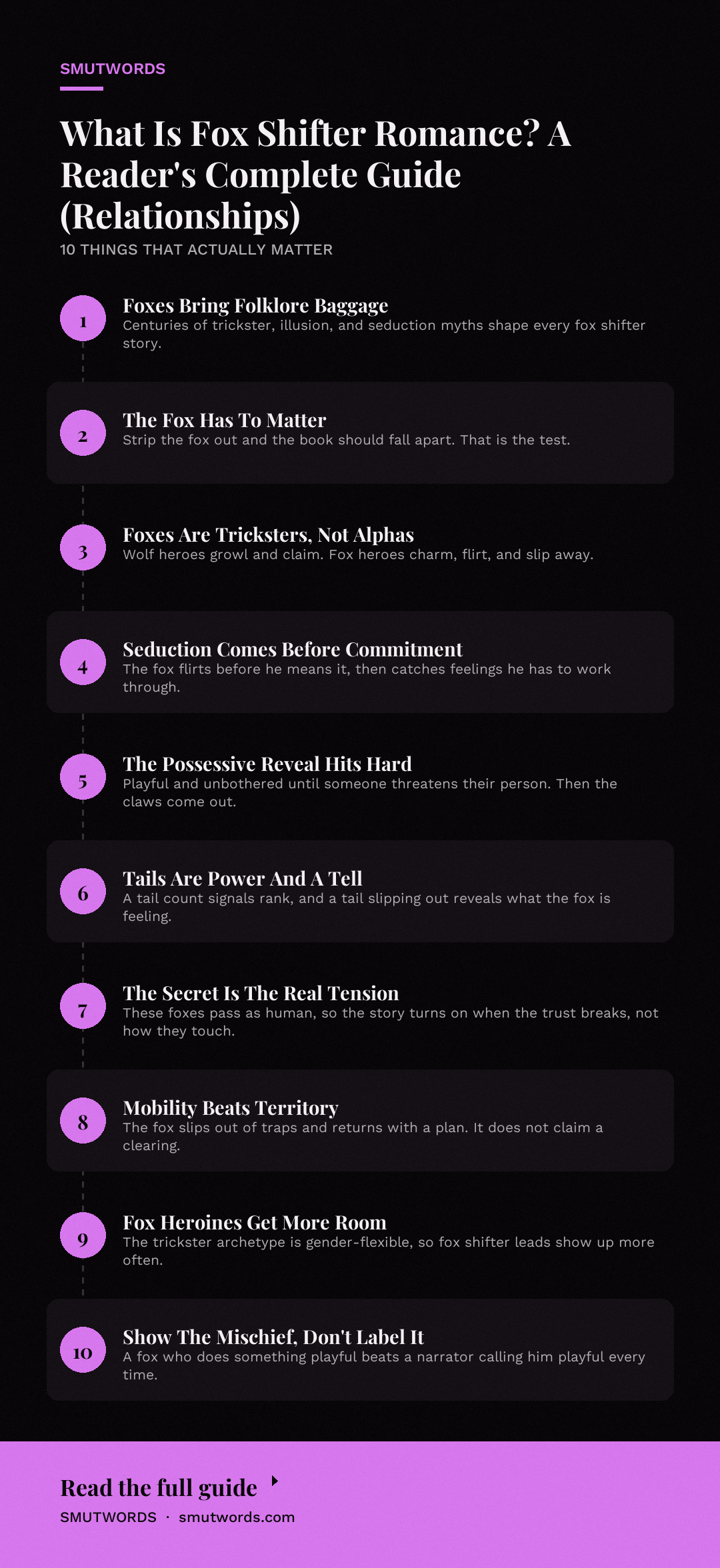
The term covers any romance novel where a fox shifter is a love interest or a significant POV character, and where the fox nature matters to the plot or the relationship rather than serving as a costume. Strip the fox out entirely and the book should fall apart. That's the test.
The shifter part is straightforward: a human form and an animal form, with some mechanism for switching between them. Where fox shifter romance differs from wolf or bear shifter romance is the cultural baggage layered onto the animal. Foxes carry thousands of years of folklore about trickery, illusion, and seduction. Authors draw on it whether or not they're being deliberate about it.
What counts as fox shifter romance:
- A romance where at least one main character shifts into a fox form and the fox identity shapes their personality, instincts, or magical abilities
- Kitsune romance, which specifically draws on Japanese fox spirit mythology: multiple tails, powers that grow with each tail, the ability to take human form through spell or practice
- Fox familiar romance, where the fox shifter is bound to a witch or magic-worker, adding a power dynamic on top of the animal one
- Fox shifter mate bond stories, where a fated pairing (often framed as a soulbond) drives the main plot
What doesn't count:
- A werefox who's really just a werewolf with a fur color swap and a "sly" personality; the fox needs to matter
- Books where the fox is a familiar or pet animal, not a person who shifts
- Fox shifters in a supporting role only, with no romance arc of their own
The most common misconception is that fox shifter romance is just wolf shifter romance with a smaller animal. It isn't. Wolf shifters get written as dominant, territorial, and pack-bound. Fox shifters get written as solitary, clever, and slippery.
The romance dynamics are almost inverted. Where the wolf hero is explicit about his claim, the fox hero is more likely to seduce before he admits he's serious.
The other misconception lumps all fox shifter books into kitsune territory. Plenty are set in Western contexts with no Japanese folklore at all; the fox is simply a shape-shifting animal with a long literary reputation for cunning. Both branches are legitimate fox shifter romance.
Where Fox Shifter Romance Comes From
The genre didn't appear in a vacuum. Foxes have carried the trickster mantle across cultures for centuries: Aesop's fox who can't reach the grapes, the Reynard cycle of medieval European fables where a single clever fox outwits lions and kings, and the Japanese kitsune tradition with its tail count and shape-shifting powers. All three feed into what a fox means in fiction today.
In paranormal romance specifically, the fox shifter arrived a step behind the wolf. Wolf shifter romance had its commercial boom starting in the early 2000s, with packs, alphas, and mate bonds doing the heavy lifting. Fox shifters appeared around the same time but stayed a smaller category for years. There was no giant, single author-catalyst the way there was for vampires or werewolves.
What changed was the rise of kitsune romance in the 2010s. Writers pulled from Japanese folklore and built out stories with nine tails, magic that grows with each tail, and characters who could pass as human for decades or centuries. That gave fox shifter romance a richer history to draw on and a distinct identity beyond "smaller wolf."
Another notable shift: fox shifters started being written as heroines and same-sex love interests more frequently than wolf shifters were. The trickster archetype is gender-flexible in a way the dominant-alpha archetype isn't. Readers who were tired of the growling possessive hero found the fox's playful seduction a welcome change.
The trope has also benefited from the broader rise of cozy fantasy and cozy paranormal romance. Fox shifters suit lower-stakes, high-warmth stories beautifully: a magical shop that runs better when the owner's fox is allowed to nap in the sun, a small town where the fox shifter is everyone's favorite chaotic neighbor. The genre has room for dark, hot reads and gentle, charming ones, and the fox moves comfortably between those tones.
How It Shows Up in Erotica
Craft-wise, fox shifter romance has a specific toolbox. The good books reach for all of it. The flat ones lean on the "sly" adjective and hope that's enough.
The seduction-first hero
Where the classic wolf shifter hero opens with a growl and a claim, the fox shifter hero opens with charm. He flirts before he means it, then catches feelings and has to work through the fact that his usual tactics are useless against someone he actually wants. That arc is one of the most reliable tension engines in the genre. It's a variation on what actually keeps readers turning pages: anticipation, misdirection, and the moment the mask slips.
The possessive reveal
The strongest version of the trope uses a distinct move: the fox is playful and unbothered until someone or something threatens their person, and then the claws come out. The shift is sharp and convincing because the author has built up so much surface levity. Flat versions skip the build. The fox goes from witty to feral in one sentence and the reader doesn't feel the turn.
The tails as a power and a tell
In kitsune romance, tail count becomes a status marker, a power gauge, and a way for the reader to know things the human characters don't. Nine-tailed foxes are ancient and immensely powerful. A character can't control their tails when they're emotional, which is a built-in reveal mechanism: the love interest sees a tail they weren't supposed to see and knows something has changed. That's a much more elegant version of the "eyes flashing gold" move from wolf shifter romance.
Enjoyed this? Get a free book.
Join the list and we will send a complete free story straight to your inbox, plus new releases every week after that. No credit card, no catch.
The shape-shifting problem
Fox shifters who can pass as human for long stretches create specific problems for intimacy. How does a lover react when they find out? Does the fox tell them, or does the secret get exposed? Many of the genre's strongest scenes are about the reveal, not the sex that comes after.
The sex that follows often uses the animal senses: a fox can smell arousal, hear a heartbeat, feel a shift in temperature. Writers who use these senses in the bedroom create tension that a human romance can't replicate easily.
Common variations
- Kitsune traditional: Japanese-inspired worldbuilding, tail count as rank, centuries-old shifters
- Western paranormal: fox shifters with no mythological framing, pack-adjacent or lone operators
- Familiar dynamic: a fox shifter bound to a witch or mage, adding a service/power element common in alpha/beta/omega dynamics adjacent writing
- Mate bond focus: the book is really about the bond, with the fox element providing instant heat and familiarity
- Cozy small-town: low-conflict fox shifter with a magical cottage and a lot of baking
- Dark fae-tangent: fox shifters written as fae-adjacent, dangerous in a way that overlaps with elf romance and its long-lived, otherworldly tone
What separates strong from flat
A strong fox shifter romance commits to one of two tracks: the fox is a trickster who uses misdirection, or the fox is a fox spirit with real mythological weight. Books that try to have both without earning them fall flat.
The most common failure mode is making the fox "playful" as a personality label instead of a behavior. A fox hero who does something playful on the page is different from one the narrator tells us is playful. Always show the mischief.
The other differentiator is how the author handles the double nature. The best fox shifters feel like one character with two modes, not two characters sharing a body. The fox should inform the human's quirks, napping preferences, taste for the hunt, distrust of dogs. When the human form and the fox form feel like the same person, the shift is a gut-punch every time.
Readers drawn to the trickster energy here often find it also in the tension of primal instinct kink: the hunt, the chase, the moment the pretending stops. Fox shifters hit a similar note without the predatory dominance of a wolf.
Fox Shifter Romance vs Territorial Shifter Trope
These two get confused because both live in the shifter shelf and often overlap in the same book. The territorial shifter trope is about land, property lines, and the instinct to defend a physical space. It's mostly a wolf, bear, or big-cat mode.
Fox shifters can be territorial, but their defining trait is mobility. They slip out of traps. They don't claim a clearing.
They disappear into the woods and come back with a plan. A fox shifter romance that leans hard on territorial instincts is really borrowing from wolf shifter conventions, which is fine, but it's a borrowed move rather than a native one. The best fox shifter books use the fox's evasive, boundary-crossing nature as the source of conflict.
Same goes for comparisons to creature-shifter subgenres like merman romance or kraken romance. Those subgenres deal with the alien body problem in literal, physical terms. Fox shifters pass as human, which shifts the tension from "how do we touch" to "when does the trust break." The fox has already been invited in.
Frequently Asked Questions
What is a fox shifter romance?
A fox shifter romance is a paranormal romance in which the love interest or main character is a fox shifter, capable of moving between human and fox form. The fox identity typically shapes the character's personality (cunning, playful, fiercely loyal) and often their magical abilities, especially in kitsune-inspired stories.
What's the difference between fox shifter romance and kitsune romance?
Kitsune romance is a specific subcategory that draws directly from Japanese fox spirit mythology, with features like multiple tails, powers that grow with each tail, and centuries-long lifespans. Fox shifter romance is the broader term that includes kitsune stories alongside Western-style fox shifters with no mythological framing.
Why do readers love fox shifter heroes?
The fox shifter offers a combination that's hard to find elsewhere in shifter romance: seductive charm, genuine wit, and a feral protective streak that reveals itself only when the character is tested. Readers who are bored of the growling alpha archetype find the fox's playful, slippery energy refreshing. The eventual possessive reveal lands harder because it's been earned.
Is fox shifter romance always spicy?
No. The category spans the full heat range. Some books are explicit and heavy on tension and bedroom scenes. Others are cozy, low-stakes paranormal reads with mostly closed-door romance.
Readers should check the heat level on individual titles rather than assuming fox shifter means spicy.
Do fox shifter books have mate bonds?
Many do, though not all. Fox shifter mate bond stories borrow the fated pairing mechanic familiar from wolf shifter romance and give it a fox-specific spin: shared dreams, a pull toward the other person that the shifter can't explain, or a magical bond that gets stronger when their fox form is involved.
Can fox shifters be the heroine instead of the hero?
Yes, and it happens more often than in wolf shifter romance. The trickster archetype is gender-flexible, and writers have used fox shifter heroines for chaotic, charming, morally flexible characters who don't fit the demure-heroine mold. Some of the genre's most-loved leads are fox shifter women who get to be just as slippery and seductive as their male counterparts.
Final Thoughts
Fox shifter romance is where the shifter shelf goes when it wants to lighten up without losing the bite. The trickster energy, the seduction-first hero, the tail count reveal: all of it works because the fox has been a symbol for clever, dangerous, ungovernable desire for a very long time. If you've only read wolf shifters, pick up a kitsune-flavored fox shifter book next and see how different the same subgenre can feel.




Loading comments…