
An interactive JOI game is a structured masturbation scenario where someone else controls the pace, the permission, and the payoff. JOI stands for jerk-off instructions, and the "game" part is what separates it from a simple command: there are rules, escalating stages, choices, and usually a refusal to let the participant finish until the script says so.
In erotica and romance, the interactive JOI game shows up most often as a solo scene with a remote director: a voice on the phone, a chat window, or an app that responds to what the character types back. The reader gets the sweaty physicality of one person alone in a room, plus the psychological charge of that person being watched, timed, and told exactly what to do next.
What Interactive JOI Game Actually Means
The term is a compound, and each piece does work. "JOI" is shorthand that came out of adult audio and webcam culture, where performers would talk a listener through masturbation in real time.
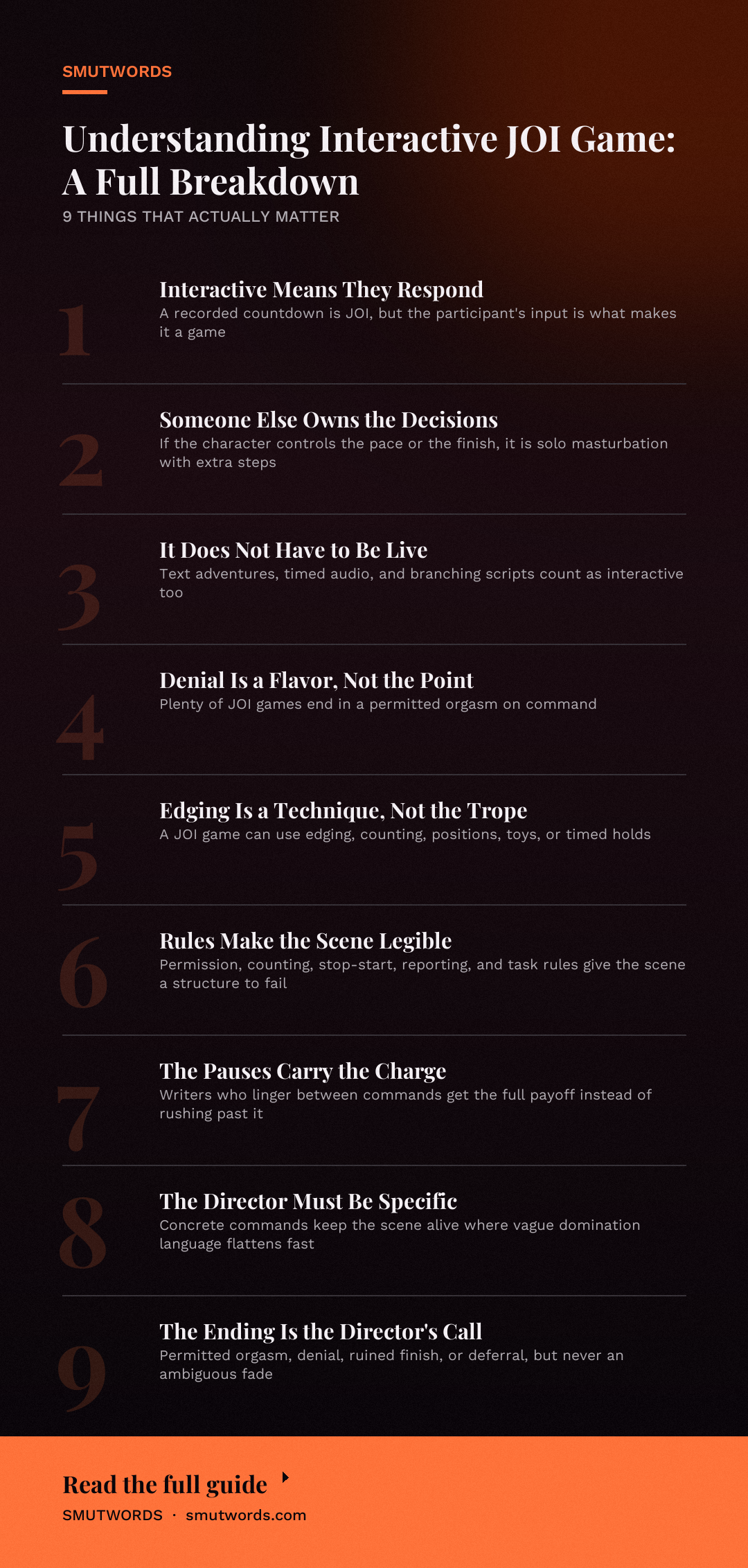
"Interactive" is the load-bearing word, because it implies the participant is not just receiving a monologue. They respond. They report back. They make choices that change what happens next.
So what counts? A recorded audio file where someone counts down and you follow along is JOI, but it is not particularly interactive.
A live video call where a dominant watches, adjusts, and punishes hesitation is interactive. A choose-your-own-adventure text where each page offers two commands and a consequence is interactive. A chatbot that asks how close you are and then decides whether you have earned the next stroke is interactive.
The category lives on a spectrum. The more the participant's input feeds back into the scenario, the further along that spectrum it sits.
What does not count is anything where the participant holds the reins. If the character is the one deciding when to speed up, slow down, or finish, that is solo masturbation with extra steps. The defining mechanic of an interactive JOI game is transferred authority: someone or something else owns the decisions.
A few misconceptions worth clearing up before we go further.
- It has to be live. Not true. Plenty of interactive JOI games are asynchronous, built as text adventures, timed audio, or branching scripts the participant plays alone.
- It has to involve a real other person. Also not true in fiction. A recorded voice, an AI, an anonymous stranger in a chat room, or even a written set of instructions can all hold the controlling role.
- It is always about denial. Denial is a popular flavor, but plenty of JOI games end in a permitted orgasm on command. The control is the point, not the deprivation.
- It is the same as edging. Edging is a technique. An interactive JOI game is a container that might use edging, but it can also use counting, positions, toys, or timed holds.
The short definition you probably arrived with says "a dominant voice or system issues escalating instructions." That is accurate, but it undersells how much craft goes into the escalation. A good interactive JOI game is structured like a scene in the theatrical sense, with a warm-up, rising action, a crisis point, and a resolution. The instructions are the dialogue. The participant's obedience is the plot.
Where Interactive JOI Game Comes From
JOI as a recognizable form is younger than most kinks in the erotic vocabulary. It grew out of phone sex lines and early webcam rooms in the late nineties and early 2000s, when performers realized that talking a listener through the act was more engaging than performing for a passive audience.
The format was cheap to produce, worked over any medium that carried a voice, and created a weird intimacy: the listener was doing the physical work, but the performer was doing the directing.
Around the same time, the internet was teaching itself to make instruction interactive. Text-based erotic roleplay in chat rooms and MUDs let two strangers build a scene together in real time, one command at a time. Those early chat scenes are the direct ancestor of the interactive JOI game as a written form. The commands were typed, the obedience was typed back, and the whole thing existed as a transcript.
The next shift was technological. When adult audio sites launched in the 2000s and 2010s, JOI became a genre with its own tags and its own listeners. Then chatbots arrived, and the interactive branch exploded, because now a participant could have a back-and-forth with something that responded to their input without a human on the other end.
And when erotica publishers noticed how well JOI-adjacent scenes sold, the trope migrated into romance novels and short fiction, where it usually appears as a phone call, a text thread, or a remote-controlled toy.
The publishing history is short. You will not find interactive JOI games in Victorian erotica or mid-century pulp.
What you will find, if you look, is the older trope this one descends from: the commanding voice. The dominatrix who gives orders by letter, the spouse who leaves written instructions, the lover who talks a partner through it from another room. Interactive JOI is what happens to that trope when the commanding voice gets a live channel and a feedback loop.
In romance specifically, the trope has evolved in one clear direction over the last decade. Early versions were almost always anonymous: a stranger on a phone line, a voice with no face. Contemporary versions increasingly use established relationships, because readers want the control to mean something.
A husband directing his wife over a video call while he is away on business hits harder than a faceless stranger, because the obedience carries emotional weight. The anonymity is still a valid variation. It just isn't the default anymore.
There has also been a shift in who gets to be in control. The classic framing is male participant, female director, which mirrors the demographic history of JOI audio. Recent fiction has diversified both sides of that equation, and the mechanic works the same regardless of who holds the script.
How It Shows Up in Erotica
On the page, an interactive JOI game is a scene about two people who are not in the same room, which is a technical challenge and an opportunity. The writer has to make solo physical action feel like a two-hander. The standard solution is to alternate between the participant's body and the director's voice, cutting back and forth so the reader never forgets that someone is watching.
Here is what a strong version of this scene actually does.
It establishes the channel early. The reader needs to know what medium is carrying the control: a phone call, a video chat, a series of texts, an app, a written note, a live audio feed. That detail determines what the director can and cannot perceive, and it shapes the whole tension. A voice-only director cannot see whether the participant is following instructions, which creates a beautiful uncertainty the writer can exploit.
It builds a rule set. The best interactive JOI scenes are games in the literal sense, with constraints the participant has to work inside. Common ones:
- The permission rule. The participant cannot finish without being told to. Asking is part of the scene.
- The count rule. Strokes are counted out loud, and mistakes mean starting over.
- The stop-start rule. Any time the director says stop, the participant's hands come off. The interval is unpredictable.
- The reporting rule. The participant has to narrate how close they are, which turns their own body into evidence.
- The task rule. The participant has to do something else while continuing, like recite a phrase or hold a position.
Those rules are what make the scene legible to a reader. Without them, the instructions are just dirty talk. With them, they are a structure the participant can fail, and failure is where the drama lives.
It escalates in stages. A flat JOI scene gives the same command at increasing intensity. A strong one changes the nature of the demand.
Stage one might be about pace. Stage two adds a restriction. Stage three introduces a piece of equipment, perhaps a remote toy or something from the participant's bedside drawer.
Stage four raises the stakes by making the participant do something they would not have agreed to at the start, which is the standard shape of scene play in fiction.
It uses anticipation as the engine. The reason anticipation play pairs so naturally with interactive JOI is that the participant is always waiting for the next instruction. The pause between commands is where the erotic charge sits.
Writers who rush through the pauses lose the effect. Writers who linger in them, letting the participant stew and letting the reader wonder whether the next command is permission or a delay, get the full payoff.
It gives the director a distinct voice. The controlling character needs a register that reads as authority without becoming a caricature. Great JOI directors are specific: they use the participant's name, they reference details from earlier in the scene, they notice when something is working and lean on it.
Enjoyed this? Get a free book.
Join the list and we will send a complete free story straight to your inbox, plus new releases every week after that. No credit card, no catch.
Vague domination language ("you belong to me," "obey") flattens fast. Concrete commands ("left hand only, slower, tell me when you're at seven") keep the scene alive.
It ends deliberately. The resolution can be a permitted orgasm, a denial, a ruined finish, or a deferral to later. What matters is that the ending is a decision made by the director. The whole scene has been about someone else owning the outcome, and an ambiguous fade to black throws that away.
The Variations Authors Actually Use
Interactive JOI is a flexible container, and most of its range comes from swapping out one or two elements.
The channel can be live (phone, video, audio) or asynchronous (texts, notes, app, pre-recorded commands). The director can be a known partner, an anonymous stranger, an AI, or a system like a dice-roll or a deck of cards.
The rule set can be permissive or restrictive. The endgame can be completion, denial, or a wager. The most common published variations:
- Remote partner. A lover who is away on business, deployed, or in another state, running the scene by video call.
- Anonymous voice. A stranger on a private line or app, often with a reveal at the end.
- Choose-your-own-orgasm. A branching text where each choice closes off the other options and the participant has to live with the consequences.
- App or chatbot. A program that responds to input, sometimes with a twist about who wrote it.
- Written instructions. A letter, list, or note left to be followed at a set time, with a check-in at the end.
- Live performance. The participant is on camera for the director, which overlaps with the exhibitionism that drives so much of what readers search for in voyeurism fiction.
The flat version of this trope announces the control and skips the game. The character is told to masturbate, does, finishes, done.
What is missing is the friction. The strong version keeps the participant in a state of not-quite-knowing, and every command either confirms or violates their expectation. That gap between what the participant is sure of and what the director actually intends is the whole machine.
One more craft note: the physical details matter more here than in almost any other trope, because the participant is alone and the reader is depending on sensation to carry the scene. Position, room temperature, what is on the floor, whether a door is locked, whether a phone is on speaker, whether the camera is angled so the director can see.
Small specifics make the difference between a scene that reads as a phone call and a scene that reads as a body being managed by a voice.
Writing the Director's Perspective
A lot of interactive JOI fiction is written entirely from the participant's point of view, which keeps the reader in the position of obedience. That is the natural default, and it works.
The other option is to split the POV, giving the reader access to the director's head.
That move is powerful because it lets you show the director's own state, which in fiction often looks a lot like domspace: the particular focus that comes from being responsible for someone else's body and pleasure across a distance. The director is listening hard, tracking what they can perceive, deciding what to withhold.
Showing that calculation on the page makes the control feel earned rather than declared.
A split POV also solves a common problem with this trope: how to make the director a character instead of a voice. A voice can be sexy for a scene. A character can carry a whole novel.
What Makes a Bad Interactive JOI Scene
Three failure modes show up again and again in slush piles and review complaints.
First, the instructions have no internal logic. The participant is told to do random things in random order, which reads as noise rather than control. A real game has structure.
Second, the participant never struggles. If the character is obedient from command one to command forty with no hesitation, no resentment, no near-miss, there is no scene. The reader needs to feel the pull between wanting to obey and wanting to come, and those are not always the same thing.
Third, the director is interchangeable. If the controlling voice could be swapped out for any other character without the scene changing, the writer has not made them specific enough. Their particular obsessions should shape the instructions.
Interactive JOI Game vs Scene Play
The two terms get conflated in reader reviews, and the relationship is worth clarifying. An interactive JOI game is a specific type of scene, defined by the mechanic of directed solo masturbation.
Scene play is the umbrella term for any negotiated, contained erotic scenario, from a single session to a full day. Every interactive JOI game is scene play. Not every scene is a JOI game.
The distinction matters most when you are tagging or recommending. If you want the specific mechanic of transferred masturbation control, you want JOI. If you want the broader category of choreographed kink between characters, you want scene play. The reader who searches for one and gets the other usually bounces.
Frequently Asked Questions
Is an interactive JOI game the same as edging?
No, though they overlap. Edging is a specific technique: bringing yourself close to orgasm and stopping. An interactive JOI game is a scenario where someone else controls the sequence of events, and that sequence might include edging. The game is the container; edging is one possible content.
Why do so many interactive JOI scenes involve a remote partner?
Because distance is what creates the need for instruction. If the two characters were in the same room, they would just touch each other. Putting them on opposite ends of a phone line or a video call forces the control through language, and language is what makes the trope readable on the page.
Can an interactive JOI game be consensual if one person has all the control?
Yes, and that is the standard shape. Consensual power exchange works because both parties agree to the frame, including how to pause or stop. In fiction, that agreement is often written into the setup as a kink negotiation, sometimes as a quick exchange before the scene begins. In real life, it is not optional.
Does the participant ever take back control in these scenes?
Part of the appeal is the surrender, so the power stays with the director in most published versions. Some scenes play with a reversal partway through, where the participant tests the director or the director has to improvise when the participant goes off script. Those variations exist but are less common.
What is a safeword for in a JOI game, and why does fiction mention it?
A safeword is a pre-agreed signal that pauses or ends the scene immediately, no questions asked. In fiction, mentioning one signals that the control is consensual and the characters are competent, which makes the scene hotter for many readers. In real life, any directed masturbation involving edging, denial, or orgasm control should have a safeword, a way to pause, and a check-in afterward.
How is a JOI game different from a domination scene?
Domination scenes can involve anything from service to impact to humiliation. Interactive JOI is narrower: the specific content is directed solo sexual activity, usually through a remote channel, with rules governing permission and pace. A JOI game is a subset of domination, not a synonym.
Final Thoughts
The interactive JOI game works because it puts a character in a room alone and makes them feel watched. The reader gets both sides of that feeling, the obedience and the exposure, and the whole thing runs on one engine: someone else decides what happens next.
If you want to see the mechanic stretched across a full novel, the ranked list below is your next stop. If you want the neighboring territory, try the guides on chase and capture play and primal play, or the RACK entry if you want the consent framework underneath all of it. Read one. Then read the one next to it.








Loading comments…