Masochism is the erotic charge that comes from receiving pain, humiliation, or submission, where intensity itself becomes the source of arousal rather than something to endure on the way to it. That is the working definition, and it covers more ground than most readers expect.
A masochist might get off on a stinging slap, a verbal degradation, a rope bite, or the quieter ache of giving up control entirely. The common thread is that sensation or surrender lands as pleasure, not damage. In erotica, masochism is one of the load-bearing kinks of the entire genre. It is also one of the most frequently misunderstood.
What Masochism Actually Means
The word comes from Leopold von Sacher-Masoch, the nineteenth-century Austrian writer whose novel Venus in Furs turned submission to a dominant woman into literature. A sexologist named Richard von Krafft-Ebing coined "masochism" from his name, then paired it with "sadism" after the Marquis de Sade. The pairing stuck, which is unfortunate, because it implies the two always come as a matched set. They don't.
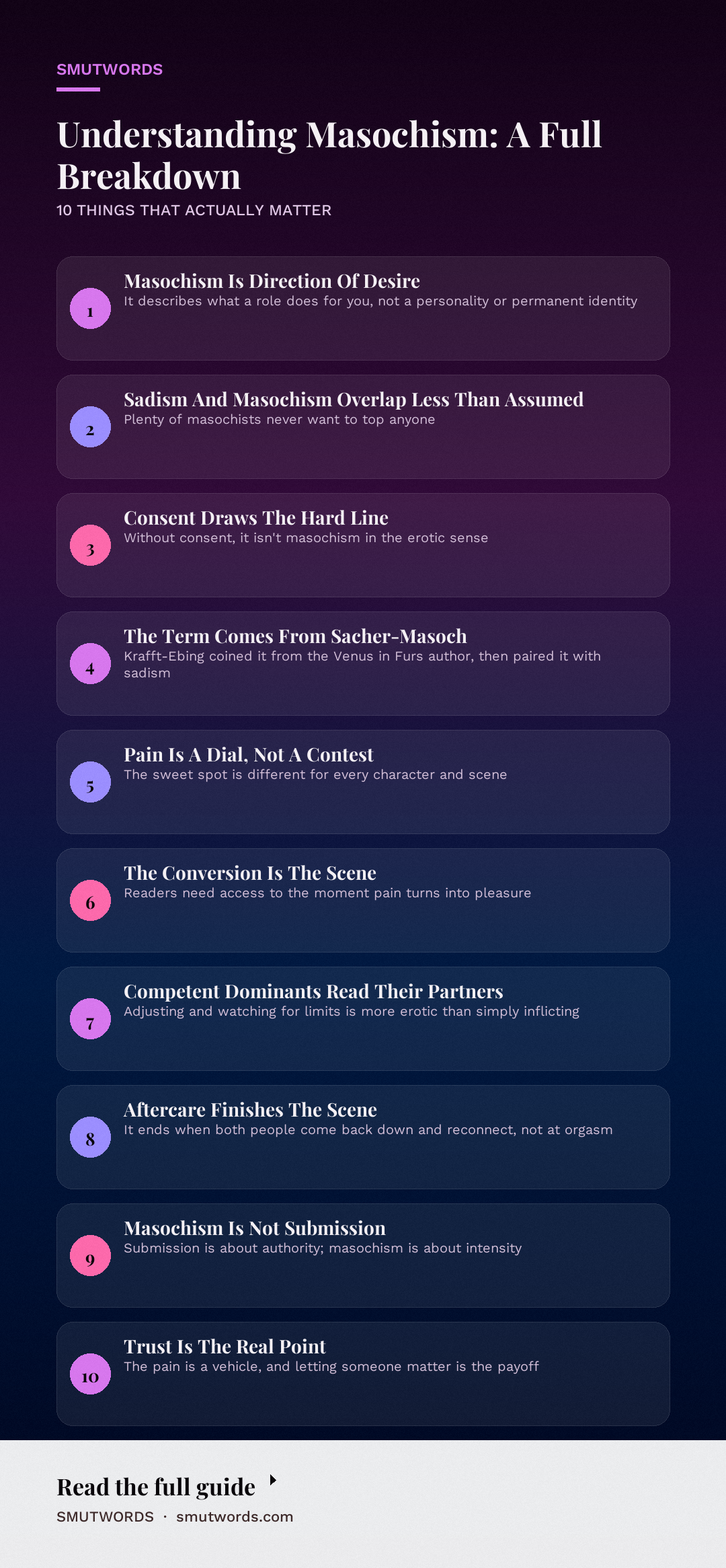
Plenty of masochists have no interest in topping anyone, and plenty of sadists want nothing to do with receiving pain. The two kinks overlap in practice far less than the language suggests. What masochism actually describes is a direction of desire inside a scene. It is not a personality type and not a permanent identity label.
What counts as masochism in erotic writing is broad. It includes physical pain play like spanking, caning, flogging, biting, and wax. It includes humiliation and degradation, which are psychological rather than physical.
It also includes submission as its own reward, where the ache is the loss of control rather than any specific sensation. Some readers rank orgasm denial, bondage strain, or being made to wait as the purest form.
What doesn't count is anything without consent. A character who is genuinely harmed, coerced, or unable to stop a scene isn't experiencing masochism in the erotic sense. The genre draws a hard line here, and good writing makes that line visible on the page.
Common misconceptions are worth naming directly:
- That masochists are broken or self-destructive. The erotic version of pain is a chosen, negotiated experience. Self-harm and masochism have nothing in common beyond a surface resemblance.
- That masochism means wanting to be hurt by anyone. It means wanting a specific intensity from a specific person under specific terms. The partner matters enormously.
- That it always involves physical pain. Humiliation, bondage, and service submission are all masochistic for many people with no impact play involved.
- That it is the same as bottoming. Bottoming describes a role in a scene. Masochism describes what that role does for you.
- That more pain is always better. Intensity is a dial, not a competition, and the sweet spot is different for every character and every scene.
The short definition gets readers in the door. What keeps them there is the psychology underneath: a masochist is someone whose body and mind translate certain kinds of overwhelm into pleasure, and that translation is inherently dramatic, which is why it works so well in fiction.
Where Masochism Comes From
As a publishing phenomenon, masochism has been central to erotic literature for longer than the term has existed. Venus in Furs was published in 1870, and it established the template that a century and a half of romance has been refining: a powerful figure, a willing supplicant, and a negotiation of who actually holds the power. The novel is explicit that Severin's suffering is the point, not an obstacle to his pleasure.
The twentieth century pushed the theme underground and then brought it back in pieces. Mid-century pulp paperbacks ran spanking and domination stories behind coy covers. The lesbian pulp era used submission as one of the few available vehicles for explicit desire. By the 1970s, the emerging leather publishing scene was producing fiction written by and for the people living it, which changed the tone considerably.
The real inflection point for mainstream romance was the early 2010s, when BDSM romance exploded into commercial prominence. Suddenly masochistic heroines and heroes were on bestseller lists, and publishers discovered that readers wanted the negotiation, the safeword, and the aftercare rendered in as much detail as the scene itself. That was a genuine shift.
Earlier erotica often treated pain as a punishment or a corruption. The post-2010 wave reframed it as a skill, a trust exercise, and a form of intimacy. Contemporary masochism in romance is more likely to be a character's chosen language for closeness than a symptom of damage.
The genre's history also runs through fanfiction, which deserves credit here. Hurt/comfort, one of the named variants, was codified in fan spaces decades ago. The structure is simple: a character is injured or overwhelmed, and another character tends to them.
The hurt is the setup and the comfort is the payoff, and the erotic charge lives in the gap between. That template migrated into published romance and never left. You can see its fingerprints in the way modern predator/prey play gets written, where the chase and the catch carry more weight than the act itself.
Today masochism shows up across paranormal, contemporary, historical, and dark romance without needing to announce itself. It's less a subgenre than a current that runs under the whole field.
How It Shows Up in Erotica
On the page, masochism is a craft problem before it's a kink problem. A scene has to make the reader feel the intensity without numbing them, and that requires control of pacing, sensory detail, and point of view. Writers who do it well treat pain the way they treat any other sensation: specific, localized, and tied to a reaction.
Vague pain is dead on arrival. "It hurt" tells the reader nothing. The strong version names the sensation and the response together: the exact sound of the impact, the heat blooming after, the way the character's breath catches, the involuntary sound they make. Physical detail is the entire ballgame in impact play, and it is the same discipline that makes latex fetish writing work, where the texture of a thing carries the erotic weight.
The variations authors reach for are worth cataloging, because they produce very different books:
- Impact play. Spanking, flogging, caning, belts. Physical, immediate, and the most common on-page form. The best versions track the buildup across the body and the emotional shift as the character stops flinching and starts leaning in.
- Humiliation and degradation. Psychological rather than physical. The intensity comes from words, positions, and exposure. This is where a spitting kink or other degradation-adjacent play can enter a scene as a power statement rather than a physical act.
- Sensation play. Wax, ice, clamps, blindfolds. The point is contrast and unpredictability. A character who can't see what's coming experiences every touch at full volume.
- Bondage and restraint. The ache here is muscular and positional. Shibari is the classic form: rope work that is itself a kind of impact, leaving marks that last past the scene and reminding the character of it for hours.
- Service submission. No pain at all, just the sustained discipline of putting someone else first. The masochism is in the erasure of the self for a stretch of time.
- Hurt/comfort. Injury or overwhelm followed by tender care. The hurt is the setup and the comfort is the payoff, and the erotic charge lives in the transition.
- Orgasm control. Denial, edging, enforced waiting. The suffering is entirely internal and often the most excruciating version on the page.
What separates a strong masochism scene from a flat one usually comes down to three things. First, the character's interiority. The reader needs access to the moment the pain converts into pleasure, because that conversion is the whole event. If the prose stays outside the character's head, the scene reads as violence rather than kink.
Enjoyed this? Get a free book.
Join the list and we will send a complete free story straight to your inbox, plus new releases every week after that. No credit card, no catch.
Second, the partner's attention. A dominant who is actually reading the submissive, adjusting, watching for the limit, is far more erotic than one who simply inflicts. Competence is the turn-on. The reader wants to see that the person holding the whip knows exactly what they're doing and exactly how much the other person can take.
Third, the aftermath. Aftercare in fiction is where a lot of writers get lazy, and it shows. The scene doesn't end at orgasm. It ends when both people have come back down, checked in, and reconnected.
Water, blankets, a hand on the back of the neck, a quiet joke. That coda is what makes everything before it feel safe and therefore hot.
There's also a distinct flavor of masochism that leans fully into the body's overwhelm, where the character is pushed past ordinary endurance in a way that borders on the animal. That register shows up in feral play and in monster cock kink, where the physical intensity is deliberately beyond normal human scale and the character's willingness to take it is the erotic point.
Praise and degradation are often written as opposites, but they run on the same wiring. A character with a praise kink who is also a masochist can be sent reeling by a "good girl," and the overlap is one of the most useful tools a writer has for showing that the intensity is coming from the partner's regard, not from the pain itself.
One more craft note: masochism scenes need a visible negotiation, or the reader loses the safety that makes the kink arousing. The safeword doesn't have to be spelled out in dialogue every time. A single line establishing that both parties know the rules, a check-in mid-scene, a character stated their limit earlier and the partner respects it. Small signals do enormous work.
The same is true of a masochistic character who is watching rather than participating. If the dynamic involves someone observing a scene they aren't in, that's a voyeurism thread running alongside the masochism, and it changes the emotional math. The voyeur husband trope is a common container for exactly this, where the watching is part of the submission.
Masochism vs Submission
Readers conflate masochism and submission constantly, partly because the two so often appear together and partly because both are described with the same word, "bottoming." They aren't the same thing, and the difference is genuinely useful for readers trying to find books they'll like.
Submission is about authority. A submissive character gives another person control and gets off on the transfer. The specific acts can be gentle, painless, even mundane.
Being told what to wear, being kept waiting, being made to ask permission. No pain required.
Masochism is about intensity. A masochistic character gets off on the force of the experience, which can occur entirely outside a power exchange. A character who enjoys being bitten hard by a partner who isn't dominant in any formal sense is still a masochist.
Most scenes in romance combine them, which is why the terms blur. But when a book promises one and delivers the other, readers notice. A book marketed as heavy masochism that turns out to be gentle submission will disappoint, and vice versa. Knowing which one a character actually wants is the fastest way to predict whether a given title will land.
Frequently Asked Questions
Is masochism a real thing or just a fantasy?
It's real. Consensual masochism is a recognized practice in kink communities, with established norms around negotiation and safewords. The fiction exaggerates intensity and convenience, but the underlying dynamic, where someone genuinely enjoys receiving pain or humiliation under agreed terms, is drawn from real life.
Can a masochist also be dominant?
Absolutely. Orientation and role are separate axes. A character can enjoy receiving pain and still run the scene, or top someone else entirely. Some of the most interesting dynamics in romance involve a dominant who is also a masochist, which scrambles the usual assumptions about who is in charge.
Why do readers find masochism romantic?
Because it requires radical trust. Letting someone hurt you, on purpose, and believing they'll stop the instant you need them to is an extreme form of intimacy. Readers are drawn to that vulnerability and to the partner who proves worthy of it. Pain becomes a pathway to connection rather than a barrier to it.
What's the difference between impact play and masochism?
Impact play is one technique. Masochism is the reason someone might enjoy it. Plenty of impact play happens between people who aren't masochists at all, and plenty of masochists get what they need from humiliation or restraint with no impact involved. The label describes the appetite, not the act.
Do masochism scenes in erotica need a safeword?
On the page, yes, in some form. It doesn't have to be a formal list of words, but the reader needs evidence that the arrangement is consensual and that the submissive can stop things. Without that signal, the scene reads as abuse rather than kink, and the erotic charge collapses.
Is aftercare always part of a masochism scene?
In good writing, yes. Aftercare is where the intensity gets processed and the characters reconnect, and it's the difference between a scene that feels caring and one that feels careless. Skipping it is one of the most common reasons a masochism scene falls flat for readers.
Final Thoughts
Masochism works in erotica because it externalizes something every romance is already about: the terrifying, thrilling act of letting another person matter enough to affect you. The pain is a vehicle. The trust is the point. If you want to see that dynamic executed at a level most books don't reach, start with a title that takes the negotiation and the aftermath as seriously as the scene itself, and pay attention to how the writer handles the moment the character stops resisting and starts wanting.







Loading comments…