
An MMF threesome is a sex scene or relationship dynamic involving one woman and two men where all three people are sexually engaged with each other, including the two men. The "MMF" order matters: it signals that contact between the men is part of the action rather than something the scene avoids.
It is one of the most popular configurations in erotic fiction and one of the most frequently mislabeled, which is why readers searching for a real MMF threesome often end up with something that only half delivers.
This guide covers what the term means, where it came from, how authors actually write it, and what separates a scene that works from one that just arranges three bodies in a room.
What MMF Threesome Actually Means
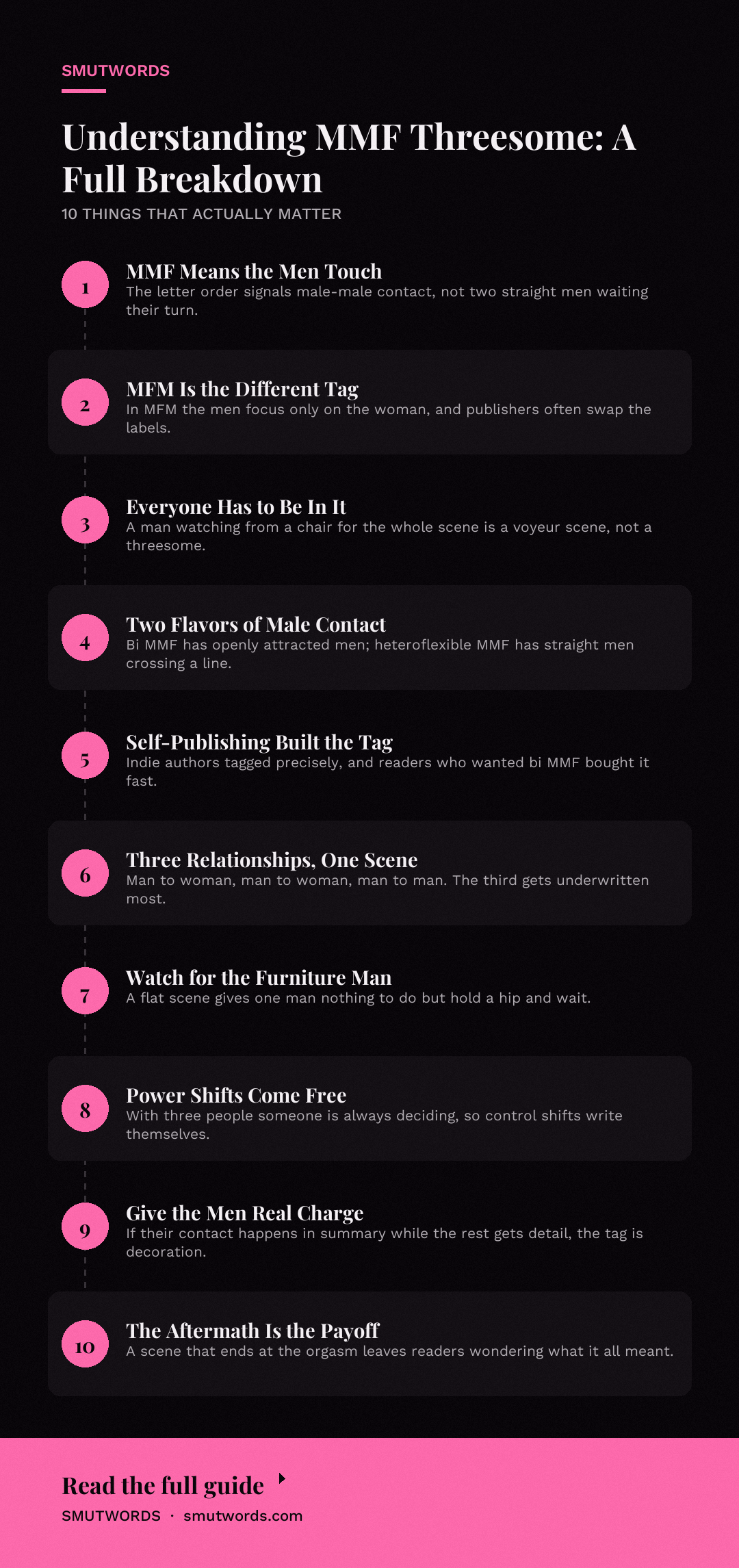
The letters map directly onto who touches whom. M-M-F means the two men interact sexually with each other as well as with the woman. That interaction can be anything from kissing and hands to full oral or anal sex between the men. What it cannot be, by definition, is two straight men who never touch, each waiting his turn with the woman in the middle.
That second arrangement is real and popular. It usually gets labeled MFM, or sometimes "MFM" with the order flipped loosely and casually. Publishers are not consistent about the distinction, which is the source of most reader frustration. Search for an MMF threesome and get a book where the men are aggressively heterosexual and barely make eye contact, and you have been handed an MFM scene wearing the wrong tag.
The definition also carries a second requirement: all three people are actively engaged. A scene where one man watches from a chair for the entire encounter is a voyeur scene with a third participant, not a threesome in the sense readers mean. The men do not have to be equally involved at every second, but both need to be participants rather than audience.
What Counts as MMF
- Bi MMF: both men are openly attracted to men and act on it with enthusiasm. The male-male thread is as developed as the male-female threads.
- Heteroflexible MMF: the men identify as straight or mostly straight but cross into contact with each other inside this specific scene, often for the first time. The novelty and hesitation are part of the appeal.
- MMF with a dominant/submissive structure: one man leads, the other follows, and the woman may be the prize, the director, or the one holding both of them on a leash.
- Established-triad MMF: all three are already together. The scene is domestic and familiar rather than a first-time encounter.
What Doesn't Count
A scene with two men and one woman where the men never touch each other is MFM. A scene where one man leaves the room, falls asleep, or is explicitly excluded from the action is not a threesome at all. A scene where the male-male contact exists only as a single glancing brush that the narrative immediately walks back is technically MMF on a checklist and a disappointment on the page.
One common misconception: MMF is not automatically a dominance scene. Plenty of MMF erotica is playful, tender, or comedic.
Another: it is not the same as a love triangle. In a true MMF, the three people are in the same room making the same choices at the same time. That is a very different engine than two rivals circling one woman from a distance.
Where MMF Threesome Comes From
The threesome as a category has been a staple of erotic publishing for as long as erotic publishing has existed in recognizable form. The specific MMF tag, with its emphasis on male-male contact, is a more recent development in how the market packages and sells the fantasy. Its history is mostly a history of labeling, distribution, and reader demand rather than a single cultural origin story.
For decades, erotic fiction treated male-male contact inside a mixed threesome as a seasoning rather than a headline. It appeared in underground and small-press work, frequently under bisexual or "anything goes" banners, and often got softened or removed when a story was reprinted for a broader market. Readers who wanted the male-male thread had to hunt for it, with no reliable way to know what they were getting until they were already reading.
The self-publishing boom changed the math. Indie romance authors could tag precisely, price low, and publish fast, and they discovered that readers who wanted bi MMF would buy it voraciously when they could find it. The tag became a marketing promise. Authors started building series around it, and the MMF/MFM distinction hardened into something readers actively policed in reviews.
Two shifts followed. First, heteroflexible MMF grew into its own subcategory, aimed at readers who wanted the male-male contact to feel like a threshold being crossed rather than a settled identity. Second, MMF bled into mainstream romance structure through the why choose romance format, where the heroine ends up with multiple partners and the book refuses to make her pick one. That format gave MMF a plot architecture beyond the single scene.
What changed most is who gets to be the center. Early versions often treated the woman as a prize the men negotiated over. Contemporary MMF more often puts her in charge of the encounter, deciding who does what and when, and it treats the men's desire for each other as a genuine relationship thread rather than a stunt.
How It Shows Up in Erotica
An MMF threesome on the page has three separate relationships to manage in a single scene: man to woman, man to woman, and man to man. The third is the one that distinguishes the tag, and the one that most often gets underwritten. Strong MMF writing treats all three as live wires running at once.
The Craft Problem: Three Bodies, One Scene
Writing any threesome is a staging problem before it is anything else. Two people can be tracked easily. Three people create geometry: who is where, whose hands are on whom, whose mouth is where, and how does anyone reposition without the prose turning into a furniture diagram.
Authors solve this in a few reliable ways. Some anchor the scene to one point of view and let the other two bodies arrive as sensations, which keeps the geography clean. Some rotate the POV between the three participants in short sections, which lets each person's interior experience of the same moment land separately. Some keep one character directing traffic out loud, which makes positioning feel like part of the eroticism rather than stage management.
A flat MMF scene usually has the same failure: one man becomes furniture. He holds a hip, he waits, he says something encouraging. The reader notices within a page. A strong scene gives each man a distinct appetite, a distinct rhythm, and at least one moment where his attention to the other man is unmistakable.
Common Variations Authors Use
- The first-time heteroflexible scene. Two straight-identifying men discover they are willing to touch each other inside this encounter. The tension is in the hesitation and the permission.
- The established couple plus one. A couple brings in a third man. The negotiation between the couple is as charged as the sex, and jealousy gets handled rather than ignored.
- The two men already together. A male couple invites a woman in, which flips the usual center of gravity and changes who is being welcomed.
- The competitive variant. Both men want to be the better lover. The rivalry fuels the scene and often resolves into cooperation.
- The submissive-center variant. The woman gives up control and both men take it. This is where power play and use kink vocabulary often enter.
- The dominant-woman variant. She runs the encounter, decides what the men do to each other, and the male-male contact happens on her instruction.
Where Power Play Enters
MMF is a natural home for control shifts because the numbers make them visible. With three people, someone is always deciding something: who goes first, who touches whom, who is allowed to come. That structural fact gives authors a free hand with dominance and submission without contriving it.
Two common configurations. The first is a single dominant, usually one of the men or the woman, with the other two deferring. The second is a rotating or negotiated control, where each person takes the lead at different points and the scene's heat comes from the handoffs.
At the rougher end, MMF scenes borrow from degradation kink vocabulary of being used, passed around, and spoken down to, always with the fiction's safety net intact. At the more physical end, scenes can drift toward primal play energy, all grasping hands and no negotiation on the page. Writers who want a structured power object in the room sometimes borrow from keyholding: one character literally holds the means of permission while the others wait.
What Makes a Strong MMF Scene
The best versions share a few traits. Each participant wants something specific and the scene makes that want legible. The male-male contact carries real charge rather than being a checkbox. The woman has agency even when she is surrendering it, and the narrative knows the difference.
Enjoyed this? Get a free book.
Join the list and we will send a complete free story straight to your inbox, plus new releases every week after that. No credit card, no catch.
They also trust the reader to track three people without hand-holding. And they give the scene an aftermath.
A threesome that ends at the orgasm leaves the reader wondering what any of it meant. A scene that shows the characters afterward, negotiating what just happened, is the version readers remember. If you want a sense of how much work goes into making that aftermath land, the same craft shows up in guides to possessiveness kink, where jealousy and attachment have to be written with the same care as the sex.
MMF Across Romance Structures
Within a standalone erotic short, MMF is usually a single set piece: the encounter is the plot. Within a novel, it tends to attach to a relationship structure. The most common are the why choose romance, where the heroine keeps both men and the book treats that as a happy ending, and the friends-to-lovers route, where the three people arrive at the encounter through a long friendship that changes shape.
Some authors use MMF as a turning point inside a couple's story, which means the scene has to do double duty: deliver the heat and resolve a plot question. Compare that to a friends with benefits setup, where the emotional stakes are already established and the threesome is the disruption, or a one night stand, where the encounter is deliberately rootless and the point is the experience rather than the future.
Some scenes close the emotional loop with a makeup-style reconciliation beat, and makeup sex after a jealous argument is a recognizable variant. The threesome becomes the resolution rather than the provocation.
Keeping the Male-Male Thread Honest
Readers of MMF are unusually attentive to whether the male-male contact is being written with real desire or being smuggled past. The tell is where the narrative's attention goes. If the two men's contact happens entirely in summary while the man-woman contact gets full sensory treatment, the book has signaled its actual priorities.
The MMF scenes that earn loyalty give the male-male thread the same specificity as everything else: the hesitation, the surprise, the texture, the eye contact. If you want a model for how much detail that requires, look at how a guide to scar fetish vs marking kink handles the difference between a surface detail and the thing it actually means. That same distinction decides whether an MMF scene's male-male thread is decoration or substance.
MMF Threesome vs MFM Threesome
This is the comparison that matters most, and it confuses people because the two abbreviations look nearly identical. MMF puts the two men adjacent, signaling male-male contact. MFM puts the woman between them, signaling that each man's sexual attention is aimed at her. The scene's center of gravity is different even when the same three people share the same bed.
The confusion is compounded by inconsistent publishing. Plenty of books tag "MFM" when the men do touch, and a smaller number tag "MMF" when they do not. The most reliable signal is the blurb's language: look for "bi," "bisexual," "heteroflexible," or explicit description of contact between the men. Absent those, a tag alone will not tell you what you are getting.
The other frequent comparison is MMF against why choose romance. The two overlap but are not the same. MMF describes a configuration, a specific number and arrangement of bodies. Why choose describes a relationship structure where the heroine ends up with multiple partners and the book refuses to make her choose.
An MMF scene can appear inside a why choose book, and many do, but plenty of why choose books have no male-male contact at all.
A third, less common pairing: FFM, where two women and one man are all involved with each other. It shares the "everyone touches everyone" principle and none of the male-male thread. If you have read good MMF and are curious about the mirror version, a guide to feet worship vs leg fetish is a useful reminder that two configurations that seem adjacent often turn out to be separate interests with separate appeal.
Frequently Asked Questions
What does MMF stand for in a threesome?
MMF stands for male-male-female. The letter order signals that the two men are sexually involved with each other as well as with the woman, unlike MFM, where the men's attention is directed only at the woman. The distinction is widely used in romance and erotica tagging.
What is the difference between MMF and MFM?
MMF includes male-male sexual contact between the two men. MFM does not: the men are straight and focus entirely on the woman. Both are three-person scenes with one woman and two men, but the experience of reading them is very different, and publishers are not always careful about the tag.
Is an MMF threesome always bisexual?
No. Heteroflexible MMF is a large and popular subcategory where men who identify as straight or mostly straight cross into contact with each other inside the specific scene. Bisexual MMF, where both men are openly attracted to men, is the other main category. Both count.
How do I find books that actually have male-male contact?
Check the blurb for words like "bi," "bisexual," or "heteroflexible," and read the sample chapter. Reviews are also reliable, because MMF readers are vocal about mistagging. When in doubt, trust the description over the abbreviation.
Why is MMF so popular in romance?
It delivers a fantasy of undivided attention from two men at once, offers visible power shifts, and gives readers the taboo charge of male-male intimacy inside a safe fictional space. The why choose romance format also lets the fantasy carry a full happy ending.
Does MMF always involve a dominant?
No. Plenty of MMF scenes are playful or tender with no power exchange at all. But the three-person structure makes control shifts easy to write, so dominance and submission appear often, including scenes where the woman directs both men or where one man leads the other.
Final Thoughts
The MMF threesome rewards authors who take the third relationship seriously. When the scene treats male-male desire as the main event alongside everything else, it stops being a gimmick and becomes the whole reason to read.
Start with a book that has earned its tag reputation, and read the sample first for one specific tell: does the blurb or the opening scene give the two men's attraction to each other the same weight as everything else? If it does, you have found the version of MMF that readers keep coming back for.





Loading comments…