Most people who are into scars find out by accident. You see a raised line across someone's shoulder blade in a changing room, or a burn scar on a forearm resting on a bar, and something in your chest goes quiet and interested in a way you weren't expecting.
Two different appetites get called the same thing. A scar fetish is attraction to real, already-there scar tissue: the texture, the history, the way a body records what happened to it.
A marking kink is the appetite for making temporary marks on purpose, with consent, and watching them fade over days. People conflate the two constantly because both involve skin and permanence and a certain amount of staring. The logistics are nothing alike, and neither is the conversation you need to have about them.
This guide treats both as things adults do on purpose with other informed adults. If you're here because a scar fetish caught you off guard, or because you want to leave a mark and don't know how to ask, both are workable. Neither is a problem to be managed. They just require more specificity than most people bring to a first conversation about sex.
What a Scar Fetish Actually Is
A scar fetish is desire directed at existing scar tissue. That's the whole definition. It can mean finding scars erotic in themselves, or finding the story behind a scar erotic, or finding the vulnerability of someone letting you look at and touch a part of their body they usually keep covered.
The scar might be surgical, accidental, a childhood injury, a self-harm scar, a burn, a stretch mark someone counts in the same category. People draw the line in different places. Know where yours is before you start telling a partner about it.
What separates this from generic body admiration is the history. A person with a scar fetish usually isn't indifferent to how the scar got there. The interest tends to run toward the evidence of survival, of a body that went through something and knit itself back together.
That's why the appeal so often gets described in terms of intimacy and trust rather than pure aesthetics. The scar is a thing the owner didn't choose to show you, and being shown it means something.
Worth saying plainly, because it comes up in every discussion of this: a scar fetish is not the same as wanting to cause scars. The overwhelming majority of people with this interest want nothing to do with injuring anyone. If someone tells you they're into your scars and then suggests giving you a new one, those are two separate propositions. You're allowed to be interested in one and bolt from the other.
What a Marking Kink Actually Is
Marking is the deliberate creation of temporary marks on a consenting partner's body: bites, scratches, hickeys, the sting of a flogger, rope marks that linger an hour, a handprint that fades by morning. The point is the visible record. The mark is proof of what happened, worn under clothes for a day or two, a private thing the marked person knows is there even when nobody else can see it.
Marking lives close to possessiveness kink, and the overlap is real: the mark says this happened, someone was here. It also sits near collaring in the way it functions as a symbol of an ongoing dynamic, though collaring is usually a deliberate ceremony and marking is often spontaneous. If you want the ceremonial version, the ritual collaring ceremony breakdown covers how people formalize that kind of claiming. Marking is the messier, more physical cousin.
Two things have to be true for marking to be fine. The marks have to be temporary, and the person wearing them has to have agreed, in advance, to where and how visible they'll be.
A bite on the shoulder is a different negotiation than a bruise on the throat that a coworker will clock on Monday. Get specific about location before anyone's teeth are involved.
Scar Fetish vs Marking Kink: The Differences That Matter
The two get mixed up because both are about marks on skin and both carry a charge of permanence. The practical differences are what determine how you bring them up and what you have to plan for.
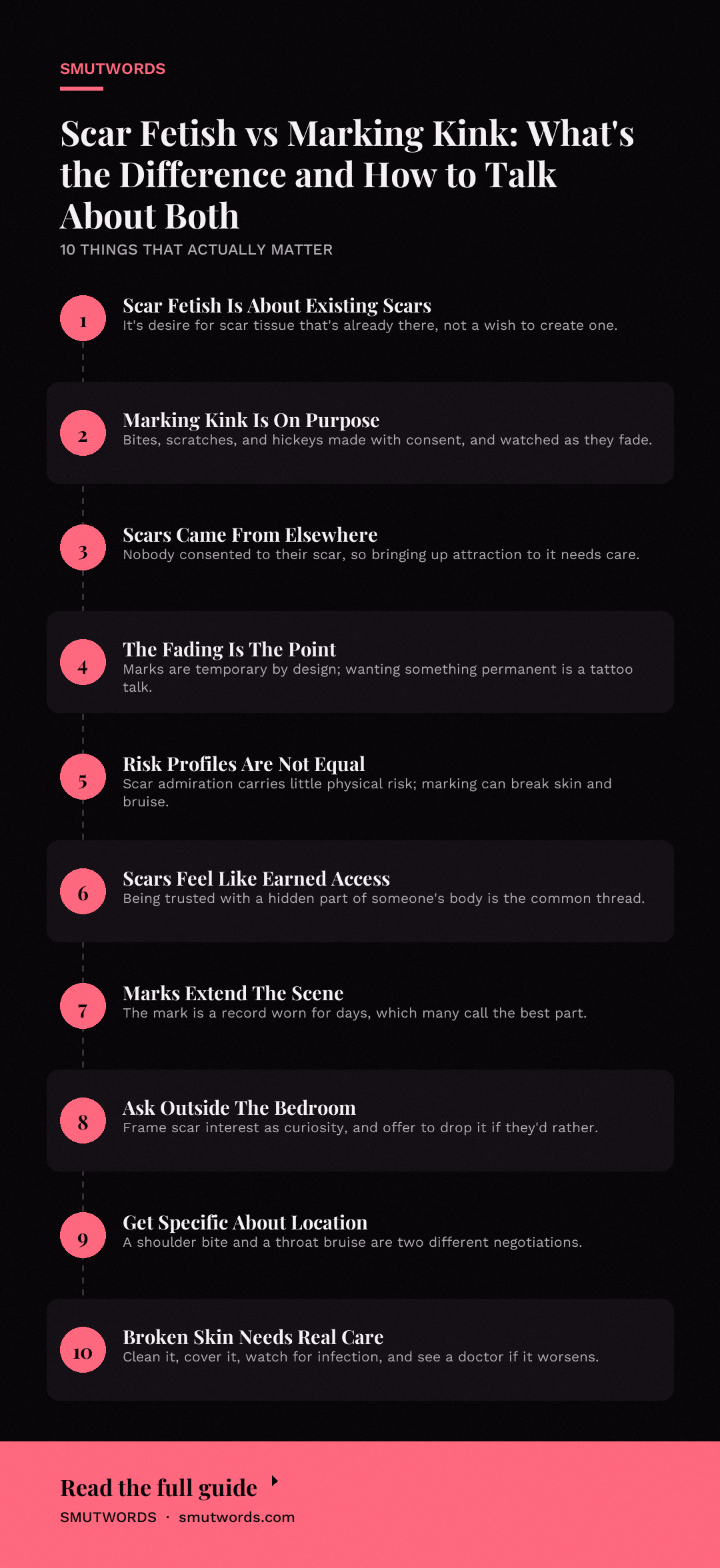
- Direction of time. A scar fetish is about something that already happened. A marking kink is about something you're doing now, and what it'll look like tomorrow.
- Who made it. Scars usually came from surgeons, accidents, illness, or a hard period in someone's life. Marks come from a partner, on purpose, with consent. That's a completely different emotional object even when it looks similar on the surface.
- Consent history. Nobody consented to their scar. That's why bringing up attraction to it needs care. Marking is negotiated from the ground up, which makes it more straightforward in some ways and more logistically demanding in others.
- Permanence. Scars don't fade. Marks do, and the fading is part of the appeal. If someone wants a permanent mark, that's a tattoo conversation, and it's a separate conversation with its own rules.
- Risk profile. Scar fetish carries almost no physical risk as long as you're respectful. Marking carries real risk: broken skin, infection, bruising over a joint, marks in places that will get someone in trouble at work.
Why People Are Drawn to Scars
The most common thread in accounts from people with a scar fetish is the intimacy of being trusted with something vulnerable. Scars are often the parts of a body people hide. Being allowed to see one, touch one, kiss one, is a form of access that feels earned.
There's also the history angle. A scar is evidence of a body that survived something. For some people the erotic charge is in that resilience, in the sense of being close to someone who has been through fire and is still here and is letting you near.
For others it's simpler: texture is interesting, and a raised scar under a fingertip is a specific sensation that some people find arousing in the way others find freckles or a particular jawline arousing.
A smaller group is drawn to the idea of being marked permanently, or of being with someone who already carries permanent marks. That can overlap with the fantasy of being claimed, the same engine that drives a lot of the dominance dynamics in fiction. Absolute Surrender runs on that exact current, the appeal of belonging to someone completely, and it's a useful way to understand the fantasy without anyone having to actually cut anybody.
Why People Are Drawn to Marking
Marking is a physical record of an experience that the marked person gets to carry around afterward. That's the core of it. The bite mark on a shoulder is a reminder for the next two days that a specific person did a specific thing. It extends the scene past the moment it ended, which is why so many people describe the aftermath, the looking at it in the mirror, as the best part.
There's also a power dimension. Leaving a mark is an assertion, and wearing one is an acceptance of that assertion. For people in a dominant/submissive dynamic, the mark is a quiet piece of structure that persists between scenes. It can function like a claim, the same energy that drives scenes in something like Whore of Wall Street: the appeal of being visibly, unmistakably someone's.
And then there's the plain sensory fact that biting and scratching feel good during sex for a lot of people. The mark is just the evidence left behind.
How to Bring Up a Scar Fetish Respectfully
Scars are loaded for a lot of people. Some are proud of theirs, some are indifferent, some are actively self-conscious, and some are attached to trauma they haven't finished processing. So the way you raise this matters more than it does for a lot of kinks.
The worst version is commenting on a partner's scar mid-sex in a way that suggests you're getting off on their pain. Even if that's not what you mean, it can land badly.
The better version is a conversation outside the bedroom, framed as curiosity with an explicit offer to drop it. Something like: "I've noticed you have a scar on your back. I find it attractive, and I wanted to say so, but if you'd rather I didn't mention it, tell me and I'll leave it alone." Then actually leave it alone if they ask you to.
Enjoyed this? Get a free book.
Join the list and we will send a complete free story straight to your inbox, plus new releases every week after that. No credit card, no catch.
If the scar is from something painful, don't make them tell you the story to earn your interest. Some people want to talk about it. Some don't.
Your attraction doesn't entitle you to the medical history. If they volunteer it, listen. If they don't, admire the scar and let the origin stay theirs.
Practical points:
- Ask before touching a scar directly, especially if it's recent, surgical, or in a sensitive spot. Some scar tissue is tender or numb.
- Don't assume every scar is fair game for admiration. Self-harm scars in particular need to be handled with actual care, and some people find any commentary on them intrusive.
- Never compare one partner's scars to another's. It's a body, not a collection.
- Make clear that your interest is in them, not in the wound. "I like your scar" is fine. "I wish I'd been there when it happened" is not.
How to Bring Up a Marking Kink Respectfully
Marking is easier to raise because it's a mutual activity with a built-in ask. You can just say it. "I like leaving marks. Bites, scratches, that kind of thing. Are you into that, and if so, where's off-limits?"
That's most of the conversation. The rest is about visibility: a mark is only fun if the person wearing it can live with where it is.
Get specific:
- Where are marks okay? Shoulders, back, thighs, and chest are common; anything above the collar is usually a separate negotiation.
- How visible is acceptable? A mark that shows under a t-shirt is a different commitment than one that only shows in a swimsuit.
- How long is okay? A hickey lasts a few days. Bruising from a paddle can last a week or more. Scratches heal on their own timeline.
- Is there a hard no? Jobs, family events, medical appointments, photos. Find out before you leave anything.
- What do you do if a mark shows up somewhere you didn't plan? Have an answer ready, and don't make it the marked person's problem to hide.
If you're on the receiving end and want to ask for marks, the same script works in reverse. "I like being marked. I'd be into bites on my shoulders, nothing above the collar because of work. Are you into that?" That's a complete negotiation in three sentences.
Scars and Marks in Fiction, and What Readers Actually Want
Fiction is where a lot of people first notice they have either of these interests. A character with a scar across his jaw, a scene where someone is bitten and the mark lingers, a dynamic where one person belongs to another in a way that's visible if you know where to look.
The fantasy on the page is usually doing something cleaner than the reality: no healing time, no visible bruise at the office, no conversation about whether a scar is okay to mention.
If you want to read the marking fantasy done well, Free Use Celebrity Afterparty runs on the idea of being visibly claimed and used.
She Made the First Move: A Dominant Wife Awakening is a good example of a dynamic where marking fits naturally into the power structure. The voyeur cuckold fantasy is a different angle on the same current: the appeal of being seen, of being marked as someone's in a way others can witness. For speculative tastes, Spored and Stored takes the marking impulse somewhere considerably weirder.
None of that replaces the actual conversation. Fiction is a safe place to figure out what you want. It's not a substitute for telling your partner what you want.
Safety and Healing Basics for Marking
Most marking is low-risk. Some of it isn't, and the difference is usually about how hard and where.
Broken skin is the line where marking stops being a kink and starts being a wound. Scratches that draw blood, bites that break the surface, anything that leaves an open cut needs to be cleaned, covered, and watched for infection.
If a mark gets hot, swollen, or starts oozing, that's a doctor visit, not a wait-and-see. Bites in particular carry a real infection risk because human mouths are not clean, and a bite that breaks skin over a joint is worth getting looked at.
Bruising is usually fine but not always. Deep bruising over a kidney, a joint, or the throat is a genuine concern, and you should avoid those areas entirely. If you're using impact toys, the first-restraints guide covers the same principle for rope: know what the equipment does to a body before you use it on one.
Healing timeline, roughly:
- Hickeys and light bruising: a few days to a week.
- Scratches: three to seven days if they don't break skin.
- Deeper bruising from impact: one to two weeks, sometimes longer.
- Anything that broke skin: two weeks minimum, and only if it's clean and healing properly.
If you're the one being marked, you get to change your mind mid-scene. Tell your partner a mark is too much, or that you don't want one there after all, and that's the end of it. "I changed my mind" is a full sentence and requires no justification.
When to Stop, and When to Talk About Something Else
The stop signal for both of these is the same: if a partner seems uncomfortable, self-conscious, or is humoring you, stop. A scar fetish is only fun if the person with the scar is enjoying being admired. Marking is only fun if the person wearing the mark actually wants it there. Neither of these works as something you talk someone into.
If a scar turns out to be tied to something painful and your partner clams up, drop it and don't circle back unless they do. If a mark shows up somewhere unexpected and your partner is upset, that's a conversation about planning, not a fight. If someone keeps asking for marks in places you've said no to, that's a boundary problem and you're allowed to call it that.
One more thing worth knowing: both of these interests can sit alongside a lot of other ones, and people often discover they have more than one at once. The same person who likes scars often likes soldier romance for the same reason, the sense of a body that's been through something.
The same person who likes marking often likes rockstar romance or revenge romance, both of which run on possession and visible claiming. None of that is a problem. It's just useful to know what your own pattern is before you try to explain it to someone else.
Final Thoughts
If you only read one thing after this, make it a scene where the marking actually has weight. Absolute Surrender is the book to start with, because it takes the marking fantasy seriously enough to give it a cost and a consequence, which is exactly the thing the good version of this kink has and the bad version doesn't. Read it, notice what you respond to, and bring that to your partner as a sentence rather than a hope.




Loading comments…