
The possessive hero is the man who cannot stop watching her. He notices who talks to her at the party, who texts her too late, who looks at her a second too long, and he files every one of those names away.
In romance and erotica, the possessive hero is a lead character defined by intense protectiveness and jealousy. He stakes an unmistakable claim on the heroine and treats any threat to the relationship as a personal emergency. His possessiveness is written as devotion rather than control: he wants her so completely that the wanting reorganizes his entire life around keeping her.
He is one of the most reliable engines in the genre. Put a possessive hero on the cover or in the blurb and readers know exactly what emotional ride they're buying.
The tension isn't whether he'll want her. It's what he'll do about it, and how far he'll go when someone else tries to take her.
What Possessive Hero Actually Means
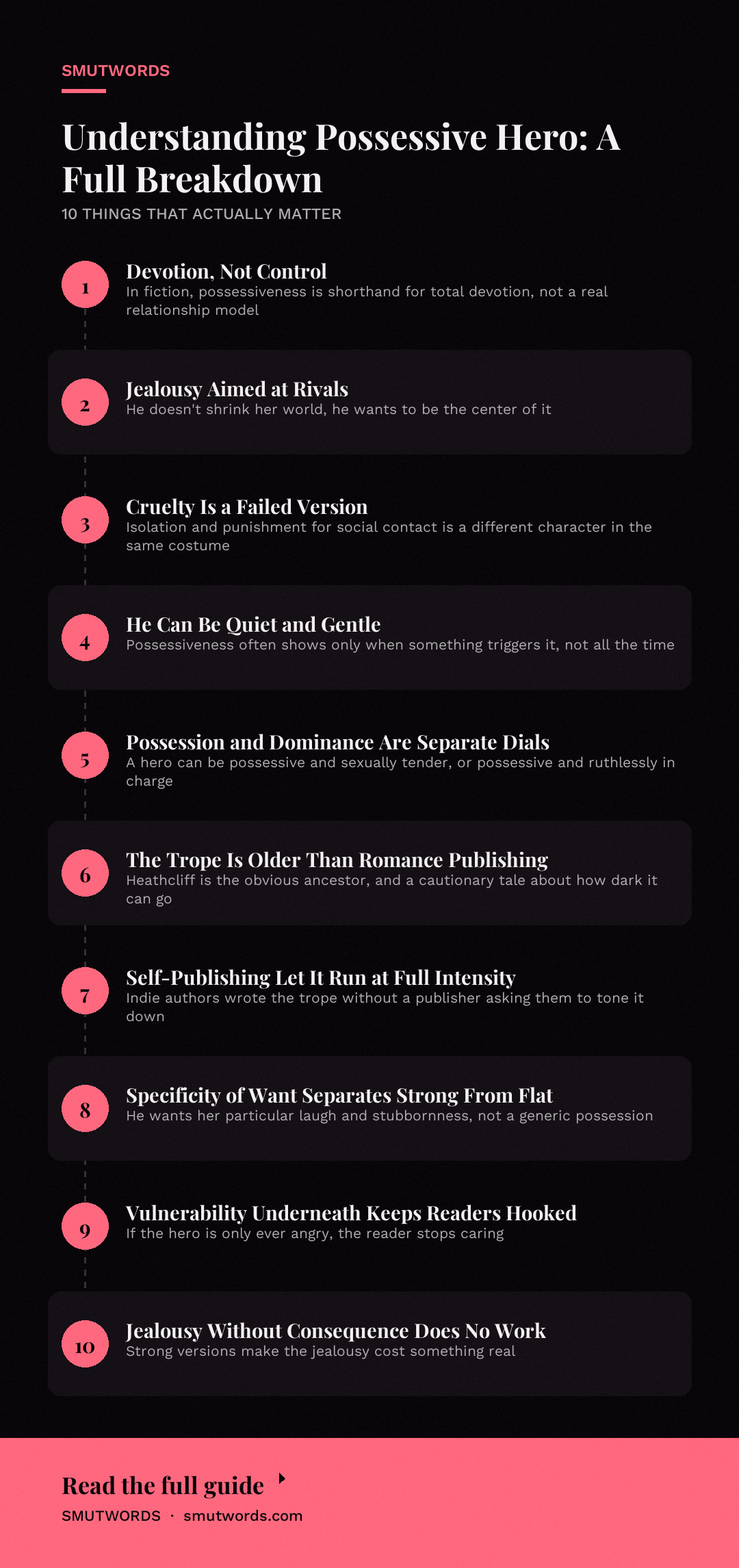
The label describes a characterization pattern. Not a personality disorder, and not a relationship model to aspire to in real life. In fiction, possessiveness functions as shorthand for total devotion. When a hero says "mine," the genre hears "I have chosen you completely and I will not be casual about it."
The word "possessive" carries real-world weight. It describes behavior that, in an actual partner, often signals danger. Fiction deliberately strips the threat out and keeps the intensity.
The hero's jealousy is aimed at rivals, not at the heroine's freedom. He doesn't want to shrink her world. He wants to be the center of it, and he wants that position acknowledged out loud.
What counts as a possessive hero:
- Territorial language. He uses words like mine, ours, and never again. Claiming is verbal before it's physical.
- Laser focus on rivals. Other men are obstacles, and he tracks them with unnerving precision.
- Physical proximity as policy. A hand at the small of her back, a body positioned between her and the room.
- Devotion framed as instinct. His behavior reads as compulsion, something he cannot help rather than something he chooses to inflict.
What doesn't count, or counts as a failed version: cruelty, isolation, punishment for ordinary social contact, or jealousy that the heroine is expected to manage and apologize for. That's a different character wearing the same costume. Readers of this trope are not confused about the difference, and they police it in reviews.
A common misconception is that the possessive hero has to be a jerk. Plenty of them are quiet, controlled, even gentle in daily life, with the possessiveness showing up only when something triggers it. The tension between a calm exterior and a jealous interior is one of the trope's best tools.
Another misconception: that possessiveness equals dominance in bed. The two often travel together, but they're separate dials. A hero can be possessive and sexually tender, or possessive and ruthlessly in charge, and the trope works either way.
Where Possessive Hero Comes From
The possessive hero is older than the modern romance industry. He shows up in nineteenth-century fiction as the brooding, jealous man whose love curdles toward obsession (Heathcliff is the obvious ancestor, and a cautionary tale about how dark the trope can go). Gothic novels built entire plots around men who wanted a woman too much and had the power to act on it.
The twentieth century softened the archetype into something more romantic. Mid-century category romances and historicals gave readers the "jealous duke" and the "overprotective rancher," men whose possessiveness was played for thrills and resolved into marriage by the final chapter. The language was gentler. The fantasy was the same.
The real boom came with the rise of the internet and the explosion of self-published romance in the 2010s. Indie authors could write the trope at full intensity without a publisher asking them to tone it down. Dark romance, mafia romance, motorcycle club fiction, and paranormal romance all made the possessive hero a centerpiece, and reader communities built entire recommendation economies around the phrase "he's so possessive and I loved it."
BookTok and its predecessors pushed the trope further into the mainstream by turning specific lines and scenes into shareable content. A single "who did this to you" moment could sell thousands of copies. The possessive hero became one of the few character types with instant name recognition across romance subgenres, which is why it earned a permanent entry in the SmutWords glossary in the first place.
The evolution is visible in the details. Older versions often ended with the heroine's jealousy being the plot's engine, or with the hero's possessiveness treated as a flaw he had to overcome. Contemporary versions mostly skip the redemption arc. The possessiveness is the appeal, presented as a trait the heroine comes to want and the reader is invited to enjoy without apology.
How It Shows Up in Erotica
On the page, the possessive hero is a craft machine. He generates conflict, heat, and forward momentum with very little external plot required. A party invitation and a stranger's glance are enough to build a whole chapter.
Writers deploy him in recognizable patterns. The most common is the claiming scene: a moment where the hero makes his ownership explicit, verbally or physically, and the heroine's reaction shifts from resistance to surrender. Variations include the public claim (he makes sure everyone in the room knows), the private claim (only the two of them, often in bed), and the deferred claim (he holds back until the heroine asks for it, which is a favorite for slow burns).
Jealousy scenes are the other workhorse. A rival appears, the hero's control frays, and the reader gets to watch the mask slip.
Strong versions give the heroine agency in these scenes. She's not a passive object being fought over. She's a person choosing, and her choice is what makes the claim land.
What separates a strong possessive hero from a flat one comes down to a few things:
- Specificity of want. He wants her, not a woman, not a possession. Flat versions are possessive of the idea of a partner. Strong versions are possessive of her particular laugh, her stubbornness, the way she argues with him.
- Stakes that scale with the character. If he's a soldier, the claim has to survive distance and danger. That's why the trope pairs so naturally with soldier romance, where absence itself becomes the threat he can't control.
- Vulnerability underneath. The best possessiveness is rooted in fear of loss. If the hero is only ever angry, the reader stops caring. If the hero is terrified of losing her and handling it badly, the reader is hooked.
- Reciprocity. The heroine has to want the claim too, at least by the end. A one-sided possession is a thriller, not a romance.
Subgenre changes the texture. In mafia and motorcycle club romance, possessiveness is institutional. The club or the family expects him to claim and protect, and the heroine enters a world with its own rules.
Enjoyed this? Get a free book.
Join the list and we will send a complete free story straight to your inbox, plus new releases every week after that. No credit card, no catch.
In celebrity romance and rockstar romance, the threat is public: fans, paparazzi, and exes who know exactly how to get under his skin. In prince/princess romance, the claim runs against protocol, and the jealousy has to operate inside the constraints of a palace.
Paranormal and monster romance push the trope into biology. Fated mates, scent marking, and territorial instincts make possessiveness literal, and shifter fiction often ties it to physical mating behavior that you can read more about in our guide to knotting. The claim has a body to it, and the language gets more primal.
Heat level matters less than people assume. The possessive hero can anchor a slow-burn that ends at a closed door, or a scorching book with scenes that run for pages. What stays constant is the intensity of focus. Everything the hero does points at her.
One craft trap worth naming: possessiveness written as constant low-grade menace becomes exhausting. The best authors vary the temperature. He's possessive in a specific moment, then tender, then funny, then possessive again. The trope lands hardest when the reader has a baseline of calm to measure the intensity against.
Another trap is jealousy without consequence. If the hero snarls at a rival and nothing comes of it, the scene did no work.
Strong versions make the jealousy cost something. He alienates an ally. He reveals a fear. He forces the heroine to make a choice she wasn't ready to make.
That's when possessiveness becomes plot.
Possessive Hero vs Motorcycle Club Romance
These two get tangled up in recommendation threads constantly, so it's worth separating them. A possessive hero is a character. Motorcycle club romance is a setting and social structure. You can have an MC book with a possessive hero, and you can have a possessive hero in a boardroom or a ballroom with no motorcycle in sight.
The confusion comes from overlap. MC fiction leans hard on the trope, and its heroes are frequently territorial in ways that define the subgenre's whole tone.
But the club brings its own machinery: brotherhood, rival crews, old ladies, and codes that exist independently of any one man's jealousy. In an MC book, the threat is often structural. The possessive hero in a different setting is usually fighting smaller, more personal battles.
If you love MC books for the sense of a man embedded in a violent community that treats loyalty as law, start with the motorcycle club romance glossary entry. If the part that actually grabbed you was the growl in his voice when another man looked at her, you're here for the trope, and this page is your home.
Frequently Asked Questions
Is a possessive hero the same as an alpha male?
Not exactly. Alpha male describes a broad power posture: commanding, confident, used to being obeyed. Possessive hero describes a specific emotional pattern about one person. Many alphas are possessive, but you can write an alpha who is secure and generous with his partner and never jealous at all.
Why do readers find possessiveness attractive in fiction?
It delivers a fantasy of being wanted beyond reason. A man who notices every rival and refuses to be casual about you is the opposite of being overlooked. The trope also guarantees total commitment from page one, which removes the anxiety of not knowing where a relationship stands.
How do I know if a possessive hero book has gone too dark for me?
Check reviews for mentions of control, isolation, or the heroine needing to change her life for him. When the possessiveness is framed as devotion and she keeps her friendships, autonomy, and voice, you're in standard trope territory. When she loses those things and the book treats it as romantic, you're in a much darker corner of the genre.
Can the heroine be possessive too?
Absolutely, and reciprocal jealousy is one of the trope's best variations. When both leads are territorial, the dynamic becomes a mutual claim, and the power balances instead of tilting to one side. Some of the genre's most memorable books run the trope in both directions.
Does the possessive hero always have to be physically strong?
No. His power can be money, status, information, or sheer stubbornness. What matters is that he has something to protect her with and that he uses it ruthlessly. A brains-over-brawn version can be just as effective as a fighter or a soldier.
What other plot devices pair well with this trope?
Anything that raises the stakes on exclusivity. Blind date romance gives the hero an immediate rival setup.
Marriage in trouble makes the claim a thing he has to win back, which is one of the most emotionally potent uses of the trope. Secret baby and pregnancy plots force the possessiveness into the future tense, where he's claiming not just her but a family. Some readers find that irresistible, and you can see the kink explored in our breakdown of impregnation kink in romance.
Final Thoughts
The possessive hero endures because he answers a very specific fantasy: someone who will not lose you without a fight, who tracks the exits and watches the room and chooses you in front of everyone.
Written well, he's equal parts threat and shelter, and the tension between those two things is what keeps the trope on bestseller lists decade after decade. Start with a book where the man's possessiveness costs him something he actually cares about. That's the version you'll still be thinking about a week later.







Loading comments…