What Does Knotting Mean in Romance?
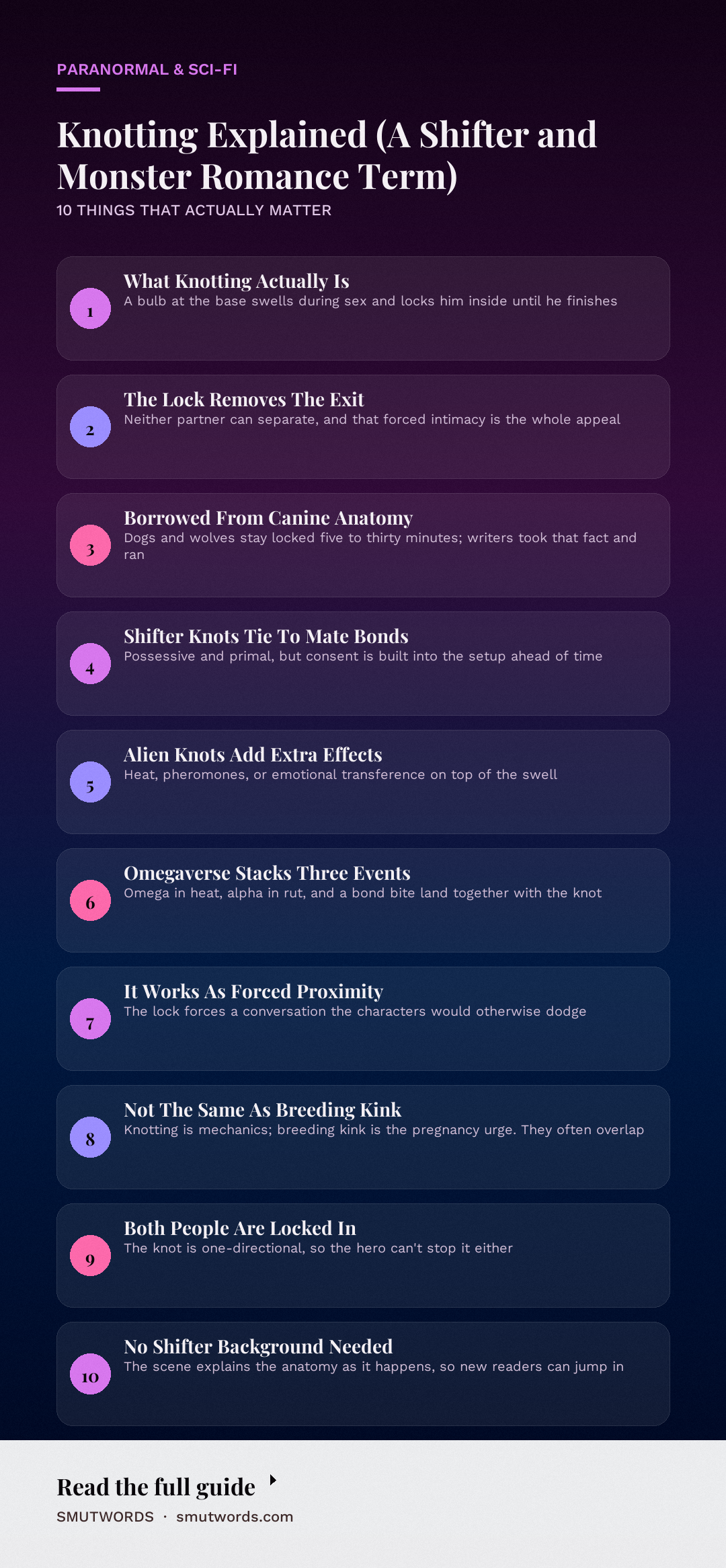
Knotting is the anatomical detail that shows up in shifter and monster romance when a non-human male character has a bulb at the base of his cock that swells during sex and locks him inside his partner until he finishes. That's the whole mechanic. In anthropomorphic or alien anatomy it mimics what happens with actual canines.
Writers in this genre borrowed it wholesale because it does something no human anatomy can: it forces an extended, involuntary, inescapable intimacy at the exact moment a character is most exposed.
If you've been searching for knotting romance explained without finding a straight answer, this is it. The swelling is real within the fiction. The lock is real. Everything that happens after that is where the genre does its work.
The confusion most new readers hit is that knotting isn't just a physical gimmick. It's a plot device with rules, and the rules change depending on whether you're in a wolf shifter book, a dragon shifter book, or a sci-fi monster romance where the alien biology is invented from scratch. Once you know the baseline, you can tell within a few pages what kind of knotting you're getting.
Where the Trope Comes From
Canine anatomy, obviously. Dogs and wolves have a bulbous glandis that swells after penetration, which is why mating pairs stay locked together for anywhere from five to thirty minutes in the wild.
Writers took that biological fact and ran with it in two directions. In shifter romance books, it's treated as a species marker: this is how you know the love interest isn't fully human, even when he's wearing a suit and running a company. In monster and alien romance, knotting is often one of several non-human traits stacked together, alongside ridged cocks, multiple orgasms for the female partner, or a mating bond that makes separation physically painful.
The trope migrated from early online shifter fic into published paranormal romance somewhere in the 2010s, and it's been a fixture ever since. It shows up in omegaverse, in fated-mates series, in alien abduction romance, and increasingly in books that have nothing to do with wolves at all, because the lock-in mechanic is just useful.
Shifter Fiction vs. Monster Romance: How Knotting Differs
The execution splits into two recognizable styles, and knowing which one you're reading changes what you should expect from the scene.
- Shifter knotting usually ties into a mate bond. The knot triggers a possessive, primal shift in the hero, and the female lead often can't leave until he's done, which the book frames as both overwhelming and safe. Consent is built into the setup ahead of time.
- Alien or monster knotting leans harder on the "this is not human, and I am not prepared" angle. The hero might not warn her. The knot might come with additional effects like heat, pheromone overload, or a link that lets him feel her emotions through the swell. Science replaces instinct.
- Omegaverse knotting typically involves an omega in heat, an alpha in rut, and a bond bite layered on top of the knot itself. Three biological events happening at once, and the scene is built around all three landing together.
If you want to see the alien version played straight, Alien Heatwave: An Alien Breeding First Contact Erotica is a good reference for how knotting blends with a first-contact scenario where neither party fully understands what's happening to them.
Why Readers Search for It
Knotting does something specific that a regular sex scene can't. It removes the option to leave. That's the whole appeal, and it explains why readers who say they aren't into possessiveness still go looking for knotting scenes specifically.
The lock-in creates a moment where the female character is physically held in place by the hero's body, often for an extended stretch of time after the main event, and the book has to fill that time with something.
Some writers use it for emotional intimacy: forced conversation, confessions, the hero unable to move away while the heroine processes what just happened. Others use it for round two, or round three, since the knot doesn't release until he's fully finished, and some characters take that as an invitation.
It also pairs naturally with a possessive hero, because the biology itself is possessive. He can't pull out. She can't push him off. That dynamic sits right at the center of what knotting scenes are built to deliver, and readers who like that register tend to seek the trope out on purpose.
You'll see the same instinct at work in Bred Beneath the Bio Domes, where the environment itself conspires to keep the characters locked together long past the point either of them planned for.
Knotting and Breeding Kink: Not the Same Thing
These two get tangled up constantly, and they're distinct even though they overlap in practice. Knotting is anatomy and mechanics. Breeding kink is the desire, on the page or in the reader, for pregnancy and the act of trying for it.
A knotting scene can be a breeding scene, and often is, but plenty of knotting happens in books where pregnancy is off the table entirely: the hero's species can't reproduce with humans, the plot is set in a galaxy with contraception, or the point is just the physical lock and everything it forces.
Where they combine, the knot gets framed as a mechanism for keeping the hero's seed inside the heroine: no spill, no escape, maximum exposure to the pregnancy risk. That's the erotic logic. If you want that setup delivered cleanly, The Heir of Two Worlds: An Alien Hybrid Breeding Erotica layers knotting mechanics directly onto a hybrid pregnancy plot, so the two tropes are doing their jobs in the same scene instead of trading off.
Enjoyed this? Get a free book.
Join the list and we will send a complete free story straight to your inbox, plus new releases every week after that. No credit card, no catch.
Quick Reference: What Knotting Actually Does in a Scene
- The base of the penis swells during sex, usually just before or during the hero's climax.
- The swell creates a physical lock, so neither partner can separate until the swelling subsides.
- The lock typically lasts minutes, sometimes much longer in fiction, giving the scene space for aftermath, dialogue, or repeat rounds.
- In shifter books, the knot often triggers the mate bond or marks the hero as non-human in a way the heroine can't ignore.
- In alien and monster books, the knot may carry extra effects: pheromones, heat, emotional transference, or a claim that only one partner can instigate.
That last point matters. In most of these books the knot is one-directional, meaning the hero's body does it to him and he can't stop it either. Both people are locked in. If you're coming from a genre where the man is always in control, that flip is one of the things that makes knotting land the way it does.
Common Questions New Readers Ask
Is knotting always about wolves?
No. It started there, but it's traveled into dragons, gargoyles, aliens, and full monster-design territory. Gargoyle romance is a good example of the trope applied to a species that has nothing to do with canines, and it works because readers respond to the lock-in effect itself, not the biology it came from.
Does the female character always come during knotting?
In most of these books, yes, and often more than once. The trope overlaps heavily with the "non-human stamina" convention, where the hero's species is built for extended sex, and the knot is the anchor point for a scene that runs long enough for multiple orgasms. It's wish fulfillment, and it's written as such.
Do I need to read shifter romance first to get it?
Not at all. The glossary version, if we're keeping it simple: knotting is the swelling lock, everything else is context. You can walk into a knotting scene in chapter three of an alien romance having never read a shifter book and follow it completely, because the scene will explain the anatomy as it happens. Writers know a chunk of their audience is new, and they write accordingly.
Is knotting the same as a mating bond?
No, though they're frequently paired. The mating bond is the emotional or psychic link between two characters, and it can exist in books with no knotting at all. Knotting is physical. The two overlap in maybe half the books that use one or the other, which is what causes the confusion.
If you want the bond side of the equation unpacked without the anatomical component, Alien Mate Bonds vs Human Marriage is the better starting point.
How Knotting Scenes Work When They Work
A knotting scene that fumbles typically treats the knot as a surprise the reader doesn't get to see coming, or as a detail mentioned once and then forgotten. The good ones build it into the character's body before it happens.
The hero knows his own tell. Maybe he warns her. Maybe he tries to pull out and can't. Maybe the scene starts with him explaining exactly what's about to happen and giving her the chance to say yes or no.
That last option is doing a lot of work, since it lets the scene be graphic without ever reading as coercive, and it's the version most readers who love the trope point to when they explain why.
Where the knot gets used as a plot beat rather than just a scene mechanic, it's usually because the lock forces the characters into a conversation they'd otherwise dodge. He can't leave. She can't leave. Whatever they were avoiding comes up.
That's forced proximity executed at the level of the body, and it's the same engine that drives books with a literal locked room or a broken-down car, just compressed into a single physical event.
You can see the trope working with a whole planetary-scale setup in Planet Of Orgasms, where the environment itself is the mechanism keeping the characters bound to each other. For a tighter, more personal register, try, in Zorgon's Pet, where the dynamic between captor and captive does a similar job to the knot: forcing an intimacy neither party planned for and refusing to let either of them step out of it early.
Reading Knotting Without Reading the Same Book Ten Times
The trope has enough range that you can structure a whole reading list around it. If you want the pure shifter version, start with a fated-mates wolf series and work forward. If you want the alien version, anything with "breeding" or "hybrid" in the title is a strong bet.
For the broader genre context, 50 Best Paranormal & Sci-Fi Books You Can Read This Year covers a range that includes knotting-heavy titles without making it the centerpiece of every recommendation. Useful if you want to sample the trope without committing to a whole subgenre built around it.
And if you're drawn to the found-family side of these books rather than the biology, Found Family in Monster Romance: The Hive, the Clan, the Den tracks the other thread that runs through this corner of the genre, where a knotting scene is often the moment a lone heroine gets pulled into a group she didn't know she needed. The two things feed each other in the better books: the physical lock, then the social one.
Final Thoughts
If you want one book to test whether the trope lands for you, start with Milked in the Moonpit: A Sci-Fi Cult Lactation And Breastmilk Ritual Erotica. It stacks knotting alongside other body-horror-adjacent mechanics, so you'll know within a chapter or two whether this register of monster romance is your thing or not. Better than wasting a full series on that answer.







Loading comments…