
A redemption arc romance is a love story built around a character who has done real damage and has to earn their way back, with the relationship serving as both the engine and the reward of that change. The morally compromised lead (the villain, the rake, the man who burned his own life down) gets a second chance, and the plot tracks the work it takes to deserve it.
This is one of the most reliable emotional structures in the genre, and it runs on a specific tension: the reader wants the flawed character forgiven, but wants the forgiveness earned rather than handed over.
That tension is exactly why the redemption arc romance keeps getting rewritten, subverted, and sold by the truckload. Done well, it delivers a catharsis almost nothing else matches. Done badly, it produces the most infuriating hero in fiction.
This guide covers what the term actually means, where the shape came from, how authors build one that lands on the page, and how to tell a genuine redemption arc from a character who just gets excused.
What Redemption Arc Romance Actually Means
The name is literal. A redemption arc is the narrative curve a character travels from moral low point toward something better, and in romance that curve is fused to the love story. The relationship is the catalyst for the change, the pressure that keeps it honest, and the prize that makes the change worth the cost.
The key word is arc. A redemption arc romance requires movement: the character has to start somewhere genuinely bad and end somewhere meaningfully different, and the reader has to be able to trace the steps between the two points.
A hero who was secretly noble all along is not on a redemption arc. He was the love interest wearing a disguise.
What counts as a redemption arc romance:
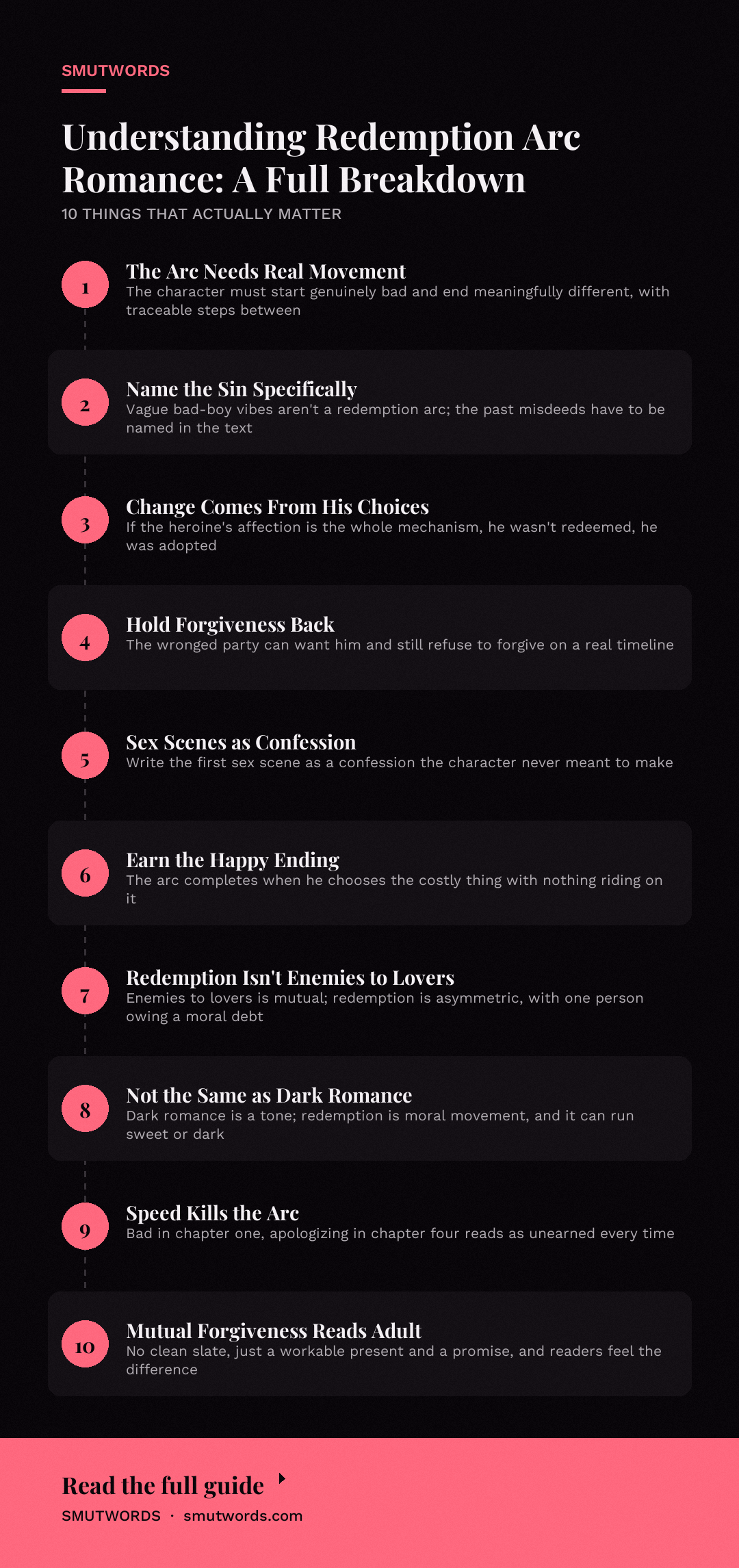
- The lead's past misdeeds are specific and named in the text, not vague bad-boy vibes.
- The change happens on the page, driven by choices the character makes rather than by the love interest's magic influence.
- The wronged party (or the wider world) has real reasons to withhold forgiveness.
- The happy ending lands only after the character has done something to earn it.
What doesn't count, even though it gets marketed as one:
- The misunderstood grump. Nothing to atone for, just a bad attitude and a soft center.
- The alphahole who never apologizes. If the reader is told he changed but the text shows the same behavior, there is no arc. Our alphahole guide explains precisely where that character goes wrong.
- Redemption by love interest. If the heroine's affection is the entire mechanism of the change, the character was never redeemed. He was adopted.
Common misconception: a redemption arc romance has to involve a literal villain. It doesn't. The reformed rake, the disgraced soldier, the con artist with a conscience, the schemer who betrayed his own family all sit on the same curve. What matters is real wreckage in the character's past and the work of clearing it.
Where Redemption Arc Romance Comes From
The honest history of this trope lives mostly in publishing, not in real-world kink. The redemption arc has been in literature since long before the genre existed as a category, but its modern romance shape is a twentieth-century commercial-publishing invention that kept getting sharpened as the market expanded.
The nineteenth-century marriage-plot novel gave the genre its early reformed rakes. Richardson's Lovelace is the anti-hero most likely to get rewritten today with a redemption arc the original never granted, and the Victorian rake-as-husband became one of the first repeatable romance formulas. The man who slept his way across Europe and then meets the right woman was a standardized product well over a century ago.
The Regency historical ran on the reformed rake for decades, and by the blockbuster 1970s and 1980s era, the romance market had a proven template. The paperback boom of that period is where the term itself started circulating among readers and editors, alongside the rise of genre-specific reviewing and fan networks.
The biggest shift came in the 2010s. Dark romance moved the redemption arc to the center of the marketing pitch, and the "villain gets the girl" label started appearing on covers and in review tags. Romance readers, already the most organized and vocabulary-rich fanbase in publishing, pushed the trope from a subplot device to a full standalone premise.
The contemporary version has softened some edges and hardened others. The change is now routinely shown rather than asserted, and the wronged heroine has more power than she did in older historicals. There's also a current strain, born on social platforms and driven by reader demand, of the so-called anti-hero's defeat: a redemption arc where the character does the work and still doesn't get the girl. That's the genre's most interesting recent complication.
How It Shows Up in Erotica
The craft question with any redemption arc romance is the same: what does the page actually do with it? Below are the mechanics good authors use, and the failure modes that let a strong premise go flat.
Make the sin specific
The reader can't feel redemption they can't measure. A hero who's "done bad things" is a mood. A hero who falsified evidence that sent an innocent man to prison, and has been running from it for twelve years, is a redemption arc. Erotica rewards specificity because it gives the sex scenes something to push against: atonement and desire share a language of exposure.
Enjoyed this? Get a free book.
Join the list and we will send a complete free story straight to your inbox, plus new releases every week after that. No credit card, no catch.
Let him be loved and still not forgiven
The strongest versions have the wronged party and the wider cast refuse forgiveness on a real timeline. The love interest can want him and still hold the line. The sibling he betrayed still won't return his calls in chapter twenty. If everyone in the book forgives him the moment he apologizes, the reader feels cheated and clocks it immediately.
Use the sex scenes as confession rather than absolution
This is where erotica has an advantage over general romance. Sex is a place where a person can be the most exposed and the most vulnerable. Skilled authors write the first sex scene as a confession scene the character didn't intend to make. The second one, after the wrong has been named, is where the dynamic shifts and the power transfer happens on the page.
Common variations authors use
- Reformed rake. Historical standard, a man with an established reputation and no belief he's capable of being better.
- Villain gets the girl. The full anti-hero version: morally bad throughout most of the book, changed only by the heroine's refusal to be charmed.
- Second chance at redemption. The character was already given a chance once and blew it. The second chance costs more.
- Anti-hero's defeat. The arc runs to its completion and the character doesn't get the girl. A version most often tagged in revenge romance and darker varieties.
- Enemies who wronged each other. Mutual atonement where neither party has moral high ground, which lands well in hate to love plots.
Earn the ending
The most common failure is a happy ending delivered before the redemption work is finished. A good version performs the arc's completion on the page, where the character chooses the difficult, costly thing with nothing riding on it, and the reader watches him do it. If the ending arrives as a proposal or a grand gesture that doesn't cost him anything, the trope reads as a simple apology-and-osculation scene and the emotional payoff sags.
Some of the strongest redemption arcs also sit inside plots built on structure rather than feeling. A marriage in trouble plot forces two people who already wronged each other back into daily proximity. A contract marriage premise can keep the redeemed character in place long enough for real change to show. That forced proximity makes the atonement legible scene by scene.
Redemption Arc Romance vs Enemies to Lovers
These get used interchangeably online and they aren't the same thing. The hate to love dynamic is built on mutual antagonism and the eventual thaw. Neither party usually has a moral debt to repay.
A redemption arc romance requires that one character come from below the moral line and do work to return to it. Enemies to lovers can happen between two morally equal people who simply dislike each other. Redemption is asymmetric: one person has to atone, the other has to decide whether the atonement is enough.
What about a villain who also happens to be a rockstar?
Worth a note because the categories do stack. A rockstar romance can carry a redemption arc cleanly, because the fame and public fall give the character a visible low point. The same is true of premises that demand the character be watched: a reality TV romance turns the redemption arc into a public performance, which changes how the privacy of the change reads. Those aren't separate tropes, they're containers the arc can live inside.
Frequently Asked Questions
Is a redemption arc romance the same as a dark romance?
No, though they overlap. Dark romance describes the overall tonal register: morally gray characters, taboo subject matter, and often a controlling or obsessive lead. A redemption arc romance can be dark from start to finish, but it can also be a sweet comedy about a con man going straight. What defines the arc is the moral movement, not the darkness.
Can the villain get the girl without being redeemed?
Yes, and this is one of the genre's guiltier pleasures. Some authors keep the villain genuinely unredeemed. In that version the story becomes a test of the heroine's own morality, and readers often find it compelling for exactly that reason. It's a different experience from a redemption arc, but it lives under the same marketing umbrella.
What makes a redemption arc feel unearned?
Usually the speed. The character does something bad in chapter one and apologizes in chapter four. There's no real cost, no relapsed behavior, no period of being refused. Readers also flag the version where the wronged party is written as unreasonable for withholding forgiveness, which reverses the moral logic and taints the whole arc.
How much of the change should happen before or after the romance?
The strongest versions show most of the internal change happening before the love interest knows about it, and most of the proof happening during and after. The hero becomes genuinely better on his own time and only then has to prove it to the woman he wants. When the change is caused entirely by her, the arc reads as managed rather than chosen.
Is a reformed rake a redemption arc?
Historically, yes. The Regency rake was the redemption arc's early template. The catch is that many contemporary "reformed rake" heroes weren't actually bad, just promiscuous, which skips the sin entirely. A true reformed-rake arc has behavior to answer for beyond simply having a past.
Are there redemption arcs that end in mutual forgiveness rather than absolution?
Yes, and they read as more adult than the standard version. The character doesn't get the clean slate, gets a workable present and a promise, and the reader feels the difference. A few of the genre's best-reviewed redemption arcs end this way and are worth reading before you write one.
Final Thoughts
The redemption arc romance endures because it dramatizes something every reader has felt: the wish to be seen at one's worst and still chosen. The books that get this right do something specific and repeatable. They name the sin, build the cost, hold forgiveness back long enough to matter, and then let the character earn it with a choice the reader can trace.
If you want a starting point, pick a romance that takes the atonement seriously and doesn't rush the absolution. The catalog recommendations below will point you at the strongest examples in the collection. If you want to write the trope yourself, read at least one of them with a pen in hand.
For a related tension readers often pair with this arc, a story about desire returning after a long absence runs on the same forgiveness logic: something has to be rebuilt from the ground up. Redemption arcs simply apply that rebuilding to the whole person.







Loading comments…