
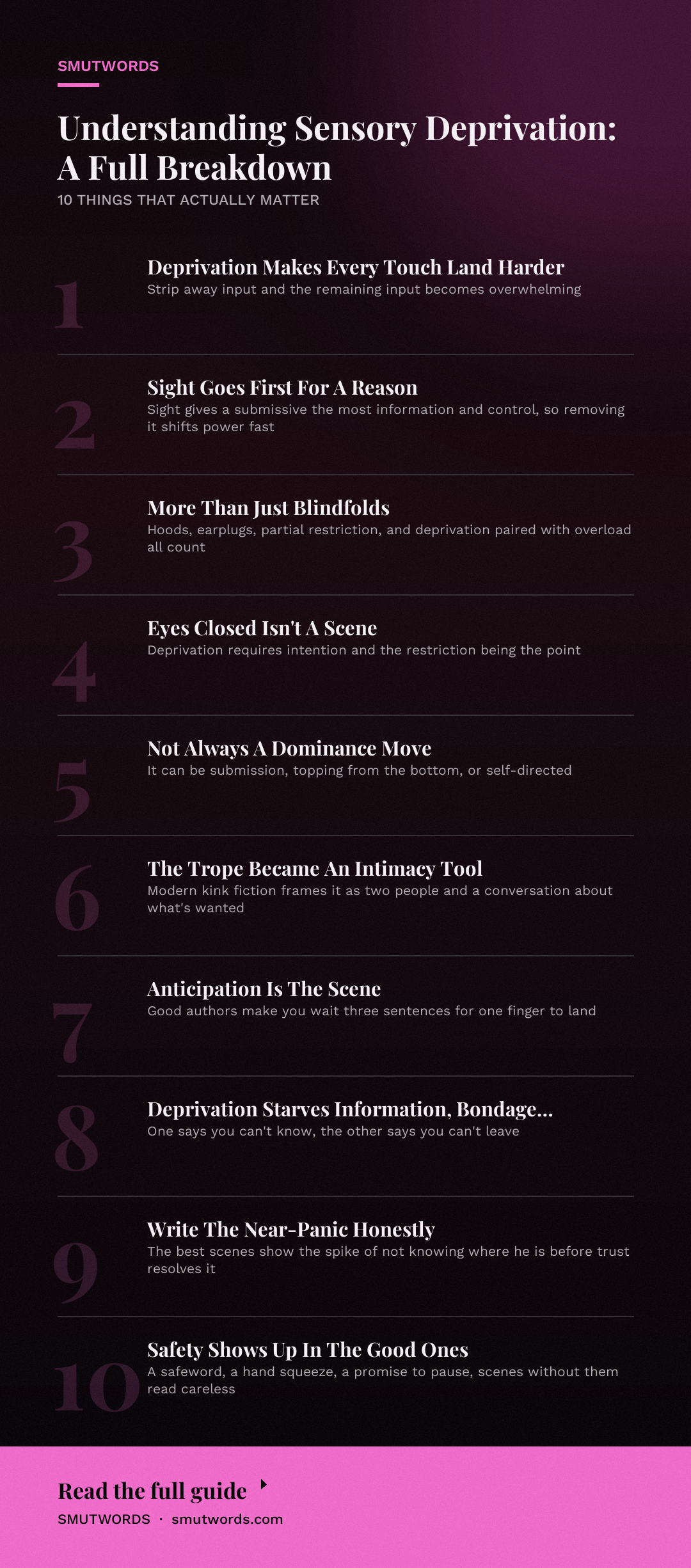
Sensory deprivation is a kink where one partner's senses get deliberately limited, most often sight and sometimes hearing, so that everything left (touch, taste, smell, anticipation) hits harder. A blindfold is the entry-level version. A padded hood with earplugs underneath is the deep end. Either way, the point is the same: strip away input, and the remaining input becomes overwhelming.
In erotica, sensory deprivation is one of the most efficient tools an author has for making a single fingertip feel like a lightning strike. It shows up everywhere from one-scene dungeon interludes to full-length romance arcs built around a single pair of cuffs and a strip of black silk.
What Sensory Deprivation Actually Means
The name is literal. You are depriving the senses. Sight goes first and most often, because sight is the sense that gives a submissive the most information and the most control. Take it away and the power imbalance of a scene shifts instantly, without a single rope or command being added.
What counts as sensory deprivation in kink writing is broader than most readers assume. It includes:
- Blindfolds of every material: silk scarves, leather masks, sleep masks, hands held over eyes. The classic. Also the safest starting point.
- Hoods and gags paired with blindfolds, which remove sight and speech at once and leave the submissive with almost no way to communicate except sound and gesture.
- Earplugs, noise-canceling headphones, or muffled hoods that dampen hearing. These are underused in fiction relative to how effective they are, because they force an author to write around what a character can't hear and can only feel.
- Partial sensory restriction, where only one sense is removed for a short window, or where a sense is restricted rather than fully blocked (dim lighting, a hood with eyeholes, one ear covered).
- Sensory overload in combination, where deprivation of one sense is paired with overstimulation of another. Blindfolded and vibrated. Hooded and spanked. The deprivation makes the overload land harder.
What doesn't count: a character simply closing their eyes during sex. That's an orgasm face, not a scene. Sensory deprivation requires intention, a decision made by one partner and accepted (or enforced on) the other. It also requires that the restriction itself be the point, or at least a load-bearing part of the scene, and not a random detail.
A common misconception is that sensory deprivation is inherently a dominance move. It can be. But it can also be a submission move, a topping move from the bottom, or something a character does to themselves in private. The kink is the restriction of input, and who's holding the blindfold is a separate question.
Where Sensory Deprivation Comes From
Sensory deprivation as a real-world kink practice has roots in mid-twentieth-century research into sensory isolation, but its life in erotic fiction runs on a different track entirely. The trope entered erotic literature because it solves a specific problem authors have always had: how do you make a scene feel new when readers have seen every position and every command before?
Answer: remove the senses, and every touch becomes fresh again. The blindfold gives an author permission to describe a fingertip on a wrist with the same intensity they'd normally spend on penetration. That's a gift.
In the paperback erotica era, blindfold scenes were shorthand for "trust me." In the internet era, they became a standard set piece in BDSM romance. By the time the Fifty Shades boom pushed mainstream romance readers into kink fiction, blindfolds and silk ties were as familiar in the genre as a wedding dress on a contemporary cover. Hoods and earplugs stayed more niche, because they're harder to write and they look scarier on the page.
The most significant shift over the last fifteen years is positioning. Older erotica often treated sensory deprivation as an escalation, something a dominant does to a submissive to prove how far she'll go. Contemporary kink fiction increasingly treats it as an intimacy tool: two people, one blindfold, and a conversation about what the blindfolded partner actually wants.
That shift tracks the genre-wide move toward negotiated, consent-forward BDSM, and it's made the trope richer, not tamer. Another consequence: sensory deprivation now stands on its own as a kink rather than a garnish. You find entire novellas built around a single blindfolded weekend, where the plot is essentially a long, slow exploration of what one partner can feel when they can't see.
How It Shows Up in Erotica
Craft time. If you've read enough of these books, you start to notice which ones handle sensory deprivation well and which ones just throw a blindfold on the cover and hope for the best.
A strong sensory deprivation scene does three things on the page.
First, it slows down the prose. A character who can't see doesn't know what's coming, so every sound, every temperature shift, every shift in the mattress has to be written and registered by the POV character before the touch lands.
The anticipation is the scene. Authors who rush to the touch lose the entire effect. The good ones make you wait three sentences for one finger.
Second, it doubles the interiority. The blindfolded character has nothing to look at, so she's stuck inside her own head, cataloging sensation and second-guessing what happens next. That's where the vulnerability lives. The reader isn't watching a scene; the reader is inside a nervous system.
Third, it makes dialogue do more work. When a character can't see, every word from the other partner carries extra weight. A whisper becomes a command. A question becomes a test.
This is why sensory deprivation pairs so cleanly with a praise kink or with degradation kink: with the eyes covered, the submissive can't see the smirk, so she has to trust or fear the tone entirely.
Common variations that show up again and again:
Enjoyed this? Get a free book.
Join the list and we will send a complete free story straight to your inbox, plus new releases every week after that. No credit card, no catch.
- The first-time blindfold. A partner who has never been blindfolded gets the silk scarf. The whole scene is about learning to trust.
- The full hood. Sight, hearing, sometimes speech all restricted. Usually reserved for later in a D/s arc, once trust is established and the deprivation reads as a reward rather than a test.
- The "you can't see what I'm going to do next" game. The dominant chooses from a tray of implements while the submissive listens and guesses. The guessing is the foreplay.
- The reward deprivation. A character is blindfolded specifically so a single sensation, an ice cube, a feather, a mouth, lands harder. This is the softest version and often the most erotic on the page.
- The unwanted blindfold. Used carefully and always resolved with negotiation. A character is blindfolded before consent is fully articulated, which becomes the source of the arc's tension rather than a shortcut to coercion.
What separates a flat scene from a great one is usually one thing: whether the author writes the disorientation honestly. Sensory deprivation is not automatically hot. It is disorienting, and for some characters it flirts with panic before it lands in pleasure. The best scenes show that moment of near-panic, that first spike of "I don't know where he is," and then the trust that resolves it.
That's also why the trope pairs so often with shibari. Rope removes movement; the blindfold removes sight; together they hand almost all physical control to one partner, which is a fast way to push a submissive into subspace.
Authors who want that arc but only have the space for one device will usually reach for the blindfold, because it does more per page. If you want to understand what's happening inside the submissive's head once she's there, that guide goes much deeper.
It shows up less often in group scenes, but it does happen. In a well-written orgy, a single blindfolded participant becomes the axis everything else turns around: hands from every direction, no way to tell whose. That's a specific and effective use of the kink, because the disorientation scales with the number of people in the room.
Sensory Deprivation vs Bondage
These two get collapsed constantly, and they shouldn't be, because they do different jobs.
Bondage (rope, cuffs, straps) restricts movement. It tells a character "you can't leave." Sensory deprivation restricts input. It tells a character "you can't know." The first is about physical containment; the second is about information starvation.
You can absolutely have one without the other. A submissive can be tied spread-eagle with full sight and hearing intact, aware of every move her partner makes. Or she can be loose on the bed, hands free, blindfolded, and utterly unable to predict anything. The second is often the more unsettling scene, because the character could move but doesn't know where to move.
When both are present, the reader is watching a character with no movement and no information. That's the deepest version of the trope, and it's the one that most reliably produces the helpless, floating headspace readers of this kink are chasing.
If you want the full picture of how restraint and sensation interact in these books, we covered it in the complete BDSM guide. The simple version: bondage takes options away, sensory deprivation takes predictions away, and great scenes take both.
Frequently Asked Questions
Is sensory deprivation a real kink or just a fiction thing?
It's a real, widely practiced kink. Blindfolded play is one of the most common entry points into kink for couples, precisely because it requires almost no equipment and lowers performance pressure on both partners. Fiction popularized the fantasy version, but the practice exists independently of it.
What's the difference between a blindfold and a hood in sensory deprivation?
A blindfold removes sight alone. A hood typically removes sight and can also muffle hearing and speech, sometimes shutting down three senses at once. Hoods are more intense, demand more trust, and are usually introduced later in a dynamic rather than as a starting point.
Why does sensory deprivation show up so often in BDSM romance?
Because it's the most efficient way to write vulnerability and trust into a scene without adding equipment, plot, or explanation. One silk scarf, one conversation, and suddenly every touch in the following pages carries triple the weight. It's economy, and good authors exploit it.
Can sensory deprivation be emotionally safe in a book?
Fiction doesn't owe anyone a safety manual, but the best books model it anyway: they show a safeword, or a squeeze-the-hand check-in, or a promise to pause if the blindfolded partner needs it. Scenes with none of that usually read as careless rather than edgy, because readers in this genre know the difference.
Does sensory deprivation always involve a dominant and a submissive?
No. It can be a mutual experiment, a self-directed practice, or a scene where the blindfolded partner is topping from underneath by directing what happens next. The kink is the restriction of input, and whoever controls that restriction is a separate question.
Why is sensory deprivation so often paired with gags?
Because once you've taken sight, removing speech too strips the last easy channel of communication, which doubles down on helplessness and forces the submissive to rely on sound and gesture. It's an escalation, and it works best in fiction once the reader already trusts the dynamic enough to enjoy watching it get harder.
Final Thoughts
Sensory deprivation earns its place in the kink canon because it turns a scene inside out. Remove the input and you're no longer writing about what happens to a character; you're writing about what it feels like to not know. The good books make you wait in the dark with her.
If you want to see the trope handled with real patience, the deep-trust version of it, pick up a story where the blindfold goes on in chapter one and doesn't come off for another two hundred pages. The slow build is where this kink lives. The payoff is on page two hundred, and it's worth every dark second of the wait.







Loading comments…